Quick Verdict: A Midsize Hybrid That Punches Above Its MPG
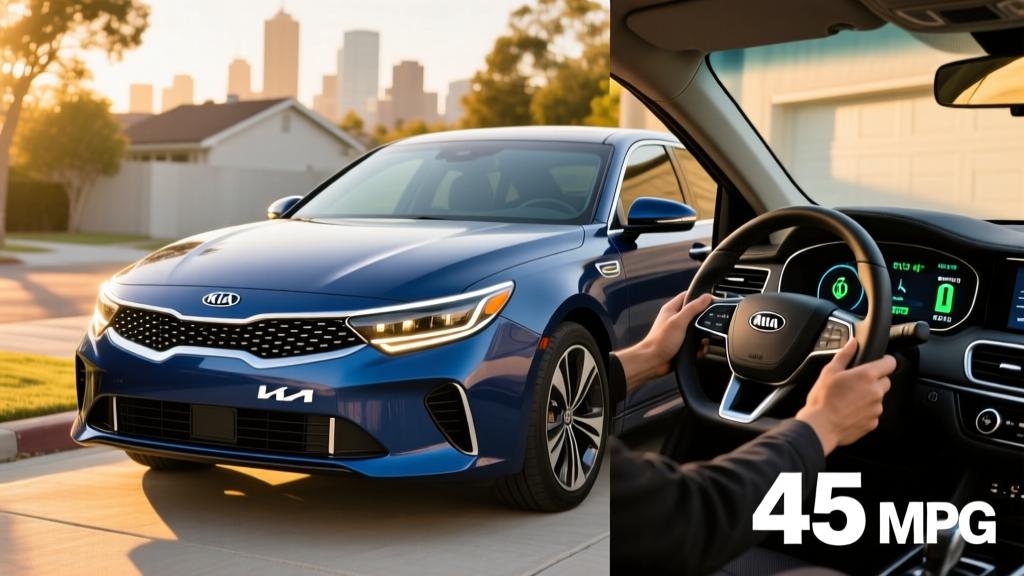
The 2020 Kia Optima Hybrid was the final model year before Kia retired the Optima nameplate in favor of the K5. For used-car shoppers in 2026, it remains one of the most efficient midsize sedans you can buy on the secondhand market. The conventional hybrid (HEV) delivers an EPA-estimated 41 MPG combined, while the plug-in hybrid (PHEV) variant adds 28 miles of electric-only range for commuters with charging access. Neither requires you to change your driving habits — the HEV never needs plugging in, and the PHEV functions as a normal hybrid once its battery is depleted.
This guide covers real-world fuel economy, powertrain specs, battery longevity, and whether the 2020 Optima Hybrid or its PHEV sibling fits your commute better than a full EV or a gas-only alternative.
HEV vs PHEV: Which 2020 Optima Hybrid Are You Looking At?
Conventional Hybrid (HEV): The Optima Hybrid uses a 2.0L four-cylinder engine paired with an electric motor and a small 1.62 kWh lithium-ion battery. It regenerates energy during braking and deceleration. You never plug it in — just fill up with gas and drive. This is the simpler, more affordable choice.
Plug-In Hybrid (PHEV): The Optima PHEV pairs the same 2.0L engine with a more powerful 50 kW electric motor and a larger 9.8 kWh battery pack. It can drive up to 28 miles on electricity alone before the gas engine kicks in. You plug it in overnight (or at work) to recharge, but it operates as a regular hybrid when the battery is empty. No range anxiety — ever.
If you have access to a standard 120V outlet or a Level 2 charger at home or work, the PHEV lets most commuters complete daily round trips on electricity alone. If you lack charging access or want the lowest upfront cost, the HEV is the pragmatic pick.
Fuel Economy: EPA Ratings and Real-World MPG
According to fueleconomy.gov, here is how the 2020 Optima Hybrid and PHEV stack up:
| Metric | Optima Hybrid (HEV) | Optima PHEV |
|---|---|---|
| EPA City MPG | 40 MPG | — (electric mode first) |
| EPA Highway MPG | 43 MPG | — (see charge-depleted below) |
| EPA Combined MPG | 41 MPG | — |
| Combined MPGe (PHEV electric mode) | — | 101 MPGe |
| Charge-Depleted Combined MPG | — | 40 MPG |
| Electric-Only Range (PHEV) | N/A | 28 miles |
| Total Range (PHEV, full tank + full charge) | N/A | ~490 miles |
Real-World MPG: What Owners Actually See
Kia's hybrid system is tuned for efficiency across both city and highway driving. In real-world use, many owners report matching or slightly exceeding the EPA combined figure in city-heavy commuting, where regenerative braking recovers the most energy. On sustained highway trips at 75+ MPH, expect the HEV to return closer to 38–40 MPG. The PHEV, when driven within its 28-mile electric window, effectively uses zero gasoline for short commutes. Once the battery depletes, it settles into roughly 38–41 MPG as a conventional hybrid.
Cold-weather note: Hybrid fuel economy drops modestly in freezing temperatures — typically 3–5 MPG combined — because the engine runs more often to provide cabin heat and because battery chemistry is less efficient in cold. The PHEV's electric-only range may shrink to 22–24 miles in winter conditions.
Powertrain Specs: Engine, Motor, and Combined Output
| Specification | 2020 Optima Hybrid (HEV) | 2020 Optima PHEV |
|---|---|---|
| Engine | 2.0L GDI 4-cylinder | 2.0L GDI 4-cylinder |
| Engine HP | 154 hp | 154 hp |
| Electric Motor | 38 kW (51 hp) | 50 kW (67 hp) |
| Combined System Output | 192 hp | 202 hp |
| Transmission | 6-speed automatic | 6-speed automatic |
| Battery Capacity | 1.62 kWh (Li-ion) | 9.8 kWh (Li-ion) |
| Drivetrain | FWD | FWD |
| 0–60 MPH (est.) | ~8.2 seconds | ~7.8 seconds |
Both variants use Kia's 6-speed automatic transmission rather than a CVT. This gives the Optima Hybrid a more natural acceleration feel compared to rivals like the Toyota Camry Hybrid, which uses an eCVT. The PHEV's larger motor provides noticeably stronger electric-only acceleration, making it feel responsive around town without the engine engaging.
PHEV Charging: How Long Does It Take?
The Optima PHEV does not support DC fast charging. This is standard for PHEVs — their smaller batteries are designed for slower AC charging.
| Charging Method | Power | 0–100% Time | Notes |
|---|---|---|---|
| Level 1 (120V household outlet) | ~1.4 kW | ~9 hours | Overnight; sufficient for most commuters |
| Level 2 (240V home/public charger) | ~3.3 kW | ~3 hours | Faster top-ups; requires J1772 connector |
If you can plug into a standard 120V outlet overnight, you will wake up to a full 28-mile electric range every morning. A Level 2 home charger is convenient but not strictly necessary for a PHEV with this battery size.
Battery Warranty, Reliability, and Replacement Cost
Hybrid battery longevity is a top concern for used buyers. Here is what you need to know about the 2020 Optima Hybrid and PHEV:
Original factory warranty: Kia covered the hybrid battery for 10 years / 100,000 miles from the original in-service date for the first owner. For subsequent owners, coverage drops to 10 years / 100,000 miles in many states, but in CARB states (California and states that follow CARB emissions rules), the hybrid battery warranty may extend to 10 years / 150,000 miles. A 2020 model's original warranty remains valid through the 2030 model year or 100K miles — whichever comes first.
Reliability: Kia's 2.0L hybrid powertrain has proven durable. The hybrid battery in the Optima has not shown the widespread failure patterns seen in some early-generation hybrids from other brands. Most hybrid batteries last well beyond 150,000 miles with normal use.
Replacement cost: If the hybrid battery does need replacement out of warranty, expect to pay between $2,500 and $4,000 for the HEV battery pack and $4,500 to $7,000 for the PHEV's larger 9.8 kWh pack, including labor at a dealership. Independent hybrid-battery specialists and refurbished packs can reduce this to $1,800–$3,000 (HEV).
Before buying a used 2020 Optima Hybrid, ask for a battery state-of-health (SoH) readout from a Kia dealer or a qualified hybrid technician. A pack retaining 90%+ of original capacity at 60,000 miles is typical and indicates healthy degradation.
Pricing and Tax Credit Eligibility in 2026
The 2020 Optima Hybrid is only available on the used market. Here is a pricing snapshot:
| Trim / Variant | Original MSRP (2020) | Typical Used Price (2026) |
|---|---|---|
| Optima Hybrid Premium | $30,490 | $15,000–$19,000 |
| Optima Hybrid EX | $32,490 | $17,000–$21,000 |
| Optima PHEV EX | $36,490 | $17,000–$22,000 |
| Optima PHEV EX Premium | $39,490 | $19,000–$24,000 |
Tax Credits
New-vehicle federal credit (§30D): No longer applicable — the 2020 Optima is discontinued. When new, the PHEV qualified for a federal tax credit of approximately $4,543 (based on battery capacity), but the Optima PHEV's credit was subject to Kia's phase-out timeline under pre-IRA rules.
Used-EV federal credit (§25E): Under current IRS rules, the Optima PHEV may qualify for the used clean vehicle credit of up to $4,000 (30% of sale price, capped at $4,000) if purchased from a licensed dealer for $25,000 or less, and the buyer meets income thresholds (adjusted gross income ≤ $75,000 single / $150,000 married filing jointly). The conventional HEV does not qualify for this credit — it applies only to plug-in vehicles with at least 7 kWh of battery capacity, which the Optima PHEV's 9.8 kWh pack meets.
Consult a tax professional to confirm eligibility based on your income, filing status, and purchase details.
Pros and Cons: The Honest Assessment
Pros
- 41 MPG combined (HEV) is among the best in the midsize sedan class
- PHEV's 28-mile EV range covers most daily commutes without gas
- 6-speed automatic feels more natural than a CVT
- Spacious interior with 15.9 cu ft of trunk space (HEV); PHEV trunk slightly reduced to 13.3 cu ft due to battery
- Strong factory warranty coverage remaining on most 2020 examples
- Apple CarPlay and Android Auto standard across all trims
Cons
- No DC fast charging on the PHEV (typical for PHEVs)
- PHEV trunk space reduced by 2.6 cu ft vs. the HEV
- Ride quality is competent but not as refined as the Toyota Camry Hybrid
- Discontinued — no new examples available; limited dealer support in some regions
- HEV does not qualify for any federal tax credits
Who Should Choose the 2020 Optima Hybrid vs. a Full EV or Gas Car?
Choose the Optima Hybrid (HEV) if:
- You want maximum MPG without ever thinking about plugging in
- You lack home or workplace charging access
- Your budget is under $20,000 and you want a reliable midsize sedan
- You drive 12,000+ miles per year and want to minimize fuel costs (at 41 MPG vs. 30 MPG for a gas-only Camry, you save roughly $400–$600/year at 15,000 miles)
Choose the Optima PHEV if:
- You have access to a 120V or 240V outlet at home
- Your round-trip commute is under 30 miles — you may go weeks without buying gas
- You want to drive on electricity daily but still need the freedom to take 400+ mile road trips without planning charging stops
- You may qualify for the $4,000 used clean vehicle credit
Choose a full EV instead if:
- You have reliable Level 2 home charging and your daily driving rarely exceeds 200 miles
- You want zero tailpipe emissions and the lowest per-mile fuel cost
- You are willing to spend $25,000+ on a used EV like the Hyundai Kona Electric or Chevrolet Bolt EUV
Frequently Asked Questions
How many MPG does the 2020 Kia Optima Hybrid get?
The conventional HEV is EPA-rated at 40 city / 43 highway / 41 combined MPG. Real-world results cluster around 39–43 MPG depending on driving style and conditions. The PHEV achieves 101 MPGe in electric mode and 40 MPG combined after the battery depletes.
How far can the Optima PHEV go on electric only?
The EPA rates the 2020 Optima PHEV at 28 miles of electric-only range. In warm weather with gentle driving, some owners report 30–32 miles. In cold weather or at highway speeds, expect 22–25 miles before the gas engine engages.
Is the 2020 Optima Hybrid reliable?
Yes. Kia's hybrid system has a solid track record, and the 2.0L engine is well-proven. The original 10-year / 100,000-mile hybrid battery warranty still covers most 2020 examples through 2030. Major failures are uncommon based on owner reports and NHTSA data.
What does a hybrid battery replacement cost?
HEV battery replacement runs $2,500–$4,000 at a dealer; PHEV replacement is $4,500–$7,000. Refurbished packs from independent shops can reduce costs to $1,800–$3,000 for the HEV. Most hybrid batteries outlast 150,000 miles without issue.
Does the 2020 Optima Hybrid qualify for any tax credit?
The conventional HEV does not qualify for federal credits. The PHEV may qualify for the IRS used clean vehicle credit (§25E) of up to $4,000 if purchased from a dealer for $25,000 or less and you meet income caps ($75,000 single / $150,000 married). Check IRS.gov or consult a tax professional for your specific situation.
Does the Optima Hybrid need to be plugged in?
The conventional HEV does not plug in at all — it charges its small battery through regenerative braking and the gas engine. Only the PHEV variant benefits from plugging in, using a standard J1772 connector on Level 1 (120V) or Level 2 (240V).