Quick Verdict: The Camry Hybrid's Performance Surprise
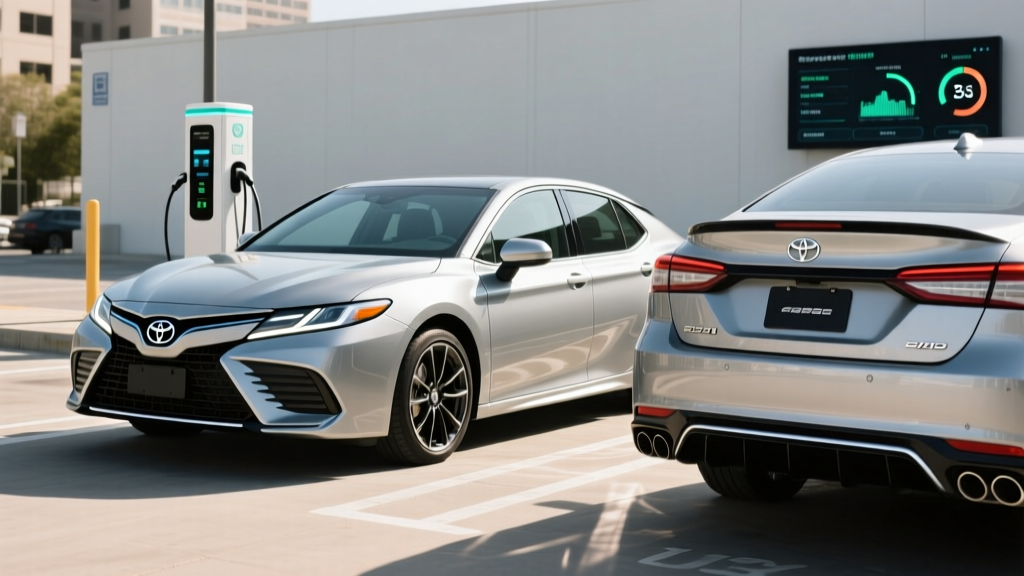
For years, the Toyota Camry Hybrid carried a reputation as the ultimate sensible-but-slow sedan. The current-generation Camry Hybrid — which went fully hybrid across all trims starting with the 2025 model year — flips that script. With the available electronic all-wheel-drive system, the Camry Hybrid 0-60 time drops to approximately 6.7 seconds, a figure that would have been unthinkable for a hybrid Camry just a few years ago. Even the front-wheel-drive version posts a respectable 7.2-second run. The question isn't whether the Camry Hybrid is quick enough — it is — but whether its blend of 50+ MPG efficiency, proven reliability, and sub-$30,000 starting price makes it the smartest sedan buy in its class.
This guide breaks down every performance, efficiency, and ownership metric you need, with real-world context that goes beyond the EPA sticker.
Camry Hybrid 0-60 and Powertrain Specs
The 2026 Camry Hybrid uses Toyota's fifth-generation hybrid system, pairing a 2.5-liter four-cylinder engine with electric motors. Here's exactly what's under the hood:
| Specification | FWD | AWD (Electronic) |
|---|---|---|
| Combined Horsepower | 225 hp | 232 hp |
| Engine | 2.5L 4-cyl + 1 front motor | 2.5L 4-cyl + front & rear motors |
| 0-60 mph | ~7.2 sec | ~6.7 sec |
| EPA City MPG | 53 mpg | 51 mpg |
| EPA Highway MPG | 50 mpg | 49 mpg |
| EPA Combined MPG | 51 mpg | 50 mpg |
| Hybrid Battery | ~1.6 kWh lithium-ion (sealed NiMH on some trims) | |
| Drivetrain | Front-wheel drive | Electronic AWD (rear motor) |
| Base MSRP (LE trim) | ~$29,990 | |
| Battery Warranty | 10 years / 150,000 miles | |
The AWD variant's 232 hp comes from the addition of a rear-axle electric motor that engages automatically for traction and acceleration. That extra 7 hp and the instant torque from electric motors is what shaves a meaningful half-second off the 0-60 run. In practice, the AWD model feels notably quicker off the line than the FWD, largely because electric motors deliver peak torque at 0 RPM — no waiting for the engine to spool up.
Real-World MPG: EPA Sticker vs. What You'll Actually See
Hybrids have a well-documented advantage in city driving, where regenerative braking and electric-only low-speed operation maximize efficiency. The Camry Hybrid's EPA ratings reflect this:
| Trim/Drivetrain | City | Highway | Combined |
|---|---|---|---|
| LE (FWD) | 53 mpg | 50 mpg | 51 mpg |
| SE/XLE (FWD) | 51 mpg | 49 mpg | 50 mpg |
| LE (AWD) | 51 mpg | 49 mpg | 50 mpg |
| SE/XLE (AWD) | 50 mpg | 48 mpg | 49 mpg |
Real-world expectation: In mixed driving, most owners report averaging 48–54 mpg depending on conditions. City-heavy commutes with frequent stops often yield above the EPA city number — sometimes 55+ mpg — because that's where the hybrid system works hardest. Highway-only trips at 75+ mph will trend toward 44–47 mpg, as aerodynamic drag dominates and the engine runs more continuously. In cold weather (below 30°F), expect a 5–10% efficiency drop during the first few miles as the engine runs to heat the cabin and warm the catalytic converter.
For authoritative EPA data, check the official figures at fueleconomy.gov.
HEV vs. PHEV: Why the Camry Hybrid Is a Conventional Hybrid (Not Plug-In)
A common point of confusion: the Camry Hybrid is a conventional hybrid electric vehicle (HEV), not a plug-in hybrid (PHEV). You never plug it in. The small hybrid battery charges exclusively through regenerative braking and the gasoline engine.
HEV (Camry Hybrid) vs. PHEV (e.g., RAV4 Prime) — Key Differences
| Feature | HEV (Camry Hybrid) | PHEV (e.g., RAV4 Prime) |
|---|---|---|
| Plug-in charging? | No — self-charging | Yes — plug in for EV range |
| Electric-only range | ~1 mile at low speed | 35–42 miles typical |
| Battery size | ~1.6 kWh | ~18.1 kWh |
| Federal tax credit | Not eligible | Up to $7,500 (§30D) |
| Best for | No home charging access, want simplicity | Home charging + short daily EV commute |
| Starting price | ~$29,990 | ~$44,000+ |
Toyota does not currently offer a Camry PHEV in the US market. If plug-in electric-only range is a priority, you'd need to look at the RAV4 Prime (42 miles EV range) or a competitor like the Hyundai Tucson PHEV. The trade-off is price: PHEVs carry significantly larger batteries, higher MSRP, and added weight, but they unlock short EV-only commutes and potential tax-credit eligibility.
Does the Camry Hybrid Qualify for a Tax Credit?
No. The Camry Hybrid is a conventional HEV and does not qualify for the federal §30D clean vehicle tax credit. That credit applies only to plug-in vehicles (BEVs and PHEVs) meeting battery-sourcing, MSRP caps, and buyer income requirements under current IRS rules.
Some states offer modest rebates or HOV-lane access for hybrids, but these vary widely by jurisdiction. Check your state's energy or DMV website for specifics — and consult a tax professional before making purchase decisions based on incentive assumptions.
Battery Warranty, Reliability, and Replacement Cost
Toyota Hybrid Battery Warranty
Coverage: 10 years or 150,000 miles (whichever comes first) for the hybrid battery pack, effective on 2020+ model-year Toyotas. This is one of the longest hybrid battery warranties in the industry.
What's covered: Defects in materials/workmanship and capacity loss below a defined threshold (typically ~60–70% of original capacity).
Toyota's hybrid system is among the most proven in the world, with over two decades of real-world data since the original Prius. The Camry Hybrid's nickel-metal-hydride (NiMH) or lithium-ion hybrid battery — depending on trim and model year — is designed for longevity, not energy density. Unlike a full EV battery, it's small (~1.6 kWh) and operates in a narrow state-of-charge window (roughly 40–80%), which dramatically reduces degradation stress.
Real-world reliability data: Hybrid battery failures before 150,000 miles are uncommon in Toyota's system. When replacement is eventually needed (often at 180,000–250,000+ miles), costs typically range from $2,000 to $4,000 for a new OEM battery pack, or $1,000–$2,000 for a refurbished unit from a third-party supplier. Independent hybrid-specialty shops can perform the swap in 2–3 hours.
For reliability and safety ratings, reference IIHS crash-test data and Toyota's published warranty terms.
Who Should Buy the Camry Hybrid (and Who Shouldn't)
Decision Framework
Choose the Camry Hybrid if:
- You want 50+ MPG without changing your fueling habits (no plugs, no apps, no charging networks)
- Your daily commute is 20–80 miles and you want minimal cost-per-mile
- You prioritize proven reliability and low long-term maintenance over cutting-edge EV tech
- You live in an area with limited public charging infrastructure
- You want a sub-$30,000 sedan with strong resale value
Choose a full EV (BEV) instead if:
- You have reliable Level 2 home charging and want zero tailpipe emissions
- Your daily driving is under 40 miles and you want the lowest per-mile energy cost (~$0.04–0.06/mile on home electricity vs. ~$0.07–0.09/mile at 51 mpg)
- You want the $7,500 federal tax credit and qualify under current §30D income and sourcing rules
- You prefer instant torque, one-pedal driving, and a frunk
Choose a PHEV instead if:
- You can charge at home and want 30–40 miles of daily EV-only driving, but need gas-engine range for road trips
- You want partial tax-credit eligibility while eliminating range anxiety entirely
Camry Hybrid vs. the Competition
| Metric | 2026 Camry Hybrid (AWD) | 2026 Honda Accord Hybrid | 2026 Hyundai Sonata Hybrid |
|---|---|---|---|
| Combined HP | 232 hp | 204 hp | 192 hp |
| 0-60 mph | ~6.7 sec | ~7.5 sec | ~7.8 sec |
| EPA Combined MPG | 50 mpg | 48 mpg | 47 mpg |
| AWD Available? | Yes | No | No |
| Starting MSRP | ~$29,990 | ~$33,990 | ~$31,250 |
| Hybrid Battery Warranty | 10 yr / 150k mi | 8 yr / 100k mi | 10 yr / 100k mi |
The Camry Hybrid's AWD availability and 0-60 time give it a clear performance edge in this segment. The Accord Hybrid offers a slightly more refined interior and a larger trunk, while the Sonata Hybrid provides strong value. But if acceleration and all-weather traction matter alongside efficiency, the Camry Hybrid AWD stands alone.
Pros and Cons
Pros
- AWD model hits 0-60 in ~6.7 sec — genuinely quick for a 50-mpg sedan
- 50+ mpg combined with no plug-in required
- 10-year / 150,000-mile hybrid battery warranty
- Sub-$30K starting price undercuts Accord Hybrid by ~$4,000
- AWD availability rare in this class
- Proven Toyota hybrid reliability with massive service network
Cons
- No PHEV variant — can't do EV-only commuting
- No federal tax credit eligibility
- Infotainment interface lags behind Hyundai/Kia competitors
- Trunk slightly smaller than Accord's due to battery placement
- AWD fuel economy penalty (~1–2 mpg vs. FWD)
- Rear-seat headroom tight for taller passengers
Frequently Asked Questions
How fast is the Camry Hybrid 0-60?
The 2026 Camry Hybrid with AWD reaches 0-60 mph in approximately 6.7 seconds. The FWD version does it in about 7.2 seconds. Both figures represent Toyota's fifth-generation hybrid system, which uses electric motors for instant low-end torque.
How many MPG does the Camry Hybrid actually get?
The EPA rates the FWD Camry Hybrid LE at 53 city / 50 highway / 51 combined mpg. In real-world mixed driving, most owners see 48–54 mpg. City-heavy routes often exceed the EPA city number thanks to regenerative braking; sustained highway driving at 75+ mph typically drops to 44–47 mpg.
Do I need to plug in the Camry Hybrid?
No. The Camry Hybrid is a conventional HEV. Its small battery charges through regenerative braking and the gasoline engine. You fuel it like any other car — there's no plug, no charging cable, and no EV-only range to manage.
Is the Camry Hybrid battery reliable, and what does replacement cost?
Toyota's hybrid batteries are among the most reliable in the industry, commonly lasting 180,000–250,000+ miles. The battery is warrantied for 10 years / 150,000 miles. If replacement is needed, expect $2,000–$4,000 for an OEM pack or $1,000–$2,000 for a refurbished unit.
Does the Camry Hybrid qualify for any tax credit?
No. The federal §30D clean vehicle credit applies only to plug-in vehicles (BEVs and PHEVs). The Camry Hybrid is a conventional HEV and is not eligible. Some states may offer minor incentives — check your local jurisdiction.
Camry Hybrid vs. a full EV — which should I choose?
If you lack reliable home charging or regularly drive 200+ miles between stops, the Camry Hybrid is the pragmatic choice. If you can charge at home, drive under 40 miles daily, and want the lowest per-mile cost plus tax-credit eligibility, a BEV like the Tesla Model 3 or Hyundai Ioniq 6 may save more over five years.