The Real Decision Behind Hybrid Car vs Electric Car
Choosing between a hybrid and a fully electric vehicle isn't about which technology is "better" — it's about matching a powertrain to your daily driving, your charging access, and your budget. In 2026, both categories have matured significantly: conventional hybrids (HEVs) now routinely deliver 50+ MPG combined, plug-in hybrids (PHEVs) offer 30–50 miles of electric-only range, and battery-electric vehicles (BEVs) push past 300 miles of EPA range with sub-20-minute fast-charging stops.
Yet the wrong choice still costs buyers thousands. Pick a BEV without home charging, and you'll spend weekends hunting for public chargers. Pick a hybrid when you have a garage and a short commute, and you'll leave federal tax credits and fuel savings on the table. This guide breaks down the exact numbers — MPG, kWh, kW charge rates, MSRP, and ownership costs — so you can make a spec-driven decision.
HEV vs PHEV vs BEV: What Each Powertrain Actually Does
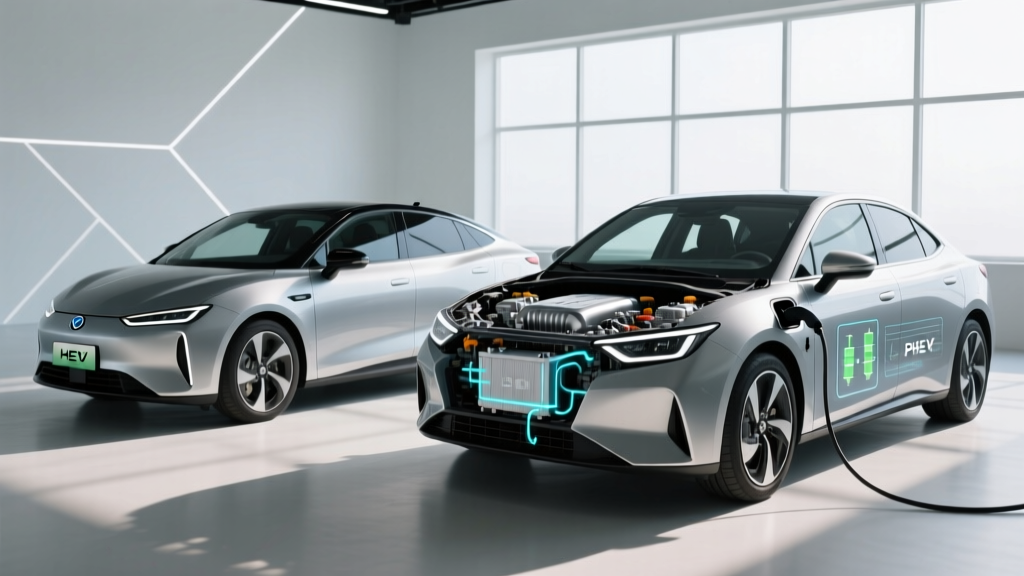
Before comparing a hybrid car vs electric car, you need to understand the three electrified powertrains available in 2026. Each has distinct hardware, fueling requirements, and use cases.
Conventional Hybrid (HEV)
A small battery (typically 1–2 kWh) paired with a gasoline engine and one or more electric motors. The battery recharges through regenerative braking and the engine — you never plug it in. Examples: Toyota Prius, Honda Accord Hybrid, Hyundai Tucson Hybrid.
Plug-In Hybrid (PHEV)
A larger battery (typically 13–25 kWh) that you can plug in to charge, providing 30–50 miles of electric-only driving before the gasoline engine takes over. Total combined range often exceeds 450 miles. Examples: Toyota RAV4 Prime, Jeep Wrangler 4xe, Chrysler Pacifica Hybrid.
Battery Electric Vehicle (BEV)
No gasoline engine at all. A large traction battery (60–120+ kWh) powers one or more electric motors. You charge at home or at public DC fast-charging stations. Examples: Tesla Model Y, Hyundai Ioniq 5, Chevrolet Equinox EV.
| Spec | Toyota Prius (HEV) | Toyota RAV4 Prime (PHEV) | Hyundai Ioniq 5 (BEV) |
|---|---|---|---|
| Powertrain | 2.0L 4-cyl + 2 motors | 2.5L 4-cyl + 2 motors | Dual motor AWD |
| Combined HP | 196 hp | 302 hp | 320 hp |
| Battery (usable) | ~1.0 kWh (NiMH/Li-ion) | 18.1 kWh (Li-ion) | 77.4 kWh (NMC) |
| EPA Combined MPG / MPGe | 57 MPG combined | 94 MPGe (EV mode) / 38 MPG (gas) | 110 MPGe |
| EV-Only Range | N/A | 42 miles | 303 miles (EPA) |
| Total Range | ~580 miles | ~490 miles (EV + gas) | 303 miles |
| Plug-In Required? | No | Yes (for EV benefit) | Yes (sole energy source) |
| Base MSRP | $29,445 | $44,900 | $46,650 |
Fuel Economy and Real-World MPG: What the EPA Sticker Doesn't Tell You
Hybrids have a unique efficiency advantage in city driving. Because regenerative braking recovers energy that gas cars waste as heat at every stoplight, hybrids often exceed their EPA city estimates in stop-and-go traffic. The 2026 Toyota Prius, rated at 57 MPG combined (57 city / 56 highway per fueleconomy.gov), regularly returns 60+ MPG in real-world city driving during moderate weather.
Highway driving tells a different story. At sustained 75–80 mph speeds, the electric motor contributes less and aerodynamic drag dominates. Expect hybrid highway fuel economy to drop 5–10% below the EPA sticker. A Prius rated at 56 highway may return 50–52 MPG on a flat interstate at 78 mph.
For PHEVs, the critical metric is how often you charge. A RAV4 Prime driven 30 miles daily and charged nightly might use zero gasoline for months. The same vehicle driven 80 miles daily without charging operates as a 38-MPG hybrid — still efficient, but you've paid a premium for battery capacity you're not using.
| Model | EPA City | EPA Highway | EPA Combined | Real-World Expectation |
|---|---|---|---|---|
| Toyota Prius (HEV) | 57 MPG | 56 MPG | 57 MPG | City: 58–63 / Hwy: 50–53 MPG |
| Honda Accord Hybrid | 51 MPG | 44 MPG | 48 MPG | City: 50–55 / Hwy: 40–44 MPG |
| Toyota RAV4 Prime (PHEV gas mode) | 40 MPG | 36 MPG | 38 MPG | City: 38–42 / Hwy: 33–36 MPG |
| Hyundai Tucson Hybrid | 38 MPG | 38 MPG | 38 MPG | City: 36–40 / Hwy: 34–38 MPG |
PHEV Electric-Only Range and Charging: The Commute Test
If you're considering a PHEV, electric-only range is the number that determines whether you'll actually save fuel. Here's what 2026's leading PHEVs deliver on a full charge:
- Toyota RAV4 Prime: 42 miles EV-only (18.1 kWh battery)
- Toyota Prius Prime: 44 miles EV-only (13.6 kWh battery)
- Jeep Wrangler 4xe: 22 miles EV-only (17.3 kWh battery)
- Chrysler Pacifica Hybrid: 32 miles EV-only (16.0 kWh battery)
- Ford Escape PHEV: 37 miles EV-only (14.4 kWh battery)
Most PHEVs charge on Level 2 (240V) at 3.3–7.2 kW, reaching a full charge in 2–5 hours. Critically, most PHEVs do not support DC fast charging. The RAV4 Prime, for example, charges at up to 6.6 kW on Level 2 — a full charge takes roughly 2.5 hours. Only a handful of PHEVs (like certain BMW and Mercedes models) offer DC fast-charge capability, and even those peak at 50–60 kW, far below the 150–350 kW rates of modern BEVs.
If your round-trip commute is under 40 miles and you can charge at home overnight, a PHEV effectively becomes an EV for daily driving — with a gas engine as backup for road trips. If your commute exceeds the EV range, you'll burn gas daily and may be better served by a conventional hybrid or a long-range BEV.
Tax Credits and Incentives: Where the Math Shifts
The federal §30D tax credit is a major factor in the hybrid car vs electric car decision, but eligibility rules are strict and model-specific. As of 2026, here's how the landscape breaks down:
- Conventional hybrids (HEVs): Do NOT qualify for the federal §30D clean vehicle credit. Some states offer minor rebates, but there is no federal incentive.
- Plug-in hybrids (PHEVs): May qualify for up to $7,500, but must meet the same battery-sourcing, critical-mineral, MSRP cap ($80,000 for SUVs/trucks/vans, $55,000 for sedans), and buyer income limits ($150K single / $300K joint) as BEVs. As of 2026, the RAV4 Prime does NOT qualify due to battery-component sourcing rules. Always verify on irs.gov before purchasing.
- Battery electric vehicles (BEVs): Several qualify for the full or partial $7,500 credit, available as a point-of-sale rebate at the dealer. Eligible 2026 models include certain trims of the Tesla Model Y, Chevrolet Equinox EV, and others — but sourcing requirements eliminate some trims. Check current eligibility on the IRS website.
The bottom line: if maximizing incentives is a priority, a qualifying BEV often nets $7,500 off the effective purchase price, narrowing the gap with hybrids. A conventional hybrid has no such offset, making its lower MSRP the primary cost advantage.
Total Cost of Ownership: 5-Year Breakdown
Let's compare a 5-year ownership scenario for three popular choices. Assumptions: 15,000 miles/year, $3.50/gallon gas, $0.14/kWh home electricity, no state incentives.
| Cost Factor | Toyota Prius (HEV) | RAV4 Prime (PHEV) | Hyundai Ioniq 5 (BEV) |
|---|---|---|---|
| Base MSRP | $29,445 | $44,900 | $46,650 |
| Federal Tax Credit | $0 | $0* | –$7,500† |
| Effective Purchase Price | $29,445 | $44,900 | $39,150 |
| Fuel/Energy (5 yr) | $4,605 | $2,200‡ | $3,750 |
| Maintenance (5 yr) | $2,800 | $2,600 | $1,500 |
| Insurance (5 yr est.) | $7,500 | $8,500 | $9,000 |
| Total (purchase + fuel + maint. + ins.) | $44,350 | $58,200 | $53,400 |
| *RAV4 Prime does not currently qualify per IRS sourcing rules. †Ioniq 5 eligibility depends on trim and buyer income. ‡Assumes 80% of PHEV miles driven on electricity. | |||
The Prius wins on pure cost by a wide margin. The Ioniq 5 closes the gap substantially when the $7,500 credit applies and fuel/maintenance savings compound. The RAV4 Prime occupies a middle ground: it's the most expensive option here, but it offers AWD, 302 hp, and the flexibility of gas-free commuting with unlimited road-trip range.
Battery Reliability, Warranty, and Replacement Costs
Battery longevity is a top concern for hybrid and EV buyers alike, and the data in 2026 is reassuring. Federal law mandates that hybrid and EV batteries carry a minimum warranty of 8 years or 100,000 miles (10 years/150,000 miles in California and states that follow CARB emissions standards). Many manufacturers match or exceed this.
Hybrid Battery Warranty Snapshot (2026 Models)
- Toyota (Prius, RAV4 Prime): 10 years / 150,000 miles on hybrid battery
- Honda (Accord Hybrid): 8 years / 100,000 miles
- Hyundai (Tucson Hybrid, Ioniq 5): 10 years / 100,000 miles on HV battery
Real-world degradation data shows that modern hybrid batteries typically retain 85–90%+ capacity after 150,000 miles. The NiMH packs in older Prius models have demonstrated 200,000+ mile lifespans. PHEV batteries, which cycle more deeply, may see slightly more degradation, but the larger buffer and active thermal management in 2026 models mitigate this.
If a hybrid battery does need replacement out of warranty, expect to pay $2,000–$4,000 for a conventional hybrid pack (Prius, Accord) and $6,000–$12,000 for a PHEV pack, depending on the model. BEV battery replacements remain more expensive at $10,000–$20,000+, though full replacements are rare — individual module repair is increasingly available.
For context, a conventional hybrid's battery replacement cost is comparable to a major transmission repair on a gas car — significant but not catastrophic, and unlikely to occur within the typical ownership window.
Who Should Choose a Hybrid, a PHEV, or a Full EV?
Choose a Conventional Hybrid (HEV) If:
- You cannot charge at home or work (apartment, street parking, no garage outlet)
- Your budget is under $35,000 and you want maximum fuel savings with no behavioral change
- You drive in extreme cold regularly (hybrid MPG drops less than BEV range in sub-freezing temps)
- You want the lowest total cost of ownership without relying on tax credits
Choose a Plug-In Hybrid (PHEV) If:
- Your daily round-trip commute is under 40 miles and you can charge at home every night
- You take regular road trips of 300+ miles and don't want to plan around DC fast chargers
- You want EV-like daily driving with zero range anxiety on long drives
- You need AWD or towing capability that current BEVs in your budget can't match
Choose a Battery Electric Vehicle (BEV) If:
- You have reliable Level 2 home charging (240V garage or driveway outlet)
- You want to qualify for the $7,500 federal tax credit and your income/MSRP/model qualifies
- Your daily driving is under 250 miles and you're comfortable with DC fast-charging on road trips
- You want the lowest per-mile energy cost (~$0.04–$0.06/mile on home electricity vs. $0.10–$0.14/mile for a hybrid)
- You want minimal maintenance (no oil changes, no transmission fluid, fewer moving parts)
Pros and Cons at a Glance
Hybrid (HEV) Pros
- No charging infrastructure needed
- 50+ MPG combined in most models
- Lower purchase price than PHEV or BEV
- Proven long-term reliability (20+ years of Prius data)
- No range loss in extreme cold
Hybrid (HEV) Cons
- No federal tax credit
- Still requires gasoline and oil changes
- Higher emissions than PHEV or BEV
- Less powertrain smoothness than electric drive
PHEV Pros
- 30–50 miles gas-free for daily commuting
- Unlimited range via gas engine for road trips
- Stronger acceleration (combined engine + motor power)
- May qualify for partial federal credit (model-dependent)
PHEV Cons
- Highest purchase price of the three categories
- Requires home charging to realize EV benefit
- Most lack DC fast charging
- Two powertrains to maintain (engine + electric)
BEV Pros
- Lowest per-mile energy cost
- $7,500 federal credit on eligible models
- Minimal maintenance (no oil, spark plugs, or transmission)
- Instant torque and smooth, quiet operation
- Zero tailpipe emissions
BEV Cons
- Requires home Level 2 charging for practicality
- Road trips require DC fast-charging planning
- 15–30% range loss in cold weather
- Higher insurance premiums on average
- Charging infrastructure gaps in rural areas
Frequently Asked Questions
How many MPG does a hybrid car get compared to a gas car?
A typical 2026 hybrid like the Toyota Prius achieves 57 MPG combined, roughly double the 28–30 MPG combined of a comparable gas-only compact sedan. In city driving, the gap widens further — hybrids gain efficiency from regenerative braking while gas cars lose efficiency in stop-and-go traffic. The EPA's fueleconomy.gov database lets you compare specific models side by side.
How far can a PHEV go on electric only?
Most 2026 PHEVs deliver 30–50 miles of electric-only range. The Toyota Prius Prime leads at 44 miles, the RAV4 Prime offers 42 miles, and the Ford Escape PHEV provides 37 miles. This covers the average American's daily round-trip commute of roughly 32 miles, according to Federal Highway Administration data, meaning many PHEV owners can drive for weeks without visiting a gas station.
Is a hybrid or PHEV battery reliable, and what does replacement cost?
Hybrid batteries are among the most reliable components in modern vehicles. Toyota's hybrid battery warranty covers 10 years/150,000 miles, and real-world data shows many Prius packs lasting 200,000+ miles. Out-of-warranty replacement costs $2,000–$4,000 for a conventional hybrid and $6,000–$12,000 for a PHEV. For comparison, a gas car's transmission replacement can cost $3,000–$7,000.
Do hybrids qualify for any tax credit?
Conventional hybrids (HEVs like the Prius or Accord Hybrid) do not qualify for the federal §30D clean vehicle credit. Plug-in hybrids (PHEVs) may qualify for up to $7,500, but must meet battery-sourcing, critical-mineral, MSRP, and buyer-income requirements. As of 2026, many popular PHEVs — including the RAV4 Prime — do not qualify due to battery-component sourcing rules. Always verify current eligibility at irs.gov before purchasing, and consult a tax professional for your specific situation.
Which is cheaper to own long-term: a hybrid car vs electric car?
Over 5 years and 75,000 miles, a conventional hybrid like the Prius typically has the lowest total cost (~$44,000 all-in) thanks to its low MSRP and strong MPG. A qualifying BEV like the Ioniq 5 can close the gap to ~$53,000 when the $7,500 credit and lower fuel/maintenance costs are factored in. A PHEV tends to be the most expensive option overall (~$58,000) but offers unique flexibility. Your actual costs depend on local electricity rates, gas prices, insurance, and whether you qualify for incentives.
Can I charge a PHEV at a DC fast charger?
Most PHEVs cannot. The majority charge exclusively on Level 1 (120V) or Level 2 (240V), with Level 2 rates of 3.3–7.2 kW. A full Level 2 charge typically takes 2–5 hours. Only select European PHEVs (certain BMW, Mercedes, and Volvo models) offer DC fast-charging capability, and even those peak well below BEV charge rates. If you need rapid charging, a BEV is the better choice.