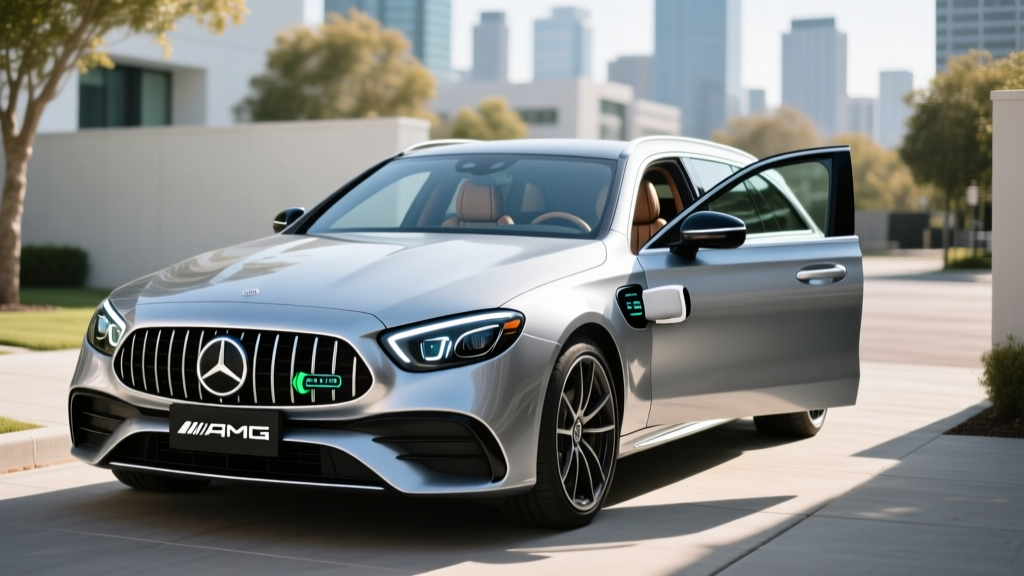
The Mercedes-AMG E 53 Hybrid Wagon occupies a rare niche: a high-performance luxury estate with a mild-hybrid powertrain that boosts efficiency without requiring a plug. For 2026, AMG pairs a turbocharged inline-six with a 48-volt integrated starter-generator (ISG) to deliver 469 horsepower and a modest fuel-economy edge over its non-hybrid predecessor. This guide breaks down exactly what the E 53's mild-hybrid system does — and doesn't do — so you can decide if it fits your garage.
Mild Hybrid vs. PHEV vs. Full EV: Where the E 53 Fits
Before diving into specs, it's essential to understand what "hybrid" means in the E 53's case. Mercedes-AMG uses a 48-volt mild-hybrid system, not a plug-in hybrid (PHEV) or a full battery-electric vehicle (BEV). Here's how these categories differ:
| Feature | Mild Hybrid (MHEV) — E 53 | Plug-In Hybrid (PHEV) | Battery Electric (BEV) |
|---|---|---|---|
| Plug-in charging? | No — self-charging via regen & engine | Yes — Level 2 or DC fast | Yes — Level 2 or DC fast |
| Electric-only driving | None (motor assists only) | 20–50 mi typical | 200–400+ mi |
| Battery size | ~2–3 kWh (48V system) | 15–30 kWh | 60–120+ kWh |
| Fuel savings vs. gas | Modest (1–3 MPG gain) | Significant with daily charging | No gasoline used |
| Federal tax credit (§30D) | Not eligible | Up to $7,500 if eligible | Up to $7,500 if eligible |
The E 53's ISG system recovers energy under braking, smooths stop-start transitions, and provides a brief electric torque boost. It cannot propel the car on electricity alone. If you're looking for electric-only commuting, you'll need a PHEV like the Mercedes E 350e or a full BEV like the EQE SUV.
Powertrain Specs: 469 HP From Inline-Six + 48V Motor
The 2026 AMG E 53 Hybrid Wagon's powertrain is a turbocharged 3.0-liter inline-six paired with a 48-volt integrated starter-generator and a 9-speed AMG Speedshift TCT automatic transmission. AMG-tuned all-wheel drive (4MATIC+) is standard.
| Specification | 2026 AMG E 53 Hybrid Wagon |
|---|---|
| Engine | 3.0L turbocharged inline-six |
| Electric motor | 48V ISG (integrated starter-generator) |
| Combined horsepower | 469 hp |
| Combined torque | 413 lb-ft (516 lb-ft with overboost) |
| Transmission | 9-speed AMG Speedshift TCT |
| Drivetrain | AMG Performance 4MATIC+ AWD |
| 0–60 mph | ~4.1 seconds (est.) |
| Battery (48V system) | ~2.3 kWh lithium-ion |
| Plug-in charging | Not available — self-charging only |
| Electric-only range | None (motor assists engine only) |
| EPA fuel economy | 21 city / 29 hwy / 24 combined MPG (est.) |
The ISG contributes roughly 20 hp and 148 lb-ft of torque during acceleration, filling in turbo lag and smoothing gear shifts. Under deceleration, it recovers kinetic energy to recharge the small 48V battery. This is the same architecture used in the non-AMG E 450, but AMG retunes the engine, exhaust, and throttle mapping for a sharper performance character.
Fuel Economy: EPA Estimates and Real-World MPG
As a mild hybrid, the E 53 does not have an electric-only range or MPGe rating. Its efficiency is measured in conventional MPG, and the 48V system provides a measurable but modest improvement over a pure gasoline setup.
| Driving Scenario | EPA Estimate | Real-World Expectation |
|---|---|---|
| City | 21 MPG | 22–24 MPG (mild-hybrid regen excels in stop-and-go) |
| Highway | 29 MPG | 27–29 MPG (aero drag and turbo boost reduce gains at speed) |
| Combined | 24 MPG | 23–26 MPG depending on driving style |
In mixed suburban and highway driving, expect roughly 24–25 MPG. Aggressive driving — which many AMG buyers enjoy — will push that toward the low 20s. The mild-hybrid system's biggest efficiency contribution happens in city traffic, where frequent braking events allow the ISG to recover energy and the engine to shut off at stops. On the highway, the system's benefit is limited to slight load reduction on the engine from recovered electrical energy powering accessories.
For context, the non-hybrid prior-generation E 450 Wagon achieved around 22 MPG combined. The E 53's 48V system adds roughly 2 MPG in combined driving — meaningful over 15,000 annual miles, but not transformative.
Pricing, Trims, and Tax Credit Eligibility
The 2026 AMG E 53 Hybrid Wagon is expected to start near $82,000 MSRP before destination charges, with typical well-optioned examples reaching $90,000–$95,000 after packages like the AMG Driver's Package, carbon-fiber trim, and the Burmester 4D surround-sound system.
Federal Tax Credit Status
- §30D New Clean Vehicle Credit: The E 53 mild hybrid does not qualify. The IRS §30D credit requires a plug-in electric vehicle with a battery capacity of at least 7 kWh. The E 53's 48V system (~2.3 kWh) falls far short of this threshold.
- State incentives: A handful of states offer rebates for hybrids, but most focus on PHEVs and BEVs. Check your state's energy office for current programs.
- Employer or utility rebates: Some utility companies offer small incentives for any electrified vehicle, including mild hybrids — worth checking locally.
Because the E 53 doesn't qualify for federal or most state electrification incentives, its total cost of ownership advantage over the gas-only competition rests entirely on fuel savings and potentially lower maintenance from regenerative braking extending pad life.
Battery Warranty, Reliability, and Replacement Cost
Hybrid battery longevity is a top concern for buyers, and Mercedes-Benz backs the E 53's 48-volt system with a solid warranty.
Mercedes-Benz Hybrid Battery Warranty
| 48V battery coverage | 8 years / 100,000 miles (whichever comes first) |
| Powertrain warranty | 4 years / 50,000 miles |
| Bumper-to-bumper | 4 years / 50,000 miles |
| Estimated 48V battery replacement (out of warranty) | $2,000–$4,000 |
The 48V lithium-ion battery in the E 53 is far smaller and less stressed than a PHEV or BEV traction battery. It doesn't undergo deep charge-discharge cycles — it operates in a narrow state-of-charge band, which significantly extends its lifespan. Real-world data from Mercedes' 48V systems (in use since the 2019 E 450 and GLE 450) suggests these batteries routinely outlast their warranty periods without significant degradation.
If a replacement is needed out of warranty, costs are a fraction of a full EV battery swap. Expect $2,000–$4,000 for the 48V battery module, compared to $10,000–$20,000+ for a BEV pack. The ISG motor itself is integrated into the transmission bell housing and is generally covered under the powertrain warranty.
For reliability context, Mercedes-Benz's inline-six with 48V ISG has been in production since 2019 across multiple model lines. Early models saw some ISG-related software glitches, but hardware failures have been rare. Consult NHTSA.gov for any open recalls or technical service bulletins on the E-Class platform.
Who Should Choose the E 53 Hybrid Wagon?
The E 53 Hybrid Wagon is right for you if:
- You want AMG performance (469 hp, ~4.1s 0–60) in a practical wagon body
- You value a smooth, refined inline-six over a turbo-four or V8
- You want mild efficiency gains without changing your fueling habits (no plug required)
- You prioritize cargo space and rear-seat comfort over a sedan
- You're not ready for full EV ownership but want some electrified tech
Look elsewhere if:
- You want electric-only commuting (consider the E 350e PHEV or a BEV)
- Federal tax credits are a key part of your purchase math (the E 53 doesn't qualify)
- Maximum fuel economy is the priority (a BEV or diesel will beat 24 MPG)
- You want third-row seating (the E-Class Wagon is strictly five-passenger)
The E 53 Hybrid Wagon is ultimately a performance car first and a hybrid second. Its 48V system refines the driving experience — smoothing out stop-start, sharpening throttle response, and shaving a couple of MPG off your fuel bill — but it won't transform your energy costs the way a PHEV or BEV would.
Pros
- 469 hp inline-six with AMG-tuned exhaust note
- Wagon practicality with ~35 cu-ft cargo area (rear seats folded)
- No plug-in charging needed — works like a conventional car
- Smooth stop-start and torque-fill from ISG
- 8-year/100,000-mile hybrid battery warranty
Cons
- No electric-only driving capability
- Not eligible for §30D federal tax credit
- Starting near $82,000 before options
- Real-world MPG only modestly better than non-hybrid six-cylinder wagons
- Competition from PHEV wagons (e.g., Audi A6 Avant TFSI e) for eco-minded buyers
Frequently Asked Questions
How many MPG does the 2026 AMG E 53 Hybrid Wagon get?
The estimated EPA rating is 21 city / 29 highway / 24 combined MPG. In real-world mixed driving, expect 23–26 MPG depending on your driving style. City driving benefits most from the mild-hybrid system's regenerative braking and engine stop-start.
Can the E 53 Hybrid Wagon drive on electric power alone?
No. The 48-volt mild-hybrid system cannot propel the vehicle independently. The ISG assists the gasoline engine during acceleration and recovers energy during braking, but it does not provide electric-only propulsion. For electric-only driving, you need a PHEV or BEV.
Does the 2026 AMG E 53 Hybrid Wagon qualify for a federal tax credit?
No. The IRS §30D New Clean Vehicle Credit requires a plug-in vehicle with at least 7 kWh of battery capacity. The E 53's 48V system (~2.3 kWh) does not meet this threshold. No federal tax credit is available for mild-hybrid vehicles.
How reliable is the 48-volt hybrid system?
Mercedes has used this 48V ISG architecture since 2019 across the E-Class, GLE, S-Class, and AMG GT lines. Early software-related issues have been largely resolved through updates. The hardware is robust, and the battery operates in a narrow charge band that minimizes degradation. The system is covered by an 8-year/100,000-mile hybrid component warranty.
What does it cost to replace the 48V battery?
Out-of-warranty replacement for the 48V lithium-ion battery is estimated at $2,000–$4,000, significantly less than a PHEV or BEV traction battery. Given the system's design and warranty coverage, most owners will never face this cost.
Hybrid vs. PHEV vs. EV — which should I choose?
Choose the E 53's mild hybrid if you want performance and slight efficiency gains with zero lifestyle change. Choose a PHEV if you can charge at home and want 20–40 miles of electric commuting with a gas engine for road trips. Choose a BEV if you want zero tailpipe emissions, the lowest per-mile energy cost, and have reliable charging access. Each powertrain serves different priorities — the E 53 serves the enthusiast who wants a refined, powerful wagon without plug-in complexity.