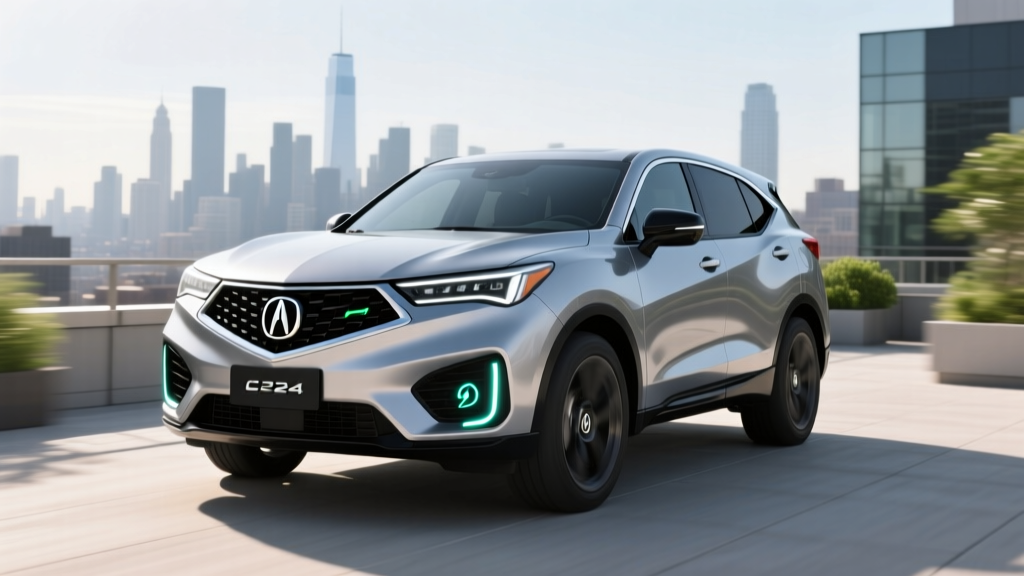
The Short Answer: Does a 2026 Acura RDX Hybrid Exist?
As of early 2026, Acura has not officially confirmed a hybrid or plug-in hybrid variant of the RDX compact luxury SUV. The current-generation RDX (refreshed for 2025) continues to sell exclusively with a 2.0-liter turbocharged four-cylinder gasoline engine. However, Honda's broader electrification strategy — which includes the e:HEV hybrid system deployed in the CR-V Hybrid and Accord Hybrid — makes an RDX hybrid one of the most anticipated powertrain additions in the luxury compact segment.
This guide breaks down what we know, what Honda's platform roadmap suggests, and whether waiting for an electrified RDX makes sense versus buying the current gas model, a competing hybrid SUV, or stepping into a full battery-electric vehicle.
No 2026 RDX hybrid has been officially unveiled by Acura. All specs, pricing, and availability details in this article are projected based on Honda's published electrification roadmap and platform-sharing patterns. We will update this page when Acura makes a formal announcement.
Why an RDX Hybrid Is Likely — Honda's e:HEV Platform Strategy
Honda has committed to offering electrified variants across its core lineup by the late 2020s. The fourth-generation e:HEV two-motor hybrid system already powers the CR-V Hybrid (which shares a platform lineage with the RDX), the Accord Hybrid, and the Civic Hybrid. In the Acura division, the MDX does not yet offer a hybrid, but the Acura Integra remains gas-only while the ZDX has gone fully electric.
The business case for an RDX hybrid is strong:
- Competitive pressure: The BMW X3 xDrive30e (PHEV), Lexus NX 350h (HEV), NX 450h+ (PHEV), and Volvo XC60 Recharge (PHEV) all offer electrified powertrains in this segment.
- Platform readiness: The RDX's underlying architecture can accommodate Honda's e:HEV system with modest engineering changes.
- Regulatory environment: CAFE standards and state-level zero-emission mandates push automakers to electrify high-volume models.
- Consumer demand: Hybrid adoption has surged since 2023, with buyers prioritizing fuel savings without range anxiety or charging dependency.
Based on Honda's cadence — the CR-V Hybrid launched roughly one year after the gas CR-V's redesign — an RDX hybrid could plausibly debut for the 2027 model year, potentially appearing in late 2026 as an early release. A mid-cycle refresh of the current RDX generation is the most likely trigger.
Projected Specs: What an RDX Hybrid Could Deliver
If Acura follows Honda's established e:HEV playbook, here's what an RDX Hybrid would likely look like based on platform-sharing data and the current CR-V Hybrid's powertrain:
| Specification | Projected HEV | Projected PHEV | Current RDX (Gas) |
|---|---|---|---|
| Powertrain | 2.0L turbo + 2-motor e:HEV | 2.0L turbo + 2-motor + larger battery | 2.0L turbo I4 |
| Combined Horsepower | ~270–290 hp | ~300–320 hp | 272 hp |
| Drivetrain | SH-AWD (rear motor) | SH-AWD (rear motor) | SH-AWD |
| Battery Capacity | ~1.1 kWh (NiMH or Li-ion) | ~17–19 kWh (Li-ion NMC) | N/A |
| EPA Combined MPG | ~30–34 MPG | ~28–30 MPG (hybrid mode) | 24 MPG |
| Electric-Only Range | N/A (self-charging) | ~30–38 miles | N/A |
| DC Fast Charging | N/A | Unlikely (most Honda PHEVs are AC-only) | N/A |
| Level 2 Charge Time (PHEV) | N/A | ~2.5–3 hours (7.2 kW onboard) | N/A |
| 0–60 mph | ~6.0–6.5 sec | ~5.5–6.0 sec | 6.4 sec |
| Estimated Base MSRP | $46,000–$49,000 | $52,000–$56,000 | $44,350 |
These projections are based on the CR-V Hybrid's 204 hp combined output scaled up for Acura's performance positioning, and the Accord PHEV's ~18.1 kWh battery and 48-mile EV range as an upper-bound reference. Acura would likely tune the system for more power and sportier calibration than its Honda counterparts.
HEV vs. PHEV: Which RDX Hybrid Would Make Sense?
Conventional Hybrid (HEV)
How it works: A small battery recharges through regenerative braking and the engine. No plug required — you fuel it like a normal car.
- No charging infrastructure needed
- Seamless fuel savings (25–40% vs gas)
- Lower upfront cost than PHEV
- No electric-only range to manage
- Best for: drivers without home charging access
Plug-In Hybrid (PHEV)
How it works: A larger battery provides 30–40 miles of electric-only driving, then operates as a conventional hybrid once depleted. Plug in at home to maximize savings.
- Electric-only commuting (zero gas on short trips)
- Eligible for up to $7,500 federal tax credit (§30D)
- Higher upfront cost, offset by incentives
- Requires home Level 2 charger for best experience
- Best for: commuters with predictable routes and home charging
For the RDX specifically, an HEV variant would be the higher-volume play — it requires no behavioral change from buyers and directly competes with the Lexus NX 350h. A PHEV would position the RDX against the BMW X3 xDrive30e and Volvo XC60 Recharge but at a significant price premium.
Fuel Economy: Projected MPG and Real-World Expectations
| Vehicle | City MPG | Highway MPG | Combined MPG | Annual Fuel Cost* |
|---|---|---|---|---|
| Current RDX (2.0T AWD) | 21 | 27 | 24 | ~$2,850 |
| Projected RDX HEV | ~33–36 | ~28–30 | ~30–34 | ~$2,000–$2,200 |
| Lexus NX 350h AWD | 41 | 37 | 39 | ~$1,750 |
| BMW X3 xDrive30e (PHEV) | — | — | — | ~$1,500 (with charging) |
*Based on 15,000 miles/year, $3.50/gallon regular unleaded. Source: fueleconomy.gov estimates for current models; projected figures are author estimates.
Pricing, Tax Credits, and Total Cost of Ownership
If a PHEV variant arrives, it could qualify for the federal §30D clean vehicle tax credit — up to $7,500 — subject to several requirements:
- MSRP cap: SUVs must be priced at or below $80,000
- Buyer income cap: AGI ≤ $150,000 (single) or $300,000 (joint)
- Battery sourcing: Critical minerals and battery components must meet phased-in domestic/free-trade-area sourcing thresholds (increasing annually through 2029)
- Point-of-sale transfer: Eligible buyers can apply the credit as a down-payment reduction at the dealer
- North American assembly: Final assembly must occur in the U.S., Canada, or Mexico
An RDX PHEV assembled at Honda's Ohio or Alabama plants with compliant battery sourcing could qualify. However, battery-sourcing rules tighten each year — eligibility is never guaranteed and should be verified at purchase time against the latest IRS guidance.
A conventional HEV variant would not qualify for the §30D federal credit (which requires plug-in capability and minimum battery capacity), though some states offer separate hybrid incentives. Check your state's energy office for local programs.
Battery Reliability, Warranty, and Replacement Costs
Projected Hybrid Battery Warranty
- Coverage: 8 years / 100,000 miles (10 years / 150,000 miles in CARB states including CA, NY, MA, and others)
- Capacity threshold: Warranty covers repair/replacement if battery capacity drops below ~70% of original
- Chemistry: HEV likely uses NiMH or small Li-ion; PHEV would use NMC Li-ion
- Replacement cost (out of warranty): HEV battery pack: $2,500–$4,000; PHEV battery pack: $8,000–$12,000
Honda's hybrid battery track record is strong. The first-generation Insight and Civic Hybrid batteries showed measurable degradation after 10–12 years, but the modern e:HEV system uses more conservative charge windows (never fully charging or fully depleting the pack) and advanced thermal management. CR-V Hybrid owners report minimal capacity loss after 100,000+ miles.
For context, a hybrid battery replacement is a rare event. Most hybrid batteries outlast the vehicle's economic life. The warranty provides substantial protection, and CARB-state residents get extended coverage that often spans the entire ownership period.
Should You Wait for the RDX Hybrid or Buy Now?
The Decision Framework
Buy the current gas RDX now if:
- You need a vehicle within the next 3–6 months
- You drive fewer than 10,000 miles per year (fuel savings from hybrid are modest at low mileage)
- You prefer a proven powertrain with no electrification uncertainty
- Current dealer incentives on the gas RDX are attractive
Wait for the RDX Hybrid if:
- You drive 15,000+ miles per year (fuel savings compound quickly)
- You plan to keep the vehicle 8+ years (hybrid reliability and resale value advantage)
- Your commute is stop-and-go city driving (where hybrids shine most)
- You want SH-AWD without the fuel penalty of the current turbo-four
Consider a competitor hybrid now if:
- The Lexus NX 350h's 39 MPG combined and proven hybrid system meet your needs
- You want a PHEV today — the BMW X3 xDrive30e or Volvo XC60 Recharge are available now
- You're open to a full EV like the Acura ZDX or Tesla Model Y and have home charging
Competitive Landscape: RDX Hybrid vs. the Segment
| Vehicle | Type | Combined MPG / EV Range | HP | Base MSRP |
|---|---|---|---|---|
| Lexus NX 350h | HEV | 39 MPG combined | 244 hp | ~$43,500 |
| Lexus NX 450h+ | PHEV | 37 mi EV / 84 MPGe | 304 hp | ~$59,500 |
| BMW X3 xDrive30e | PHEV | ~35 mi EV (est.) | 292 hp | ~$55,000 |
| Volvo XC60 Recharge | PHEV | 35 mi EV / 63 MPGe | 455 hp | ~$58,000 |
| Projected RDX HEV | HEV | ~30–34 MPG (est.) | ~270–290 hp | ~$46,000–$49,000 |
| Projected RDX PHEV | PHEV | ~30–38 mi EV (est.) | ~300–320 hp | ~$52,000–$56,000 |
The Lexus NX 350h currently dominates on pure fuel economy and has years of real-world reliability data behind it. An RDX hybrid would need to compete on Acura's traditional strengths: SH-AWD performance dynamics, a sportier driving feel, and potentially more aggressive pricing than the German PHEV alternatives.
Frequently Asked Questions
How many MPG would a 2026 RDX hybrid get?
Based on Honda's e:HEV system performance in the CR-V Hybrid, a conventional RDX HEV would likely achieve 30–34 MPG combined (with higher city numbers than highway). A PHEV variant would deliver similar MPG in hybrid mode after depleting its electric range. The current gas-only RDX gets 24 MPG combined per the EPA.
How far could an RDX PHEV go on electric only?
If Acura follows the Accord PHEV's architecture (~18 kWh battery), expect 30–38 miles of electric-only range. This covers most daily commutes without using gasoline, provided you plug in nightly. Actual range varies with temperature (expect 20–25% reduction in cold weather below 32°F) and driving style.
Would the RDX hybrid need to be plugged in?
Only the PHEV variant. A conventional HEV (like the Lexus NX 350h) never needs plugging in — it recharges its small battery through regenerative braking and the engine. You fuel it at a gas station exactly like the current RDX. The PHEV version benefits enormously from home charging but will still operate as a regular hybrid if you never plug it in.
Does an RDX hybrid qualify for the federal EV tax credit?
A PHEV variant could qualify for up to $7,500 under IRS §30D, provided it meets MSRP caps ($80,000 for SUVs), buyer income limits, battery sourcing requirements, and North American assembly rules. A conventional HEV does not qualify for the federal credit. Always verify eligibility at point of purchase, as sourcing rules change annually.
Is a hybrid RDX reliable? What about battery replacement cost?
Honda's e:HEV system has proven reliable across millions of vehicles. Hybrid battery warranty is expected at 8 years/100,000 miles (10/150,000 in CARB states). Out-of-warranty replacement for an HEV battery pack would cost roughly $2,500–$4,000; a PHEV pack would be $8,000–$12,000. Most hybrid batteries last the life of the vehicle under normal use.
Should I wait for the RDX hybrid or buy a competing hybrid SUV now?
If you need a vehicle now and hybrid efficiency is a priority, the Lexus NX 350h (39 MPG, ~$43,500) is the segment benchmark and available today. If you're loyal to the Acura brand and can wait 12–18 months, an RDX hybrid is plausible based on Honda's electrification commitments — but it has not been officially confirmed. The BMW X3 xDrive30e and Volvo XC60 Recharge serve buyers who want a PHEV today.
Will the RDX hybrid have SH-AWD?
Almost certainly yes. Honda's e:HEV system can incorporate a rear-axle electric motor for all-wheel drive, and SH-AWD is a core Acura differentiator. The rear motor would provide torque vectoring similar to the current mechanical SH-AWD system, potentially with even faster response times.
This article will be updated when Acura makes an official announcement regarding an RDX hybrid or PHEV variant. Last updated: early 2026. For current RDX specifications, visit Acura's official site. For hybrid fuel economy data, see fueleconomy.gov.