Quick Verdict: Who the 2025 Tucson Hybrid SEL Convenience Is For
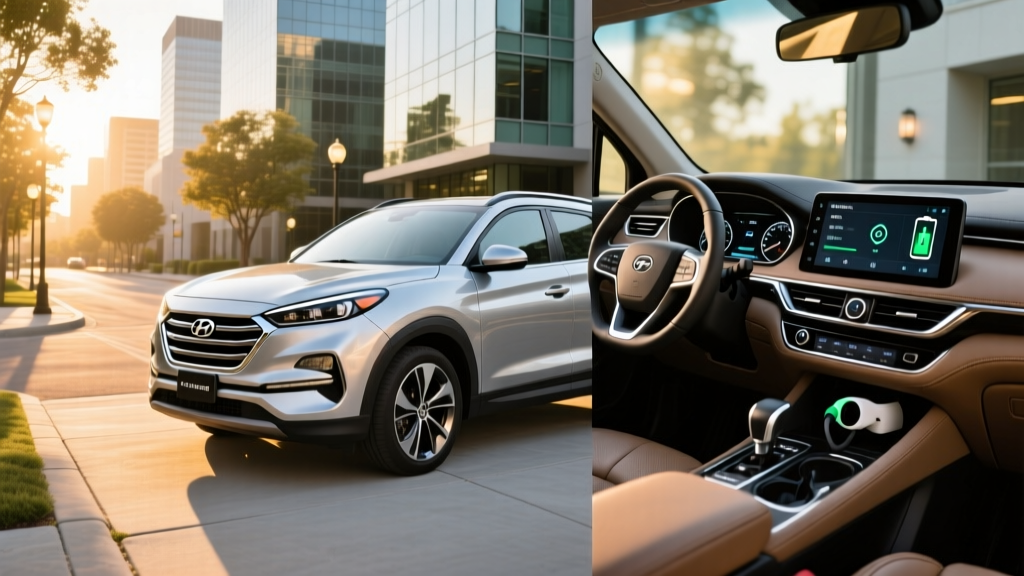
The 2025 Hyundai Tucson Hybrid SEL Convenience occupies a specific lane in the compact crossover segment: buyers who want meaningful fuel savings without plugging in, but still want premium features like a panoramic sunroof, hands-free liftgate, and Hyundai's full suite of driver-assist technology. At roughly $36,000 before destination, it undercuts many competing hybrid trims while delivering 38 MPG combined and 231 horsepower from its turbocharged hybrid powertrain.
This is a conventional hybrid (HEV) — not a plug-in. You never need to charge it. The gasoline engine and regenerative braking handle all battery replenishment. If you're cross-shopping the Tucson PHEV (plug-in hybrid) or a full battery-electric vehicle like the Ioniq 5, we break down exactly which powertrain fits your driving pattern below.
HEV vs PHEV: Understanding the Tucson Hybrid Lineup
Hyundai sells the Tucson in three powertrain flavors for 2025: a conventional gas model, a conventional hybrid (HEV), and a plug-in hybrid (PHEV). The SEL Convenience trim is available on the HEV. Here's the critical distinction:
| Attribute | Tucson Hybrid (HEV) | Tucson Plug-In Hybrid (PHEV) |
|---|---|---|
| Needs to plug in? | No — self-charging via engine + regen | Yes — plug in for electric-only driving |
| Battery size | 1.49 kWh (small buffer) | 13.8 kWh usable |
| Electric-only range | ~1 mile at low speed | 33 miles (EPA) |
| EPA combined MPG / MPGe | 38 MPG combined | 80 MPGe (electric) / 35 MPG (gas-only) |
| Combined horsepower | 231 hp | 268 hp |
| DC fast charging | N/A | No — Level 2 AC only (~2 hours) |
| Federal tax credit (§30D) | Not eligible | Up to $7,500 (subject to sourcing/income rules) |
| Starting MSRP (approx.) | ~$33,000 (Blue trim) | ~$40,000 (SEL trim) |
If you have reliable home charging and a commute under 33 miles, the PHEV lets you drive most weekdays on electricity alone. If you lack charging access or take frequent long road trips, the HEV's simplicity and strong city MPG make it the more practical choice.
Fuel Economy: EPA Ratings and Real-World MPG
The 2025 Tucson Hybrid carries the following EPA fuel economy estimates:
| Driving Cycle | EPA Rating |
|---|---|
| City | 38 MPG |
| Highway | 38 MPG |
| Combined | 38 MPG |
The flat 38/38/38 split is unusual and worth explaining. Turbocharged hybrids like the Tucson's 1.6-liter powertrain tend to perform relatively well on the highway compared to non-turbo hybrids (like the Toyota RAV4 Hybrid), which typically show a city-highway gap because their Atkinson-cycle engines are optimized for low-speed efficiency.
Real-World MPG: What to Actually Expect
Hyundai's hybrid system recovers energy aggressively in stop-and-go traffic. In real-world mixed driving, owners commonly report:
- City-heavy commuting: 39–42 MPG (hybrids often exceed EPA city ratings in genuine stop-and-go conditions)
- Mixed suburban/highway: 35–38 MPG
- Sustained 75+ MPH highway: 32–35 MPG (aerodynamic drag dominates at higher speeds)
- Cold weather (below 30°F): 30–34 MPG (engine runs more often for cabin heat and battery warming)
With a 13.7-gallon fuel tank, expect a real-world range of roughly 430–520 miles between fill-ups depending on your driving mix. That's competitive with any compact crossover on the market, electrified or not.
Powertrain and Performance Specs
| Specification | 2025 Tucson Hybrid |
|---|---|
| Engine | 1.6L turbocharged 4-cylinder |
| Electric motor | 47.7 kW permanent-magnet synchronous |
| Combined system output | 231 hp / 271 lb-ft torque |
| Transmission | 6-speed automatic (no CVT) |
| Drivetrain | HTRAC AWD (standard on all trims) |
| 0–60 mph | ~7.1 seconds (est.) |
| Towing capacity | 2,000 lbs |
| Hybrid battery | 1.49 kWh lithium-ion polymer |
| Cargo volume (behind rear seats) | 38.7 cu ft |
| Cargo volume (rear seats folded) | 80.3 cu ft |
The 6-speed automatic is a deliberate choice by Hyundai. Unlike the Toyota RAV4 Hybrid's eCVT, the Tucson Hybrid shifts through actual gears, giving it a more natural acceleration feel that drivers accustomed to conventional transmissions tend to prefer. The trade-off is slightly less seamless low-speed electric assist, but the 271 lb-ft of torque fills in any gaps.
Standard HTRAC all-wheel drive means the rear axle is engaged automatically when the system detects slip. This is a full-time hybrid AWD system — there's no mechanical driveshaft to the rear wheels; instead, the hybrid system manages torque distribution electronically.
SEL Convenience Trim: What You Get for the Price
The SEL Convenience sits in the upper-middle of the Tucson Hybrid trim ladder. For 2025, it adds substantial content over the base SEL:
- Panoramic curved display (12.3-inch digital cluster + 12.3-inch infotainment)
- Hands-free smart power liftgate
- Panoramic sunroof
- Leatherette seating surfaces (H-Tex)
- Heated front seats and heated steering wheel
- Wireless phone charging pad
- Highway Driving Assist (HDA) with adaptive cruise and lane centering
- Blind-spot collision-avoidance assist with rear cross-traffic alert
- LED projector headlights with auto high-beam
Pricing: The 2025 Tucson Hybrid SEL Convenience starts at approximately $36,260 (MSRP including destination). This positions it between the Toyota RAV4 Hybrid XLE Premium (~$37,500) and the Honda CR-V Hybrid Sport-L (~$38,000) while offering comparable or better feature content.
Tax Credit Eligibility
Federal tax credit status: The 2025 Tucson Hybrid (HEV) does not qualify for the §30D Clean Vehicle Credit. That credit applies only to plug-in electric vehicles (BEVs and PHEVs) meeting battery sourcing, MSRP cap, and buyer income requirements.
The Tucson PHEV may qualify for up to $7,500 under §30D, but eligibility depends on critical-mineral and battery-component sourcing rules that change annually. Consult a tax professional and check the latest fueleconomy.gov tax credit listings before purchasing.
Some states offer separate hybrid or clean-vehicle rebates. These vary widely by jurisdiction — check your state's energy or environmental agency for current programs.
Battery Warranty, Reliability, and Replacement Cost
Hybrid battery longevity is the top concern for buyers new to electrified vehicles. Here's the data:
| Coverage | Duration |
|---|---|
| Hybrid battery warranty | 10 years / 100,000 miles (original owner) |
| Hybrid battery warranty (CARB states) | 10 years / 150,000 miles |
| Hybrid system components | 10 years / 100,000 miles |
| Powertrain warranty | 10 years / 100,000 miles |
| New vehicle warranty | 5 years / 60,000 miles |
The Tucson Hybrid's 1.49 kWh battery is small and operates within a narrow state-of-charge window (roughly 40–80%), which significantly reduces degradation stress. Hyundai has used lithium-ion polymer hybrid batteries since the 2011 Sonata Hybrid, and large-scale failure rates have been low. Independent data from sources like Consumer Reports and J.D. Power generally place Hyundai's hybrid reliability in the average-to-above-average range for the segment.
Battery Replacement Cost
If the hybrid battery does fail outside warranty, replacement costs for the Tucson Hybrid's small 1.49 kWh pack typically range from $2,000 to $3,500 including labor — far less than a full EV battery replacement. This is because you're replacing a compact module, not a 70+ kWh floor-mounted pack. Many hybrid batteries last 150,000–200,000+ miles before significant capacity loss.
Hybrid vs PHEV vs Full EV: Which Powertrain Fits You?
Choose the Tucson Hybrid (HEV) if:
- You don't have access to home or workplace charging
- You take frequent road trips exceeding 300 miles
- You want lower upfront cost (no PHEV premium)
- Your commute involves heavy stop-and-go traffic where hybrids excel
- You want a simple ownership experience — just fill up with gas
Choose the Tucson PHEV or a Full EV if:
- You have Level 2 home charging (240V outlet or hardwired station)
- Your daily commute is under 33 miles (PHEV) or under 250 miles (EV)
- You want to minimize or eliminate gasoline purchases
- You qualify for the federal §30D tax credit, offsetting the higher purchase price
- You want stronger electric acceleration and one-pedal-style regen (EV)
The math is straightforward: if you drive 12,000 miles per year at 38 MPG, the Tucson Hybrid uses roughly 316 gallons annually — about $1,100 at $3.50/gallon. A comparable gas-only Tucson at 28 MPG combined burns 429 gallons, costing about $1,500. That's roughly $400/year in fuel savings, or about $2,000 over five years. The hybrid premium on the SEL Convenience over a gas equivalent is modest enough that the payback period is typically 3–5 years, after which you're saving money every mile.
Competitor Comparison: How the Tucson Hybrid Stacks Up
| Model | EPA Combined MPG | Horsepower | AWD Standard? | Approx. MSRP (comparable trim) |
|---|---|---|---|---|
| 2025 Tucson Hybrid SEL Convenience | 38 MPG | 231 hp | Yes | $36,260 |
| 2025 Toyota RAV4 Hybrid XLE Premium | 39 MPG | 219 hp | Yes | $37,545 |
| 2025 Honda CR-V Hybrid Sport-L | 37 MPG | 204 hp | Yes | $38,100 |
| 2025 Kia Sportage Hybrid EX | 38 MPG | 231 hp | Yes | $34,090 |
The Tucson Hybrid's 231 hp leads the segment (tied with its Kia Sportage platform-mate), and its 6-speed automatic gives it a more engaging driving character than the CVT-equipped RAV4 and CR-V. The RAV4 Hybrid edges it by 1 MPG on the EPA cycle, a difference imperceptible in real-world driving.
Frequently Asked Questions
How many MPG does the 2025 Tucson Hybrid get in real driving?
The EPA rates it at 38 MPG combined (38 city / 38 highway). In real-world city-heavy driving, many owners see 39–42 MPG thanks to aggressive regenerative braking. Sustained highway driving at 75+ MPH typically yields 32–35 MPG. Cold weather reduces efficiency by roughly 10–15%.
Does the Tucson Hybrid need to be plugged in?
No. The Tucson Hybrid (HEV) is a conventional self-charging hybrid. The 1.49 kWh battery is recharged entirely by the gasoline engine and regenerative braking. You fuel it like any other car. Only the Tucson PHEV (plug-in hybrid) requires plugging in to access its 33-mile electric-only range.
How far can the Tucson PHEV go on electric only?
The 2025 Tucson Plug-In Hybrid achieves an EPA-rated 33 miles on electric power alone before the gas engine engages. Total combined range (electric + gasoline) exceeds 400 miles. Level 2 charging takes approximately 2 hours from empty; the PHEV does not support DC fast charging.
Is the Tucson Hybrid reliable? What about battery replacement?
Hyundai's hybrid system has demonstrated average-to-above-average reliability across its model range. The hybrid battery carries a 10-year/100,000-mile warranty (10 years/150,000 miles in CARB-emission states). If replacement is needed outside warranty, the small 1.49 kWh pack typically costs $2,000–$3,500 — a fraction of full EV battery replacement costs.
Does the 2025 Tucson Hybrid qualify for any federal tax credit?
The conventional Tucson Hybrid (HEV) does not qualify for the §30D federal Clean Vehicle Credit, which is reserved for plug-in vehicles (PHEVs and BEVs). The Tucson PHEV may qualify for up to $7,500 depending on battery sourcing requirements and buyer income limits. Check IRS guidelines and consult a tax professional for your specific situation.
Is the SEL Convenience worth the premium over the base SEL?
If you value the panoramic sunroof, hands-free liftgate, larger curved display, and Highway Driving Assist, the Convenience package adds meaningful daily-use features for roughly $3,000–$3,500 over the base SEL. For buyers who prioritize value, the SEL still includes core safety tech and hybrid efficiency. The Convenience trim is the sweet spot for those who want near-Limited luxury without the Limited's $39,000+ price tag.