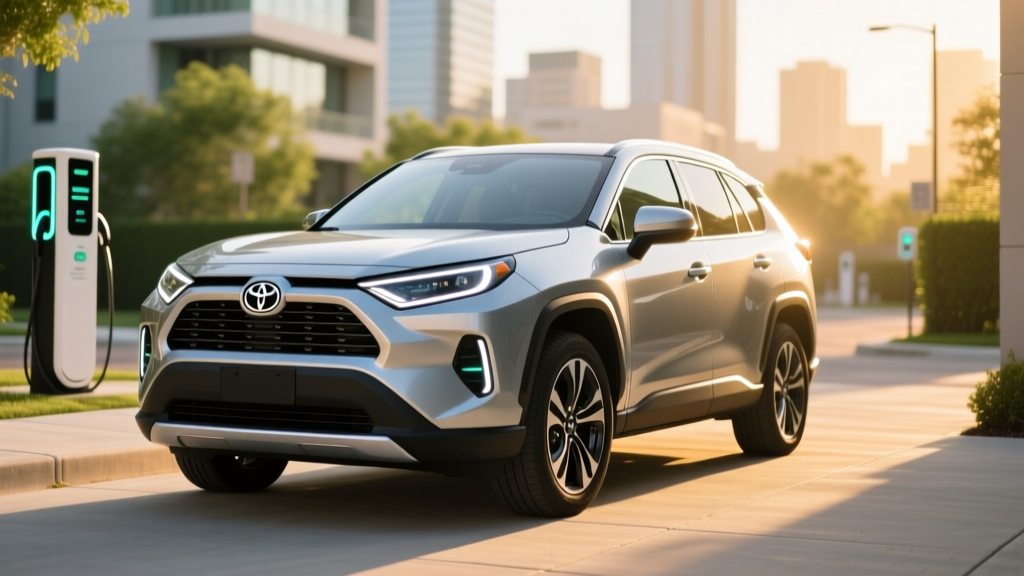
The 2025 Toyota RAV4 Prime PHEV occupies a narrow but compelling space: a compact SUV that covers most daily commutes on electricity alone, then switches to a proven hybrid system for longer trips without range anxiety. With 302 combined horsepower, standard all-wheel drive, and an EPA-rated 42 miles of electric-only range, it remains one of the most capable plug-in hybrids on the market — even as Toyota keeps production tight and dealer markups common.
This guide breaks down the RAV4 Prime's real-world efficiency, charging behavior, powertrain specs, pricing, and tax-credit eligibility so you can decide whether it fits your garage better than a full EV or conventional hybrid.
HEV vs. PHEV: Where the RAV4 Prime Fits
Conventional Hybrid (HEV) — The standard RAV4 Hybrid pairs a 2.5L engine with electric motors and a small ~1.6 kWh battery that recharges via regenerative braking and the engine. You never plug it in. EPA-rated at 39 MPG combined, it's a fuel-sipper but offers no meaningful electric-only driving.
Plug-in Hybrid (PHEV) — The RAV4 Prime uses the same 2.5L engine but adds a much larger 18.1 kWh lithium-ion battery and more powerful electric motors. You plug it in to charge, gaining up to 42 miles of zero-emission driving before the hybrid system seamlessly takes over. Think of it as an EV for your commute and a hybrid for road trips.
The distinction matters because the two vehicles target different ownership patterns. If you lack home charging access, a conventional HEV makes more sense — plugging in is what unlocks the Prime's efficiency advantage. If you can charge at home and your round-trip commute is under 40 miles, the Prime effectively operates as a daily EV that happens to have a gas engine backup.
Powertrain and Performance Specs
| Specification | 2025 RAV4 Prime |
|---|---|
| Combined Horsepower | 302 hp |
| Engine | 2.5L 4-cylinder (177 hp) |
| Front Electric Motor | 134 kW (180 hp) |
| Rear Electric Motor | 40 kW (54 hp) |
| Drivetrain | Electronic AWD (eAWD) |
| Battery Capacity | 18.1 kWh lithium-ion |
| 0–60 mph | 5.7 seconds |
| EPA Electric-Only Range | 42 miles |
| Total Combined Range | ~600 miles |
| Towing Capacity | 2,500 lbs |
That 5.7-second 0–60 time makes the RAV4 Prime the quickest RAV4 variant and one of the quickest compact SUVs in its class. The electric motors deliver instant torque, and the transition from EV to hybrid mode is nearly imperceptible under normal acceleration. The eAWD system uses the rear motor for traction rather than a mechanical driveshaft, which means rear-wheel engagement is electronically managed and responds in milliseconds.
Fuel Economy and Electric Efficiency
| Mode | City | Highway | Combined |
|---|---|---|---|
| EV Mode (MPGe) | 114 MPGe | 84 MPGe | 94 MPGe |
| Hybrid Mode (MPG) | 40 MPG | 36 MPG | 38 MPG |
How many MPG does the RAV4 Prime get? In charge-sustaining (hybrid) mode with a depleted battery, the EPA rates it at 38 MPG combined — 40 city, 36 highway. When operating on battery charge, it earns 94 MPGe combined.
Real-world MPG vs. EPA: Toyota hybrids historically match or exceed EPA city estimates because regenerative braking recovers energy in stop-and-go traffic. In mixed suburban driving, owners frequently report 39–42 MPG in hybrid mode. Highway efficiency drops more noticeably — expect 33–35 MPG at sustained 75–80 mph speeds, especially with roof cargo or in cold weather.
Real-world electric range: The EPA's 42-mile electric estimate assumes moderate temperatures and mixed driving. In practice, expect 35–40 miles in warm weather with gentle acceleration, and 28–33 miles in freezing conditions or at highway speeds. The battery's usable capacity is approximately 14.9 kWh of the total 18.1 kWh — Toyota reserves a buffer to protect long-term battery health.
Charging: Speeds, Connectors, and What to Expect
The RAV4 Prime uses a J1772 connector for AC charging. It does not support DC fast charging — a deliberate Toyota decision that keeps cost and weight down but means you're limited to Level 1 and Level 2 AC charging.
| Charging Level | Power | 0–100% Time | Notes |
|---|---|---|---|
| Level 1 (120V) | ~1.4 kW | ~12 hours | Standard household outlet; sufficient for overnight top-up |
| Level 2 (240V, standard trim) | 3.3 kW | ~5.5 hours | SE trim; built-in charger limited to 3.3 kW |
| Level 2 (240V, upgraded) | 6.6 kW | ~2.5 hours | XSE with Premium Package; 6.6 kW onboard charger |
The 6.6 kW onboard charger (available on XSE with the Premium Package) is the one to target if you plan to charge at public Level 2 stations during the day or want a faster home top-up. On a standard 32-amp Level 2 home charger, the 6.6 kW variant fills the battery in about 2.5 hours — useful for mid-day charging if you have solar production or time-of-use rate windows.
On a 120V Level 1 outlet, expect roughly 4 miles of electric range per hour of charging. For owners with short commutes and overnight parking near an outlet, Level 1 alone can keep the battery topped up most days.
Pricing, Trims, and Tax Credit Eligibility
The 2025 RAV4 Prime is offered in two trims:
- SE: Starting MSRP approximately $43,690 (destination included)
- XSE: Starting MSRP approximately $47,575 (destination included)
Does the 2025 RAV4 Prime qualify for a federal tax credit? Under current IRS §30D rules, the RAV4 Prime does not qualify for the full $7,500 federal EV tax credit. The credit requires that a vehicle meet critical-mineral sourcing and battery-component manufacturing thresholds that shift annually. Toyota's PHEV battery supply chain has not consistently met these thresholds for the Prime. Some buyers may qualify for a partial credit depending on the specific model year's sourcing certification — always check the latest fueleconomy.gov tax credit list before purchasing.
§30D Credit Checklist for PHEV Buyers:
- Vehicle must have ≥7 kWh battery capacity (Prime qualifies at 18.1 kWh)
- Buyer income cap: $150K single / $300K joint (modified AGI)
- MSRP cap: $80,000 for SUVs (Prime qualifies)
- Battery components and critical minerals must meet sourcing thresholds — this is where the Prime currently falls short for the full credit
- Credit is non-refundable; point-of-sale transfer available for eligible vehicles
Consult IRS.gov §30D guidance or a tax professional for your specific situation. Rules change annually and by model year.
Some states offer additional PHEV rebates. California's CVRP program, for example, has historically offered up to $1,000–$1,500 for qualifying PHEVs, though funding availability varies. Check your state energy office for current programs.
Reliability, Battery Warranty, and Replacement Cost
Hybrid Battery Warranty: Toyota covers the RAV4 Prime's traction battery for 10 years or 150,000 miles (whichever comes first) in all 50 states. This applies to both the high-voltage PHEV battery and the hybrid system components. The standard vehicle warranty is 3 years/36,000 miles bumper-to-bumper and 5 years/60,000 miles powertrain.
Is the RAV4 Prime reliable? Toyota's hybrid powertrains have accumulated two decades of real-world durability data. The RAV4 Prime's planetary-gear eCVT transmission has no traditional clutch packs or bands to wear out, and the electric motors have minimal moving parts. Toyota's hybrid battery packs routinely exceed 150,000 miles with modest capacity loss — typically 10–15% degradation over a decade of use.
Battery replacement cost: If the traction battery fails outside warranty, expect a replacement cost of approximately $4,000–$6,500 for the pack plus labor at a Toyota dealer. Third-party refurbished batteries are becoming available for older Toyota hybrids at roughly $2,000–$3,500, though the Prime's larger 18.1 kWh pack commands a premium. Given the 10-year/150,000-mile warranty and Toyota's track record, most original owners will never face this expense.
The 12V auxiliary battery (a standard lead-acid or AGM unit) is a separate, more common replacement item — typically $150–$250 every 4–6 years, same as any vehicle.
Who Should Choose the RAV4 Prime vs. a Full EV or Gas Car?
Choose the RAV4 Prime PHEV if:
- You have home charging (even a 120V outlet) and a commute under 40 miles round-trip
- You want EV-like daily driving but regularly take trips exceeding 200 miles and don't want to plan around charging stations
- You need AWD and cargo versatility in a compact SUV footprint
- You value Toyota's long-term reliability record and 10-year battery warranty
Choose a full EV (e.g., Tesla Model Y, Hyundai Ioniq 5) if:
- You have reliable home Level 2 charging and rarely drive more than 250 miles in a single day
- You want to eliminate gasoline entirely and minimize maintenance (no oil changes, no engine)
- You qualify for the full $7,500 federal tax credit on an eligible EV
- You prioritize DC fast charging for road trips (20–30 minute stops at 150–250 kW chargers)
Choose the standard RAV4 Hybrid (HEV) if:
- You cannot charge at home (apartment, street parking, no outlet access)
- You want maximum fuel efficiency without changing your refueling habits
- The $3,000–$5,000 price premium of the Prime over the HEV doesn't pencil out for your mileage
The RAV4 Prime makes the most financial sense for drivers who can charge at home nightly and will use most of that 42-mile electric range daily. At an average electricity cost of $0.14/kWh, fully charging the Prime's battery costs roughly $2.10 — equivalent to about 0.6 gallons of gas at $3.50/gallon. If you drive 35 electric miles per day and 10,000 miles per year, you could use under 100 gallons of gasoline annually.
Pros and Cons
Pros
- 42-mile EPA electric range covers most commutes
- 302 hp and 5.7-second 0–60 make it genuinely quick
- Standard eAWD with no mechanical drivetrain penalty
- 10-year/150,000-mile hybrid battery warranty
- 600+ mile total range eliminates road-trip range anxiety
- Strong resale value; high demand keeps used prices elevated
Cons
- No DC fast charging — Level 2 max only
- Limited availability; dealer markups remain common
- Does not qualify for the full $7,500 federal tax credit
- 3.3 kW onboard charger on SE trim is slow for public L2 charging
- EV range drops to ~28–33 miles in freezing weather
- Cargo space slightly reduced vs. RAV4 Hybrid (battery placement)
Frequently Asked Questions
How far can the 2025 RAV4 Prime go on electric only?
The EPA rates the RAV4 Prime at 42 miles of electric-only range. In real-world warm-weather driving, expect 35–40 miles. In freezing temperatures or at sustained highway speeds, that drops to approximately 28–33 miles. The vehicle seamlessly transitions to hybrid mode once the battery's usable charge is depleted — you never strand yourself.
Does the RAV4 Prime need premium fuel?
No. The 2.5L Atkinson-cycle engine runs on regular 87-octane gasoline, same as the standard RAV4 Hybrid.
Can the RAV4 Prime charge while driving?
Yes, in a limited sense. Regenerative braking recovers energy during deceleration, and the engine can charge the battery in Charge Mode (activated via a dashboard button). However, engine charging is less efficient than plugging in — you'll burn more gasoline generating electricity than you would by simply charging from the grid. Reserve Charge Mode for situations where you want to save battery for a specific destination (e.g., an emissions-restricted zone).
Is the RAV4 Prime worth the premium over the RAV4 Hybrid?
The price gap is typically $3,500–$5,000 depending on trim. If you charge at home and use 30+ miles of electric range daily, fuel savings can offset the premium within 4–6 years — faster if electricity is cheap and gas is expensive. The performance upgrade (302 hp vs. 219 hp) and the 10-year battery warranty also factor into the value equation.
What happens when the RAV4 Prime battery degrades?
Toyota's hybrid batteries are designed to degrade gradually rather than fail suddenly. After 10 years, expect 85–90% of original capacity — meaning your 42-mile range might shrink to 35–38 miles. The 10-year/150,000-mile warranty covers defects and premature capacity loss. If replacement is needed out of warranty, budget $4,000–$6,500 at a dealer.
Does the RAV4 Prime qualify for HOV lane access?
In many states, yes. California, for example, has historically granted Clean Air Vehicle decals to qualifying PHEVs, allowing single-occupant carpool lane use. Program availability and decal expiration rules vary by state and year — check your local DMV for current eligibility.
Sources: EPA fueleconomy.gov — 2025 Toyota RAV4 Prime; Toyota RAV4 Prime official specifications; IRS §30D Clean Vehicle Credit guidance.