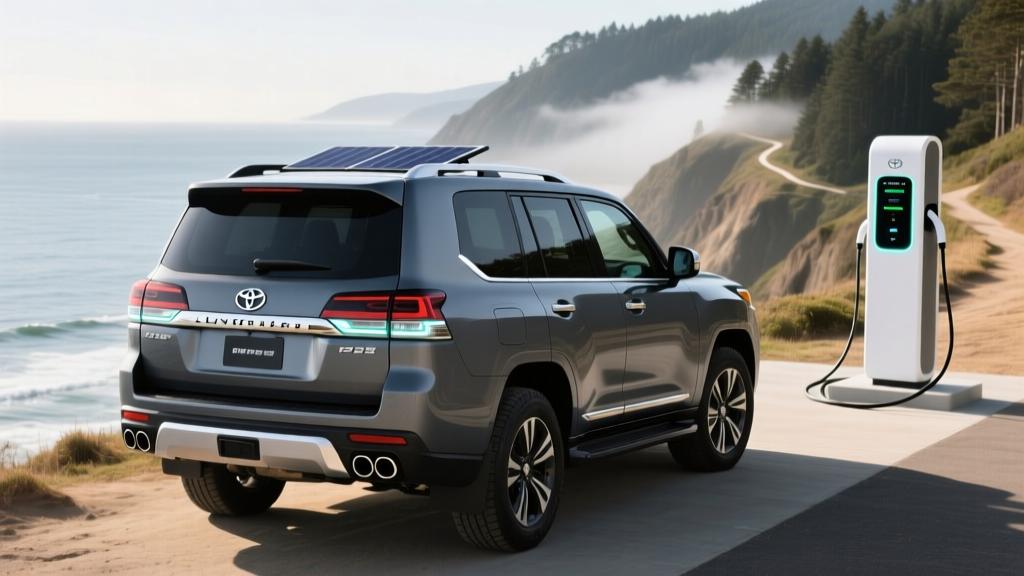
The 2025 Toyota Land Cruiser returns to the U.S. market as a hybrid-only nameplate, built on the i-FORCE MAX turbocharged hybrid powertrain. This is not a plug-in hybrid — it is a conventional self-charging hybrid (HEV) that pairs a 2.4-liter turbocharged four-cylinder engine with an electric motor integrated into an 8-speed automatic transmission. The result is a body-on-frame SUV that delivers 326 combined horsepower and 465 lb-ft of torque while achieving an EPA-estimated 23 MPG combined — a meaningful improvement over the V8 Land Cruisers of the previous generation.
This guide covers everything a prospective buyer needs to know: exact fuel economy figures, powertrain architecture, pricing across trims, battery warranty terms, real-world efficiency expectations, and whether this hybrid SUV makes more sense than a full EV or a conventional gas truck for your lifestyle.
HEV vs PHEV: What the 2025 Land Cruiser Actually Is
A critical distinction before we go further: the 2025 Toyota Land Cruiser is a conventional hybrid electric vehicle (HEV), not a plug-in hybrid (PHEV). Understanding the difference is essential for setting the right expectations around fueling, range, and tax incentives.
| Feature | HEV (2025 Land Cruiser) | PHEV (e.g., RAV4 Prime) |
|---|---|---|
| Plug-in charging? | No — self-charging via regen & engine | Yes — plug into Level 1 or Level 2 |
| Electric-only range | None (electric motor assists only) | 25–42 miles typical |
| Battery capacity | ~1.87 kWh (small, buffer-limited) | 18–22 kWh usable |
| DC fast charging | N/A | Rarely available on Toyota PHEVs |
| Federal tax credit (§30D) | Not eligible | May qualify (battery sourcing rules apply) |
| Fueling | Gasoline only (regenerative braking recovers energy) | Gasoline + grid electricity |
The Land Cruiser's hybrid system does not have a charge port. You will never plug it in. The small nickel-metal hydride (NiMH) hybrid battery charges through regenerative braking and the gasoline engine. Its role is to provide torque fill at low RPMs, enable brief engine-off coasting, and smooth out stop-start driving — not to propel the vehicle on electricity alone for meaningful distances.
Fuel Economy: EPA Ratings and Real-World MPG
The 2025 Land Cruiser carries a single powertrain across all trims, so EPA fuel economy figures are consistent whether you choose the base 1958 edition, the mid-grade Land Cruiser, or the range-topping First Edition.
| Metric | EPA Estimate | Real-World Expectation |
|---|---|---|
| City MPG | 22 MPG | 22–24 MPG (hybrid advantage in stop-and-go) |
| Highway MPG | 25 MPG | 21–23 MPG (aerodynamic drag, 5,000+ lb curb weight) |
| Combined MPG | 23 MPG | 21–24 MPG depending on driving mix |
| Annual fuel cost (15,000 mi) | ~$2,850* | Varies with local fuel prices |
*Based on EPA assumptions of $3.50/gal regular unleaded and 15,000 miles/year. Source: fueleconomy.gov.
Real-world nuance: Toyota's hybrid system excels in city driving where regenerative braking frequently recovers kinetic energy. Owners who commute in heavy traffic often report matching or slightly exceeding the 22 MPG city sticker. Highway efficiency drops noticeably — this is a boxy, body-on-frame SUV with a frontal area that fights the wind above 70 mph. On a loaded road trip with roof cargo and headwinds, expect closer to 20 MPG combined. Towing (rated at 6,000 lbs) will drop figures into the mid-teens.
Powertrain Deep Dive: i-FORCE MAX Hybrid Specs
| Specification | Value |
|---|---|
| Engine | 2.4L turbocharged inline-4 |
| Electric motor | 48 HP / 184 lb-ft (integrated in transmission bell housing) |
| Combined system output | 326 HP / 465 lb-ft |
| Transmission | 8-speed automatic (Direct Shift-8AT) |
| Drivetrain | Full-time 4WD with locking center differential |
| 0–60 mph | ~6.5 seconds (est.) |
| Towing capacity | 6,000 lbs |
| Fuel type | Regular unleaded (87 octane) |
| Fuel tank capacity | 17.9 gallons |
| Total driving range | ~410 miles (EPA combined) |
| Hybrid battery type | NiMH (nickel-metal hydride), ~1.87 kWh |
| Curb weight | ~5,050–5,150 lbs (trim-dependent) |
The i-FORCE MAX system uses the electric motor primarily for low-speed torque augmentation. When you accelerate from a stop, the motor provides immediate thrust before the turbo spools, eliminating the lag typical of small-displacement turbo engines. Under light loads, the system can briefly shut off the engine during coasting and deceleration, but it does not offer a sustained EV-only driving mode.
This architecture is shared with the Toyota Tacoma i-FORCE MAX and the 4Runner, meaning Toyota has a growing service network familiar with the powertrain — a reliability positive.
Pricing, Trims, and Tax Credit Eligibility
The 2025 Land Cruiser is offered in three configurations:
- Land Cruiser 1958 — MSRP from ~$57,345 (destination included). Retro-styled with round LED headlights, 18-inch wheels, and a simplified interior.
- Land Cruiser — MSRP from ~$62,345. Adds rectangular headlights, available premium audio, heated/ventilated seats, and additional off-road tech.
- Land Cruiser First Edition — MSRP from ~$73,345 (limited production). Fully loaded with exclusive two-tone paint and upgraded interior materials.
Federal Tax Credit Status
The 2025 Toyota Land Cruiser HEV does not qualify for the IRS §30D Clean Vehicle Credit. Under current IRS rules, only battery electric vehicles (BEVs) and plug-in hybrids (PHEVs) with a minimum battery capacity of 7 kWh are eligible. Conventional hybrids like the Land Cruiser are excluded regardless of price or battery sourcing.
Some states may offer modest rebates for hybrid vehicles through local utility or air-quality programs. Check your state energy office or utility provider for current offerings.
Without a federal credit, the Land Cruiser's purchase price is its true cost at the dealership. However, Toyota's strong resale values historically soften the ownership equation — the previous-generation Land Cruiser (J200) held its value among the best of any SUV on the market.
Battery Warranty, Lifespan, and Replacement Cost
Hybrid battery longevity is the number-one concern for buyers new to the technology. Here is what Toyota provides:
| Coverage Item | Term |
|---|---|
| Hybrid battery warranty | 10 years / 150,000 miles (whichever comes first) |
| Hybrid system components | 8 years / 100,000 miles |
| Powertrain warranty | 5 years / 60,000 miles |
| Basic bumper-to-bumper | 3 years / 36,000 miles |
Expected lifespan: Toyota's NiMH hybrid batteries, proven over two decades in the Prius and Highlander Hybrid, routinely exceed 150,000 miles without significant degradation. The small capacity (~1.87 kWh) and conservative buffer management (the system never fully charges or fully depletes the pack) contribute to exceptional cycle life. Real-world data from Toyota's hybrid fleet shows failure rates well below 2% within the warranty period.
Replacement cost if out of warranty: A new OEM hybrid battery pack for the i-FORCE MAX system is estimated at $2,500–$4,000 installed, based on comparable Toyota hybrid systems. Third-party refurbished packs may reduce this to $1,500–$2,500. Given the 10-year/150,000-mile warranty and the battery's proven durability, out-of-pocket replacement is unlikely for most original owners.
Who Should Choose This Hybrid Over an EV or Gas SUV?
Choose the 2025 Land Cruiser HEV if:
- You need a body-on-frame SUV with genuine off-road capability (locking diffs, crawl control, stabilizer bar disconnect on higher trims)
- You tow regularly (6,000 lb rating) and cannot risk EV range loss under load
- You do not have reliable home charging access (apartment, street parking, no garage)
- You drive in remote areas with limited charging infrastructure
- You want hybrid fuel savings without any change in fueling behavior
Consider a full EV (Rivian R1S, Tesla Model X) instead if:
- You have home Level 2 charging and drive mostly in urban/suburban areas
- You want to qualify for the $7,500 federal tax credit (income and sourcing rules apply)
- Your daily commute is under 80 miles round-trip
- You prioritize lowest per-mile fuel cost (electricity at $0.04–$0.06/mile vs. gasoline at $0.15–$0.20/mile)
A conventional gas SUV (4Runner V6, Jeep Wrangler) makes sense if:
- Upfront purchase price is the primary constraint and you drive under 10,000 miles/year
- You prefer the simplest possible powertrain with no hybrid system components
Reliability, Safety, and Ownership Costs
Toyota's hybrid systems carry an industry-leading reliability track record. The i-FORCE MAX is newer than the Prius drivetrain, but its core components — the electric motor, inverter, and NiMH pack — share architecture with Toyota's proven hybrid lineage. The 2025 Land Cruiser rides on the TNGA-F platform shared with the global Land Cruiser 300 Series, which has been in production since 2021 with strong durability reports from international markets.
Safety technology includes Toyota Safety Sense 3.0 as standard: pre-collision system with pedestrian detection, lane departure alert with steering assist, full-speed-range dynamic radar cruise control, and automatic high beams. NHTSA and IIHS crash-test results for the 2025 model year should be monitored as testing completes — the previous J200 generation earned strong marks, and the stiffer TNGA-F platform is expected to perform well.
Insurance: Expect premiums 10–15% higher than a comparable non-hybrid mid-size SUV, driven by the vehicle's MSRP and repair complexity. Get quotes before purchase.
Maintenance: Hybrid-specific maintenance is minimal. There is no hybrid battery cooling filter to replace on this system. Standard intervals include engine oil (0W-16 synthetic, every 10,000 miles), cabin air filter, and brake fluid. Regenerative braking extends pad life significantly — many Toyota hybrid owners report 60,000+ miles on original brake pads.
Pros, Cons, and the Bottom Line
Pros
- 326 HP / 465 lb-ft with smooth electric torque fill — no turbo lag from stops
- EPA 23 MPG combined is strong for a 5,000+ lb body-on-frame SUV
- 10-year / 150,000-mile hybrid battery warranty — class-leading coverage
- Genuine off-road hardware: full-time 4WD, locking center diff, available front stabilizer disconnect
- 6,000-lb towing without the range-loss anxiety of an EV under load
- Regular 87-octane fuel — no premium required
- Historically exceptional resale value for the Land Cruiser nameplate
Cons
- No federal tax credit eligibility (HEV excluded from §30D)
- Highway MPG drops to ~21–23 loaded — boxy aero hurts at speed
- Base price of $57,345 is steep for a two-row mid-size SUV
- No plug-in hybrid variant available (no EV-only commuting mode)
- Cargo space limited compared to three-row competitors (~41 cu ft behind second row)
- Dealer markups remain common on Land Cruiser trims — negotiate firmly
Frequently Asked Questions
How many MPG does the 2025 Toyota Land Cruiser hybrid get?
The EPA rates the 2025 Land Cruiser at 22 MPG city, 25 MPG highway, and 23 MPG combined. In real-world driving, city commuters often match or slightly exceed 22 MPG thanks to regenerative braking, while highway-heavy trips and towing will pull figures down to 20–21 MPG combined.
Is the 2025 Land Cruiser a plug-in hybrid?
No. The 2025 Land Cruiser is a conventional hybrid (HEV). It has no charge port, no plug, and no electric-only driving range. The hybrid battery charges exclusively through regenerative braking and the gasoline engine. If you want plug-in capability from Toyota, the RAV4 Prime (PHEV) offers 42 miles of electric-only range.
Does the 2025 Land Cruiser qualify for any federal tax credit?
No. Under current IRS §30D rules, only BEVs and PHEVs with at least 7 kWh of battery capacity qualify for the Clean Vehicle Credit. The Land Cruiser's ~1.87 kWh NiMH pack does not meet the threshold. Check your state and local utility for any hybrid-specific rebates.
How long will the Land Cruiser hybrid battery last?
Toyota warranties the hybrid battery for 10 years or 150,000 miles. Based on two decades of Toyota hybrid data (Prius, Camry Hybrid, Highlander Hybrid), NiMH packs routinely exceed 200,000 miles without failure. The conservative charge/discharge buffer in the i-FORCE MAX system further protects longevity.
What does it cost to replace the hybrid battery out of warranty?
Estimated at $2,500–$4,000 for a new OEM pack installed at a Toyota dealer. Refurbished third-party packs may cost $1,500–$2,500. Given the warranty coverage and proven NiMH durability, most original owners will never face this cost.
Should I buy the Land Cruiser hybrid or a full EV like the Rivian R1S?
If you tow, drive in remote areas without charging infrastructure, or lack home charging access, the Land Cruiser HEV is the pragmatic choice. If you have Level 2 home charging, commute under 80 miles daily, and want the lowest per-mile fuel cost plus federal tax credit eligibility, the Rivian R1S (or a used Tesla Model X) offers compelling advantages. The Land Cruiser wins on off-road credibility and simplicity; EVs win on running cost and incentives.
Can the 2025 Land Cruiser tow with its hybrid powertrain?
Yes. The Land Cruiser is rated for 6,000 lbs of towing — competitive with the Jeep Wrangler and 4Runner. The electric motor's instant torque is an advantage when pulling from a stop or climbing grades. Expect fuel economy to drop to 14–17 MPG while towing a loaded trailer.
Sources: fueleconomy.gov, IRS §30D Clean Vehicle Credit, Toyota Motor North America product specifications.