If you're researching a 2025 Toyota hybrid SUV, you're looking at one of the most mature hybrid lineups in the industry. Toyota has been refining its Hybrid Synergy Drive system for over 25 years, and the current generation spans four distinct SUV models — each with different sizes, powertrain configurations, and fuel economy profiles. This guide breaks down every 2025 Toyota hybrid SUV with exact EPA figures, real-world expectations, battery longevity data, and pricing to help you decide which model fits your driving pattern.
The 2025 Toyota Hybrid SUV Lineup at a Glance
Toyota offers four hybrid SUVs for the 2025 model year, plus one plug-in hybrid variant. Here's how they stack up on paper:
| Model | Type | EPA Combined MPG | City / Hwy MPG | Combined HP | Starting MSRP |
|---|---|---|---|---|---|
| RAV4 Hybrid | HEV | 39 MPGe | 41 / 38 | 219 hp | $33,575 |
| RAV4 Prime (PHEV) | PHEV | 94 MPGe (electric) 38 MPG (gas) | 40 / 36 (gas) | 302 hp | $44,490 |
| Highlander Hybrid | HEV | 36 MPGe | 36 / 35 | 243 hp | $42,090 |
| Grand Highlander Hybrid | HEV | 36 MPGe | 37 / 34 | 245 hp | $47,170 |
| Grand Highlander Hybrid MAX | HEV | 27 MPGe | 26 / 27 | 362 hp | $54,070 |
| Venza (discontinued after 2024) | HEV | 39 MPGe | 40 / 37 | 219 hp | N/A (replaced by Crown Signia) |
The Venza was discontinued after the 2024 model year. For 2025, Toyota introduced the Crown Signia as its replacement in the midsize crossover segment, which we cover briefly below.
HEV vs PHEV: Understanding Toyota's Two Hybrid Approaches
PHEV (Plug-in Hybrid): Has a larger battery you can charge from a wall outlet or charging station. It can drive on electricity alone for a set range (typically 30–45 miles) before the gas engine kicks in. The Toyota RAV4 Prime is Toyota's only SUV PHEV.
The practical difference: an HEV gives you better fuel economy with zero behavior change — you just fill up with gas less often. A PHEV gives you a short daily electric commute (zero tailpipe emissions on those trips) but requires access to a plug, ideally at home, to realize its full efficiency advantage. If you can't charge at home or work, a PHEV's larger, heavier battery becomes dead weight and you'll get worse MPG than the equivalent HEV once the electric range depletes.
2025 RAV4 Hybrid and RAV4 Prime: The Volume Leader
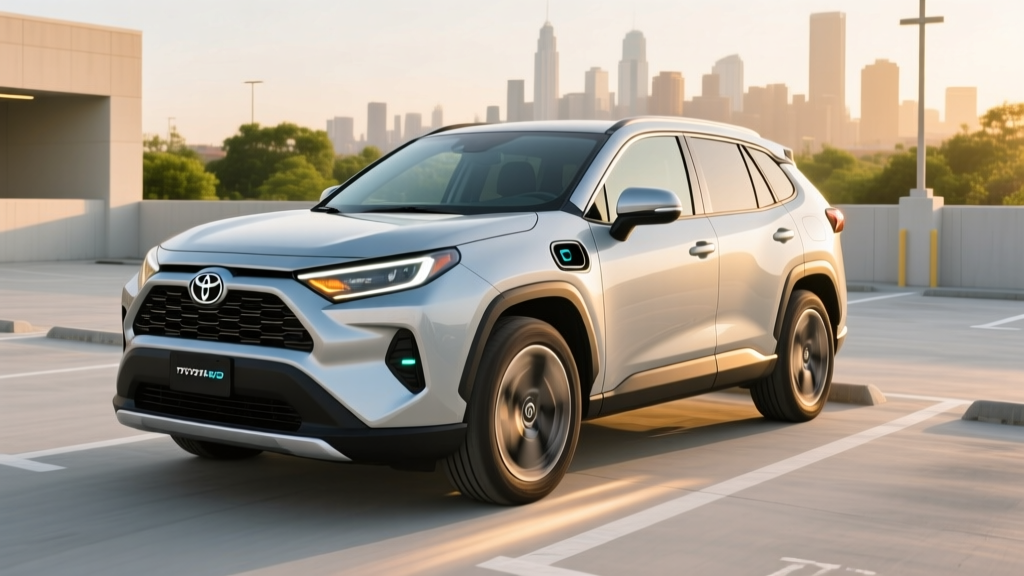
The RAV4 Hybrid remains Toyota's best-selling hybrid and one of the best-selling vehicles in America, period. For 2025, it carries over with the proven 2.5-liter four-cylinder hybrid powertrain producing 219 combined horsepower through Toyota's eCVT (electronically controlled continuously variable transmission).
RAV4 Hybrid MPG: EPA vs Real World
| Metric | EPA Estimate | Real-World Expectation |
|---|---|---|
| City | 41 MPG | 40–44 MPG (hybrids excel in city) |
| Highway | 38 MPG | 34–37 MPG (less regen benefit at steady speed) |
| Combined | 39 MPG | 36–40 MPG |
Toyota hybrids consistently match or exceed their EPA city estimates because stop-and-go driving maximizes regenerative braking and electric-motor usage. Highway driving is where real-world numbers tend to fall slightly short, especially above 70 mph or with roof cargo. In mixed driving with moderate temperatures, owners on fueleconomy.gov frequently report averages between 37 and 42 MPG — right at or above the EPA sticker.
RAV4 Prime (PHEV): Electric-Only Range and Specs
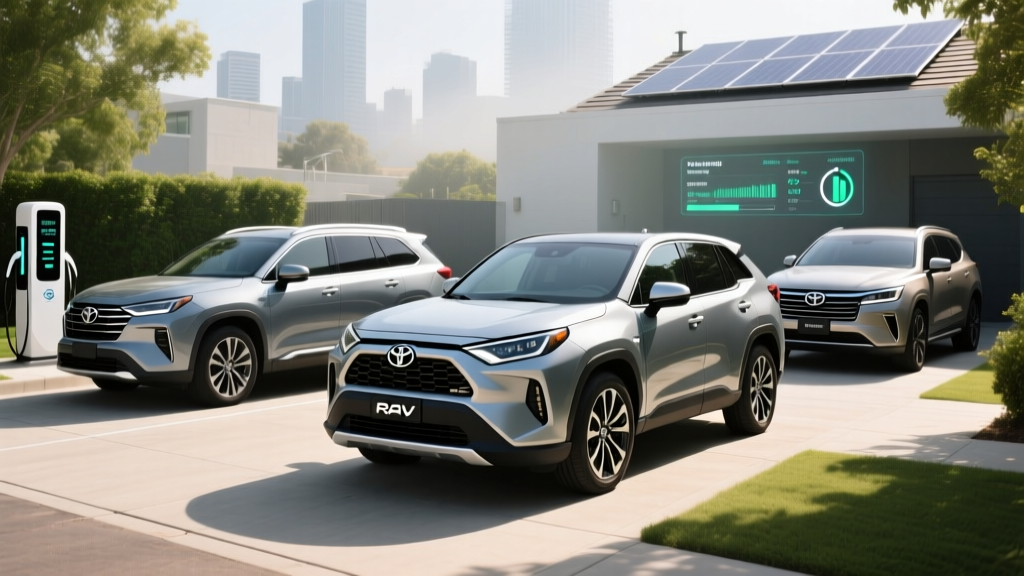
The RAV4 Prime pairs the same 2.5L engine with a larger 18.1 kWh lithium-ion battery and more powerful electric motors for 302 combined horsepower — making it the quickest RAV4 in the lineup (0–60 mph in approximately 5.7 seconds).
| Spec | RAV4 Prime Detail |
|---|---|
| Battery capacity | 18.1 kWh (lithium-ion) |
| EPA electric-only range | 42 miles |
| Real-world electric range | 35–42 miles (temperature/load dependent) |
| Total combined range | ~600 miles (electric + 14.5 gal tank) |
| Level 1 charging (120V) | ~12 hours (full charge) |
| Level 2 charging (240V) | ~2.5 hours (with 6.6 kW onboard charger) |
| DC fast charging | Not available |
| MPG after battery depletes | 38 combined (same as RAV4 Hybrid AWD) |
Critical note: The RAV4 Prime does not support DC fast charging. This is a limitation shared by most PHEVs — the smaller battery and lower charge acceptance rate make DCFC impractical. You'll charge exclusively on Level 1 (standard outlet) or Level 2 (240V home or public station). For a 42-mile electric range, Level 2 overnight charging is more than adequate for daily use.
2025 Highlander Hybrid and Grand Highlander Hybrid: Three-Row Efficiency
For families needing three rows, Toyota offers both the midsize Highlander Hybrid and the larger Grand Highlander Hybrid. Both use a 2.5-liter four-cylinder hybrid system, though the Grand Highlander's tuning differs slightly.
Highlander Hybrid MPG Breakdown
| Trim Configuration | City | Highway | Combined |
|---|---|---|---|
| LE (FWD) | 36 MPG | 35 MPG | 36 MPG |
| LE (AWD) | 35 MPG | 35 MPG | 35 MPG |
| Limited/Platinum (AWD) | 35 MPG | 34 MPG | 35 MPG |
For a three-row SUV weighing over 4,400 lbs, 35–36 MPG combined is exceptional. The non-hybrid Highlander with its turbocharged 2.4L four-cylinder manages roughly 24 MPG combined — meaning the hybrid saves you approximately $500–$700 per year in fuel at current gas prices and 15,000 annual miles, according to EPA estimates on fueleconomy.gov.
Grand Highlander Hybrid: More Space, Similar Efficiency
The Grand Highlander adds roughly 6.5 inches of length for genuinely usable third-row adult seating and more cargo space. Despite the size increase, the standard hybrid powertrain still achieves 36 MPG combined (37 city / 34 highway) in LE trim — a remarkable engineering result.
The Grand Highlander Hybrid MAX, however, is a different animal. This performance-oriented variant pairs a turbocharged 2.4L engine with a hybrid system for 362 hp and a conventional 6-speed automatic (no eCVT). Efficiency drops to 27 MPG combined (26 city / 27 highway). Choose this only if acceleration and towing matter more than fuel savings — it's a niche trim.
Battery Longevity, Warranty, and Replacement Costs
This is one of the strongest hybrid battery warranties in the industry and a key reason Toyota hybrids dominate reliability surveys. Here's what the data shows:
- Typical hybrid battery lifespan: Toyota's nickel-metal hydride (NiMH) and lithium-ion hybrid batteries routinely last 150,000–200,000+ miles before significant degradation. Many first-generation Prius batteries exceeded 200,000 miles.
- Degradation pattern: Unlike full EV batteries, hybrid batteries operate in a narrow state-of-charge window (roughly 40–80% SoC), which dramatically reduces stress and extends cycle life. You'll rarely see a hybrid battery fail from normal aging alone.
- Replacement cost if out of warranty: A new OEM hybrid battery pack for a RAV4 Hybrid runs approximately $3,000–$5,000 installed. For the RAV4 Prime's larger lithium-ion pack, expect $6,000–$8,000. Third-party refurbished packs are available for $1,500–$2,500 for conventional hybrids.
- Individual module replacement: Many independent shops can replace individual failed battery modules (cells) rather than the entire pack, reducing cost to $500–$1,500 for NiMH packs.
The bottom line: hybrid battery replacement is a statistically rare event during normal ownership periods, and Toyota's 10-year/150,000-mile warranty covers the vast majority of ownership timelines. This should not be a primary purchase concern.
Pricing, Trims, and Tax Credit Eligibility
Here's the current pricing landscape for the 2025 Toyota hybrid SUV lineup:
| Model | Trim Range | MSRP Range |
|---|---|---|
| RAV4 Hybrid | LE → Woodland Edition | $33,575 – $39,410 |
| RAV4 Prime (PHEV) | SE → XSE | $44,490 – $48,915 |
| Highlander Hybrid | LE → Platinum | $42,090 – $53,075 |
| Grand Highlander Hybrid | LE → Limited | $47,170 – $55,305 |
| Grand Highlander Hybrid MAX | Limited → Platinum | $54,070 – $59,405 |
Federal Tax Credit: Does a Toyota Hybrid Qualify?
Conventional hybrids (HEV): No. The RAV4 Hybrid, Highlander Hybrid, and Grand Highlander Hybrid do not qualify for the federal §30D Clean Vehicle Credit. This credit applies only to plug-in vehicles (BEVs and PHEVs) meeting battery sourcing, MSRP cap, and buyer income requirements.
RAV4 Prime (PHEV): The RAV4 Prime has historically qualified for a partial or full federal tax credit, but eligibility under current IRS rules depends on several factors that change periodically:
- MSRP cap: SUVs must have an MSRP under $80,000 (all RAV4 Prime trims qualify)
- Buyer income cap: Modified AGI must not exceed $150,000 (single), $225,000 (head of household), or $300,000 (joint)
- Battery sourcing: Critical minerals and battery components must meet escalating domestic/free-trade-partner sourcing percentages. Toyota has worked to localize RAV4 Prime battery supply, but verify current-year eligibility on IRS.gov before purchasing.
- Point-of-sale transfer: As of 2024, you can transfer the credit to the dealer at purchase for an immediate price reduction rather than waiting to claim it on your tax return.
State incentives: Several states offer additional rebates for PHEVs (typically $1,000–$2,500), but these vary by jurisdiction. Check your state's energy or environmental agency website for current programs. Conventional hybrids occasionally qualify for state-level incentives in a handful of states, but this is uncommon.
Crown Signia: The Venza's Replacement
Toyota discontinued the Venza after 2024 and introduced the Crown Signia for 2025 — a lifted wagon/crossover that slots between the RAV4 and Highlander in size. It comes exclusively as a hybrid with a 2.5-liter powertrain producing 240 hp and achieving an EPA-estimated 38 MPG combined (39 city / 37 highway). Starting MSRP is approximately $43,990. It's worth considering if you want something more distinctive than a RAV4 Hybrid but don't need three rows.
Toyota Hybrid vs PHEV vs Full EV: Which Is Right for You?
Choose a Toyota HEV (RAV4 Hybrid, Highlander Hybrid) if:
- You can't charge at home (apartment, street parking, no garage)
- You want maximum simplicity — no plugs, no charging apps, no behavior change
- You want 35–41 MPG with a lower purchase price than a PHEV or EV
- You frequently take long road trips and don't want to plan charging stops
- You can install a Level 2 charger at home and your daily commute is under 40 miles
- You want to drive electric most weekdays but need gas flexibility for weekend trips
- You want the quickest RAV4 (302 hp, 0–60 in ~5.7 seconds) with the lowest daily operating cost
- You may qualify for federal/state PHEV tax credits that narrow the price gap
- You can charge at home and want zero tailpipe emissions and minimal maintenance
- You want the lowest per-mile fuel cost (electricity is typically $0.04–$0.06/mile vs $0.12–$0.18/mile for a hybrid on gas)
- You qualify for the full $7,500 federal EV credit and state incentives
- You're comfortable planning longer trips around DC fast charging infrastructure
Frequently Asked Questions
How many MPG does the 2025 Toyota RAV4 Hybrid actually get?
The EPA rates the RAV4 Hybrid at 41 city / 38 highway / 39 combined. In real-world driving, many owners report matching or exceeding the city figure (40–44 MPG) thanks to regenerative braking. Highway driving at 70+ mph typically yields 34–37 MPG. Annual fuel cost at 15,000 miles and $3.50/gallon averages approximately $1,350.
How far can the RAV4 Prime go on electric only?
The EPA rates the RAV4 Prime at 42 miles of electric-only range. Real-world results vary from about 35 miles (cold weather, highway speeds, heavy cargo) to 42+ miles (moderate temperatures, city driving). Once the battery depletes, the gas engine takes over seamlessly and delivers 38 MPG combined — identical to the standard RAV4 Hybrid AWD.
Is a Toyota hybrid reliable? What about battery replacement cost?
Toyota's hybrid system is among the most proven in the automotive industry, with over 25 years of continuous refinement. The hybrid battery carries a 10-year/150,000-mile warranty. Out-of-warranty replacement for a conventional hybrid battery costs $3,000–$5,000 (OEM) or $1,500–$2,500 (refurbished), but failures before 200,000 miles are uncommon. The hybrid system actually reduces wear on the gas engine and eliminates the traditional starter and alternator — two common failure points in non-hybrid vehicles.
Does a 2025 Toyota hybrid SUV qualify for a federal tax credit?
Conventional Toyota hybrids (RAV4 Hybrid, Highlander Hybrid, Grand Highlander Hybrid) do not qualify for the federal §30D Clean Vehicle Credit. Only the RAV4 Prime PHEV may qualify, subject to current IRS rules on battery sourcing, buyer income limits, and MSRP caps. Always verify eligibility on IRS.gov or with a tax professional before purchasing.
Do I need to plug in a Toyota hybrid?
No — conventional Toyota hybrids (HEV) charge their own batteries through regenerative braking and the gas engine. You never plug them in. Only the RAV4 Prime (PHEV) requires plugging in to access its electric-only range. If you don't plug in a PHEV, it still functions as a regular hybrid, but you lose the efficiency and cost benefits that justify its higher price.
Which 2025 Toyota hybrid SUV is best for families?
For two-row needs, the RAV4 Hybrid offers the best value at $33,575 with 39 MPG combined and strong cargo space (37.6 cu ft behind the rear seats). For three rows, the Grand Highlander Hybrid provides genuine adult-sized third-row seating and 36 MPG combined starting at $47,170. The standard Highlander Hybrid is slightly smaller and less expensive but has a tighter third row best suited for children.