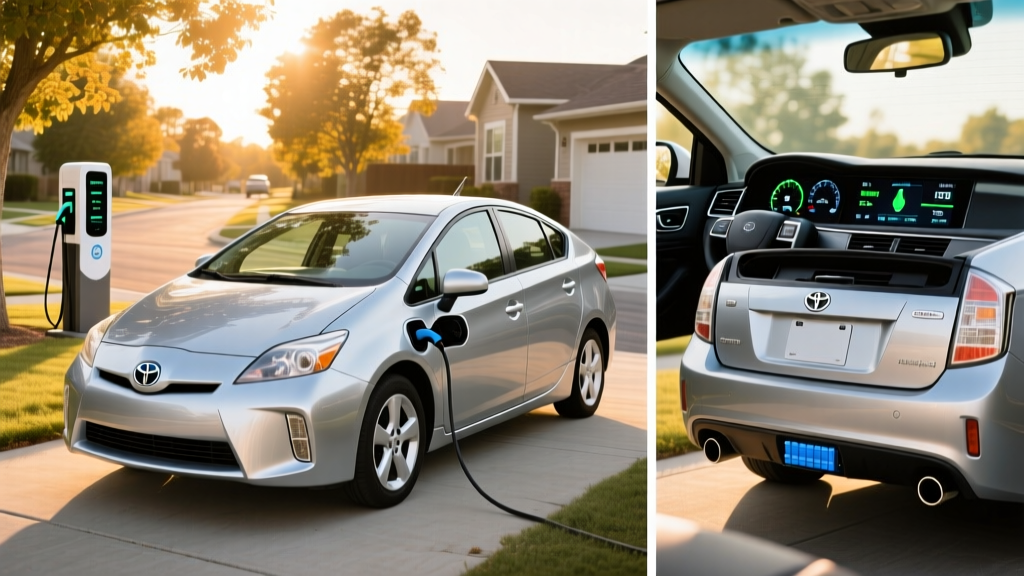
Toyota sells more hybrids than any other automaker in the United States, and the 2025 model year represents its broadest electrified lineup yet. Every core nameplate — from the Corolla to the Sequoia — now offers a hybrid variant, and the fifth-generation Prius continues to set the efficiency benchmark. But with nine distinct hybrid models spanning conventional hybrids (HEVs) and plug-in hybrids (PHEVs), choosing the right one requires understanding real-world MPG, pricing, battery longevity, and whether a plug-in variant makes financial sense for your driving pattern.
This guide breaks down every 2025 Toyota hybrid with exact EPA figures, real-world expectations, powertrain specs, and total cost context so you can match a model to your commute, budget, and charging access.
HEV vs PHEV: Which Toyota Hybrid Architecture Fits You?
Toyota's 2025 hybrid lineup splits into two categories, and confusing them is the most common buyer mistake:
Conventional Hybrid (HEV)
How it works: A gasoline engine paired with one or more electric motors and a small battery (typically 1.0–1.6 kWh). The battery charges through regenerative braking and the engine — you never plug it in.
Advantage: No charging infrastructure needed. Consistently high MPG in city driving where regenerative braking recaptures energy. Lower upfront cost.
2025 Toyota HEVs: Corolla Hybrid, Camry (all trims hybrid-only), RAV4 Hybrid, Highlander Hybrid, Corolla Cross Hybrid, Crown, Sienna, Sequoia, Prius.
Plug-in Hybrid (PHEV)
How it works: A larger battery (13.6–18.1 kWh usable) that charges via a plug and delivers 30–44 miles of pure electric driving before the gasoline engine engages.
Advantage: Daily commutes under ~40 miles can run entirely on electricity. Longer road trips use the hybrid system seamlessly. Eligible for the §30D federal tax credit (up to $7,500) if sourcing and income requirements are met.
2025 Toyota PHEVs: Prius Prime, RAV4 Prime.
The decision framework is straightforward: If you can charge at home or work and your daily round-trip commute is under 40 miles, a PHEV eliminates most gasoline use. If you lack reliable charging access or regularly drive long distances, an HEV delivers excellent efficiency without lifestyle changes.
Complete 2025 Toyota Hybrid MPG & Specs
The table below compiles EPA-rated fuel economy, powertrain output, and starting MSRP for every 2025 Toyota hybrid. All MPG figures are from fueleconomy.gov.
| Model | Type | Combined HP | EPA City MPG | EPA Hwy MPG | EPA Combined MPG | Starting MSRP |
|---|---|---|---|---|---|---|
| Prius (LE FWD) | HEV | 194 hp | 57 | 56 | 57 | $28,350 |
| Prius (XLE/Limited AWD) | HEV | 196 hp | 53 | 54 | 54 | $31,695 |
| Prius Prime (SE) | PHEV | 220 hp | 127 MPGe | — | 44 mi EV + 48 MPG | $33,445 |
| Corolla Hybrid (LE AWD) | HEV | 138 hp | 53 | 46 | 50 | $24,050 |
| Camry Hybrid (LE FWD) | HEV | 225 hp | 53 | 50 | 51 | $29,495 |
| Camry Hybrid (AWD) | HEV | 232 hp | 51 | 49 | 50 | $30,895 |
| RAV4 Hybrid (LE AWD) | HEV | 219 hp | 41 | 38 | 39 | $33,855 |
| RAV4 Prime (SE AWD) | PHEV | 302 hp | 94 MPGe | — | 42 mi EV + 38 MPG | $44,515 |
| Corolla Cross Hybrid (AWD) | HEV | 196 hp | 46 | 43 | 44 | $30,185 |
| Crown (XLE) | HEV | 236 hp | 42 | 41 | 41 | $42,535 |
| Highlander Hybrid (LE AWD) | HEV | 243 hp | 35 | 35 | 35 | $42,090 |
| Sienna (LE FWD) | HEV | 245 hp | 36 | 36 | 36 | $38,085 |
| Sequoia (SR5 RWD) | HEV | 437 hp | 21 | 24 | 22 | $62,895 |
Note: For the 2025 model year, the Camry is sold exclusively as a hybrid — Toyota discontinued the gasoline-only Camry after 2024. All RAV4 Hybrid and RAV4 Prime trims come standard with electronic AWD.
PHEV Deep Dive: Prius Prime and RAV4 Prime Electric Range & Charging
Toyota's two plug-in hybrids are the models buyers most often research before committing, because the premium over their HEV siblings needs to be justified by electric-only commuting. Here are the exact numbers:
| Spec | Prius Prime (SE) | Prius Prime (XSE/XSE Premium) | RAV4 Prime (SE) | RAV4 Prime (XSE) |
|---|---|---|---|---|
| Battery (usable) | 13.6 kWh | 13.6 kWh | 18.1 kWh | 18.1 kWh |
| EPA Electric Range | 44 miles | 40 miles | 42 miles | 42 miles |
| Total Combined Range | ~480 miles | ~440 miles | ~600 miles | ~600 miles |
| Level 1 Charge (120V) | ~4 hours | ~4 hours | ~12 hours | ~12 hours |
| Level 2 Charge (240V) | ~2 hours | ~2 hours | ~2.5 hours (6.6 kW) | ~2.5 hours (6.6 kW) |
| DC Fast Charge | No | No | No | No |
| Combined System HP | 220 hp | 220 hp | 302 hp | 302 hp |
| 0–60 mph | 6.6 sec | 6.6 sec | 5.7 sec | 5.7 sec |
Critical note on DC fast charging: Neither the Prius Prime nor the RAV4 Prime supports DC fast charging. Both are limited to Level 2 (240V) AC charging at a maximum of 6.6 kW. For daily home charging, this is perfectly adequate — a Level 2 home charger replenishes either battery overnight. But it means you cannot use public DC fast-charging stations (Electrify America, EVgo, Tesla Supercharger) to top up on road trips. Once the electric range is depleted, both vehicles seamlessly switch to hybrid mode.
Real-world electric range: The EPA electric range figures assume moderate temperatures and mixed driving. In cold weather (below 35°F), expect a 15–25% reduction in electric-only miles due to cabin heating demand and reduced battery efficiency. The Prius Prime SE's 44-mile EPA rating may drop to 33–37 miles in winter conditions. Highway-speed electric driving also depletes the battery faster than city driving due to aerodynamic drag.
Real-World MPG: What Toyota Hybrids Actually Deliver
Toyota's hybrid system — branded as Toyota Hybrid System (THS) in its fifth generation for most 2025 models — is optimized for city and suburban driving. The regenerative braking system recaptures kinetic energy during deceleration, and the engine shuts off at stops, which is where conventional gasoline vehicles waste the most fuel.
Where Toyota Hybrids Exceed EPA
- City driving: Expect 2–5 MPG above EPA city ratings in stop-and-go traffic. The Camry Hybrid's EPA city rating of 53 MPG can reach 55–58 MPG in dense urban driving with frequent stops.
- Warm weather: Battery efficiency peaks between 65–85°F. Spring and fall commutes consistently beat EPA figures.
- Flat terrain: Minimal elevation change lets the hybrid system optimize engine load.
Where Toyota Hybrids Fall Below EPA
- Sustained highway speeds above 75 mph: Aerodynamic drag dominates, and the hybrid advantage narrows. Expect 3–6 MPG below EPA highway on fast interstates.
- Cold weather (below 30°F): Engine runs longer to heat the cabin and warm the catalytic converter. Expect a 10–15% MPG penalty.
- Mountain driving: Sustained grades force the engine to work harder; regenerative braking recovers some energy on descents but not enough to offset climbing losses.
Practical expectation: For a mixed commute of 60% city / 40% highway, most Toyota HEV owners report fuel economy within ±2 MPG of the EPA combined figure. The Prius LE's 57 MPG combined is one of the few EPA ratings that owners routinely match or slightly exceed in real-world use, per aggregated data on fueleconomy.gov's My MPG tracker.
Battery Warranty, Lifespan & Replacement Costs
Toyota Hybrid Battery Warranty (2025 models): 10 years or 150,000 miles, whichever comes first. This applies to all HEV and PHEV models and covers battery capacity loss below a defined threshold (typically 60–70% of original capacity, though Toyota does not publish the exact percentage publicly).
Powertrain warranty: 5 years / 60,000 miles for the hybrid transaxle, inverter, and related components.
Toyota's hybrid battery longevity is among the most proven in the industry. The Prius has been sold in the US since 2001, and real-world data shows:
- Typical HEV battery lifespan: 12–15 years or 150,000–200,000 miles before significant degradation. Many original Prius batteries have exceeded 200,000 miles.
- PHEV battery degradation: The larger batteries in the Prius Prime and RAV4 Prime experience less stress per cycle because they operate in a shallower state-of-charge window. Long-term data from the Prius Prime (introduced for 2017) shows minimal degradation in the first 5 years.
- Chemistry: Toyota HEVs use nickel-metal hydride (NiMH) batteries in most models, while the Prius Prime and RAV4 Prime use lithium-ion (NMC chemistry). Both chemistries have proven durable in Toyota's thermal management systems.
Replacement cost if out of warranty:
- Prius / Corolla Hybrid / Camry Hybrid battery: $2,000–$4,000 (refurbished or new OEM)
- RAV4 Hybrid battery: $3,000–$5,000
- Prius Prime battery: $5,000–$7,000
- RAV4 Prime battery: $6,000–$9,000
- Highlander Hybrid / Sienna battery: $3,000–$5,000
Third-party refurbishers offer hybrid battery replacements at 30–50% below OEM pricing, and individual cell replacement (replacing only degraded modules) is available for $500–$1,500 at specialized hybrid repair shops.
Tax Credits & Incentives for 2025 Toyota Hybrids
Federal tax credit eligibility under IRS §30D is a common source of confusion for Toyota hybrid buyers. Here is the precise breakdown:
- Conventional HEVs (Prius, Camry Hybrid, RAV4 Hybrid, etc.): Do NOT qualify for the §30D federal clean vehicle credit. This credit applies only to plug-in vehicles (BEVs and PHEVs) with sufficient battery capacity and domestic battery/mineral sourcing.
- Prius Prime: Qualifies for up to $3,750 in federal tax credit (the PHEV receives a reduced credit compared to full BEVs because its battery is smaller). Eligibility depends on the buyer's modified adjusted gross income (AGI caps: $150,000 single / $300,000 joint), the vehicle's MSRP (must be under $55,000 for sedans), and battery component/critical mineral sourcing requirements that tighten annually.
- RAV4 Prime: Eligible for up to $7,500 in federal tax credit, subject to the same income caps and an MSRP cap of $80,000 for SUVs. However, the critical mineral and battery component sourcing requirements under the Inflation Reduction Act have reduced the credit amount for many PHEVs. Check the fueleconomy.gov tax credit lookup for the current credit amount, as it changes based on sourcing compliance.
- Point-of-sale transfer: As of 2024, eligible buyers can transfer the §30D credit to the dealer at purchase, receiving the credit as an immediate price reduction rather than waiting to claim it on their tax return. This applies to both the Prius Prime and RAV4 Prime if eligibility requirements are met.
State incentives: Several states offer additional rebates or HOV lane access for PHEVs. California's CVRP program, for example, has historically offered up to $1,000–$2,000 for qualifying PHEVs, though funding availability varies. Check your state's energy office or DMV for current programs.
Which 2025 Toyota Hybrid Should You Buy?
Choose the Prius LE if: You want maximum fuel efficiency (57 MPG combined), have a sub-$30,000 budget, and primarily drive solo or with one passenger. The Prius's 20.5 cu-ft cargo area is limited, but its efficiency is unmatched.
Choose the Prius Prime if: Your daily commute is under 40 miles round-trip, you can install a Level 2 home charger, and you want to drive mostly on electricity while retaining gasoline flexibility for road trips. The $3,750 potential tax credit narrows the price gap with the standard Prius.
Choose the Camry Hybrid if: You need a midsize sedan with more interior space, a smoother ride, and 225–232 hp. The Camry Hybrid's 51 MPG combined is nearly identical to the Prius in a larger, more comfortable package. Best for families who prefer sedans over SUVs.
Choose the RAV4 Hybrid if: You need an SUV with AWD, 37.5 cu-ft of cargo space, and strong resale value. The 39 MPG combined is excellent for the segment, though highway-heavy drivers will see closer to 35 MPG.
Choose the RAV4 Prime if: You want the most powerful RAV4 (302 hp, 5.7-sec 0–60), 42 miles of electric range, and potential $7,500 tax credit eligibility. At $44,515 base, it's the premium choice — but the tax credit and fuel savings can make it cost-competitive with the RAV4 Hybrid over 5 years of ownership.
Choose the Highlander Hybrid or Sienna if: You need three rows of seating. The Sienna (hybrid-only since 2023) delivers 36 MPG in a minivan — a remarkable figure for a vehicle that seats eight. The Highlander Hybrid offers similar efficiency in an SUV form factor.
Choose the Sequoia if: You need full-size SUV capability (9,000-lb towing) and accept 22 MPG combined as the trade-off. The i-FORCE MAX hybrid powertrain produces 437 hp and 583 lb-ft of torque.
Hybrid vs PHEV vs Full EV: The Honest Comparison
The right choice depends on three variables: charging access, daily mileage, and budget.
| Factor | Toyota HEV | Toyota PHEV | Full EV (e.g., bZ4X) |
|---|---|---|---|
| Home charging needed? | No | Recommended (Level 2) | Essential (Level 2) |
| Daily range anxiety | None | Minimal (gas backup) | Moderate (planning required for trips) |
| Fuel cost per mile | ~$0.09 (at $3.30/gal, 36 MPG) | ~$0.04 electric / $0.09 gas | ~$0.04 (at $0.14/kWh) |
| Maintenance | Standard (oil changes, brakes) | Standard (less engine wear if EV-commuting) | Minimal (no oil, fewer brake replacements) |
| Federal tax credit | None | Up to $3,750–$7,500 | Up to $7,500 |
| Best for | No charging access, long commutes | Home charging + short commute + road trips | Home charging + short/moderate commute |
If you cannot charge at home and regularly drive more than 60 miles per day, a Toyota HEV is the pragmatic choice — you get 35–57 MPG without any infrastructure investment. If you can charge at home and want to minimize gasoline consumption while retaining road-trip flexibility, a PHEV is the optimal bridge. If your daily driving is under 250 miles and you have reliable home charging, a full EV offers the lowest operating cost, but Toyota's current BEV offering (the bZ4X at 252 miles EPA range) trails competitors in range and charging speed.
Frequently Asked Questions
How many MPG does the 2025 Toyota Prius get?
The 2025 Prius LE (FWD) is EPA-rated at 57 city / 56 highway / 57 combined MPG. The AWD XLE and Limited trims are rated at 53/54/54 MPG. In real-world city driving with frequent stops, many owners report 58–62 MPG. Highway cruising at 75+ mph typically yields 50–53 MPG.
How far can the RAV4 Prime go on electric only?
The EPA rates the RAV4 Prime at 42 miles of electric-only range. In real-world conditions, expect 38–42 miles in warm weather and 30–35 miles in cold weather (below 35°F) when cabin heating draws additional power. Highway-speed electric driving also reduces range to approximately 32–36 miles.
Do Toyota hybrids need to be plugged in?
No. Conventional Toyota hybrids (HEVs) — including the Prius, Camry Hybrid, RAV4 Hybrid, Highlander Hybrid, Sienna, and Sequoia — never need to be plugged in. They charge their batteries through regenerative braking and the gasoline engine. Only the Prius Prime and RAV4 Prime (PHEVs) benefit from being plugged in to access their electric-only range.
Is the 2025 Toyota hybrid lineup reliable?
Toyota's hybrid system has over two decades of proven reliability. The fifth-generation THS used in most 2025 models has fewer moving parts than a conventional automatic transmission (no torque converter, no traditional gear shifts). Consumer Reports and J.D. Power consistently rank Toyota hybrids among the most reliable vehicles in their segments. The hybrid battery is warranted for 10 years / 150,000 miles.
What does it cost to replace a Toyota hybrid battery?
Out-of-warranty replacement costs range from $2,000–$4,000 for a Prius or Camry Hybrid to $6,000–$9,000 for a RAV4 Prime. However, most Toyota hybrid batteries last 150,000–200,000+ miles, and many vehicles reach end-of-life before the battery needs replacement. Refurbished batteries and individual cell replacement services offer lower-cost alternatives at $500–$2,500.
Does any 2025 Toyota hybrid qualify for a federal tax credit?
Only the plug-in hybrids — the Prius Prime (up to $3,750) and RAV4 Prime (up to $7,500) — may qualify for the §30D federal clean vehicle credit. Conventional hybrids do not qualify. Eligibility depends on buyer income (AGI caps: $150K single / $300K joint), vehicle MSRP limits, and battery sourcing requirements. Verify current eligibility on fueleconomy.gov and consult a tax professional, as sourcing rules change annually.
Is a Toyota hybrid better than a full EV?
It depends on your situation. A Toyota HEV or PHEV is better if you lack home charging, regularly drive long distances, or live in an area with sparse public charging infrastructure. A full EV is better if you have home charging, drive under 250 miles daily, and want the lowest per-mile fuel cost and minimal maintenance. Toyota's current BEV (bZ4X) has limited range (252 mi EPA) and slower charging than competitors, making Toyota's hybrids the stronger choice in their lineup for most buyers in 2025.