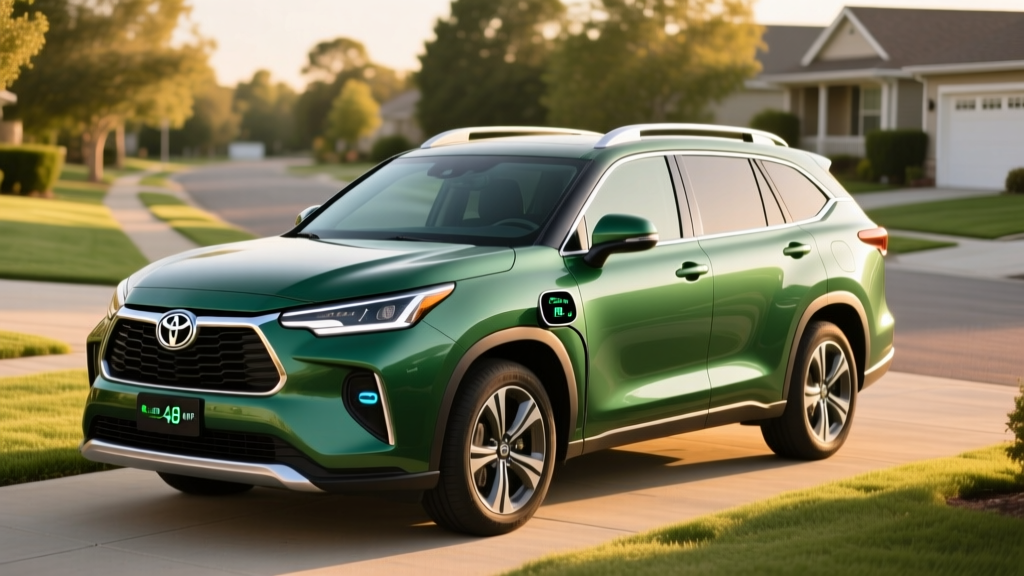
The three-row hybrid SUV segment doesn't have many players, and the 2025 Toyota Highlander Hybrid remains the default choice for families who want SUV space without the fuel bill of a body-on-frame truck. But with Toyota offering both a conventional hybrid (HEV) and a plug-in hybrid variant in the Grand Highlander lineup, buyers need clarity on what the standard Highlander Hybrid actually delivers — and whether its EPA numbers hold up once you leave the test loop.
This guide breaks down the 2025 Toyota Highlander Hybrid MPG ratings, powertrain details, real-world efficiency expectations, battery longevity, and how it stacks up against going full electric or sticking with a plug-in hybrid alternative.
EPA MPG Ratings: What the Sticker Says
The 2025 Toyota Highlander Hybrid uses Toyota's fourth-generation hybrid system paired with a 2.5-liter inline-four engine and two electric motors (front and rear for AWD models). The result is a powertrain rated at 243 combined horsepower and EPA fuel economy figures that put it at the top of the midsize three-row SUV class.
| Configuration | City MPG | Highway MPG | Combined MPG |
|---|---|---|---|
| FWD (LE trim) | 36 | 35 | 36 |
| AWD (all other trims) | 35 | 34 | 35 |
Source: fueleconomy.gov
Those numbers are class-leading. The closest rival, the Kia Sorento Hybrid AWD, returns 34 combined MPG. The Honda Pilot, which does not offer a hybrid variant, sits at 22 combined with its V6.
Real-World MPG: Highway, City, and Cold Weather
EPA figures for hybrids tend to be more achievable than those for conventional gas vehicles because the test cycle's stop-and-go segments play to the hybrid system's strengths — regenerative braking and electric-only low-speed driving. That said, real-world results depend heavily on your driving mix.
- City-dominant commuting: 34–38 MPG (hybrids often exceed EPA city figures in low-speed traffic with frequent regen opportunities)
- Highway cruising (70–80 mph): 28–32 MPG (aerodynamic drag and sustained engine load reduce hybrid advantage)
- Mixed driving (50/50): 32–35 MPG (closely tracks EPA combined)
- Cold weather (below 30°F): 27–31 MPG (engine runs more to heat cabin and maintain battery temperature)
The key insight: if your daily driving is mostly suburban and city at speeds under 45 mph, expect to beat the EPA combined number. If you spend most of your miles at interstate speeds, plan on 3–5 MPG below the sticker. This is the opposite of gas-only vehicles, which typically do better on the highway than in town.
HEV vs. PHEV: Understanding What the Highlander Hybrid Is (and Isn't)
A critical distinction for shoppers: the 2025 Toyota Highlander Hybrid is a conventional hybrid (HEV). It cannot be plugged in. It has no electric-only driving range to speak of (roughly 1–2 miles at very low speeds). The small 1.6 kWh nickel-metal hydride battery charges exclusively through regenerative braking and the gasoline engine.
Toyota does not currently offer a plug-in hybrid (PHEV) version of the standard Highlander. If you want a Toyota PHEV with three rows, you'd need to look at the Grand Highlander Hybrid (which is also an HEV, not a PHEV) or the RAV4 Prime (a two-row PHEV with 42 miles of electric range). For a true three-row PHEV, competitors like the Mazda CX-90 PHEV (26 miles electric-only) or the Jeep Grand Cherokee 4xe (25 miles) are the current options.
| Factor | HEV (Highlander Hybrid) | PHEV (e.g., CX-90 PHEV) | BEV (e.g., Kia EV9) |
|---|---|---|---|
| Plug-in required? | No | Yes (for EV range) | Yes |
| Electric-only range | ~1 mi (low speed) | 25–42 mi typical | 250–310 mi |
| Home charging needed? | No | Recommended (Level 2) | Essential (Level 2) |
| Federal tax credit (§30D) | No | Up to $7,500* | Up to $7,500* |
| Best for | No home charging access; long road trips | Short commute + road trip flexibility | Home charging + mostly under 250 mi/day |
*§30D credit eligibility depends on MSRP caps ($80,000 for SUVs), buyer income limits, and battery component/critical mineral sourcing. Verify at irs.gov.
Powertrain and Performance Specs
| Spec | Value |
|---|---|
| Engine | 2.5L inline-4 Atkinson cycle |
| Combined system horsepower | 243 hp |
| Electric motors | Front (134 hp) + Rear (54 hp, AWD only) |
| Transmission | eCVT (planetary gearset, no fixed gears) |
| Hybrid battery | 1.6 kWh NiMH (sealed, self-charging) |
| 0–60 mph | ~7.8 seconds |
| Towing capacity | 3,500 lbs |
| Cargo volume (behind 3rd row) | 16.1 cu ft |
| Drivetrain | FWD (LE) or electronic AWD |
The 243 hp output is modest for a 4,500-lb three-row SUV, and the 7.8-second 0–60 time reflects that. This is not a performance vehicle. The eCVT delivers smooth, linear acceleration without the gear hunting of a conventional automatic, but passing maneuvers at highway speed require planning. The trade-off for that restraint is the 35 MPG combined figure — a direct result of the Atkinson-cycle engine's thermal efficiency and the hybrid system's ability to shut off the engine at stops and low loads.
Pricing, Trims, and Tax Credit Eligibility
The 2025 Highlander Hybrid is available across four trims. All trims except the LE come standard with AWD:
- LE: $41,670 (FWD) / $43,270 (AWD)
- XLE: $46,170
- Limited: $50,575
- Platinum: $54,070
Federal tax credit: The Highlander Hybrid is a conventional HEV and does not qualify for the IRS §30D plug-in electric vehicle credit. That credit is reserved for PHEVs and BEVs with battery capacities of at least 7 kWh. The older "Qualified Hybrid Motor Vehicle" credit was phased out years ago and is no longer available.
Some states may offer rebates or HOV lane access for hybrids, but these vary by jurisdiction. Check your state's energy office or DMV for current programs.
Battery Warranty, Reliability, and Replacement Cost
- Coverage: 10 years / 150,000 miles (whichever comes first)
- What's covered: Hybrid battery pack, hybrid control module, inverter
- Capacity threshold: Toyota covers defects and premature failure; unlike BEVs, there is no published minimum capacity retention percentage for HEVs
- Transferable: Yes, to subsequent owners
Toyota's hybrid reliability record is the strongest in the industry. The Highlander Hybrid's powertrain shares architecture with the RAV4 Hybrid and Camry Hybrid — systems that routinely exceed 200,000 miles with original hybrid batteries. The 1.6 kWh NiMH pack is small, chemically stable, and never deeply cycled (the system maintains a state-of-charge window between roughly 40% and 80%), which dramatically reduces degradation stress.
Battery replacement cost: If the hybrid battery fails outside warranty, a new OEM replacement runs approximately $3,000–$4,500 including labor. Refurbished or reconditioned packs are available for $1,500–$2,500. Individual module replacement (only the failed cells) can bring costs down to $800–$1,500 at a hybrid specialist shop.
For context, a BEV battery replacement (e.g., a 77 kWh pack in a comparable electric SUV) costs $12,000–$20,000+ out of warranty. The Highlander Hybrid's small, low-stress battery is one of the lowest-risk components on the vehicle.
Who Should Choose the Highlander Hybrid vs. a PHEV or Full EV?
- You lack access to home or workplace Level 2 charging
- You regularly take road trips over 300 miles
- You want three rows and 35 MPG without behavioral changes
- You live in an area with sparse DC fast-charging infrastructure
- You want the lowest-complexity electrified option
- You have home Level 2 charging and a commute under 30 miles
- You want to drive on electricity daily and use gas only for road trips (PHEV)
- You qualify for the full $7,500 §30D credit, which closes the price gap
- You want zero tailpipe emissions in daily driving
- You're willing to plan charging stops on longer trips (BEV)
Frequently Asked Questions
How many MPG does the 2025 Toyota Highlander Hybrid get?
The EPA rates the Highlander Hybrid AWD at 35 city / 34 highway / 35 combined MPG. The FWD LE trim gets 36 combined. In real-world driving, expect 32–38 MPG depending on your speed profile and climate.
Does the Highlander Hybrid need to be plugged in?
No. The Highlander Hybrid is a conventional hybrid (HEV). It charges its 1.6 kWh battery through regenerative braking and the gasoline engine. There is no plug, no charging cable, and no electric-only range beyond about 1 mile at parking-lot speeds.
Does the 2025 Highlander Hybrid qualify for a federal tax credit?
No. The IRS §30D credit applies only to plug-in electric vehicles (PHEVs and BEVs) with battery packs of at least 7 kWh. The Highlander Hybrid's 1.6 kWh pack does not qualify. Some state-level incentives may apply — check your local energy office.
How long will the Highlander Hybrid battery last?
Toyota warranties the hybrid battery for 10 years / 150,000 miles. In practice, Toyota's NiMH hybrid batteries routinely last 150,000–250,000+ miles. The system's shallow charge cycling (never fully draining or fully charging) is the primary reason for this longevity.
Is the Highlander Hybrid underpowered?
At 243 hp and a 7.8-second 0–60, the Highlander Hybrid is adequate for merging and passing but not quick. If performance is a priority, the turbocharged gas Highlander (265 hp) or a BEV like the Kia EV9 GT-Line (379 hp, 4.9-second 0–60) offer substantially more power. The hybrid's advantage is efficiency, not acceleration.
How does the Highlander Hybrid compare to the Grand Highlander Hybrid?
The Grand Highlander Hybrid uses a similar hybrid powertrain but in a larger body with more third-row and cargo space. Its EPA rating is 34 combined MPG (Hybrid MAX variant: 27 combined). If third-row usability is your top priority, the Grand Highlander is the better fit. If you want maximum MPG in a three-row package, the standard Highlander Hybrid wins by 1–2 MPG.