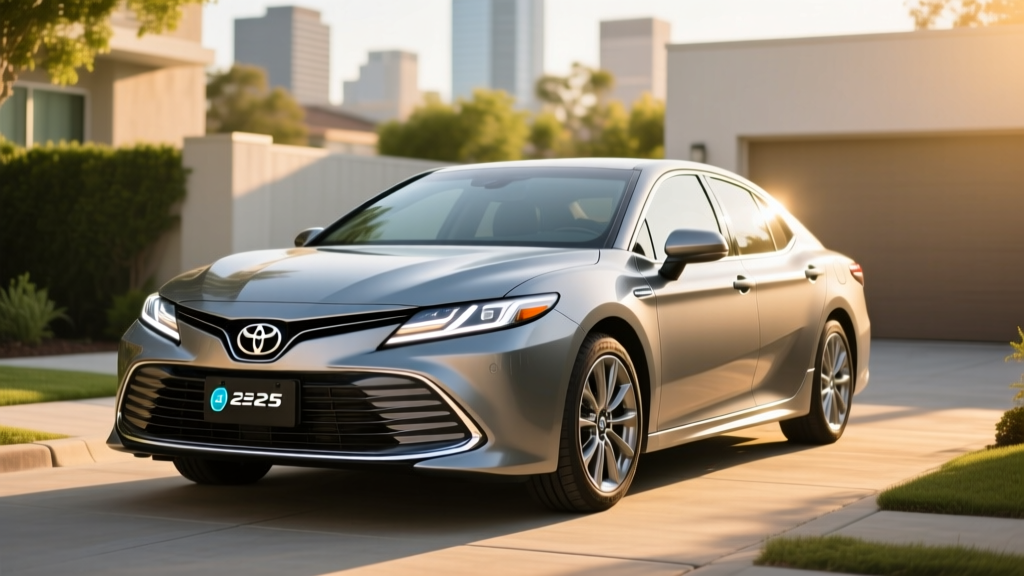
The 2025 Toyota Camry arrived with a significant powertrain shift: every model in the lineup is now a hybrid. Gone are the four-cylinder and V6 gas-only variants, replaced by Toyota's fifth-generation Hybrid Electric Vehicle (HEV) system. For buyers researching the 2025 Toyota Camry Hybrid MPG official figures, the numbers are compelling — up to 51 MPG combined — but the real story is how this sedan delivers those numbers in everyday driving without requiring a plug, a lifestyle change, or a charging installation.
This guide breaks down every official EPA fuel economy rating by trim and drivetrain, pairs them with real-world expectations, and explains where the Camry Hybrid fits against plug-in hybrids and full battery-electric vehicles in 2025.
Official EPA MPG Ratings by Trim and Drivetrain
The 2025 Camry Hybrid is offered in three trims — LE, SE, and XLE — with either front-wheel drive (FWD) or all-wheel drive (AWD). The FWD models use a single electric motor on the front axle, while AWD adds a second rear-mounted electric motor for traction (not a mechanical driveshaft). This affects efficiency slightly.
| Trim / Drivetrain | City MPG | Highway MPG | Combined MPG | Annual Fuel Cost* |
|---|---|---|---|---|
| LE FWD | 53 | 50 | 51 | $1,050 |
| SE FWD | 48 | 47 | 47 | $1,150 |
| XLE FWD | 48 | 47 | 47 | $1,150 |
| LE AWD | 51 | 49 | 50 | $1,050 |
| SE AWD | 47 | 46 | 46 | $1,150 |
| XLE AWD | 47 | 46 | 46 | $1,150 |
*Annual fuel cost estimated by EPA based on 15,000 miles/year, 55% city driving, and $3.50/gallon regular unleaded. Actual costs vary by region and driving habits.
The LE trim's advantage comes from lighter 16-inch wheels, lower rolling-resistance tires, and the absence of sport-tuned suspension components that add weight and drag. If maximum MPG is the priority, the LE FWD at 51 combined is the efficiency leader in the lineup — and one of the most efficient midsize sedans sold in the United States.
Real-World MPG: What to Actually Expect
One of the defining characteristics of Toyota's hybrid system is that real-world city driving often meets or exceeds the EPA city sticker. This is the opposite of most conventional gas cars, which typically fall short of their EPA city rating in stop-and-go traffic.
The reason is regenerative braking. In city driving, the Camry Hybrid recaptures kinetic energy during deceleration, stores it in the battery, and uses it to launch from stops on electric power alone. The gas engine shuts off at idle and during low-speed coasting. The more you stop, the more energy you recapture.
- City (stop-and-go): 50–55 MPG (often meets or beats EPA's 53)
- Highway (70–80 mph sustained): 42–47 MPG (below EPA's 50 due to aero drag)
- Mixed daily commute: 46–51 MPG
- Cold weather (below 30°F): 40–45 MPG (engine runs more for cabin heat)
Highway driving is where hybrids lose their advantage relative to the EPA sticker. At sustained 75–80 mph speeds, the Camry's gasoline engine does most of the work, and aerodynamic drag increases with the square of velocity. Expect highway-only road trips to return mid-to-upper 40s, not low 50s. For drivers whose commute is 90% highway, the gap between EPA and real-world will be more noticeable than for city-dominant drivers.
Cold weather also reduces hybrid efficiency. The gasoline engine must run longer to warm the catalytic converter and heat the cabin, reducing the time the car spends in electric-only mode. Owners in northern climates typically see a 10–15% MPG drop in winter months.
Powertrain Specs: How the Fifth-Gen Hybrid System Works
| Specification | Detail |
|---|---|
| Engine | 2.5L inline-4 (Dynamic Force, Atkinson cycle) |
| Engine Power | 184 hp / 163 lb-ft torque |
| Front Electric Motor | 100 kW (134 hp) |
| Rear Electric Motor (AWD only) | 30 kW (40 hp) |
| Combined System Horsepower | 225 hp (FWD) / 232 hp (AWD) |
| Transmission | eCVT (planetary gearset, not a belt-driven CVT) |
| Hybrid Battery | Lithium-ion, ~1.6 kWh (sealed, self-charging) |
| 0–60 mph | ~7.1 seconds (FWD), ~6.9 seconds (AWD) |
| Fuel Tank | 13.2 gallons |
| Total Driving Range | ~610–670 miles (depending on trim) |
| Fuel Requirement | Regular unleaded (87 octane) |
The combined system horsepower of 225–232 hp represents a meaningful increase over the previous-generation Camry Hybrid (208 hp), giving the 2025 model confident highway merging and passing power. Toyota's eCVT is a planetary gearset — not the rubber-band-feel belt-driven CVT found in some competitors — and it delivers smooth, direct acceleration without the droning associated with traditional continuously variable transmissions.
The ~1.6 kWh lithium-ion hybrid battery is small by EV standards, but it doesn't need to be large. It buffers energy from regenerative braking and provides short bursts of electric-only propulsion at low speeds. It is never plugged in — the system manages charge automatically.
Camry Hybrid (HEV) vs. Plug-In Hybrid (PHEV) vs. Full EV
A common point of confusion is the difference between a conventional hybrid like the Camry and a plug-in hybrid or full electric vehicle. The distinction matters for your daily routine, your budget, and your charging access.
| Feature | HEV (Camry Hybrid) | PHEV (e.g., Toyota Prius Prime) | BEV (e.g., Tesla Model 3) |
|---|---|---|---|
| Plugs in? | No — self-charging | Yes — Level 1/2 | Yes — Level 1/2/DC fast |
| Electric-only range | ~1 mile at low speed | 35–44 miles (Prius Prime) | 250–360+ miles |
| Total range | 610–670 miles | 400–440+ miles (electric + gas) | 250–360+ miles |
| Home charging needed? | No | Recommended for EV-mode benefit | Essential |
| Federal tax credit | Not eligible (§30D) | Up to $7,500 (if eligible) | Up to $7,500 (if eligible) |
| Best for | No plug access, long trips | Short commute + home plug | Home charging + daily EV driving |
The Camry Hybrid is a conventional HEV. It does not plug in, has no meaningful electric-only range, and does not qualify for the federal §30D tax credit. Its advantage is simplicity: you fuel it like any gas car and get dramatically better MPG without changing your habits.
If you have access to home or workplace charging and a commute under 40 miles, a PHEV like the Toyota Prius Prime (44 miles electric-only, EPA-rated) lets you drive most weekdays without burning gas. If your commute is longer or you lack charging access, the Camry Hybrid's 600+ mile total range and no-plug convenience make it the more practical choice.
A full BEV eliminates gasoline entirely but requires reliable home or workplace charging and a willingness to plan around DC fast-charging on road trips. The Camry Hybrid occupies the middle ground: significant fuel savings with zero infrastructure requirements.
Pricing, Trims, and Tax Credit Eligibility
The 2025 Camry Hybrid starts at an MSRP of approximately $28,700 for the LE FWD, rising to roughly $35,000 for a fully optioned XLE AWD. This represents a modest price increase over the previous generation, justified by the standard hybrid powertrain (previously an upcharge option), updated infotainment, and Toyota Safety Sense 3.0.
| Trim | Drivetrain | Approx. MSRP |
|---|---|---|
| LE | FWD | $28,700 |
| LE | AWD | $30,200 |
| SE | FWD | $30,900 |
| SE | AWD | $32,400 |
| XLE | FWD | $33,200 |
| XLE | AWD | $34,700 |
Despite the lack of a federal credit, the Camry Hybrid's fuel savings are significant. At 15,000 miles per year and $3.50/gallon, the LE FWD's estimated annual fuel cost of ~$1,050 compares to roughly $1,750 for a comparable 30 MPG combined gas midsize sedan — a savings of approximately $700 per year or $3,500 over five years.
Battery Warranty, Reliability, and Replacement Cost
- Hybrid battery: 10 years / 150,000 miles (whichever comes first) — all 50 states
- Hybrid system components: 8 years / 100,000 miles
- Powertrain (engine, transaxle): 5 years / 60,000 miles
- Basic bumper-to-bumper: 3 years / 36,000 miles
Toyota's hybrid battery warranty was extended to 10 years/150,000 miles starting with the 2020 model year, up from the prior 8 years/100,000 miles. This is one of the longest hybrid battery warranties in the industry and reflects Toyota's confidence in the longevity of its lithium-ion hybrid packs.
Real-world data supports that confidence. Toyota's hybrid systems, refined over more than 25 years since the original Prius, have demonstrated exceptional longevity. Many first- and second-generation Prius vehicles exceeded 200,000 miles on the original hybrid battery. The Camry Hybrid's battery is small (~1.6 kWh), operates in a narrow state-of-charge window (roughly 40–80%), and never undergoes the deep discharge cycles that stress EV batteries — all factors that extend its lifespan.
If replacement is eventually needed out of warranty, a new OEM hybrid battery for the Camry typically costs between $2,000 and $4,000 including labor, depending on the model year and dealership. Refurbished or aftermarket options are available for $1,000–$2,000. This is a fraction of the cost of a full EV traction battery replacement.
Toyota's hybrid reliability record is well-documented. The Camry consistently earns top marks from IIHS and high reliability scores from consumer surveys. The hybrid system adds fewer moving parts than it eliminates — there is no traditional starter motor, no alternator, and the eCVT has no belts, clutches, or torque converter to wear out.
Who Should Choose the Camry Hybrid?
- You lack access to home or workplace EV charging (apartment, street parking, no garage outlet)
- You regularly take long road trips and don't want to plan around charging stops
- You want significant fuel savings without changing any driving or fueling habits
- You prioritize proven reliability and low maintenance costs
- Your budget is $28,000–$35,000 and you want a midsize sedan with strong resale value
- You have reliable Level 2 home charging and a commute under 40 miles (PHEV covers daily driving on electricity)
- You want to qualify for the $7,500 federal §30D tax credit (PHEV/BEV only)
- You want zero tailpipe emissions for daily driving (BEV) or near-zero (PHEV in EV mode)
- You want one-pedal driving, instant electric torque, or a frunk (BEV benefits)
The Camry Hybrid's ideal buyer is someone who wants a proven, comfortable midsize sedan that sips fuel, requires no infrastructure investment, and will reliably run for 150,000+ miles with basic maintenance. It's the pragmatic electrification choice — not the most technologically exciting, but one of the most financially sound.
- Up to 51 MPG combined (LE FWD) — best-in-class midsize sedan efficiency
- 610+ mile total range — no range anxiety on road trips
- No plug required — zero lifestyle or infrastructure changes
- 225–232 hp — adequate passing power, smooth eCVT
- 10-year / 150,000-mile hybrid battery warranty
- Standard Toyota Safety Sense 3.0 (adaptive cruise, lane keeping, auto emergency braking)
- Strong resale value and proven long-term reliability
- No federal tax credit (HEV, not PHEV/BEV)
- Highway MPG falls short of EPA sticker at sustained 75+ mph
- Cold weather reduces MPG by 10–15% (engine runs for heat)
- No electric-only driving mode of meaningful distance
- AWD system is electric-only rear axle — not for serious off-road or heavy towing
- SE/XLE trims sacrifice 4–5 MPG vs. LE for sport styling and larger wheels
Frequently Asked Questions
How many MPG does the 2025 Toyota Camry Hybrid get?
The official EPA rating for the 2025 Camry Hybrid LE FWD is 53 city / 50 highway / 51 combined MPG. The SE and XLE trims are rated at 48/47/47 MPG (FWD). AWD models drop 1–2 MPG across the board. Real-world city driving often meets or exceeds EPA figures, while sustained highway driving at 75+ mph typically returns 42–47 MPG.
Does the Camry Hybrid need to be plugged in?
No. The 2025 Camry Hybrid is a conventional hybrid (HEV), not a plug-in hybrid. It charges its own small battery through regenerative braking and the gasoline engine. You fuel it at a gas station like any conventional car.
Does the 2025 Camry Hybrid qualify for a federal tax credit?
No. The IRS §30D Clean Vehicle Credit applies only to plug-in electric vehicles (PHEVs and BEVs) that meet battery sourcing, MSRP, and buyer income requirements. The Camry Hybrid is a conventional HEV and is not eligible. Check your state and local utility programs for possible hybrid rebates.
How long will the Camry Hybrid battery last?
Toyota warrants the hybrid battery for 10 years or 150,000 miles. Real-world data from Toyota's hybrid lineup shows many batteries lasting well beyond 200,000 miles. The Camry's hybrid battery operates in a narrow charge window and never deep-cycles, which significantly extends its life compared to EV batteries.
What does it cost to replace the Camry Hybrid battery?
Out-of-warranty OEM replacement typically costs $2,000–$4,000 including labor at a dealership. Refurbished or aftermarket options are available for $1,000–$2,000. Given the 10-year/150,000-mile warranty and the battery's proven longevity, most owners will never need a replacement.
Hybrid vs. PHEV vs. EV — which should I choose?
Choose the Camry Hybrid (HEV) if you lack charging access or take frequent long road trips. Choose a PHEV like the Prius Prime if you can charge at home and want 35–44 miles of electric-only commuting. Choose a full EV if you have reliable home charging, want zero tailpipe emissions, and are comfortable planning DC fast-charging stops on road trips. Each has a distinct use case — there's no universally "best" option.
Is the 2025 Camry Hybrid AWD system good in snow?
The electronic AWD system uses a 30 kW rear electric motor to provide additional traction during acceleration on slippery surfaces. It is effective for light snow and rain but is not a substitute for dedicated winter tires or a traditional mechanical AWD system in deep snow or off-road conditions. It engages automatically and seamlessly.
What is the total driving range of the 2025 Camry Hybrid?
With a 13.2-gallon fuel tank and 51 combined MPG (LE FWD), the Camry Hybrid can travel approximately 670 miles between fill-ups. AWD and sport trims return roughly 610–640 miles. This exceeds virtually every EV on the market and eliminates range anxiety on long road trips.