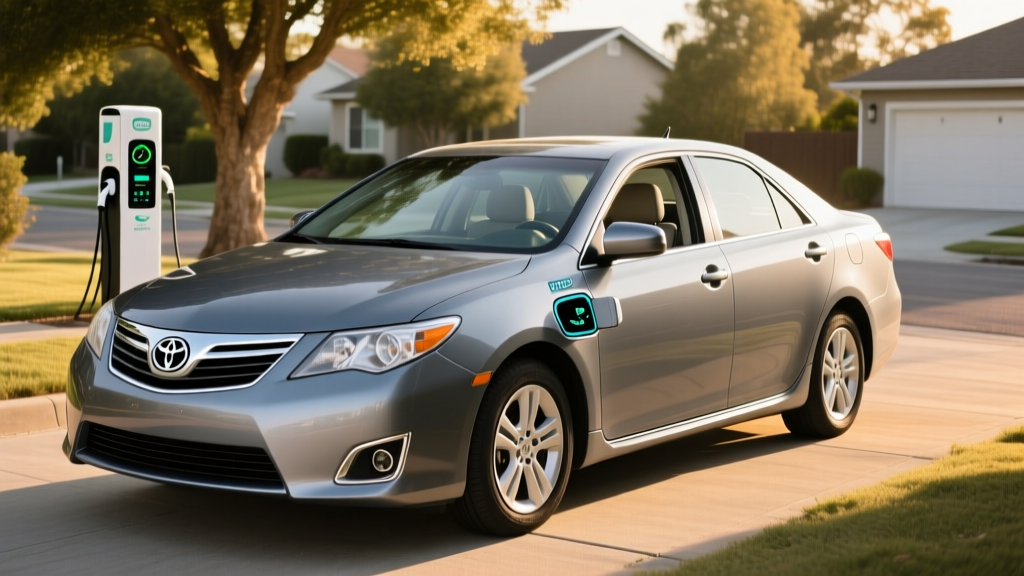
The 2025 Toyota Camry is now exclusively a hybrid. Toyota dropped the gas-only four-cylinder and V6 entirely, betting that the fifth-generation Toyota Hybrid System (THS5) delivers enough refinement, efficiency, and value to satisfy both loyal Camry buyers and cross-shoppers eyeing full EVs. For shoppers specifically researching the 2025 Toyota Camry Hybrid interior — materials, technology, space, and how the hybrid powertrain affects cabin comfort — this guide covers every spec that matters.
Below we break down the HEV powertrain, real-world MPG, cabin quality by trim, pricing, battery warranty, and how the Camry Hybrid stacks up against plug-in hybrids and full EVs for different driving lifestyles.
2025 Toyota Camry Hybrid at a Glance: Specs Table
| Specification | Detail |
|---|---|
| Powertrain type | Conventional Hybrid (HEV) — no plug required |
| Engine | 2.5L inline-4 Dynamic Force + 2 electric motor-generators |
| Combined horsepower | 225 hp (FWD) / 232 hp (AWD) |
| Transmission | eCVT (planetary gearset, not a belt-driven CVT) |
| Traction battery | ~1.6 kWh lithium-ion (sealed NiMH no longer used on this gen) |
| EPA MPG (LE FWD) | 51 city / 44 highway / 47 combined |
| EPA MPG (SE/XSE FWD) | 48 city / 41 highway / 44 combined |
| EPA MPG (AWD trims) | 49 city / 43 highway / 46 combined (LE AWD) |
| Fuel tank | 13.2 gallons |
| Total range (est.) | ~575–620 miles depending on trim |
| 0–60 mph | ~7.1 seconds (FWD) |
| Drivetrain | FWD standard; electronic AWD available |
| Starting MSRP | $28,700 (LE) — up to ~$36,500 (XSE AWD) |
| Federal §30D tax credit | Not eligible (HEV, not a PHEV or BEV) |
| Hybrid battery warranty | 10 years / 150,000 miles |
HEV vs PHEV: Why the 2025 Camry Is a Conventional Hybrid
Conventional Hybrid (HEV) — 2025 Camry: The small traction battery recharges via regenerative braking and the gas engine. You never plug it in. Electric-only driving is limited to brief low-speed coasting and parking-lot maneuvers. Efficiency gains come from the engine shutting off frequently and the electric motors assisting under load.
Plug-in Hybrid (PHEV) — e.g., Toyota RAV4 Prime, Prius Prime: Larger battery (typically 13–19 kWh), capable of 25–44 miles of pure electric driving before the engine starts. Requires plugging in (Level 1 or Level 2) to capture the EV benefit. May qualify for the federal §30D tax credit up to $7,500 if MSRP, income, and battery-sourcing requirements are met.
Key point: The 2025 Camry Hybrid does not have a plug, does not offer meaningful electric-only range, and does not qualify for the federal EV tax credit. If plug-in capability is a dealbreaker, look at the Prius Prime (44 miles EV) or a RAV4 Prime (42 miles EV).
Real-World MPG: What to Actually Expect
| Trim | EPA City | EPA Highway | EPA Combined | Real-World Expectation |
|---|---|---|---|---|
| LE FWD | 51 | 44 | 47 | 45–50 combined (city-favored driving) |
| SE / XSE FWD | 48 | 41 | 44 | 41–46 combined |
| LE AWD | 49 | 43 | 46 | 43–48 combined |
Hybrids typically beat their EPA city ratings in stop-and-go traffic because regenerative braking recovers energy that a gas car wastes as heat. In our experience with Toyota's THS5 system, drivers with commute-heavy city routes regularly see 50+ MPG in warm weather.
Highway driving is the Camry Hybrid's relative weak spot. At sustained 75–80 mph speeds, expect the LE to drop into the low-to-mid 40s. Cold weather (below freezing) typically shaves 5–10% off combined numbers because the engine runs longer to warm the cabin and bring the battery to operating temperature.
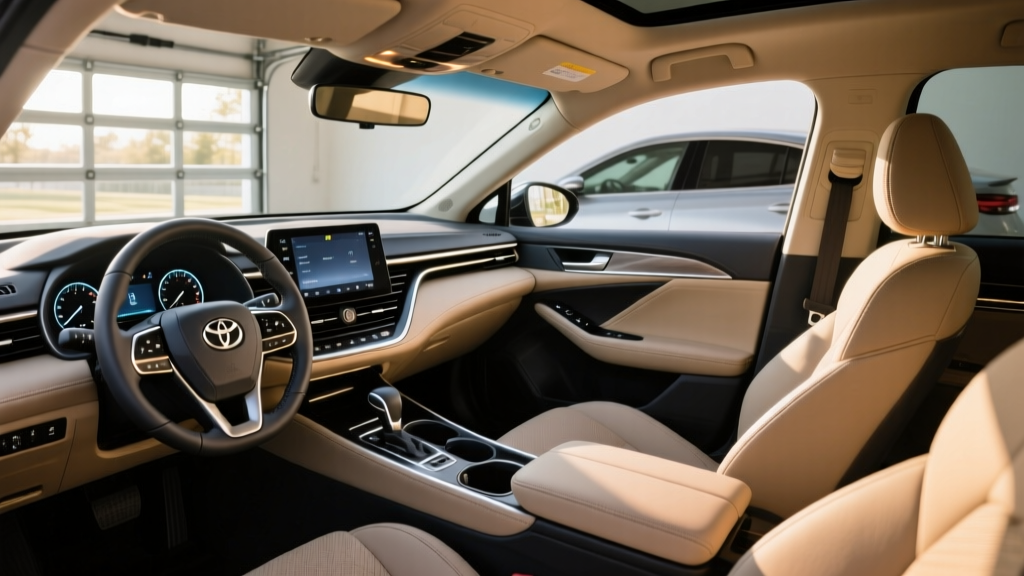
2025 Toyota Camry Hybrid Interior: Materials, Tech & Space by Trim
The ninth-generation Camry moved upmarket significantly, and the hybrid battery packaging under the rear seats preserves the trunk volume (15.1 cu ft) and rear legroom (38.0 inches) that made the Camry a midsize benchmark.
LE and SE trims
- SofTex (synthetic leather) seating surfaces; cloth accents on SE
- 8-inch touchscreen with wireless Apple CarPlay and Android Auto
- 7-inch digital driver information display
- Dual-zone automatic climate control
- Two USB-C ports front, two rear
XLE and XSE trims
- Available genuine leather-trimmed seats (XLE) or sport SofTex with red stitching (XSE)
- 12.3-inch touchscreen with Toyota Audio Multimedia
- 12.3-inch fully digital gauge cluster
- Available 10-inch color head-up display
- Available 9-speaker JBL premium audio with subwoofer
- Heated and ventilated front seats, heated steering wheel available
- Ambient interior lighting with 64 color options
The hybrid system is acoustically well-managed. The 2.5L engine is insulated enough that it only becomes vocal under hard acceleration (full-throttle merge, steep grades). Under normal city and suburban driving, the engine start/stop transitions are among the smoothest in the segment — a carryover advantage Toyota has held since the original Prius.
Cargo space is unaffected by the hybrid powertrain: 15.1 cu ft trunk with a 60/40 split-folding rear seat. The spare tire is a temporary compact unit under the trunk floor.
Powertrain Deep Dive: 225 hp from the Fifth-Gen Toyota Hybrid System
The 2025 Camry uses Toyota's fifth-generation hybrid architecture. A 2.5-liter Dynamic Force inline-4 (184 hp on its own) pairs with two motor-generators through a planetary eCVT. Combined output is 225 hp for FWD models and 232 hp with AWD (which adds a rear-mounted electric motor, not a mechanical driveshaft).
The traction battery is a compact lithium-ion pack rated at approximately 1.6 kWh. It is not user-serviceable and not designed for plug-in charging. Its role is strictly as an energy buffer: capturing regen energy and delivering brief torque assist.
Performance is adequate rather than quick. 0–60 mph in approximately 7.1 seconds puts it mid-pack among midsize sedans. The AWD model's rear motor improves traction in rain and light snow but does not materially change acceleration times. For context, a Tesla Model 3 RWD hits 60 in ~5.8 seconds and a Hyundai Sonata Hybrid runs ~7.5 seconds.
Pricing, Trims & Tax Credit Eligibility
Approximate 2025 MSRP by trim (destination included):
- LE FWD: $28,700
- LE AWD: $30,100
- SE FWD: $30,990
- SE AWD: $32,390
- XLE FWD: $33,400
- XLE AWD: $34,800
- XSE FWD: $34,200
- XSE AWD: $35,600
Federal tax credit: The 2025 Camry Hybrid does not qualify for the IRS §30D Clean Vehicle Credit. That credit applies only to battery electric vehicles (BEVs) and plug-in hybrids (PHEVs) meeting MSRP caps, buyer income limits, and critical-mineral/battery-component sourcing rules. See IRS §30D guidelines for current-year eligibility.
State incentives: Some states (notably California, Colorado, and a handful of others) offer rebates or HOV-lane access for conventional hybrids in specific circumstances, but these are uncommon and change frequently. Check your state energy office or fueleconomy.gov's incentives tool for current programs.
Reliability, Battery Warranty & Replacement Cost
Toyota's hybrid system has one of the longest reliability track records in the industry — the Prius has been in continuous production since 1997 (Japan) and 2000 (US). The Camry Hybrid has been in the lineup since the 2007 model year.
Hybrid battery warranty: Toyota covers the hybrid battery and hybrid system components for 10 years or 150,000 miles, whichever comes first, in all 50 states. This is among the best in the segment and applies regardless of ownership transfers.
Battery replacement cost: If the hybrid battery fails outside of warranty, a new OEM replacement typically runs $2,500–$4,000 installed at a Toyota dealer. Independent hybrid specialists often offer refurbished or reconditioned packs for $1,200–$2,200 installed. In practice, many Toyota hybrid batteries last 180,000–250,000+ miles before capacity loss triggers a failure code — far beyond the ownership period of most buyers.
Other long-term considerations are favorable: the eCVT has no belt to replace (it is a planetary gearset), regenerative braking extends conventional brake pad life (60,000–100,000 miles is common), and the 2.5L Dynamic Force engine has proven durable in millions of Toyota and Lexus applications.
Camry Hybrid vs PHEV vs Full EV: Which Fits Your Life?
Choose the Camry Hybrid (HEV) if:
- You cannot charge at home (apartment, street parking, no garage)
- You drive 400+ miles regularly without wanting to plan charging stops
- You want low running costs without changing any driving habits
- You live in an area with sparse DC fast-charging infrastructure
- Your budget is $28,000–$36,000 and you want a midsize sedan
Choose a PHEV (e.g., Prius Prime) if:
- You can install a Level 2 charger at home
- Your daily commute is under 40 miles round-trip (enough for EV-only driving)
- You want EV running costs most days but gas flexibility for road trips
- You may qualify for the $7,500 federal tax credit
Choose a full EV (e.g., Tesla Model 3, Hyundai Ioniq 6) if:
- You have reliable home Level 2 charging
- You want the lowest per-mile fuel cost and minimal maintenance
- You want strong acceleration and one-pedal driving
- You are eligible for the full federal tax credit and can absorb higher upfront cost
Frequently Asked Questions
How many MPG does the 2025 Toyota Camry Hybrid get?
The LE FWD is EPA-rated at 51 city / 44 highway / 47 combined. Sportier SE and XSE trims drop to 48/41/44 due to wider tires and firmer suspension tuning. Real-world combined figures typically land within 2–3 MPG of the EPA sticker, with city-heavy drivers often beating the city rating.
Does the 2025 Camry Hybrid need to be plugged in?
No. It is a conventional hybrid (HEV). The small traction battery recharges through regenerative braking and the gasoline engine. There is no plug, no charging cable, and no electric-only range beyond brief low-speed coasting.
How far can the Camry Hybrid go on electric only?
Effectively zero miles of sustained electric-only driving. You may see 0.5–1 mile of EV-mode creeping at parking-lot speeds, but the engine will start under any meaningful acceleration or load. For real electric-only range, you need a PHEV like the Prius Prime (44 miles) or a full EV.
Is the 2025 Camry Hybrid reliable?
Toyota's hybrid system has nearly 30 years of production history. The hybrid battery is warranted for 10 years / 150,000 miles, and real-world data shows many packs lasting well beyond 200,000 miles. The eCVT is mechanically simpler than a conventional automatic and has no belt or clutch packs to fail.
How much does it cost to replace the Camry Hybrid battery?
Outside warranty, expect $2,500–$4,000 for a new OEM pack at a dealer, or $1,200–$2,200 for a refurbished pack at an independent hybrid specialist. Most owners never face this cost during their ownership period.
Does the 2025 Camry Hybrid qualify for any tax credit?
Not the federal §30D credit, which is reserved for plug-in vehicles (BEVs and PHEVs). Some states and local utilities offer modest hybrid incentives, but these vary widely. Consult IRS guidelines and your state energy office.
Is the Camry Hybrid interior quieter than the previous generation?
Yes. The ninth-generation platform uses additional sound insulation and acoustic glass on higher trims. The hybrid system's low-speed electric operation and improved engine isolation make the 2025 Camry noticeably quieter at city speeds than the outgoing model.
Camry Hybrid vs Honda Accord Hybrid?
The Accord Hybrid is rated at 48/47/48 MPG (EX-L) with a 204-hp two-motor system and slightly more rear legroom. The Camry Hybrid counters with available AWD, a longer track record, and a 10-year hybrid battery warranty. Both are class leaders; the choice often comes down to styling preference and dealer relationship.
Verdict: A No-Compromise Hybrid for the Mainstream Buyer
The 2025 Toyota Camry Hybrid is the safest recommendation we make for buyers who want maximum efficiency without changing their fueling habits. The interior quality has caught up to near-premium competitors, the 47-MPG combined rating is real-world achievable, and the 10-year/150,000-mile hybrid battery warranty removes the single biggest concern shoppers raise about used hybrids.
If you can charge at home and your commute is under 40 miles, a PHEV like the Prius Prime offers lower day-to-day running costs and potential tax-credit eligibility. If you want zero tailpipe emissions and have Level 2 charging access, a BEV like the Model 3 or Ioniq 6 will cost less per mile over five years. But for the buyer who simply wants a dependable, efficient, well-appointed midsize sedan that fills up at any gas station in three minutes — the 2025 Camry Hybrid remains the segment's default answer.