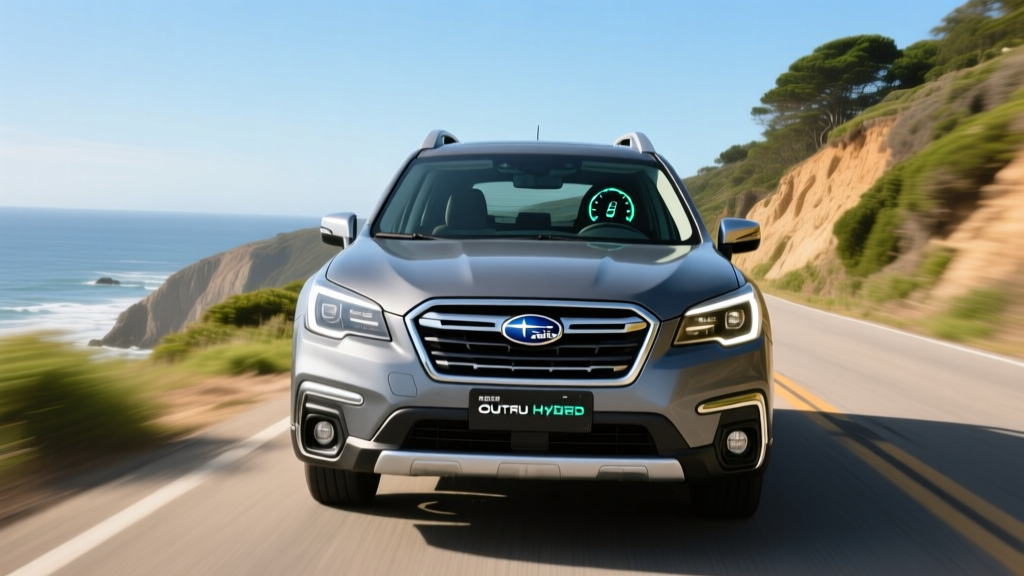
The 2025 Subaru Outback hybrid marks the return of electrification to Subaru's best-selling wagon, filling a gap left since the discontinuation of the Outback PHEV after the 2023 model year. For buyers who want better fuel economy without changing their refueling habits, this conventional hybrid (HEV) pairs Subaru's familiar 2.5-liter boxer engine with an electric motor integrated into the Lineartronic CVT. The result is a meaningful efficiency bump over the standard gas Outback while retaining the all-wheel-drive capability and 8.7 inches of ground clearance the model is known for.
Before we get into the numbers, one critical distinction: the 2025 Outback hybrid is a conventional hybrid (HEV), not a plug-in hybrid (PHEV). You never plug it in. The small battery recharges through regenerative braking and the gasoline engine. If you need electric-only driving or a plug-in option, Subaru currently does not offer a PHEV variant of the 2025 Outback — you'd need to look at competitors like the Toyota RAV4 Prime or wait for Subaru's next-generation PHEV platform.
2025 Subaru Outback Hybrid MPG and Real-World Efficiency
The headline number for any hybrid buyer is fuel economy. Subaru targets an EPA-estimated 35 MPG combined for the 2025 Outback hybrid, a substantial improvement over the standard 2.5L gas Outback's 28 MPG combined. Here's the full breakdown:
| Metric | Outback Hybrid (HEV) | Outback 2.5L Gas | Outback 2.4T XT |
|---|---|---|---|
| City MPG | 37 | 26 | 22 |
| Highway MPG | 34 | 32 | 29 |
| Combined MPG | 35 | 28 | 25 |
For comparison, the EPA's fueleconomy.gov database confirms the standard Outback 2.5L at 28 MPG combined, making the hybrid's 35 MPG a 25% improvement. Over 15,000 annual miles, that translates to roughly 107 fewer gallons of fuel per year — about $375 in annual savings at $3.50/gallon.
Powertrain: Boxer Engine Meets Electric Assist
Subaru's hybrid system uses a parallel configuration where both the gasoline engine and electric motor can drive the wheels. The setup is designed for seamless transitions rather than dramatic performance gains:
| Component | Specification |
|---|---|
| Engine | 2.5L DOHC 4-cylinder boxer (FB25) |
| Engine Output | 182 hp / 176 lb-ft torque |
| Electric Motor | Integrated CVT motor-generator (~16 hp assist) |
| Combined System Output | ~194 hp |
| Transmission | Lineartronic CVT with electric motor integration |
| Drivetrain | Symmetrical All-Wheel Drive (standard) |
| 0-60 MPH | ~8.2 seconds (estimated) |
| Towing Capacity | 2,700 lbs |
The electric motor primarily assists during acceleration from a stop and low-speed maneuvering, smoothing out the CVT's behavior and reducing the engine's workload in the most fuel-intensive driving scenarios. Unlike Toyota's more powerful hybrid systems (the RAV4 Hybrid produces 219 hp combined), Subaru's approach prioritizes efficiency gains over performance. The 0-60 time of roughly 8.2 seconds is adequate for merging and passing but won't feel quick.
All-wheel drive remains standard and fully mechanical — the hybrid system does not use a separate rear electric motor like some competitor e-AWD setups. This means AWD engagement is consistent and predictable, though the hybrid's fuel economy advantage narrows slightly compared to FWD-only hybrid competitors.
Hybrid Battery: Size, Warranty, and Replacement Cost
The 2025 Outback hybrid uses a compact lithium-ion battery pack positioned under the rear cargo area. Unlike PHEV batteries that store 10-20 kWh for electric-only driving, this HEV battery is small — approximately 1.1 kWh — because it only needs to buffer energy for short electric-assist bursts and regenerative braking capture.
Hybrid battery replacement cost is a top concern for buyers planning long-term ownership. Based on current hybrid battery pricing across the industry and Subaru's parts network, a replacement hybrid battery for the Outback HEV would likely run $2,000-$3,500 including labor. However, modern lithium-ion hybrid batteries rarely require full replacement within the warranty period. Degradation in a small HEV battery is minimal because the battery management system keeps the state of charge (SoC) within a narrow 40-80% window, avoiding the deep cycles that accelerate wear.
Subaru's hybrid system also includes a separate 12V auxiliary battery for vehicle electronics, which follows standard replacement intervals (every 4-6 years, ~$200-$300).
Pricing, Trims, and Tax Credit Eligibility
The 2025 Subaru Outback hybrid is offered across multiple trim levels, with the hybrid powertrain adding a premium over the equivalent gas model. Here's the pricing landscape:
| Trim | Hybrid MSRP | Gas Equivalent MSRP | Hybrid Premium |
|---|---|---|---|
| Premium | $35,495 | $32,995 | +$2,500 |
| Limited | $39,495 | $36,495 | +$3,000 |
| Wilderness Hybrid | $42,995 | $39,495 | +$3,500 |
| Limited XT Hybrid | $43,995 | $40,995 | +$3,000 |
At a $2,500-$3,500 hybrid premium and annual fuel savings of roughly $375, the payback period on the hybrid powertrain is approximately 7-9 years for an average driver. For high-mileage drivers covering 20,000+ miles annually, payback drops to 4-5 years.
Who Should Choose the Outback Hybrid vs. a Full EV or Gas Car
The 2025 Outback hybrid occupies a specific niche. It's not the most efficient option available, nor the most powerful — it's the option that improves efficiency without requiring any behavioral change. Here's a decision framework:
Choose the Outback Hybrid if:
- You don't have access to home or workplace charging (apartment, street parking, no garage outlet)
- You regularly drive in remote areas with limited charging infrastructure (national parks, rural routes)
- You want AWD, 8.7" ground clearance, and 75.7 cu ft of cargo space without compromise
- You plan to keep the vehicle 8+ years and want proven hybrid reliability with strong warranty coverage
- You tow occasionally (2,700 lbs) — most EVs in this price range have limited or no towing capacity
Choose a Plug-In Hybrid (PHEV) Instead if:
- You have home Level 2 charging and a commute under 35 miles (a PHEV can cover daily driving on electricity alone)
- You want to reduce fuel consumption by 60-80% on weekdays while keeping gas for road trips
- You want to qualify for the federal §30D tax credit (up to $7,500 for eligible PHEVs)
Choose a Full EV Instead if:
- You have reliable home charging and want the lowest per-mile fuel cost (~$0.04-$0.06/mile on residential electricity vs. $0.14-$0.18/mile on gas)
- Your daily driving is under 250 miles and you road-trip fewer than 3-4 times per year
- You want to eliminate oil changes, transmission fluid, and exhaust system maintenance
Reliability and Long-Term Ownership Outlook
Subaru's hybrid system is relatively new to the Outback but draws on the e-Boxer architecture the company has deployed in the Forester Hybrid and Crosstrek Hybrid in global markets since 2019. The boxer engine (FB25) is one of Subaru's most proven powerplants, and the integration of a modest electric motor through the CVT adds complexity without introducing high-stress components.
Conventional hybrids as a category have demonstrated strong long-term reliability. Toyota's hybrid systems routinely exceed 200,000 miles with original batteries, and Subaru's simpler parallel-hybrid design (smaller battery, less electric-only driving) places even less thermal stress on the battery cells. The 8-year/100,000-mile hybrid warranty (10/150,000 in CARB states) provides substantial protection.
Maintenance costs for the Outback hybrid are nearly identical to the gas version: you still have oil changes (every 6,000 miles with synthetic), brake fluid, coolant, and CVT fluid service. One advantage: regenerative braking significantly extends brake pad life, with many hybrid owners reporting 80,000-100,000+ miles on original brake pads.
Safety ratings carry over from the Outback platform. The IIHS has historically rated the Outback a Top Safety Pick+, and the hybrid variant shares the same structure, crashworthiness, and EyeSight driver-assistance suite (standard adaptive cruise control, lane-keeping, pre-collision braking).
Pros and Cons at a Glance
Pros
- 35 MPG combined — 25% better than gas Outback
- Standard AWD with 8.7" ground clearance retained
- No charging infrastructure required
- 8yr/100k hybrid battery warranty (10yr/150k in CARB states)
- Extended brake pad life from regen braking
- Full cargo capacity — no major battery intrusion
- EyeSight safety suite standard on all trims
Cons
- No federal tax credit eligibility (HEV exclusion)
- Modest power — ~194 hp combined, 8.2s 0-60
- $2,500-$3,500 premium over gas model (7-9yr payback)
- No electric-only driving mode
- Lower towing vs. gas 2.4T (2,700 vs. 3,500 lbs)
- Competitor hybrids (Toyota) offer stronger motor assist
Frequently Asked Questions
How many MPG does the 2025 Subaru Outback hybrid get?
The EPA estimates the 2025 Outback hybrid at 37 city / 34 highway / 35 combined MPG. In real-world city driving with frequent stops, expect 37-40 MPG thanks to regenerative braking. Highway driving at 70+ MPH will trend toward 32-34 MPG. Cold weather (below 30°F) reduces efficiency by roughly 5-8%.
Does the Outback hybrid need to be plugged in?
No. The 2025 Outback hybrid is a conventional hybrid (HEV), not a plug-in hybrid (PHEV). The small 1.1 kWh battery recharges automatically through regenerative braking and the gasoline engine. You fuel it exclusively at gas stations, exactly like a standard Outback.
Is there a plug-in hybrid (PHEV) version of the 2025 Outback?
No. Subaru discontinued the Outback PHEV after the 2023 model year. The 2025 lineup offers only the conventional hybrid (HEV) and standard gasoline powertrains. If you need a plug-in Subaru, the brand has not announced a 2025 or 2026 PHEV replacement for the Outback. Competitors offering PHEV wagons and SUVs include the Toyota RAV4 Prime (42 miles electric-only) and Hyundai Tucson PHEV (33 miles electric-only).
What does hybrid battery replacement cost for the Outback?
Based on current hybrid battery pricing, expect $2,000-$3,500 for a replacement hybrid battery including labor. However, HEV batteries experience minimal degradation because the battery management system maintains a narrow state-of-charge window (roughly 40-80%), avoiding deep discharge cycles. Most hybrid batteries outlast the vehicle. Subaru's hybrid warranty covers the battery for 8 years/100,000 miles (10 years/150,000 miles in CARB states).
Does the 2025 Outback hybrid qualify for any tax credit?
No federal tax credit applies. Per IRS §30D rules, only plug-in electric vehicles (BEVs and PHEVs) with at least 7 kWh of battery capacity and external charging capability qualify for the new clean vehicle credit (up to $7,500). Conventional hybrids are explicitly excluded. Some states offer separate rebates or incentives for hybrid vehicles — check your state energy office. You can verify federal eligibility on the IRS clean vehicle credit page.
Is the Outback hybrid reliable compared to the gas version?
Conventional hybrids as a category have demonstrated excellent long-term reliability. The Outback hybrid adds an electric motor and small battery to Subaru's proven FB25 boxer engine and Lineartronic CVT. The hybrid system is under warranty for 8 years/100,000 miles. Regenerative braking reduces wear on brake pads, and the electric motor assist reduces engine load during acceleration. Long-term reliability data specific to the 2025 Outback hybrid will accumulate over the next few years, but the underlying architecture is well-established.
How does the Outback hybrid compare to the Toyota RAV4 Hybrid?
The RAV4 Hybrid produces 219 hp combined (vs. ~194 hp for the Outback hybrid) and achieves 39-41 MPG combined (vs. 35 MPG). However, the Outback offers significantly more cargo space (75.7 cu ft vs. 69.8 cu ft), more ground clearance (8.7" vs. 8.1"), and standard AWD with a more robust mechanical system. The Outback is a larger vehicle optimized for utility and rough-road capability; the RAV4 Hybrid prioritizes efficiency and power in a compact SUV footprint.