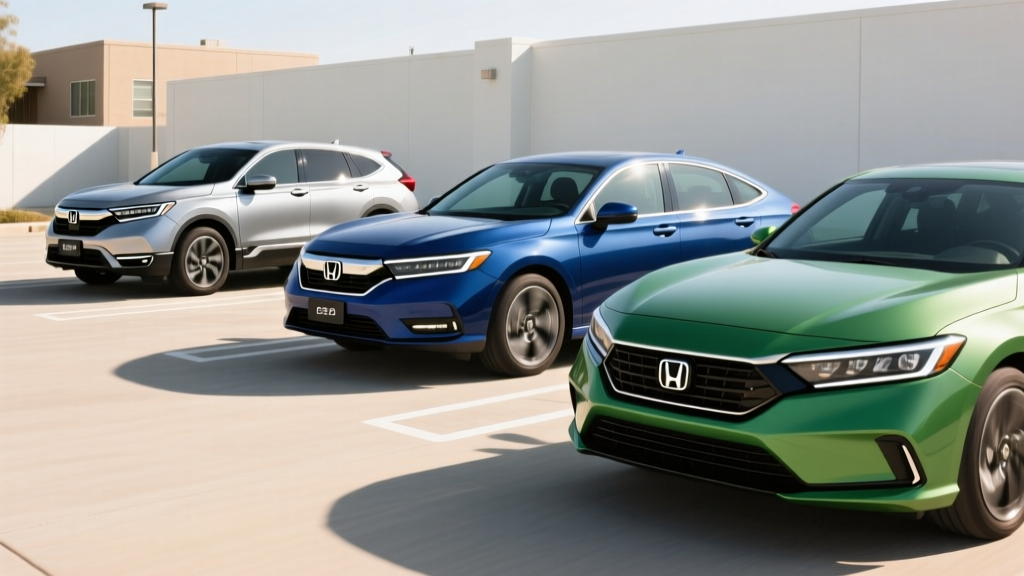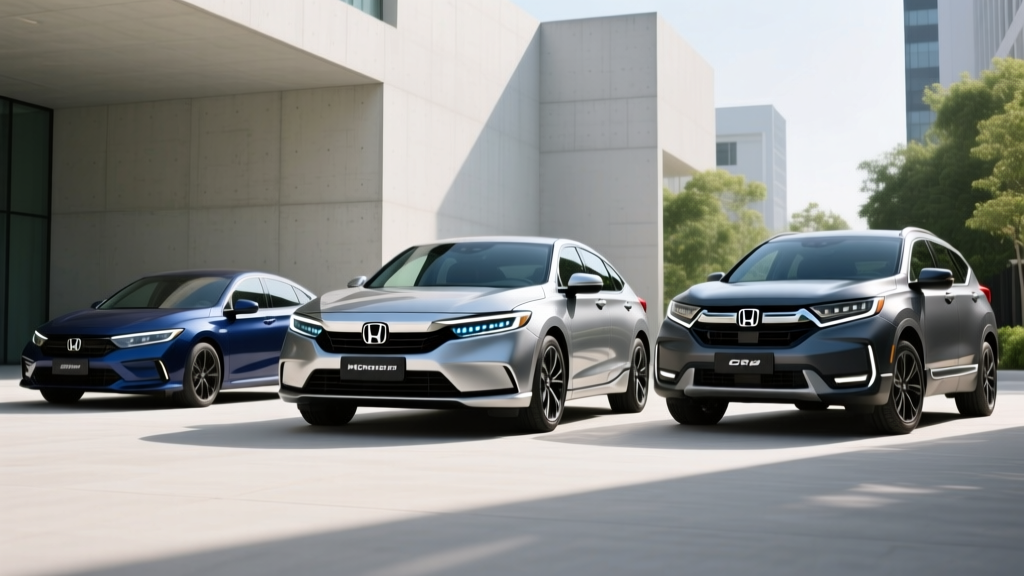
Honda's hybrid lineup for 2026 covers three of the most popular vehicle segments in America — the midsize sedan, the compact SUV, and the compact sedan — each equipped with Honda's fourth-generation two-motor hybrid system. Unlike plug-in hybrids, none of these require you to install a home charger or alter your routine. You fill up at the pump like any gas car, and the hybrid powertrain handles the efficiency gains automatically.
This guide breaks down every current hybrid Honda by the numbers: EPA MPG, real-world fuel economy, powertrain output, pricing, battery longevity, and whether any of them qualify for federal tax credits. If you've been searching for hybrid Hondas and need hard data to make a decision, this is the reference.
HEV vs PHEV: What Honda's Hybrid Lineup Actually Is
All three current hybrid Hondas — the Accord Hybrid, CR-V Hybrid, and Civic Hybrid — are conventional hybrids (HEVs). They pair a gasoline engine with one or two electric motors and a small lithium-ion battery pack that recharges through regenerative braking and engine-driven generation. You never plug them in.
HEV (Conventional Hybrid) — What Honda Offers
- No plug-in charging required
- Battery recharges via regen braking and engine
- Small battery (~1.0–1.5 kWh usable)
- Electric-only driving limited to brief low-speed bursts
- No federal EV tax credit eligibility
PHEV (Plug-In Hybrid) — Not Currently in Honda's US Lineup
- Requires plug-in charging (Level 1 or Level 2)
- Larger battery (~15–20 kWh) for 25–40 miles electric-only range
- Can qualify for federal §30D tax credit if criteria are met
- Honda discontinued the Clarity PHEV after the 2021 model year and has not introduced a replacement PHEV in the US market as of 2026
If you're looking for a Honda you can plug in for electric-only commuting, there is no current option. Honda's US strategy focuses on conventional hybrids for near-term efficiency and battery-electric vehicles (like the Prologue) for buyers ready to go fully electric.
2026 Honda Hybrid Lineup: MPG and Powertrain Specs
Here's how the three hybrid Hondas stack up on paper. All figures reflect EPA estimates as published on fueleconomy.gov and Honda's official specifications.
| Spec | 2026 Accord Hybrid | 2026 CR-V Hybrid | 2026 Civic Hybrid |
|---|---|---|---|
| Powertrain | 2.0L 4-cyl + 2-motor hybrid | 2.0L 4-cyl + 2-motor hybrid | 2.0L 4-cyl + 2-motor hybrid |
| Combined HP | 204 hp | 204 hp | 200 hp |
| Combined Torque | 247 lb-ft | 247 lb-ft | 232 lb-ft |
| EPA City MPG | 51 mpg | 43 mpg (FWD) / 40 mpg (AWD) | 50 mpg |
| EPA Highway MPG | 44 mpg | 36 mpg (FWD) / 34 mpg (AWD) | 47 mpg |
| EPA Combined MPG | 48 mpg | 40 mpg (FWD) / 37 mpg (AWD) | 49 mpg |
| Drivetrain | FWD | FWD or AWD | FWD |
| 0–60 mph (est.) | ~7.1 sec | ~7.6 sec | ~6.7 sec |
| Fuel Tank | 12.8 gal | 14.0 gal | 10.6 gal |
| Total Range (est.) | ~614 miles | ~560 miles (FWD) | ~519 miles |
Real-World MPG: What Owners Actually Report
EPA numbers on hybrids tell only part of the story. Honda's two-motor system operates primarily in electric-drive mode at low and moderate speeds, with the engine acting as a generator. This means city and suburban driving often yields real-world MPG that meets or exceeds the EPA city estimate — the opposite of what happens with conventional gas cars, which are least efficient in stop-and-go traffic.
Real-World MPG Expectations
Accord Hybrid: Owners regularly report 48–54 mpg in mixed city/suburban driving. Highway-only trips at 75+ mph typically drop to 38–42 mpg. Cold weather (below 30°F) reduces efficiency by roughly 5–10% due to increased engine running for cabin heat.
CR-V Hybrid: Real-world mixed driving lands around 36–42 mpg for FWD models. AWD models average 1–3 mpg less. Highway-heavy driving at 70+ mph returns 30–34 mpg. The CR-V's taller profile and heavier curb weight (~3,800 lbs) work against it on the open road.
Civic Hybrid: The lightest of the three, the Civic Hybrid is the easiest to push past its EPA estimates. Owners report 50–55 mpg in mixed driving and 43–48 mpg at sustained highway speeds. In moderate temperatures with conservative driving, some owners have exceeded 60 mpg on suburban routes.
The key variable is driving style and climate. Hybrids benefit enormously from regenerative braking in stop-and-go conditions. If your commute is 90% highway miles at 80 mph, a hybrid's advantage over an efficient gas car narrows considerably — but it still won't underperform one.
Pricing, Trims, and Tax Credit Eligibility
Here's where each hybrid Honda lands on price for the 2026 model year, along with a frank assessment of tax credit eligibility.
| Model | Trim | MSRP | Federal Tax Credit |
|---|---|---|---|
| Accord Hybrid | Sport | $34,995 | None |
| Accord Hybrid | Sport-L | $36,650 | None |
| Accord Hybrid | EX-L | $38,995 | None |
| CR-V Hybrid | Sport | $36,395 | None |
| CR-V Hybrid | Sport Touring | $41,895 | None |
| Civic Hybrid | Sport Hybrid | $30,450 | None |
Federal Tax Credit (IRS §30D) — Why Hybrid Hondas Don't Qualify
The federal clean vehicle credit under IRS §30D applies only to plug-in electric vehicles (BEVs and PHEVs) with a minimum battery capacity of 7 kWh. Since Honda's current hybrids are conventional HEVs with battery packs under 1.5 kWh, they do not meet the basic eligibility threshold.
- No federal tax credit for any 2026 Honda hybrid
- Some states or local utilities offer rebates for hybrid purchases — check your state energy office or utility provider
- If you want a Honda with federal tax credit potential, the all-electric Honda Prologue may qualify depending on current-year battery sourcing and MSRP rules
Battery Warranty, Longevity, and Replacement Cost
Hybrid battery anxiety is the single most common concern among first-time hybrid buyers. Here's the data.
Honda Hybrid Battery Warranty
All 2026 Honda hybrids carry a hybrid battery warranty of 8 years / 100,000 miles (whichever comes first) in most states. In California and states that follow CARB emissions rules (including CT, MA, ME, NY, NJ, OR, RI, VT, WA), the warranty extends to 10 years / 150,000 miles.
The warranty covers capacity loss that causes the battery to fall below a functional threshold — typically when it can no longer hold sufficient charge to support hybrid system operation.
In practice, Honda's hybrid batteries have proven exceptionally durable. The lithium-ion packs in the fourth-generation system are modest in size (~1.0–1.5 kWh) and are managed conservatively — the system never fully charges or fully depletes the battery, keeping it in a state-of-charge window that minimizes degradation. Data from earlier-generation Accord and CR-V hybrids shows most original batteries lasting well beyond 150,000 miles with minimal capacity loss.
Replacement cost if out of warranty: A new OEM hybrid battery pack for a current-generation Honda hybrid typically costs between $2,000 and $3,500 including labor. Aftermarket and refurbished options are available for $1,200–$2,000. This is dramatically less than a full EV battery replacement, which can exceed $10,000–$20,000.
Who Should Buy a Hybrid Honda — and Who Shouldn't
Choose a Hybrid Honda If:
- You want significantly better fuel economy without changing your fueling routine
- You don't have access to home or workplace charging (apartment, street parking)
- Your driving mix includes substantial city and suburban miles where hybrid efficiency peaks
- You want a lower purchase price than a comparable EV
- You regularly take long road trips and don't want to plan around charging stops
- You want proven reliability with minimal new-technology risk
Look at a Full EV Instead If:
- You have reliable home Level 2 charging and a daily commute under 60 miles
- You want to eliminate gasoline purchases entirely
- You qualify for the federal §30D tax credit (income under cap, vehicle meets sourcing rules)
- You want the lowest per-mile energy cost — electricity at $0.14/kWh costs roughly $0.04/mile vs. $0.12/mile for a 48-mpg hybrid on $3.40/gallon gas
- You want the smoothest, quietest acceleration (no engine noise even under hard throttle)
Quick Decision Framework
Hybrid Honda → No home charging, mixed driving with lots of city miles, budget under $42K, want max simplicity.
Plug-in Hybrid (other brands) → Home charging available, want 25–40 miles electric-only for commuting, still need gas for road trips. Honda doesn't currently offer one.
Full EV (Honda Prologue or competitors) → Home charging secured, daily driving under 250 miles, want tax credit and lowest running costs.
Frequently Asked Questions
How many MPG do hybrid Hondas actually get?
The 2026 Accord Hybrid is EPA-rated at 51 city / 44 highway / 48 combined mpg. The CR-V Hybrid rates 43/36/40 mpg (FWD) and the Civic Hybrid leads at 50/47/49 mpg. In real-world city and suburban driving, many owners match or exceed these EPA city figures thanks to Honda's electric-dominant hybrid system.
Do Honda hybrids need to be plugged in?
No. All current Honda hybrids are conventional HEVs. The battery charges through regenerative braking and the gasoline engine. You never need a charger, outlet, or charging station. Simply refuel at any gas station as you would with a non-hybrid vehicle.
Are hybrid Hondas reliable?
Honda's hybrid system is among the most proven in the industry. The fourth-generation two-motor architecture has fewer mechanical complexity points than a traditional transmission — there's no conventional gearbox, just a direct clutch for high-speed engine drive. Honda's hybrid battery is warranted for 8 years/100,000 miles (10 years/150,000 miles in CARB states), and real-world data shows most batteries lasting well beyond the warranty period. According to IIHS ratings, the Accord, CR-V, and Civic all earn top safety marks as well.
Does any Honda hybrid qualify for a tax credit?
Not at the federal level. The IRS §30D clean vehicle credit requires a plug-in vehicle with at least 7 kWh of battery capacity. Honda's hybrids have batteries under 1.5 kWh and don't plug in. Some state or utility programs may offer hybrid purchase incentives — check your local programs. Honda's all-electric Prologue is the model to look at if you want potential federal credit eligibility.
How much does it cost to replace a Honda hybrid battery?
An OEM replacement hybrid battery for a current Honda hybrid typically runs $2,000–$3,500 installed. Refurbished or aftermarket packs are available for $1,200–$2,000. Given the conservative state-of-charge management Honda uses, most original batteries last 150,000+ miles, meaning many owners will never need a replacement.
Hybrid vs PHEV vs EV — which Honda should I buy?
Honda only offers conventional hybrids (HEVs) in its 2026 lineup — there is no Honda PHEV available in the US. If you want a Honda with plug-in capability, the all-electric Prologue is the option. For most buyers without home charging, a hybrid Honda offers the best balance of efficiency, convenience, and cost. If you have home charging and a predictable commute, a full EV will deliver lower per-mile energy costs and may qualify for tax credits that hybrids cannot access.
Does AWD hurt CR-V Hybrid fuel economy?
Yes, modestly. The CR-V Hybrid AWD drops from 40 mpg combined (FWD) to 37 mpg combined — a 3-mpg penalty driven by the additional drivetrain weight and mechanical drag of the rear motor. If you need AWD for snow or rough roads, the trade-off is small. If you don't, the FWD model saves fuel and $1,500 on purchase price.