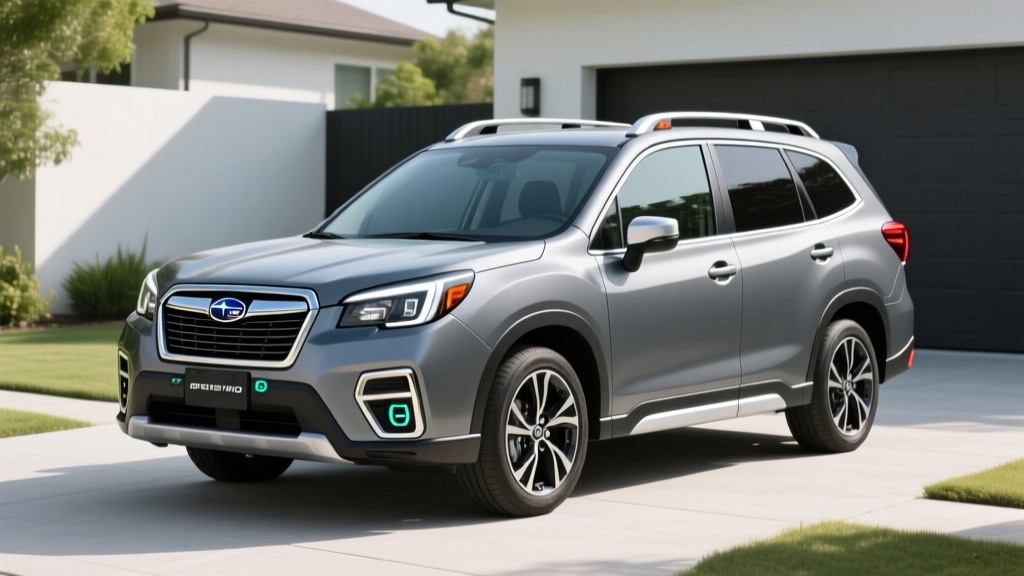
The sixth-generation Subaru Forester arrived for the 2025 model year with a redesigned platform, updated safety tech, and a highly anticipated hybrid variant. For buyers searching through 2025 Subaru Forester hybrid trim levels, the key question is straightforward: how much efficiency does the hybrid system add, and which trim delivers the best value?
Subaru's hybrid strategy here is a conventional hybrid (HEV) — not a plug-in. That means no charging cord, no electric-only range, and no federal tax credit. But it also means a lower starting price, simpler ownership, and real-world fuel economy that often beats the EPA sticker in city driving. Here's everything you need to know.
2025 Subaru Forester Hybrid Trim Lineup and Pricing
Subaru offers the 2025 Forester Hybrid across three trims, each building on the corresponding gas-only Forester configuration. All trims include Subaru's symmetrical all-wheel drive as standard — there is no FWD-only base model.
| Trim | MSRP (incl. destination) | Key Additions Over Gas Model |
|---|---|---|
| Forester Hybrid Premium | $36,495 | Hybrid powertrain, hybrid-specific instrumentation, LED fog lights |
| Forester Hybrid Sport | $38,495 | Sport-tuned appearance, 19" alloy wheels, panoramic sunroof, wireless CarPlay |
| Forester Hybrid Touring | $41,495 | Nappa leather, ventilated front seats, 180° front camera, Harman Kardon audio |
The hybrid premium over the equivalent gas-only trim is approximately $2,500 across the lineup. Whether that premium pays for itself depends on your annual mileage and driving mix — we break that math down further below.
Fuel Economy: EPA Ratings and Real-World MPG
The headline number for any hybrid buyer is fuel economy. The 2025 Forester Hybrid carries EPA estimates that represent a meaningful improvement over the gas-only Forester, which rates at 26 city / 33 highway / 29 combined MPG.
| Driving Cycle | Forester Hybrid (EPA) | Gas-Only Forester (EPA) | Improvement |
|---|---|---|---|
| City | 35 MPG | 26 MPG | +9 MPG |
| Highway | 34 MPG | 33 MPG | +1 MPG |
| Combined | 35 MPG | 29 MPG | +6 MPG |
Source: fueleconomy.gov, EPA estimates. Actual results vary by driving conditions.
Powertrain Specs: Engine, Motor, and Combined Output
The 2025 Forester Hybrid pairs Subaru's 2.5-liter flat-four (Boxer) engine with an electric motor integrated into the transmission housing. This is a parallel hybrid system — both the engine and motor can drive the wheels, and the system seamlessly blends power sources based on load and speed.
| Specification | Detail |
|---|---|
| Engine | 2.5L Boxer 4-cylinder (Atkinson cycle) |
| Engine Output | 163 hp / 174 lb-ft torque |
| Electric Motor | Integrated AC synchronous motor |
| Motor Output | 26 hp / 149 lb-ft torque |
| Combined System Output | 194 hp |
| Transmission | Lineartronic CVT |
| Drivetrain | Symmetrical AWD (standard) |
| Hybrid Battery | ~1.1 kWh lithium-ion (self-charging) |
| 0-60 mph (est.) | ~8.5 seconds |
| Towing Capacity | 1,500 lbs |
The combined 194 hp represents a 24 hp increase over the gas-only Forester's 180 hp. The more noticeable difference is low-speed torque: the electric motor's 149 lb-ft fills in the gap before the Boxer engine reaches its torque peak, giving the hybrid noticeably stronger acceleration from stops.
The 2025 Forester Hybrid is a conventional hybrid (HEV). It charges its small battery through regenerative braking and the gasoline engine. You never plug it in. A plug-in hybrid (PHEV) like the Toyota RAV4 Prime has a much larger battery (~18 kWh), can travel 30-40 miles on electricity alone, and qualifies for federal tax credits. Subaru does not currently offer a Forester PHEV. If electric-only commuting is a priority, look at the RAV4 Prime, Hyundai Tucson PHEV, or a full BEV like the Hyundai Ioniq 5.
Hybrid vs. Gas Forester: Which Trim Makes Financial Sense?
The $2,500 hybrid premium needs to be justified by fuel savings. Here's a practical payback calculation based on 15,000 miles per year and $3.50/gallon regular unleaded:
| Model | Combined MPG | Gallons/Year | Annual Fuel Cost |
|---|---|---|---|
| Forester Gas (AWD) | 29 MPG | 517 | $1,810 |
| Forester Hybrid (AWD) | 35 MPG | 429 | $1,500 |
| Annual Savings with Hybrid | $310 | ||
At this driving volume, the hybrid premium pays back in roughly 8 years. If you drive more (20,000+ miles/year), do predominantly city driving where the hybrid advantage is largest, or face higher local gas prices ($4.00+/gallon), payback shortens to 5-6 years. For lower-mileage drivers (under 10,000 miles/year), the fuel savings alone may not justify the premium within a typical ownership period, though the hybrid's stronger low-speed acceleration and reduced brake wear (from regenerative braking) add secondary value.
Battery Warranty, Lifespan, and Replacement Cost
Hybrid battery longevity is the top concern for first-time hybrid buyers. Subaru backs the Forester Hybrid's lithium-ion battery pack with a comprehensive warranty.
Subaru provides a hybrid system warranty of 8 years / 100,000 miles (whichever comes first) across all 50 states. In California Air Resources Board (CARB) states, hybrid-related emissions components may carry extended coverage up to 10 years / 150,000 miles. This warranty covers the hybrid battery pack, inverter, electric motor, and associated control modules against defects and abnormal capacity loss.
Based on data from Toyota and Honda hybrid systems (which use similar nickel-metal-hydride and lithium-ion chemistries), modern hybrid batteries routinely last 150,000-200,000 miles before significant degradation. The Forester Hybrid's relatively small ~1.1 kWh battery undergoes shallow charge/discharge cycles — it never fully depletes or fully charges, which significantly extends cell life compared to a full EV battery.
If out-of-warranty replacement is ever needed, industry estimates for compact hybrid battery packs currently range from $2,000 to $4,000 including labor, though this figure is projected for the Forester Hybrid based on comparable systems. Subaru has not published an official replacement cost as of the 2025 model year launch. Refurbished and aftermarket options typically reduce this cost by 30-50%.
Tax Credits and Incentives: What the Forester Hybrid Qualifies For
This is where managing expectations matters. Because the 2025 Forester Hybrid is a conventional HEV — not a plug-in — it does not qualify for the federal §30D Clean Vehicle Credit, which requires plug-in capability and a minimum battery capacity of 7 kWh.
- Federal §30D tax credit ($7,500): Not eligible. This credit applies only to BEVs and PHEVs meeting battery-sourcing, MSRP, and buyer income requirements per IRS guidelines.
- Federal alternative fuel vehicle credit: The HEV credit that once existed for conventional hybrids expired in 2010 and has not been reinstated.
- State incentives: A handful of states offer modest rebates or HOV-lane access for hybrids, but these are increasingly targeted at PHEVs and BEVs. Check your state's energy office or DMV for current programs — rules vary by jurisdiction and change frequently.
The absence of tax incentives means the Forester Hybrid's value proposition rests entirely on fuel savings, driving refinement, and the satisfaction of reduced fuel consumption without any lifestyle change (no charging, no range planning).
How the Forester Hybrid Compares: Hybrid vs. PHEV vs. Full EV
Buyers cross-shopping the Forester Hybrid often consider the Toyota RAV4 Hybrid, RAV4 Prime (PHEV), and all-electric alternatives. Here's a decision framework:
- You want better MPG with zero change to your fueling routine
- You need standard AWD for snow/rain climates
- You don't have access to home or workplace charging
- You value Subaru's EyeSight safety suite and visibility
- Your budget is $36,000-$42,000 and you want no charging dependency
- You can charge at home (Level 2, 240V)
- Your daily commute is under 35 miles round-trip (covers most PHEV electric-only range)
- You want federal tax credit eligibility ($3,750-$7,500 depending on model and sourcing)
- You want electric-only driving for daily errands with gas-engine backup for road trips
- You have reliable home Level 2 charging
- You want maximum fuel cost savings and lowest maintenance
- You qualify for the full $7,500 federal credit and state incentives
- Your typical trips fall within 250-300 miles or you're comfortable with DC fast charging on road trips
Pros and Cons at a Glance
- 35 MPG combined — 6 MPG better than gas Forester
- Stronger low-speed acceleration from electric motor torque
- No plug-in charging required — fill up at any gas station
- Standard AWD across all trims
- 8-year/100,000-mile hybrid battery warranty
- Subaru EyeSight 4.0 driver-assist suite standard
- Competitive cargo space (unchanged from gas model)
- No federal tax credit eligibility (HEV, not PHEV)
- $2,500 premium over gas trim with 6-8 year payback at average mileage
- Highway MPG advantage is minimal (1 MPG over gas model)
- No PHEV or EV variant available in the Forester lineup
- Towing capacity limited to 1,500 lbs (same as gas model)
- Hybrid battery replacement cost ($2,000-$4,000) if out of warranty
Frequently Asked Questions
How many MPG does the 2025 Subaru Forester Hybrid get?
The EPA rates the 2025 Forester Hybrid at 35 city / 34 highway / 35 combined MPG. Real-world city driving often yields 37-39 MPG thanks to regenerative braking. Highway driving at 75+ mph typically returns 32-34 MPG.
Does the Forester Hybrid need to be plugged in?
No. The 2025 Forester Hybrid is a conventional hybrid (HEV). Its small lithium-ion battery charges through regenerative braking and the gasoline engine. You refuel it exactly like any gas car — at a gas station.
Does the 2025 Forester Hybrid qualify for a federal tax credit?
No. The federal §30D Clean Vehicle Credit applies only to plug-in electric vehicles (BEVs and PHEVs) with at least 7 kWh of battery capacity. The Forester Hybrid's ~1.1 kWh battery does not meet this threshold. Check with a tax professional and your state's incentive programs for any local rebates.
How long will the Forester Hybrid battery last?
Subaru warrants the hybrid battery for 8 years / 100,000 miles (10 years / 150,000 miles in CARB states). Based on industry data from comparable hybrid systems, expect 150,000-200,000+ miles of service life. The shallow charge cycles in a conventional hybrid are far less stressful on battery cells than full EV charge/discharge cycles.
What does hybrid battery replacement cost?
Estimated out-of-warranty replacement for a compact hybrid battery pack is $2,000-$4,000 including labor. Subaru has not published an official figure for the 2025 Forester Hybrid specifically. Refurbished battery options and independent hybrid specialists can reduce this cost.
Is the Forester Hybrid faster than the gas model?
Marginally. The combined 194 hp (vs. 180 hp gas) and the electric motor's instant torque give the hybrid a quicker feel from 0-30 mph. Estimated 0-60 time is approximately 8.5 seconds versus roughly 9.2 seconds for the gas model. The difference is most noticeable in city driving and merging situations.
Which 2025 Forester Hybrid trim is the best value?
The Hybrid Premium at $36,495 offers the full hybrid efficiency benefit at the lowest entry price. The Sport ($38,495) adds visual upgrades and 19" wheels (which slightly reduce MPG). The Touring ($41,495) is a luxury play with Nappa leather and premium audio. For pure efficiency-per-dollar, the Premium trim is the strongest pick.