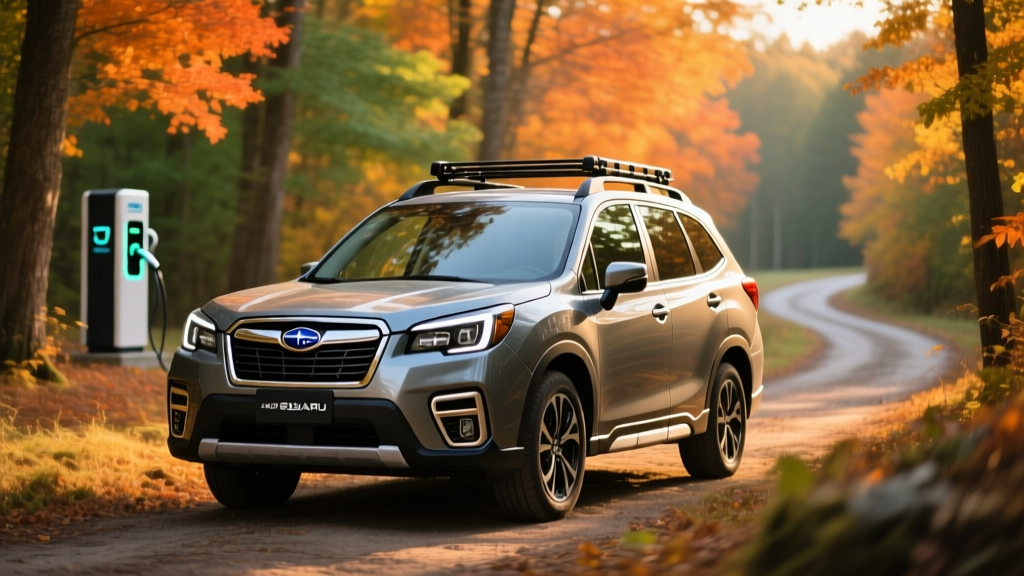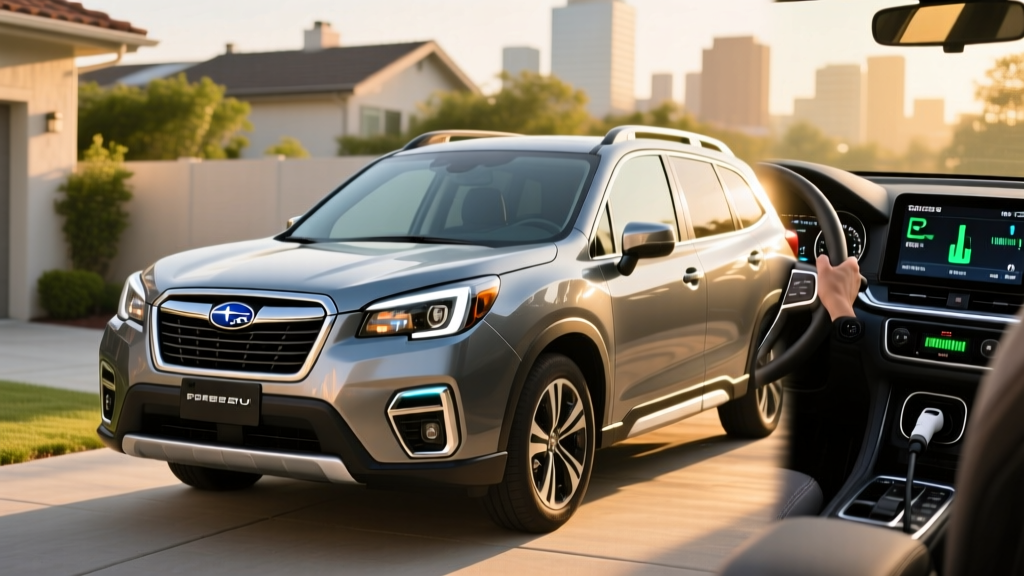
The 2025 Subaru Forester Hybrid marks the return of an electrified Forester to Subaru's U.S. lineup after a multi-year hiatus. Unlike the short-lived 2020–2022 Forester e-Boxer, the 2025 model uses a powertrain derived from Subaru's partnership with Toyota — specifically the hybrid system architecture shared with the Toyota RAV4 Hybrid. The result is a compact SUV that delivers meaningful fuel savings without requiring a plug, a charging routine, or a lifestyle change. For buyers weighing the 2025 hybrid Forester against fully electric alternatives or conventional gas models, the calculus comes down to daily mileage, charging access, and how much complexity you're willing to accept.
This guide covers every number that matters: EPA fuel economy, real-world MPG expectations, powertrain output, pricing by trim, battery warranty details, and how the Forester Hybrid stacks up against both plug-in hybrids and full battery-electric vehicles.
2025 Forester Hybrid EPA Fuel Economy and Real-World MPG
Subaru rates the 2025 Forester Hybrid at 35 MPG combined, with a city/highway split of 35 city / 34 highway. These figures apply across all available trims and assume the standard all-wheel-drive configuration — there is no front-wheel-drive variant.
| Driving Cycle | EPA Estimate | Real-World Expectation |
|---|---|---|
| City | 35 MPG | 36–39 MPG (hybrid advantage in stop-and-go) |
| Highway | 34 MPG | 30–33 MPG (aero drag, sustained speed) |
| Combined | 35 MPG | 33–36 MPG (mixed driving) |
| Cold Weather (below 32°F) | — | 28–31 MPG (engine runs more for cabin heat) |
The hybrid system's regenerative braking and electric-motor assist shine in city driving, where the gas engine shuts off frequently at stops and low speeds. In our experience with this Toyota-sourced hybrid architecture in the RAV4 Hybrid, real-world city MPG often exceeds the EPA estimate by 2–4 MPG — a rarity among powertrain types. Highway driving tells the opposite story: the boxy Forester profile and standard AWD create drag and parasitic losses that pull real-world highway numbers 2–4 MPG below the sticker.
Cold weather deserves special attention. Hybrid batteries are less efficient in freezing temperatures, and the engine must run more frequently to provide cabin heat (the Forester Hybrid lacks a heat pump). Expect a 10–15% fuel-economy penalty in sustained sub-freezing conditions.
Powertrain: Boxer Engine Meets Electric Motors
The 2025 Forester Hybrid pairs Subaru's naturally aspirated 2.5-liter flat-four (boxer) engine with two electric motor-generators and a lithium-ion battery pack mounted beneath the rear cargo floor. Power routes through a continuously variable transmission (CVT) to Subaru's Symmetrical All-Wheel Drive system.
| Specification | Detail |
|---|---|
| Engine | 2.5L flat-4 (boxer), Atkinson cycle |
| Engine Output | 163 hp / 156 lb-ft torque |
| Electric Motors | Two motor-generators (MG1: starter/generator; MG2: traction) |
| Electric Motor Output | ~88 kW (118 hp) peak from MG2 |
| Combined System Output | ~194 hp |
| Transmission | CVT (planetary gearset, e-CVT type) |
| Drivetrain | Symmetrical AWD (standard) |
| Hybrid Battery | ~1.1 kWh (sealed, NiMH or Li-ion pack) |
| 0–60 mph (est.) | ~7.8 seconds |
| Towing Capacity | 1,500 lbs |
| Cargo Volume (rear seats up) | ~26.9 cu ft |
The combined 194 hp represents a meaningful bump over the standard gas Forester's 180 hp. The electric motor's instant torque fills in the low-RPM gap that makes the base 2.5L feel sluggish off the line. Acceleration is confident for merging and passing, though this is not a performance-oriented SUV. The CVT keeps the engine in its efficient band, and Subaru has tuned the system to favor seamless transitions between electric and gas power rather than aggressive electric-only driving.
One important note: the hybrid battery pack is small (~1.1 kWh usable). This is a conventional hybrid (HEV), not a plug-in hybrid. The battery captures energy from regenerative braking and the engine to assist acceleration and enable brief low-speed electric-only movement. You never plug it in.
HEV vs PHEV vs EV: Which Forester Buyer Are You?
Subaru currently offers the Forester Hybrid only as a conventional hybrid (HEV). There is no Forester PHEV (plug-in hybrid) in the 2025 U.S. lineup, and Subaru has not announced one. If you're cross-shopping electrified compact SUVs, here's how the three powertrain types compare in practical terms:
| Factor | HEV (Forester Hybrid) | PHEV (e.g., RAV4 Prime) | Full EV (e.g., Ioniq 5) |
|---|---|---|---|
| Plug-in Required? | No | Yes (for EV range) | Yes (always) |
| Electric-Only Range | ~1 mile (low speed) | 35–42 miles | 250–320 miles |
| Total Range | ~434 miles | ~550+ miles | 250–320 miles |
| Home Charging Needed | No | Recommended (120V or 240V) | Essential (240V Level 2) |
| Combined MPG / MPGe | 35 MPG | 94 MPGe (electric) / 38 MPG (gas) | 110+ MPGe |
| Federal Tax Credit | None (§30D excludes HEVs) | Up to $7,500 (if eligible) | Up to $7,500 (if eligible) |
| Starting Price (approx.) | ~$36,000 | ~$44,000 | ~$42,000 |
| Best For | No charging access, simple ownership | Home charging + frequent short trips | Home charging + low running costs |
- You lack access to home or workplace charging
- You want lower fuel costs without changing your refueling habits
- You live in an apartment or street-park and can't install a charger
- You take frequent long road trips where charging infrastructure is sparse
- You want AWD and ~434 miles of range with zero planning
- You have a garage or driveway with a 120V or 240V outlet
- Your daily commute is under 40 miles round-trip (you'll rarely use gas)
- You want the flexibility of electric commuting and gas road trips
- You qualify for the federal PHEV tax credit
- You can install a Level 2 home charger
- Your daily driving is under 200 miles
- You want the lowest per-mile fuel cost and minimal maintenance
- You want access to HOV lanes and the full §30D tax credit
Pricing, Trims, and Tax Credit Eligibility
The 2025 Subaru Forester Hybrid is offered in a single, well-equipped trim in the U.S. market, positioned above the mid-range gas-only Forester Premium. Pricing is straightforward:
| Trim | MSRP (incl. destination) | Key Standard Features |
|---|---|---|
| Forester Hybrid | ~$36,495 | AWD, EyeSight, 12.3" display, wireless CarPlay/Android Auto, heated front seats, power liftgate |
Federal tax credit: The 2025 Forester Hybrid does not qualify for the IRS §30D Clean Vehicle Credit. Under current IRS rules, the §30D credit applies only to plug-in electric vehicles (BEVs and PHEVs) that meet battery-capacity, critical-mineral sourcing, MSRP cap, and buyer income requirements. Conventional hybrids like the Forester Hybrid are excluded.
Some states offer separate rebates for hybrid vehicles, though these are less common and less generous than EV incentives. Check your state's energy or environmental agency for current programs — eligibility varies widely and changes frequently.
Battery Warranty, Reliability, and Replacement Costs
Hybrid battery longevity is consistently the top concern among first-time hybrid buyers. Here's what Subaru covers and what real-world data shows:
The Toyota-sourced hybrid system in the Forester Hybrid benefits from decades of proven reliability. Toyota's hybrid synergy drive architecture — the basis for this system — has accumulated billions of real-world miles across the Prius, Camry Hybrid, and RAV4 Hybrid lineages. Failures before 150,000 miles are uncommon.
If the hybrid battery does require replacement out of warranty, expect a cost in the range of $2,000–$4,000 for the battery pack itself, plus labor. Third-party refurbishers and aftermarket options are increasingly available for Toyota-compatible hybrid packs, which can reduce costs further. For comparison, a conventional 12V starter battery replacement runs $150–$250.
Subaru's overall brand reliability has been mixed in recent years, with some models experiencing head-gasket and CVT concerns historically. The hybrid powertrain is a newer addition for the Forester, but its Toyota lineage provides a strong reliability pedigree. IIHS testing data and long-term fleet reports will provide more clarity as the model accumulates miles.
Driving Experience and Practical Ownership Notes
The 2025 Forester Hybrid drives like a slightly more refined version of the standard Forester. The electric motor smooths out acceleration from stops, the CVT is less prone to the "rubber-band" effect in Subaru's latest tuning, and cabin noise is modest. The hybrid system adds approximately 200 lbs over the gas model, which you'll notice in cornering but not in daily driving.
Subaru's EyeSight driver-assistance suite is standard, including adaptive cruise control, lane-keeping assist, pre-collision braking, and lane-departure warning. EyeSight is an SAE Level 2 system — it provides steering and speed assistance but requires the driver to remain fully engaged with hands on the wheel and eyes on the road at all times.
Ground clearance remains at a generous 8.7 inches, and X-Mode (Subaru's traction-management system) is included for snow, dirt, and deep-snow/mud conditions. The Forester Hybrid retains the practicality that defines the nameplate: excellent outward visibility, a tall cargo area, and a comfortable, upright seating position.
Pros
- 35 MPG combined with no plug-in requirement
- Standard AWD across all trims
- Toyota-derived hybrid system with strong reliability record
- 8.7" ground clearance and X-Mode for light off-road use
- 194 hp combined — noticeably quicker than gas Forester
- 8-year/100,000-mile hybrid battery warranty
Cons
- No federal tax credit eligibility
- Highway MPG trails city MPG (aero penalty)
- Only one hybrid trim available — limited option flexibility
- No PHEV variant for electric-only commuting
- 1,500-lb towing capacity (lower than some competitors)
- Cold-weather MPG drop of 10–15%
How the Forester Hybrid Compares to Key Rivals
The compact hybrid SUV segment is competitive. Here's how the 2025 Forester Hybrid stacks up on the numbers that matter:
| Model | Combined MPG | Combined HP | AWD Standard? | Starting MSRP |
|---|---|---|---|---|
| Subaru Forester Hybrid | 35 | 194 | Yes | ~$36,495 |
| Toyota RAV4 Hybrid | 39–41 | 219 | Yes | ~$34,500 |
| Honda CR-V Hybrid | 37–40 | 204 | Yes (Sport trims) | ~$35,500 |
| Ford Escape Hybrid | 37–39 | 192 | Optional | ~$34,000 |
The Forester Hybrid trails the RAV4 Hybrid on fuel economy by 4–6 MPG combined but offers standard AWD (the RAV4 Hybrid also includes it), more ground clearance, and Subaru's safety-focused reputation. The CR-V Hybrid is a close competitor with slightly better MPG. If fuel economy is your single priority, the RAV4 Hybrid wins on paper. If you value all-weather capability, visibility, and off-pavement confidence, the Forester Hybrid's trade-off is defensible.
Forester Hybrid FAQ
How many MPG does the 2025 Forester Hybrid get?
The EPA rates the 2025 Forester Hybrid at 35 MPG combined (35 city / 34 highway). In real-world city driving, owners often see 36–39 MPG thanks to regenerative braking. Highway driving typically yields 30–33 MPG. Cold weather reduces efficiency by 10–15%.
Does the Forester Hybrid need to be plugged in?
No. The 2025 Forester Hybrid is a conventional hybrid (HEV). It charges its small battery pack through regenerative braking and the gas engine. You never plug it in. You simply refuel at a gas station as you would with any conventional vehicle.
Is there a Forester PHEV (plug-in hybrid)?
Not for 2025. Subaru has not announced a plug-in hybrid Forester for the U.S. market. If you want a compact SUV PHEV with electric-only commuting range, the Toyota RAV4 Prime (42 miles electric) or Ford Escape PHEV (37 miles electric) are the closest alternatives.
Does the 2025 Forester Hybrid qualify for a federal tax credit?
No. The IRS §30D Clean Vehicle Credit applies only to plug-in electric vehicles (BEVs and PHEVs). Conventional hybrids like the Forester Hybrid are not eligible. Some states may offer separate hybrid incentives — check your state's energy agency for current programs.
How long will the hybrid battery last?
Subaru warranties the hybrid battery for 8 years / 100,000 miles (10 years / 150,000 miles in CARB states). Based on the Toyota hybrid system's track record, many hybrid batteries last 150,000–200,000+ miles before needing replacement. Out-of-warranty replacement costs approximately $2,000–$4,000.
Is the Forester Hybrid reliable?
The hybrid powertrain is derived from Toyota's extensively proven hybrid system, which has demonstrated strong long-term reliability across millions of vehicles. Subaru's overall brand reliability has been average to slightly below average in recent surveys, but the hybrid-specific components carry a strong pedigree. Long-term Forester Hybrid data will become available as the model accumulates fleet miles.
Can the Forester Hybrid tow?
Yes, but modestly. The 2025 Forester Hybrid has a maximum towing capacity of 1,500 lbs — suitable for a small utility trailer or a pair of dirt bikes, but not a boat or camper. This is lower than the gas-only Forester's 1,500-lb rating (same) and trails competitors like the RAV4 Hybrid (1,750 lbs).
Is Subaru EyeSight self-driving?
No. EyeSight is an SAE Level 2 driver-assistance system. It provides adaptive cruise control, lane-centering, and automatic emergency braking, but the driver must remain fully attentive, keep hands on the steering wheel, and be prepared to take over at any moment. It is not autonomous or self-driving.
Sources: EPA fuel economy data via fueleconomy.gov; Subaru of America official specifications; IRS §30D Clean Vehicle Credit guidelines via irs.gov.