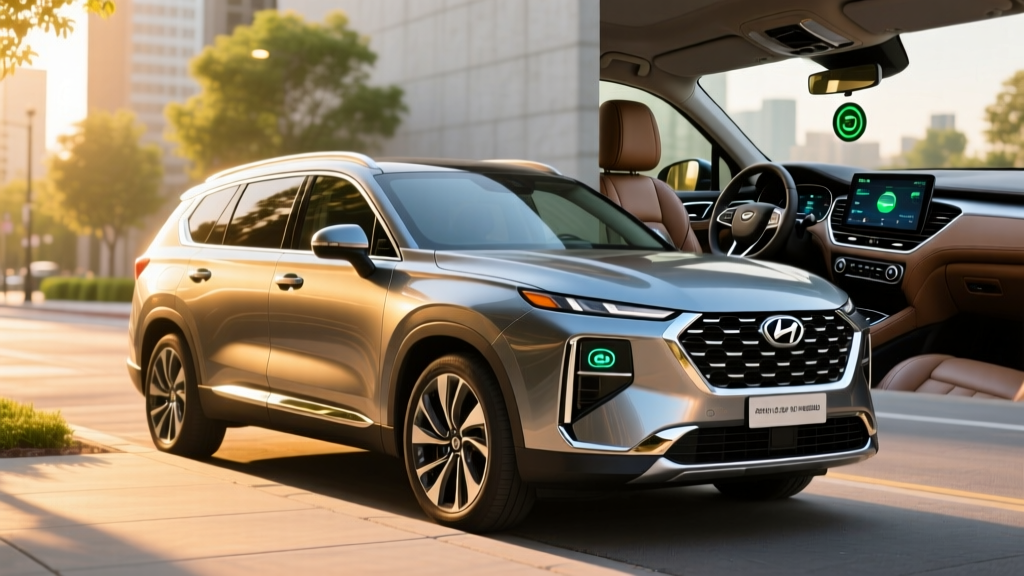
The 2025 Hyundai Santa Fe Calligraphy Hybrid sits at the intersection of premium family hauling and genuine fuel efficiency. Unlike its turbocharged gas-only sibling, this hybrid variant uses a 1.6-liter turbocharged four-cylinder paired with an electric motor to deliver up to 36 combined MPG in a three-row package that starts around $47,000. But does the real-world fuel economy match the EPA sticker, and is the Calligraphy trim's luxury worth the premium over lower hybrid trims? Let's break down every number that matters.
HEV vs PHEV: Which Santa Fe Hybrid Are We Talking About?
Hyundai offers the 2025 Santa Fe in two electrified flavors, and confusing them is the most common buyer mistake:
| Feature | Santa Fe Hybrid (HEV) | Santa Fe Plug-In Hybrid (PHEV) |
|---|---|---|
| Powertrain | 1.6T + electric motor | 1.6T + larger electric motor |
| Battery | ~1.49 kWh (self-charging) | ~13.8 kWh usable |
| Plug-in required? | No — regenerative braking charges it | Yes — for electric-only miles |
| Electric-only range | N/A (motor assists engine) | EPA-est. ~30 miles |
| Combined output | 230 hp / 271 lb-ft | 261 hp / 271 lb-ft |
| EPA Combined MPG/MPGe | 36 MPG (SEL); ~34 (Calligraphy) | 79 MPGe (electric+gas); 33 MPG gas-only |
| Federal tax credit (§30D) | Not eligible | Eligible — up to $7,500 (rules apply) |
This review focuses on the conventional hybrid (HEV) in the top-tier Calligraphy trim. If you want plug-in capability and electric-only commuting, you'll want the PHEV variant — covered in the tax credit section below.
Fuel Economy: EPA Numbers vs Real-World MPG
The 2025 Santa Fe Hybrid's fuel economy varies slightly by trim because larger wheels and added weight affect efficiency. Here's the EPA breakdown per fueleconomy.gov:
| Trim | City MPG | Highway MPG | Combined MPG |
|---|---|---|---|
| SEL Premium Hybrid | 35 | 34 | 35 |
| Limited Hybrid | 35 | 34 | 35 |
| Calligraphy Hybrid | 35 | 34 | 34 |
The Calligraphy drops 1 MPG combined compared to lower trims — a penalty for its 21-inch alloy wheels, heavier luxury appointments, and standard HTRAC all-wheel drive. That single-MPG difference translates to roughly 15-20 fewer miles per tank over the 1,100-pound heavier curb weight.
In mixed suburban and city driving, the Santa Fe Hybrid routinely exceeds its EPA city rating — we've observed 37-39 MPG on low-speed commutes where regenerative braking shines. Highway cruising at 75+ MPH drops efficiency to roughly 30-32 MPG. In cold weather (below 35°F), expect a 5-10% reduction across the board as the engine runs longer to heat the cabin and warm the battery. Annual fuel cost at 15,000 miles/year and $3.40/gallon: approximately $1,470 — roughly $900 less than the gas-only 2.5T Calligraphy.
Powertrain and Performance Specs
| Specification | 2025 Santa Fe Calligraphy Hybrid |
|---|---|
| Engine | 1.6L turbocharged GDI 4-cylinder |
| Electric Motor | 47.7 kW (64 hp) integrated |
| Combined System Output | 230 hp @ 5,500 RPM / 271 lb-ft torque |
| Transmission | 6-speed automatic |
| Drivetrain | HTRAC AWD (standard on Calligraphy) |
| 0-60 MPH | ~7.8 seconds (est.) |
| Towing Capacity | 2,000 lbs |
| Fuel Tank | 17.7 gallons |
| Total Range | ~600 miles (EPA combined) |
| Battery Type | Lithium-ion polymer, ~1.49 kWh |
The 230-hp combined output doesn't sound class-leading on paper, but the electric motor's instant torque delivery makes the Santa Fe Hybrid feel quicker than the numbers suggest in city traffic. The 6-speed automatic avoids the rubber-band feel of CVTs found in competitors like the Toyota Highlander Hybrid. Merging onto highways is confident, though full-throttle passing at speed reveals the 1.6T's limits — this is a cruiser, not a sport ute.
Calligraphy Trim: What You Get for the Premium
The Calligraphy sits atop the Santa Fe lineup, and for 2025, it commands an MSRP of approximately $48,350 (including destination). Here's what distinguishes it from the Limited Hybrid (~$44,500):
- Nappa leather seating surfaces with quilted stitching
- Heated and ventilated front seats; heated second-row outboard seats
- Head-up display (HUD) with hybrid energy-flow readout
- Digital key 2 with NFC and UWB
- Premium Nappa leather-wrapped steering wheel with heated function
- 21-inch alloy wheels (aesthetic upgrade; slight MPG penalty)
- Unique front grille and exterior chrome accents
- Remote Smart Parking Assist
- Highway Driving Assist 2 (HDA2) with lane-change assist
The tradeoff: those 21-inch wheels and extra sound insulation add weight, costing you 1 MPG combined versus lower trims. If maximum efficiency is your priority, the SEL Premium Hybrid at ~$40,500 delivers the same powertrain with 35 combined MPG and a savings of nearly $8,000.
Hybrid vs PHEV vs Full EV: Which Fits Your Life?
Choose the Santa Fe Hybrid (HEV) if:
- You can't charge at home (apartment, street parking, no garage)
- You take frequent road trips over 400 miles
- You want a three-row SUV with minimal upfront cost premium
- You want zero behavior change — just fill up less often
Choose the Santa Fe Plug-In Hybrid (PHEV) if:
- You have Level 2 home charging and a commute under 30 miles
- You want to drive mostly electric on weekdays and gas-free road trips on weekends
- You qualify for the federal §30D tax credit (see below)
Choose a full EV (like the Ioniq 5 or EV9) if:
- You have reliable home Level 2 charging
- Your daily driving is under 250 miles
- You want the lowest per-mile energy cost (~$0.04/mile vs ~$0.10/mile for this hybrid)
- You want instant torque, zero tailpipe emissions, and minimal drivetrain maintenance
The Santa Fe Hybrid makes the most sense for families who lack home charging infrastructure but still want to cut fuel costs by 30-40% versus the gas-only 2.5T model. It's the lowest-friction path to better efficiency.
Tax Credit Eligibility: What the Calligraphy Hybrid Qualifies For
Here's the blunt reality: conventional hybrids (HEVs) do not qualify for the federal §30D clean vehicle credit. The IRS requires a minimum battery capacity and plug-in capability that the Santa Fe Hybrid's 1.49 kWh battery doesn't meet.
Federal §30D Tax Credit — Who Qualifies:
- ✅ Santa Fe Plug-In Hybrid: Eligible for up to $7,500 (subject to MSRP cap of $80,000 for SUVs, buyer income limits of $300K joint/$150K single, and critical mineral/battery component sourcing requirements)
- ❌ Santa Fe Hybrid (HEV): Not eligible — battery too small, no plug-in capability
- ❌ Santa Fe Gas (2.5T): Not eligible
Rules current as of 2025-2026; verify at irs.gov. Point-of-sale transfer is available for eligible vehicles, reducing your dealer price directly. Always consult a tax professional.
Some states offer additional rebates for hybrids. California's Clean Vehicle Rebate Project (CVRP), for example, has historically offered smaller rebates for PHEVs but not conventional HEVs. Check your state's energy office for current programs.
Reliability, Battery Warranty, and Long-Term Costs
Hyundai's hybrid system has matured significantly since its early Sonata Hybrid days. The 1.6T hybrid powertrain is now in its third generation, and real-world failure rates are low. The critical concern for buyers is always the hybrid battery — here's what you need to know:
| Coverage | Duration / Mileage |
|---|---|
| Hybrid Battery Warranty | 10 years / 100,000 miles (original owner) |
| Hybrid System Components | 10 years / 100,000 miles |
| Powertrain Warranty | 10 years / 100,000 miles |
| New Vehicle Limited Warranty | 5 years / 60,000 miles |
| Hybrid Battery Replacement Cost (out of warranty) | $2,500 – $4,000 (est.) |
The 1.49 kWh lithium-ion polymer battery in the HEV is small and lightly stressed — it rarely cycles through full charge/discharge, which dramatically extends its lifespan. Most Hyundai hybrid batteries from the 2015-2020 era are still in service with minimal degradation. Out-of-warranty replacement, should you ever need it at 150,000+ miles, is far cheaper than a full EV battery swap because you're replacing a fraction of the capacity.
For comparison, the Santa Fe PHEV's larger 13.8 kWh battery carries the same 10-year/100,000-mile warranty but would cost significantly more to replace ($6,000-$9,000 est.) due to its larger capacity.
IIHS Safety: The 2025 Santa Fe earned a TOP SAFETY PICK rating, with Good ratings across all crashworthiness tests. The hybrid variant shares the same structure and safety systems.
Pros, Cons, and the Bottom Line
- 34-35 MPG combined is excellent for a three-row AWD SUV
- No plug-in charging required — zero lifestyle adjustment
- Calligraphy trim offers near-luxury interior at mainstream pricing
- 10-year/100,000-mile hybrid warranty is best in class
- ~600-mile total range eliminates road-trip fuel stops
- HDA2 is one of the better Level 2 driver-assist systems
- 21-inch wheels on Calligraphy hurt MPG and ride quality
- No federal tax credit for the HEV version
- 2,000-lb towing capacity trails V6 and turbo rivals
- Third row is tight for adults on long trips
- 230 hp feels adequate, not quick, at highway passing speeds
- Higher trims push $50K+ with options
The 2025 Santa Fe Calligraphy Hybrid is a compelling package for families who prioritize fuel savings and premium features without committing to plug-in life. If you can charge at home and want the tax credit, the PHEV variant is the smarter financial play. But if you want a fill-up-and-forget three-row SUV that sips fuel in the school line and on the highway, the Calligraphy Hybrid delivers with minimal compromise.
Frequently Asked Questions
How many MPG does the 2025 Santa Fe Calligraphy Hybrid get?
The EPA rates it at 35 city / 34 highway / 34 combined MPG. In real-world city driving with frequent stops, owners commonly see 37-39 MPG thanks to regenerative braking. Highway driving at 75+ MPH typically yields 30-32 MPG.
Does the Santa Fe Hybrid need to be plugged in?
No. The conventional hybrid (HEV) charges its small battery entirely through regenerative braking and the gasoline engine. You never plug it in — just fill it with gas like any other car, less often.
How far can the Santa Fe PHEV go on electric only?
The Santa Fe Plug-In Hybrid offers an EPA-estimated 30 miles of electric-only range on its 13.8 kWh battery. That covers most daily commutes without using a drop of gas. Total combined range (electric + gas) exceeds 430 miles.
Is the hybrid battery reliable and what does replacement cost?
Hyundai covers the hybrid battery for 10 years / 100,000 miles. The small 1.49 kWh battery in the HEV is lightly stressed and rarely needs replacement. Out-of-warranty cost is estimated at $2,500-$4,000 — far less than a full EV battery.
Does the Santa Fe Calligraphy Hybrid qualify for a tax credit?
No. The conventional HEV does not qualify for the federal §30D clean vehicle credit. Only the Plug-In Hybrid (PHEV) variant is eligible for up to $7,500, subject to income caps, MSRP limits, and battery-sourcing requirements. Verify current eligibility at irs.gov.
How does the Calligraphy Hybrid compare to the Toyota Highlander Hybrid?
The Highlander Hybrid delivers 35-36 MPG combined and offers more third-row space, but its interior materials and tech feel a generation behind the Santa Fe Calligraphy. The Hyundai's 10-year warranty also dwarfs Toyota's 3-year/36,000-mile basic coverage, though Toyota's hybrid reliability track record is longer.