Quick Verdict: A Practical Bridge Between Gas and Electric
The 2025 Mitsubishi Outlander Plug-In Hybrid occupies a specific niche: families who want daily electric commuting without surrendering the flexibility of a gasoline engine for road trips. With an EPA-rated 38 miles of electric-only range, a combined 248 horsepower, and standard all-wheel drive, it's one of the few PHEVs in the compact SUV segment that also offers DC fast charging — a genuine advantage for apartment dwellers or road-trippers who can't rely solely on overnight Level 2 charging.
Starting at $40,495 (ES trim, including destination), the Outlander PHEV undercuts competitors like the Toyota RAV4 Prime on price while delivering competitive electric range. Whether it qualifies for the federal §30D tax credit depends on battery sourcing, your income, and point-of-sale transfer rules that remain in flux for 2025. Here's every number you need to make the call.
HEV vs. PHEV: What's the Actual Difference?
Mitsubishi sells the Outlander in two electrified forms, and confusing them is a common buyer mistake:
| Attribute | Outlander HEV (Conventional Hybrid) | Outlander PHEV (Plug-In Hybrid) |
|---|---|---|
| Plug-in charging | No — charges via regenerative braking and engine | Yes — plug in to access full 38-mile EV range |
| Battery capacity | ~1.5 kWh (small buffer) | 20.0 kWh usable (22.7 kWh gross) |
| Electric-only range | Less than 1 mile at low speed | 38 miles (EPA) |
| Combined horsepower | 214 hp | 248 hp |
| DC fast charging | No | Yes (CHAdeMO) |
| Starting MSRP (2025) | ~$35,445 | $40,495 |
If you can charge at home or at work, the PHEV's larger battery and electric range make it the superior daily driver. If you lack any plug-in access, the conventional HEV still delivers strong fuel economy without lifestyle changes.
EPA Fuel Economy and Electric Range: The Numbers
| Metric | EPA Rating |
|---|---|
| MPGe (combined, electric + gas) | 64 MPGe |
| MPG combined (gas-only, battery depleted) | 26 MPG |
| MPG city (gas-only) | 25 MPG |
| MPG highway (gas-only) | 27 MPG |
| Electric-only range | 38 miles |
| Total combined range (EV + gas) | ~420 miles |
| Fuel tank capacity | 14.8 gallons |
Source: fueleconomy.gov — 2025 Mitsubishi Outlander PHEV
Powertrain and Performance Specs
| Specification | 2025 Outlander PHEV |
|---|---|
| Engine | 2.4L 4-cylinder Atkinson-cycle |
| Engine output | 126 hp / 147 lb-ft |
| Front electric motor | 114 hp / 188 lb-ft |
| Rear electric motor | 134 hp / 144 lb-ft |
| Combined system output | 248 hp |
| Drivetrain | S-AWC (twin-motor AWD, standard) |
| Battery (gross / usable) | 22.7 kWh / 20.0 kWh |
| Battery chemistry | Lithium-ion (NMC) |
| 0–60 mph (est.) | ~7.0 seconds |
| Towing capacity | 1,500 lbs |
| Cargo volume (behind 2nd row) | 33.5 cu ft |
The twin-motor all-wheel-drive system (Mitsubishi calls it S-AWC) is standard on every PHEV trim — no FWD base model exists. This gives the Outlander PHEV genuine traction credibility in snow and rain, with torque vectoring to the rear axle when needed.
Charging: Speeds, Connectors, and the DC Fast-Charging Advantage
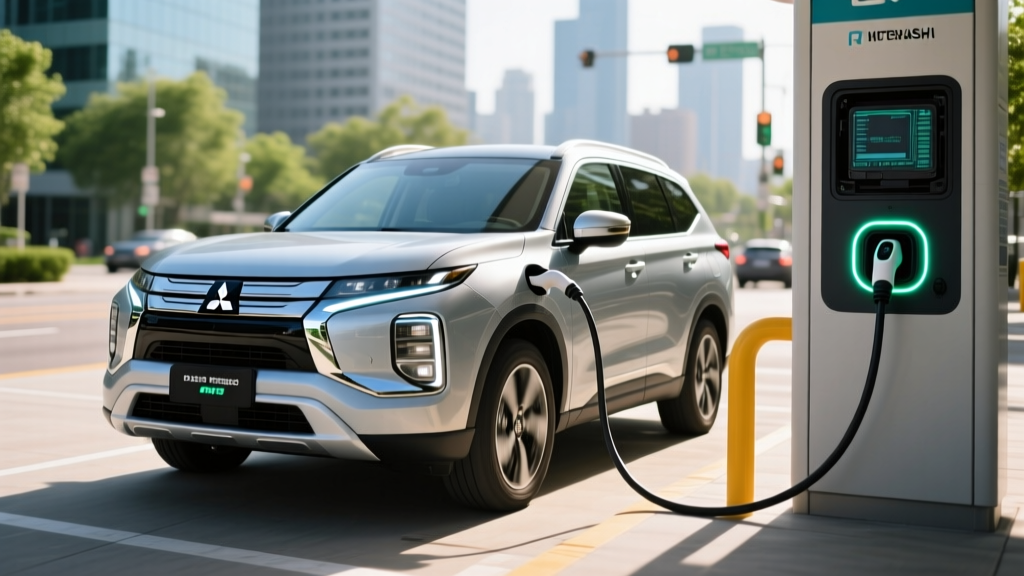
Charging capability is where the Outlander PHEV separates itself from most plug-in hybrid competitors. Most PHEVs in this segment (including the RAV4 Prime) only accept Level 2 AC charging. The Outlander PHEV adds DC fast charging via a CHAdeMO connector.
| Charging Level | Power / Connector | 0–100% Time | Notes |
|---|---|---|---|
| Level 1 (120V household) | ~1.4 kW / J1772 | ~15 hours | Emergency/trickle only |
| Level 2 (240V home/public) | ~3.3 kW / J1772 | ~6.5 hours | Overnight home charging |
| DC Fast Charge | Up to 22 kW / CHAdeMO | 0–80% in ~38 min | CHAdeMO — not CCS or NACS |
Important CHAdeMO caveat: The CHAdeMO connector is a legacy DC standard. Tesla Superchargers use NACS, and most new public DC stations (Electrify America, EVgo) use CCS1. CHAdeMO infrastructure is shrinking in the U.S. — you'll find it at some older stations and certain regional networks, but availability is declining. If DC fast charging is critical to your use case, verify CHAdeMO station density in your area via the Alternative Fuels Data Center before purchasing.
For most PHEV owners, Level 2 home charging is the primary method. A standard 240V outlet or dedicated Level 2 charger replenishes the 20 kWh usable battery in about 6.5 hours — easily overnight.
Pricing, Trims, and Federal Tax Credit Eligibility
The 2025 Outlander PHEV is offered in four trims:
- ES: $40,495
- SE: $43,495
- SEL: $46,995
- SEL Platinum Edition: ~$49,000
All prices include destination. The SE and above add features like heated seats, a power liftgate, and Mitsubishi's MI-PILOT Assist (a Level 2 driver-assistance suite — not autonomous driving).
Does It Qualify for the Federal §30D Tax Credit?
This is the most complex question for any PHEV buyer in 2025. The IRS §30D Clean Vehicle Credit can provide up to $7,500, but eligibility depends on multiple overlapping requirements:
- Battery sourcing: A percentage of critical minerals and battery components must be sourced from the U.S. or free-trade-agreement countries. These thresholds increase annually. Mitsubishi has not publicly confirmed full compliance for the 2025 Outlander PHEV — verify current status at IRS qualified vehicle list.
- MSRP cap: SUVs must be under $80,000 MSRP. The Outlander PHEV clears this easily.
- Buyer income cap: AGI must not exceed $150,000 (single), $225,000 (head of household), or $300,000 (joint).
- Point-of-sale transfer: As of 2024, eligible buyers can transfer the credit to the dealer for an immediate price reduction at purchase — but only if the vehicle qualifies at the time of sale.
- Final assembly: Must occur in North America. The Outlander PHEV is assembled in Okazaki, Japan — this likely disqualifies it from the new-vehicle §30D credit.
Battery Warranty, Reliability, and Long-Term Costs
- Powertrain warranty: 10 years / 100,000 miles
- PHEV battery warranty: 10 years / 100,000 miles (capacity retention above 70%)
- Basic bumper-to-bumper: 5 years / 60,000 miles
- Roadside assistance: 5 years / unlimited miles
Mitsubishi's 10-year/100,000-mile powertrain and battery warranty is one of the longest in the industry, matching Hyundai and Kia. The PHEV battery warranty guarantees that the pack will retain at least 70% of its original capacity during the coverage period. If degradation drops below that threshold, Mitsubishi will repair or replace the battery at no cost.
Battery Replacement Cost
If the battery needs replacement outside warranty coverage, expect a cost between $6,000 and $9,000 for the pack plus labor. This is lower than a full BEV replacement because the PHEV battery is smaller (22.7 kWh gross vs. 60–100+ kWh in a pure EV). In practice, PHEV batteries from Mitsubishi's earlier generations (2014–2020 Outlander PHEV) have shown gradual but manageable degradation — typically 10–15% capacity loss over 8–10 years.
Reliability Track Record
The Outlander PHEV's powertrain is well-proven. Mitsubishi has been building this plug-in hybrid system since 2013 (first generation launched in Japan), making it one of the oldest continuously produced PHEV platforms globally. The current-generation 2.4L Atkinson-cycle engine and twin-motor layout debuted for the 2023 model year in the U.S. Long-term reliability data for this specific generation is still building, but the underlying architecture has a strong track record. IIHS has rated the Outlander (gas version) as a Top Safety Pick+; the PHEV shares the same structure.
Real-World MPG: What Owners Actually See
The EPA rates the Outlander PHEV at 26 MPG combined when operating on gasoline alone (battery depleted). In real-world use:
- City driving (battery depleted): 24–27 MPG — regenerative braking recovers energy in stop-and-go traffic, often matching or slightly exceeding the EPA city figure.
- Highway driving (battery depleted): 25–28 MPG — the Atkinson-cycle engine is tuned for efficiency at steady speeds.
- With regular plug-in charging: Many owners report using gasoline for only 10–20% of total miles, effectively achieving 80–100+ MPGe on a blended basis.
The key insight: a PHEV's real-world efficiency is almost entirely determined by how often you charge it. Plug in nightly for a 20-mile commute, and you'll visit a gas station a few times a year. Never plug in, and you're driving a 26-MPG compact SUV — still respectable for an AWD vehicle of this size, but you're leaving the PHEV's best feature on the table.
Outlander PHEV vs. Full EV vs. Conventional Hybrid: Which Fits You?
- You can charge at home (Level 1 or 2) and your daily driving is under 40 miles
- You take road trips of 200+ miles and don't want to plan around charging stations
- You need AWD for snow/rain but want some electric operation
- You're not ready to commit to a full EV due to apartment living or unreliable charging access
- You have reliable home Level 2 charging
- Your daily driving is under 250 miles and you're comfortable with public DC charging for road trips
- You want zero tailpipe emissions, lower per-mile fuel costs, and minimal maintenance
- You want access to the full $7,500 federal credit (more EVs qualify than PHEVs)
- You have no ability to plug in at home or work
- You want better fuel economy than a gas SUV without changing your habits
- Lower purchase price is a priority (~$5,000 less than the PHEV)
Pros and Cons at a Glance
Pros
- 38-mile EV range covers most daily commutes
- Standard twin-motor AWD on every trim
- DC fast charging (CHAdeMO) — rare for PHEVs
- 10-year/100,000-mile powertrain & battery warranty
- Three rows of seating (compact PHEV competitors offer only two)
- Competitive starting price vs. RAV4 Prime
Cons
- CHAdeMO DC connector is a shrinking standard
- Gas-only MPG (26 combined) is average, not class-leading
- Assembled in Japan — likely ineligible for federal §30D credit
- Level 2 AC charging limited to 3.3 kW (slower than some PHEVs)
- Towing capacity only 1,500 lbs
- Third row is cramped — best for small children only
Frequently Asked Questions
How many MPG does the 2025 Outlander PHEV get?
The EPA rates it at 64 MPGe combined when using both electric and gas power. Once the battery is depleted, it operates as a conventional hybrid at 26 MPG combined (25 city / 27 highway). Real-world gas-only MPG typically ranges from 24–28 depending on conditions.
How far can the Outlander PHEV go on electric only?
The EPA rates it at 38 miles of electric-only range. In cold weather (below 40°F), expect 30–34 miles. At sustained highway speeds above 70 mph, expect 28–32 miles. The total combined range (electric + full gas tank) is approximately 420 miles.
Does the 2025 Outlander PHEV qualify for the federal tax credit?
Likely not. The §30D credit requires North American final assembly, and the Outlander PHEV is built in Japan. Always verify current eligibility on the IRS qualified vehicle list. State-level incentives may still apply.
Is the Outlander PHEV reliable, and what does a battery replacement cost?
Mitsubishi's PHEV system has been in production since 2013 and has a strong reliability track record. The battery is covered by a 10-year/100,000-mile warranty. Out-of-warranty replacement costs approximately $6,000–$9,000 including labor.
Can I charge the Outlander PHEV at a Tesla Supercharger?
No. The Outlander PHEV uses a J1772 connector for Level 2 AC charging and a CHAdeMO connector for DC fast charging. Tesla Superchargers use the NACS connector and are not compatible. You'll use public networks like ChargePoint, EVgo, or Electrify America (for Level 2) and CHAdeMO-equipped stations (for DC fast charging).
How long does it take to charge at home?
On a standard 120V household outlet (Level 1), a full charge takes approximately 15 hours. On a 240V Level 2 home charger, it takes about 6.5 hours. Most owners plug in overnight and wake up to a full battery every morning.
Is the Outlander PHEV better than the RAV4 Prime?
It depends on priorities. The Toyota RAV4 Prime offers more electric range (42 miles EPA), higher gas-only MPG (38 combined), and more horsepower (302 hp), but starts at a higher MSRP (~$44,000) and has faced persistent availability issues with dealer markups. The Outlander PHEV is more affordable, offers DC fast charging (RAV4 Prime does not), and includes a third row. If you prioritize efficiency and power, the RAV4 Prime wins on paper. If you prioritize value and charging flexibility, the Outlander PHEV is the stronger pick.