Quick Verdict: The 2025 Mitsubishi Outlander Plug-In Hybrid
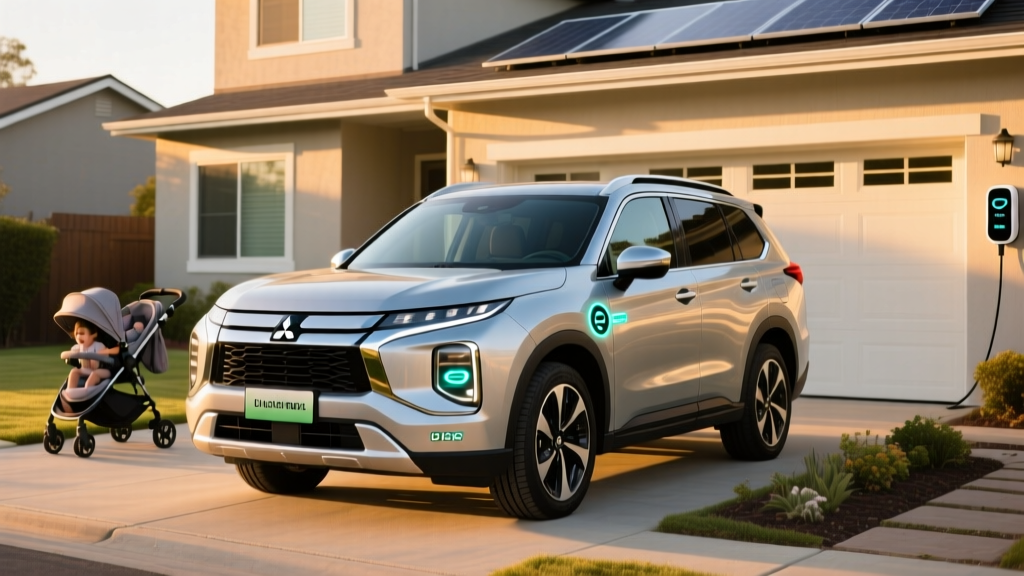
The 2025 Mitsubishi Outlander Plug-In Hybrid occupies a specific niche: a three-row compact SUV that lets you commute on electricity and road-trip on gasoline without compromise. With an EPA-rated 38 miles of electric-only range and standard Super All-Wheel Control (S-AWC), it targets families who want EV-like daily driving but aren't ready to depend entirely on public charging infrastructure. The question isn't whether it's a good PHEV — it's whether a PHEV is the right electrified vehicle for your situation.
After examining the powertrain specs, real-world efficiency data, charging behavior, and ownership economics, here's what buyers need to know before signing the paperwork.
HEV vs PHEV vs EV: Where the Outlander PHEV Fits
Before diving into specs, let's clarify the three electrified powertrain types, because Mitsubishi sells both a conventional hybrid and a plug-in hybrid version of the Outlander, and the distinction matters enormously for your wallet and daily routine.
| Powertrain Type | How It Charges | Electric-Only Driving | Plug Required? |
|---|---|---|---|
| HEV (Conventional Hybrid) | Regenerative braking + engine | Very short distances at low speed (~1 mi) | No |
| PHEV (Plug-In Hybrid) | Plug-in + regen + engine | 38 miles EPA (Outlander PHEV) | Yes, for EV range |
| BEV (Battery Electric) | Plug-in + regen only | Full range (200-400+ mi typical) | Yes, always |
The conventional Outlander Hybrid (HEV) does not plug in. It uses a small battery recharged by regenerative braking and the gasoline engine to assist acceleration and enable brief electric-only creep. You'll never see a charging port on it.
The 2025 Outlander PHEV carries a much larger 22.7 kWh battery (gross) that you charge via a plug — either a standard 120V household outlet (Level 1) or a 240V Level 2 charger. Once that battery is depleted, the 2.4-liter gasoline engine kicks in and it operates like a conventional hybrid for the remainder of your trip.
EPA Range, MPGe, and Fuel Economy: The Numbers
The 2025 Outlander PHEV carries two sets of efficiency numbers depending on whether you're running on battery or gasoline:
| Metric | EPA Rating | Real-World Expectation |
|---|---|---|
| Electric-only range | 38 miles | 30–35 mi (highway/cold); 38–42 mi (city/mild weather) |
| Combined MPGe (electric mode) | 64 MPGe | Varies heavily with driving style and climate |
| Gas-only combined MPG | 26 MPG | 24–27 MPG mixed; up to 28 highway cruise |
| Gas-only city MPG | 25 MPG | 24–26 MPG |
| Gas-only highway MPG | 27 MPG | 26–28 MPG at 65–70 mph |
| Total combined range | ~420 miles | 380–440 mi depending on conditions |
Real-world context: In city-heavy commuting with mild temperatures, many Outlander PHEV owners report exceeding the 38-mile electric range, sometimes reaching 40–42 miles before the engine fires. Highway driving at 70+ mph, aggressive acceleration, and cold weather (below 40°F) compress that range to 28–33 miles. The gasoline engine's 26 MPG combined is respectable for a 4,600-lb AWD SUV, though it won't beat a RAV4 Hybrid or CR-V Hybrid once the battery is depleted.
According to fueleconomy.gov, the 2025 Outlander PHEV's 64 MPGe rating reflects energy consumption during charge-depleting (electric) operation. Once the battery is empty, efficiency drops to the 26 MPG gas-only figure — which is why daily plugging in is essential to capture the PHEV's value proposition.
Powertrain Specs: What Moves the Outlander PHEV
| Specification | 2025 Outlander PHEV |
|---|---|
| Engine | 2.4L 4-cylinder Atkinson cycle |
| Engine output | 126 hp / 147 lb-ft |
| Front electric motor | 114 hp / 188 lb-ft |
| Rear electric motor | 134 hp / 144 lb-ft |
| Combined system output | 248 hp / 332 lb-ft (estimated) |
| Battery (gross / usable) | 22.7 kWh / ~20.0 kWh |
| Battery chemistry | Lithium-ion (NMC) |
| Drivetrain | S-AWC (twin-motor AWD, no mechanical driveshaft) |
| 0–60 mph | ~7.1 seconds (est.) |
| Towing capacity | 1,500 lbs |
| Seating | Three rows / 7 passengers |
The Outlander PHEV's powertrain architecture is unusual: the rear wheels are driven exclusively by the rear electric motor, with no mechanical connection to the engine. This twin-motor AWD system provides instant torque to all four wheels in electric mode and can seamlessly blend engine power to the front axle during hybrid operation. The result is confident traction in rain and light snow, though the 1,500-lb towing limit means this isn't a hauler.
Charging: Speeds, Connectors, and the DC Fast-Charge Advantage
The 2025 Outlander PHEV is one of the few plug-in hybrids on the market that supports DC fast charging — a significant practical advantage for apartment dwellers or road-trippers who can't rely solely on overnight Level 2 charging.
| Charging Level | Power (kW) | Connector | 0–100% Time | Practical Notes |
|---|---|---|---|---|
| Level 1 (120V household) | ~1.4 kW | J1772 | ~17 hours | Emergency/overnight top-up only |
| Level 2 (240V home/public) | ~3.6 kW (onboard charger limit) | J1772 | ~6.5 hours | Standard overnight charge; full battery by morning |
| DC Fast Charge | Up to ~22 kW peak | CHAdeMO | 0–80% in ~38 min | Rare among PHEVs; uses CHAdeMO connector (not CCS/NACS) |
Important connector note: The Outlander PHEV uses the CHAdeMO DC fast-charging standard, not CCS or the newer NACS (Tesla) connector. CHAdeMO infrastructure is declining in the U.S. as networks prioritize CCS and NACS. Before relying on DC fast charging, verify that your local public stations still offer CHAdeMO connectors. Networks like Electrify America have largely phased out CHAdeMO, while some older EVgo and Blink stations retain it.
The onboard Level 2 charger is limited to approximately 3.6 kW, meaning even a 48-amp Level 2 home charger won't speed things up — the vehicle caps the intake. A standard 16-amp, 240V circuit (like a dryer outlet) is sufficient for overnight charging.
Battery Warranty & Longevity
Mitsubishi covers the Outlander PHEV's main drive battery with a 10-year / 100,000-mile warranty (whichever comes first), which is among the strongest in the PHEV segment. The warranty covers battery capacity falling below a specified threshold (typically 70% state of health). The conventional hybrid battery and powertrain components carry separate coverage.
Replacement cost: If the main PHEV battery requires replacement out of warranty, expect a range of $8,000–$12,000 including parts and labor at a Mitsubishi dealership. However, PHEV batteries experience less cycling stress than full EV batteries due to the smaller usable window, and real-world degradation data from the prior-generation Outlander PHEV (2018–2023) shows most units retaining 85–90% capacity after 100,000 miles when regularly charged.
Pricing, Trims, and Tax Credit Eligibility
| Trim | MSRP (incl. destination) | Key Features |
|---|---|---|
| ES | ~$41,995 | Base PHEV; 18" wheels, 8" touchscreen, Apple CarPlay/Android Auto, heated front seats |
| SE | ~$44,995 | Leatherette, power liftgate, wireless CarPlay, 360° camera |
| SEL | ~$48,495 | Nappa leather, panoramic sunroof, premium audio, ventilated front seats |
Federal tax credit (§30D): The 2025 Mitsubishi Outlander PHEV's eligibility for the federal clean vehicle credit is subject to multiple requirements under current IRS §30D rules. The maximum credit is up to $7,500, split between a critical-minerals component and a battery-components component. However, eligibility depends on:
- MSRP cap: SUVs must have an MSRP at or below $80,000 (all Outlander PHEV trims qualify)
- Buyer income cap: Modified AGI must not exceed $150,000 (single), $225,000 (head of household), or $300,000 (joint filing)
- Battery sourcing: Critical minerals and battery components must meet phased-in domestic-content and free-trade-agreement thresholds that tighten annually
- FEOC restriction: Vehicles with battery components from a "foreign entity of concern" (primarily China-linked supply chains) are disqualified starting 2024–2025
- Point-of-sale transfer: Eligible buyers can transfer the credit to the dealer for an immediate price reduction at purchase
Because battery-sourcing rules change annually and Mitsubishi's supply-chain compliance can shift between model years, always verify current eligibility on the IRS Clean Vehicle Credit page or with a tax professional before purchase. Do not assume the full $7,500 applies — partial credits ($3,750) are common when only one of the two sourcing requirements is met.
Who Should Buy the Outlander PHEV vs. a Full EV or Gas Car?
Reasons to Choose the Outlander PHEV
- Daily commute under 35 miles round-trip with home charging access — you'll rarely burn gas on weekdays
- Need three rows and AWD but don't want to commit to a full EV's range limitations on long road trips
- Live in a cold climate where EV range drops 20–30% in winter — the gas engine eliminates range anxiety
- Want a lower entry price than a comparable three-row EV (Rivian R1S, Kia EV9) while still reducing fuel consumption
- Appreciate Mitsubishi's 10-year/100,000-mile powertrain and battery warranty
Reasons to Look Elsewhere
- No home or workplace charging access — an uncharged PHEV is just a heavier, less efficient hybrid
- Daily commute exceeds 50+ miles — you'll spend most of your driving on gasoline anyway
- Want maximum fuel savings — a RAV4 Prime (42-mi EV range) or a full EV like the Hyundai Ioniq 5 offers lower running costs
- Need more than 1,500 lbs of towing capacity
- Prefer CCS or NACS charging ecosystem over declining CHAdeMO infrastructure
Decision Framework
Choose the Outlander PHEV if: You have home Level 2 charging, drive under 40 miles daily, need 7 seats and AWD, and take 2–4 road trips per year where EV charging infrastructure is sparse.
Choose a full EV (e.g., Kia EV9, Hyundai Ioniq 5) if: You have reliable home charging, your longest regular trip is under 250 miles (or you're comfortable with DC fast-charging stops), and you want zero gasoline costs.
Choose the conventional Outlander HEV if: You have no plug-in access, want better fuel economy than a gas-only SUV, and don't need electric-only driving capability.
Reliability, Ownership Costs, and Long-Term Outlook
Mitsubishi's overall brand reliability has historically rated mid-pack among mainstream automakers. The Outlander PHEV powertrain, carried over and refined from the previous generation, benefits from years of real-world data in global markets (the PHEV variant has been a top seller in Europe and Australia since 2013). Common trouble spots reported on earlier models included infotainment software glitches and 12V auxiliary battery drain during extended EV-mode use — neither of which affects the high-voltage traction battery.
According to NHTSA, you should check for current safety ratings and any open recalls before purchase. The Outlander platform earned strong marks in prior model-year crash testing, and the 2025 model includes standard automatic emergency braking, lane-keeping assist, adaptive cruise control, and blind-spot monitoring across all trims.
5-year estimated ownership cost advantages: If you charge nightly and commute 30 miles round-trip, you could use approximately 2,500 fewer gallons of gasoline per year compared to a gas-only Outlander (24 MPG combined). At $3.50/gallon, that's roughly $2,000–$2,500 in annual fuel savings, depending on local electricity rates and driving patterns. Over five years, those savings can offset a meaningful portion of the PHEV's price premium over the conventional hybrid variant.
Frequently Asked Questions
How many MPG does the 2025 Outlander PHEV get?
On gasoline alone (after the battery is depleted), the EPA rates it at 25 city / 27 highway / 26 combined MPG. In electric mode, it achieves 64 MPGe. Your real-world results depend heavily on how often you plug in — owners who charge daily and commute under 38 miles may go weeks without visiting a gas station.
How far can the Outlander PHEV go on electric only?
The EPA rates it at 38 miles of electric-only range. In real-world driving, expect 30–35 miles at highway speeds or in cold weather, and up to 42 miles in city driving with mild temperatures and gentle acceleration.
Does the 2025 Outlander PHEV qualify for a federal tax credit?
It may qualify for up to $7,500 under IRS §30D, but eligibility depends on your income, the vehicle's battery sourcing compliance for the current year, and the MSRP cap (which all trims meet). Always verify on the IRS Clean Vehicle Credit page before purchasing, as sourcing rules change annually.
Is the Outlander PHEV battery reliable, and what does replacement cost?
The battery is covered by a 10-year/100,000-mile warranty. Real-world data from prior-generation models suggests good longevity with typical degradation of 10–15% over 100,000 miles. Out-of-warranty replacement costs approximately $8,000–$12,000.
Can I charge the Outlander PHEV at a Tesla Supercharger?
No. The Outlander PHEV uses a J1772 connector for Level 1/2 charging and CHAdeMO for DC fast charging. It is not compatible with Tesla's NACS connector or Supercharger network without a third-party adapter (which as of 2025 is not widely available for CHAdeMO-to-NACS).
What's the difference between the Outlander Hybrid and Outlander PHEV?
The conventional Outlander Hybrid (HEV) does not plug in and has a much smaller battery — it assists the engine but cannot drive on electricity alone for meaningful distances. The Outlander PHEV has a 22.7 kWh battery, a charge port, and 38 miles of electric-only range. The PHEV costs more upfront but saves significantly more on fuel if you plug in regularly.
Do I need a special home charger for the Outlander PHEV?
No. Any standard Level 2 (240V) home charger with a J1772 connector will work. Because the onboard charger is limited to ~3.6 kW, even a basic 16-amp Level 2 unit will fully charge the battery overnight in about 6.5 hours. You do not need a 48-amp hardwired unit.