Quick Verdict: A Practical Three-Row Plug-In Hybrid
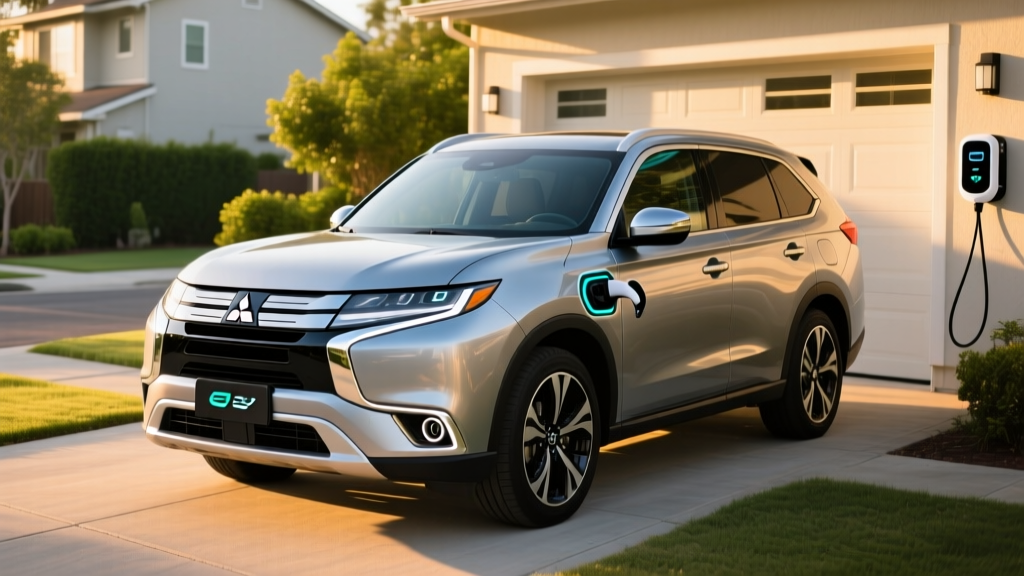
The 2025 Mitsubishi Outlander PHEV occupies a narrow but valuable slice of the market: it's one of the only plug-in hybrid SUVs offering three rows of seating, standard all-wheel drive, and DC fast-charging capability — all starting under $42,000. With an EPA-rated 38 miles of electric-only range and a total combined range of roughly 400 miles, it targets families who want daily electric commuting without sacrificing road-trip flexibility. But with a 20.3 kWh battery that limits highway electric range and a third row best suited for children, the Outlander PHEV demands a clear-eyed look at how you'll actually use it.
| Spec | Value |
|---|---|
| EPA Electric-Only Range | 38 miles |
| Total Combined Range | ~400 miles |
| Battery Capacity (Usable) | 20.3 kWh (lithium-ion) |
| Combined MPGe (Electric + Gas) | 64 MPGe |
| Gas-Only MPG (Combined) | 26 MPG |
| Combined System Horsepower | 248 hp |
| Engine | 2.4L 4-cylinder Atkinson-cycle |
| Drive System | Standard AWD (twin-motor S-AWC) |
| Level 2 AC Charge Time (0–100%) | ~6.5 hours (at 3.3 kW) |
| DC Fast Charge (0–80%) | ~38 minutes (CHAdeMO) |
| 0–60 mph | ~7.5 seconds |
| Seating | 7 passengers (3 rows) |
| Base MSRP (ES trim) | $40,495 (incl. destination) |
| Battery Warranty | 10 years / 100,000 miles |
HEV vs. PHEV: What the Outlander Actually Is
Before diving into specs, it's worth clarifying the distinction between a conventional hybrid (HEV) and a plug-in hybrid (PHEV), because Mitsubishi sells the Outlander in both forms — and they serve different buyers.
| Feature | Outlander HEV (Gas Hybrid) | Outlander PHEV (Plug-In) |
|---|---|---|
| Plugs In? | No — charges via regenerative braking and engine | Yes — has a charge port for Level 1, Level 2, and DC fast charging |
| Battery Size | ~1.5 kWh (small buffer) | 20.3 kWh usable |
| Electric-Only Driving | Very short distances at low speed | 38 miles EPA at full highway speeds |
| Fuel Economy | ~31 MPG combined (gas only) | 64 MPGe (electric + gas); 26 MPG gas-only |
| Price Premium | Lower base price | ~$5,000–$7,000 more than equivalent HEV trim |
| Tax Credit Eligible? | No | Potentially — see tax credit section below |
The Outlander PHEV is a series-parallel plug-in hybrid. It can drive on pure electric power for its full 38-mile range, then seamlessly transitions to hybrid mode using its 2.4-liter gasoline engine and dual electric motors. If you never plug it in, it functions as a conventional hybrid — but you'd be paying a premium for battery capacity you're not using.
Fuel Economy and Electric Range: EPA vs. Real World
The headline number is 38 miles of electric-only range, certified by the EPA on fueleconomy.gov. Combined MPGe sits at 64, and once the battery depletes, the gas engine delivers 26 MPG combined (25 city / 27 highway).
| Metric | EPA Rating | Real-World Expectation |
|---|---|---|
| Electric-Only Range | 38 miles | 32–36 mi (highway); 36–40 mi (city, mild weather) |
| Combined MPGe | 64 MPGe | Varies widely with charging frequency |
| Gas-Only City MPG | 25 MPG | 24–27 MPG (regenerative braking helps in stop-and-go) |
| Gas-Only Highway MPG | 27 MPG | 24–26 MPG at 70+ mph |
| Gas-Only Combined MPG | 26 MPG | 24–26 MPG |
| Total Combined Range | ~400 miles | 370–410 miles depending on conditions |
Real-world range reality check: The 38-mile EPA electric range assumes moderate temperatures and mixed driving. In winter conditions (below 32°F), expect 25–30 miles of electric range due to battery chemistry limitations and cabin heating demands. Highway driving at 75+ mph also reduces electric range to roughly 30–33 miles. City driving in mild weather can actually exceed the EPA estimate, sometimes reaching 40+ miles thanks to aggressive regenerative braking.
Charging: DC Fast Charge Capability and Home Setup
The Outlander PHEV is one of the few plug-in hybrids that supports DC fast charging — a meaningful advantage for apartment dwellers or road-trippers who can't rely on overnight Level 2 charging. However, it uses the CHAdeMO connector, not CCS or NACS, which limits the number of compatible public fast chargers as the industry shifts toward NACS.
| Charging Level | Power (kW) | Time (0–100% or 0–80%) | Connector |
|---|---|---|---|
| Level 1 (120V household) | ~1.4 kW | ~16 hours (0–100%) | J1772 |
| Level 2 (240V home/public) | 3.3 kW | ~6.5 hours (0–100%) | J1772 |
| DC Fast Charge | ~22 kW peak | ~38 minutes (0–80%) | CHAdeMO |
A critical detail: the Outlander PHEV's onboard AC charger maxes out at 3.3 kW. That means even if you install a 48-amp (11.5 kW) Level 2 home charger, the vehicle will only draw 3.3 kW. A standard 16-amp Level 2 unit is sufficient and more cost-effective for this vehicle.
The CHAdeMO connector is a legitimate concern for long-term ownership. As Electrify America and other networks prioritize CCS and NACS, CHAdeMO stations are becoming less common. For most PHEV owners who charge at home nightly, this is a minor issue. But if you're counting on public DC fast charging during road trips, verify CHAdeMO availability along your routes using apps like PlugShare.
Powertrain and Performance
The Outlander PHEV uses Mitsubishi's twin-motor Super All-Wheel Control (S-AWC) system. The front axle is driven by an 85 kW (114 hp) electric motor, the rear by a 100 kW (134 hp) motor, and a 2.4-liter Atkinson-cycle four-cylinder engine contributes 126 hp. Combined system output is 248 horsepower.
The result is a 0–60 mph time of roughly 7.5 seconds — adequate for merging and passing, though not sporty. The electric motors deliver instant torque from a stop, making the Outlander PHEV feel quicker around town than the number suggests. On the highway, the transition between electric and hybrid mode is generally smooth, though the engine can become vocal under hard acceleration due to the Atkinson-cycle design prioritizing efficiency over power density.
Seven drive modes are available, including EV (pure electric), Series Hybrid (engine generates electricity for the motors), and Parallel Hybrid (engine and motors drive the wheels together). The system manages these transitions automatically, but drivers can manually select EV mode to preserve battery for a specific portion of their trip — useful if you want silent electric driving through a neighborhood before hitting the highway.
Pricing, Trims, and Tax Credit Eligibility
The 2025 Outlander PHEV is offered in four trims:
- ES: $40,495 — base trim with 18-inch wheels, 8-inch touchscreen, heated front seats, Mitsubishi Safety Sense suite
- SE: $43,495 — adds synthetic leather, power liftgate, wireless Apple CarPlay, 9-inch screen
- SEL: $46,995 — genuine leather, panoramic sunroof, head-up display, Bose audio
- SEL Black Edition: $47,495 — blacked-out exterior accents, unique interior trim
Federal §30D Tax Credit: Does the Outlander PHEV Qualify?
Under current IRS §30D rules, the Outlander PHEV may qualify for up to $3,750 of the federal clean vehicle credit — not the full $7,500. Here's why:
- MSRP Cap: The Outlander PHEV is classified as an SUV, so the MSRP cap is $80,000. All trims qualify.
- Income Cap: Buyer AGI must not exceed $150,000 (single) / $300,000 (joint). Verify with a tax professional.
- Battery Sourcing: The $3,750 half of the credit depends on critical minerals sourcing; the other $3,750 depends on battery component manufacturing. Mitsubishi's battery supply chain currently meets one of these two requirements, yielding a likely $3,750 credit. Confirm current eligibility on the IRS qualified vehicles list at point of sale.
- Point-of-Sale Transfer: As of 2024, buyers can transfer the credit to the dealer for an immediate price reduction at purchase — no need to wait for tax filing.
- Battery Capacity: The 20.3 kWh battery exceeds the §30D minimum of 7 kWh.
Tax credit rules are subject to change. Always verify eligibility at irs.gov and consult a tax professional before purchasing.
Battery Longevity, Warranty, and Replacement Cost
Mitsubishi PHEV Battery Warranty: 10 years or 100,000 miles (whichever comes first), covering defects and capacity loss below 70% of original capacity. This is among the longest PHEV battery warranties in the segment, matching Hyundai and Kia and exceeding Toyota's 8-year/100,000-mile hybrid battery coverage.
Lithium-ion batteries in PHEVs degrade gradually. Based on industry data and owner reports from the prior-generation Outlander PHEV (2018–2023), most owners see 5–10% capacity loss over the first five years — meaning the 38-mile range might decrease to 34–36 miles by year five under normal use. Factors that accelerate degradation include frequent DC fast charging, routinely charging to 100% and storing in extreme heat, and deep discharges.
If the battery does need replacement outside warranty, expect a cost between $8,000 and $12,000 including labor, based on current PHEV battery replacement pricing. However, with Mitsubishi's 10-year/100,000-mile warranty and the relatively small 20.3 kWh pack (less stress per cell than a full EV's larger pack), out-of-pocket replacement is uncommon during typical ownership periods.
For reliability broadly, Mitsubishi as a brand ranks mid-pack. The Outlander PHEV's powertrain is well-proven — the S-AWC system has been in production since 2013 globally — but interior electronics and infotainment have drawn more complaints. Check NHTSA safety ratings and recall data for the latest information.
Who Should Buy the Outlander PHEV — And Who Shouldn't
Pros
- One of few PHEVs with 3-row seating (7 passengers)
- Standard AWD with capable twin-motor system
- DC fast charging (rare for PHEVs)
- 38-mile electric range covers most daily commutes
- 10-year/100,000-mile battery warranty
- Competitive starting price under $41,000
Cons
- CHAdeMO connector (declining public infrastructure)
- 3.3 kW AC charging is slow for Level 2
- Third row is cramped — children only
- Gas-only MPG (26 combined) trails rival hybrids
- Cargo space reduced vs. gas-only Outlander
- Likely $3,750 tax credit, not the full $7,500
Choose the Outlander PHEV if:
- You need three rows but aren't ready for a full EV
- Your daily commute is under 35 miles round-trip and you can charge at home
- You want AWD for snow/rain without the range anxiety of a battery-electric SUV
- You take occasional long road trips where charging infrastructure is sparse
Choose a full EV instead if:
- You have reliable home charging and your daily driving is under 250 miles
- You want zero gasoline maintenance (no oil changes, no engine)
- You want access to the full $7,500 federal credit (vehicles like the Hyundai Ioniq 5 or Tesla Model Y may qualify more fully)
Choose the gas-only Outlander or a conventional HEV if:
- You cannot charge at home (apartment, no garage, street parking)
- Your daily commute exceeds 50+ miles, negating the PHEV electric advantage
- You want to minimize upfront cost and don't care about electric-only driving
Frequently Asked Questions
How many MPG does the 2025 Mitsubishi Outlander PHEV get?
The EPA rates the Outlander PHEV at 64 MPGe when combining electric and gas operation, and 26 MPG combined (25 city / 27 highway) when running on gasoline alone after the battery is depleted. In real-world driving, owners who charge nightly and commute under 38 miles may use almost no gasoline for weeks. Those who rarely charge will see 24–27 MPG — respectable for a 4,600-pound AWD SUV, but not class-leading.
How far can the Outlander PHEV go on electric only?
The EPA-certified electric-only range is 38 miles. In practice, expect 32–36 miles on the highway, 36–40 miles in city driving with regenerative braking, and as little as 25–30 miles in cold winter weather. The 20.3 kWh battery provides enough range for most daily commutes, but longer trips will engage the gas engine.
Does the Outlander PHEV qualify for a tax credit?
Under current IRS §30D rules, the Outlander PHEV likely qualifies for $3,750 of the federal clean vehicle credit (not the full $7,500) due to partial battery sourcing compliance. The MSRP is under the $80,000 SUV cap, and the battery exceeds 7 kWh. Buyer income limits apply ($150K single / $300K joint). The credit can be transferred to the dealer at point of sale for an immediate price reduction. Always verify on the IRS qualified vehicles list before purchasing.
Is the Outlander PHEV reliable, and what does battery replacement cost?
The Outlander PHEV powertrain is well-established — Mitsubishi's S-AWC system has been in global production since 2013. The battery carries a 10-year/100,000-mile warranty covering capacity loss below 70%. Out-of-warranty battery replacement would cost an estimated $8,000–$12,000, though most owners will never need this during typical ownership. Overall brand reliability is mid-pack; the powertrain is solid, but infotainment and minor electrical issues have been reported more frequently.
Can I charge the Outlander PHEV at home on a regular outlet?
Yes, but slowly. Level 1 charging on a standard 120V outlet delivers roughly 1.4 kW, requiring about 16 hours for a full charge. That's enough to replenish the battery overnight if you drive less than 30 miles daily. For faster replenishment, a Level 2 (240V) home charger cuts the time to about 6.5 hours — though the vehicle's 3.3 kW onboard charger means you don't need an expensive high-amperage unit.
How does the Outlander PHEV compare to the Toyota RAV4 Prime?
The RAV4 Prime offers 42 miles of electric range (vs. 38), significantly higher gas-only MPG (38 combined vs. 26), and a CCS connector (more future-proof than CHAdeMO). However, the RAV4 Prime has only two rows of seating, a higher starting price (~$44,000), and limited availability due to high demand. If you need three rows, the Outlander PHEV has no direct PHEV rival. If you don't, the RAV4 Prime is the more efficient and more widely compatible choice.
What happens if I never plug in the Outlander PHEV?
The vehicle will operate as a conventional hybrid, using the engine and regenerative braking to manage the battery. You'll get roughly 26 MPG combined — adequate but not exceptional for a hybrid. However, you'll be carrying 400+ pounds of battery capacity you're not utilizing, reducing efficiency compared to a purpose-built HEV. The PHEV only makes financial sense if you plan to plug in regularly.