Quick Verdict: A Premium PHEV That Bridges the Gap
The 2025 Mazda CX-90 Plug-In Hybrid occupies a specific niche: families who want three rows, premium styling, and the ability to commute on electricity — without committing to a full battery-electric vehicle. With 26 miles of EPA-rated electric-only range and 327 combined horsepower from its inline-four and electric motor, it delivers a driving experience that punches above its price class. But at a starting MSRP around $49,945, buyers need to know exactly what they're getting — and what they're giving up — before signing.
This guide breaks down every number that matters: real-world MPG, electric range under actual conditions, charging logistics, federal tax credit eligibility under current §30D rules, and how the CX-90 PHEV stacks up against full EVs and conventional hybrids in the midsize SUV segment.
HEV vs. PHEV: What the CX-90 Actually Is
Before diving into specs, it's critical to understand what you're buying. The CX-90 is available in two electrified flavors, and confusing them is the most common mistake shoppers make:
CX-90 Mild Hybrid (MHEV)
- Inline-six turbo with 48-volt mild-hybrid assist
- Cannot plug in — no electric-only driving
- 280–340 hp depending on trim
- ~24 MPG combined (EPA)
- No federal EV tax credit eligibility
CX-90 Plug-In Hybrid (PHEV)
- 2.5L inline-four + electric motor + 17.8 kWh battery
- Plugs in — 26 miles EPA electric-only range
- 327 hp combined system output
- 25 MPG combined after battery depletes (EPA)
- Potential §30D federal tax credit (eligibility varies)
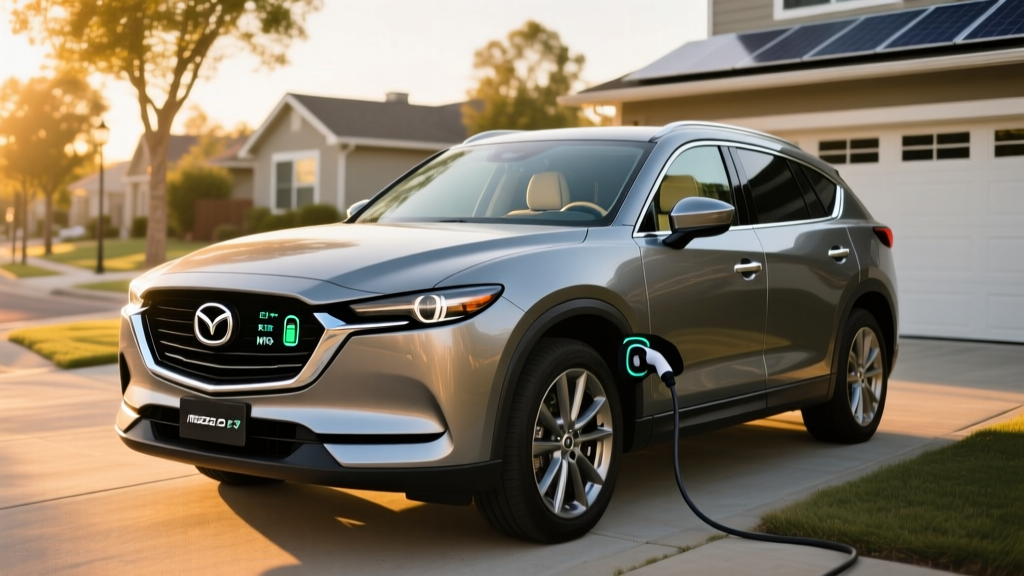
The PHEV variant is the focus of this review. It uses a fundamentally different powertrain from the mild-hybrid inline-six models. If a dealer tells you "all CX-90s are hybrids," ask specifically for the PHEV badge on the tailgate and the charge port on the driver's-side front fender.
Electric Range, MPG, and Real-World Efficiency
| Metric | EPA Rating | Real-World Expectation |
|---|---|---|
| Electric-only range | 26 miles | 20–24 mi (highway/cold); 26–30 mi (city/mild weather) |
| MPGe (electric + gas combined) | 56 MPGe | Varies heavily by charge frequency |
| Gas-only MPG (city) | 24 mpg | 25–28 mpg (city regen advantage) |
| Gas-only MPG (highway) | 27 mpg | 23–25 mpg (heavy SUV at 75+ mph) |
| Gas-only MPG (combined) | 25 mpg | 23–26 mpg depending on driving mix |
| Total combined range | ~490 miles | ~430–470 mi real-world |
The 26-mile electric range is the headline figure, but context matters. According to fueleconomy.gov, the EPA rates the CX-90 PHEV at 56 MPGe when operating in combined electric-and-gas mode. That figure is meaningful only if you charge regularly. If you never plug in, you're driving a 25 MPG, 4,800-pound SUV — respectable for its class, but not exceptional.
The gas-only MPG figures deserve a note: like most PHEVs, the CX-90 is heavier than its gas-only counterpart due to the battery pack and motor. Once the battery is depleted, you're hauling that extra mass with a 2.5L four-cylinder. Highway MPG suffers more than city MPG because regenerative braking can't recoup energy at steady speeds. Expect city driving to slightly exceed the EPA estimate (regen helps), while sustained highway driving will fall short.
Powertrain, Battery, and Charging Specs
| Specification | Detail |
|---|---|
| Engine | 2.5L inline-4 naturally aspirated |
| Electric motor | 100 kW (134 hp) integrated in transmission |
| Combined system output | 327 hp / 369 lb-ft torque |
| Transmission | 8-speed automatic (no CVT) |
| Drivetrain | All-wheel drive (standard) |
| Battery capacity (gross) | 17.8 kWh |
| Battery capacity (usable) | ~14.8 kWh (buffer protects longevity) |
| Battery chemistry | Lithium-ion (NMC) |
| Level 1 charging (120V) | ~1.4 kW — full charge in ~11 hours |
| Level 2 charging (240V) | ~7.2 kW — full charge in ~2.5 hours |
| DC fast charging | Not available |
| Charge port | J1772 (driver-side front fender) |
| 0–60 mph | ~6.2 seconds (est.) |
The 17.8 kWh battery is the energy reservoir that enables electric-only driving. Mazda uses an NMC (nickel-manganese-cobalt) lithium-ion pack, which offers good energy density but requires a thermal management system to maintain longevity. The usable capacity is approximately 14.8 kWh — the remaining ~3 kWh serves as a buffer to prevent deep discharge and overcharge, both of which accelerate degradation.
Charging is Level 1 and Level 2 only. The CX-90 PHEV does not support DC fast charging, which is typical for PHEVs in this class. On a standard 120V household outlet (Level 1), a full charge takes roughly 11 hours — fine for overnight top-ups if your commute falls within the electric range. On a 240V Level 2 home charger or public station, a full charge takes about 2.5 hours at the vehicle's 7.2 kW acceptance rate.
This matters practically: if you can install a Level 2 charger at home (a 240V outlet on a dedicated 40-amp circuit), you'll wake up to a full battery every morning. Without home charging, the PHEV advantage erodes significantly. Public Level 2 chargers at workplaces or shopping centers can supplement, but relying on them daily is inconvenient compared to home charging.
Pricing, Trims, and Tax Credit Eligibility
The 2025 CX-90 PHEV is offered across multiple trims, all with standard AWD:
- PHEV Preferred: ~$49,945 MSRP
- PHEV Premium: ~$54,250 MSRP
- PHEV Premium Plus: ~$57,450 MSRP
Destination charges add approximately $1,455. Fully loaded, a CX-90 PHEV Premium Plus approaches $60,000 before incentives.
Does the CX-90 PHEV Qualify for the Federal §30D Tax Credit?
Under current IRS rules for the §30D New Clean Vehicle Credit, plug-in hybrids may qualify for up to $7,500 — but eligibility depends on several requirements that change periodically:
- MSRP cap: SUVs must have an MSRP at or below $80,000 (all CX-90 PHEV trims qualify)
- Buyer income cap: Modified AGI must not exceed $150,000 (single), $225,000 (head of household), or $300,000 (joint)
- Battery sourcing: Critical minerals and battery components must meet escalating domestic-content thresholds — this requirement has disqualified several PHEVs in recent years
- Point-of-sale transfer: As of 2024, eligible buyers can transfer the credit to the dealer at purchase, reducing the purchase price directly rather than waiting for tax filing
The CX-90 PHEV's battery sourcing has been a moving target under evolving §30D rules. Mazda's assembly in Hofu, Japan, and its battery supply chain mean eligibility can shift as the Treasury updates its critical-minerals and component sourcing lists. Always verify current eligibility on the IRS clean vehicle credit page and with your dealer before purchase. Do not assume a flat $7,500 credit — many buyers qualify for $3,750 (meeting one of two sourcing thresholds) or nothing at all depending on model-year sourcing compliance. Consult a tax professional for your specific situation.
State incentives may also apply. States like California, Colorado, and New York offer additional rebates for PHEVs, though amounts and eligibility vary by jurisdiction. Check your state energy office or DMV for current programs.
Battery Warranty, Reliability, and Replacement Costs
The 8-year/100,000-mile hybrid battery warranty is federally mandated for emissions-related components in many states and is standard practice across the industry for PHEVs and HEVs. It provides meaningful protection: if the battery degrades prematurely or fails, replacement is covered.
Regarding reliability: Mazda's 2.5L naturally aspirated four-cylinder is one of the automaker's most proven engines, with a long track record in the CX-5 and Mazda6. The electric motor and power electronics add complexity, but PHEV systems from major manufacturers have shown strong durability in real-world use. The absence of a turbocharger on the PHEV's engine (unlike the inline-six mild-hybrid variants) reduces one common failure point.
If the battery does need replacement outside warranty, expect costs in the range of $8,000–$12,000 for the pack plus labor. This is a significant sum, but the 17.8 kWh pack is smaller and less expensive to replace than a full EV battery. Most PHEV batteries in the market have shown degradation rates of 1–2% per year under normal use, meaning at 10 years you might see 80–85% of original capacity — still adequate for daily electric commuting.
For context, Consumer Reports and J.D. Power have generally rated Mazda's hybrid systems as average to above-average in predicted reliability. The CX-90 is a newer platform (introduced for 2024), so long-term data is still accumulating. Check NHTSA and IIHS for the latest safety ratings and any recall bulletins.
Who Should Choose the CX-90 PHEV — and Who Shouldn't
Pros
- Premium interior quality rivals Audi/BMW at a lower price point
- 327 hp with smooth electric torque delivery
- 26-mile electric range covers most daily commutes
- Standard AWD with capable all-weather performance
- Three-row seating (tight third row, but usable for children)
- Conventional 8-speed automatic — no CVT drone
- No range anxiety — gas engine provides 490+ mile total range
Cons
- No DC fast charging — road trips rely entirely on gas
- 25 MPG gas-only is unremarkable for a hybrid
- Third row is cramped for adults on long trips
- Cargo space reduced vs. gas-only CX-90 due to battery placement
- Premium fuel recommended for best performance
- Tax credit eligibility uncertain due to battery sourcing rules
- Heavier than gas variant — affects tire wear and braking distances
The Decision Framework
Choose the CX-90 PHEV if:
- Your daily commute is under 25 miles round-trip and you can charge at home
- You want a premium three-row SUV but aren't ready for a full EV
- You take 2–4 road trips per year and need gas-engine flexibility
- You value driving dynamics and interior quality over maximum fuel savings
Choose a full EV (like the Kia EV9 or Tesla Model X) if:
- You have reliable home charging and your daily driving rarely exceeds 250 miles
- You want maximum fuel cost savings and lowest maintenance
- You want DC fast charging for road trips (150–350 kW capability)
Choose the CX-90 mild-hybrid (inline-six) if:
- You cannot charge at home (apartment, no garage outlet access)
- You want more power (340 hp turbo six) and don't need electric-only driving
- You want to avoid PHEV complexity and battery replacement risk
Choose a conventional hybrid (like the Toyota Grand Highlander Hybrid) if:
- You want maximum MPG without plugging in (35+ MPG combined)
- You prioritize fuel economy over premium styling and performance
Ownership Economics: PHEV vs. Gas vs. EV Over 5 Years
The financial case for the CX-90 PHEV hinges on how often you charge. If you plug in every night and your commute is within the 26-mile electric window, you'll use very little gasoline on weekdays. Electricity costs roughly $0.13–$0.18 per kWh nationally, meaning a full 14.8 kWh charge costs about $2.00–$2.70 — equivalent to less than a gallon of gas for 20+ miles of driving.
However, if you rarely charge, the CX-90 PHEV is simply a 25 MPG, $50,000 SUV that costs more than the inline-six mild-hybrid variant and offers no fuel savings. The PHEV premium over the base mild-hybrid CX-90 is roughly $5,000–$7,000 depending on trim. You need consistent charging habits to recoup that through fuel savings.
Insurance premiums for the PHEV tend to run 5–10% higher than the mild-hybrid variant due to the high-voltage system and higher repair costs in collision scenarios. Get quotes before purchasing.
Maintenance is generally lower than a gas-only vehicle (no starter motor, reduced brake wear from regen, simpler engine), but higher than a full EV (you still have an internal combustion engine requiring oil changes, coolant service, and spark plug replacement on schedule).
Frequently Asked Questions
How many MPG does the 2025 Mazda CX-90 PHEV get?
The EPA rates it at 25 MPG combined (24 city / 27 highway) when running on gasoline after the battery is depleted. In electric mode, it achieves 56 MPGe combined. Real-world gas MPG ranges from 23–28 depending on driving conditions — city driving often slightly exceeds the EPA estimate due to regenerative braking, while sustained highway driving at 75+ mph falls short.
How far can the CX-90 PHEV go on electric only?
The EPA rates it at 26 miles of electric-only range. In real-world conditions, expect 20–24 miles on the highway or in cold weather, and up to 28–30 miles in mild-weather city driving with regenerative braking. The 17.8 kWh battery (14.8 kWh usable) powers the electric motor independently of the gas engine at speeds up to roughly 75 mph.
Does the CX-90 PHEV qualify for a federal tax credit?
It may qualify for up to $7,500 under the §30D New Clean Vehicle Credit, but eligibility depends on current battery sourcing requirements, your income, and the vehicle's MSRP. The MSRP cap for SUVs ($80,000) is met by all trims. Battery component and critical-mineral sourcing rules are the main variable — these change as the Treasury updates approved supply chains. Always verify on IRS.gov before purchase and consult a tax professional.
Is the CX-90 PHEV reliable, and what does battery replacement cost?
Mazda's 2.5L engine is well-proven, and the PHEV system uses conventional technology shared across the industry. The high-voltage battery is warranted for 8 years / 100,000 miles. Out-of-warranty battery replacement costs approximately $8,000–$12,000. Most PHEV batteries degrade at 1–2% per year, retaining 80–85% capacity at the 10-year mark under normal use.
Can I DC fast charge the CX-90 PHEV?
No. The CX-90 PHEV supports Level 1 (120V, ~1.4 kW) and Level 2 (240V, ~7.2 kW) charging only. A full Level 2 charge takes approximately 2.5 hours. DC fast charging is not available, which is standard for PHEVs — the battery is too small to justify the cost and weight of DC fast-charge hardware.
How does the CX-90 PHEV compare to a full EV like the Kia EV9?
The Kia EV9 offers 230–304 miles of EPA range, DC fast charging at up to 350 kW (10–80% in ~15 minutes), and zero tailpipe emissions — but starts around $55,000 and requires reliable charging access. The CX-90 PHEV offers gas-engine flexibility for road trips and a lower entry price, but limited electric range and no fast charging. If you can charge at home and rarely drive more than 250 miles in a day, the EV9 is the more future-proof choice. If you need road-trip flexibility without planning charging stops, the PHEV is the pragmatic bridge.
Do I have to plug in the CX-90 PHEV?
You don't have to — the vehicle operates as a conventional hybrid when the battery is depleted, using the gas engine and regenerative braking. However, if you never plug it in, you're paying a PHEV premium for a 25 MPG hybrid. The economic and environmental case for a PHEV only works if you charge regularly. If you can't or won't plug in, the CX-90 mild-hybrid inline-six or a conventional hybrid SUV is a better financial choice.