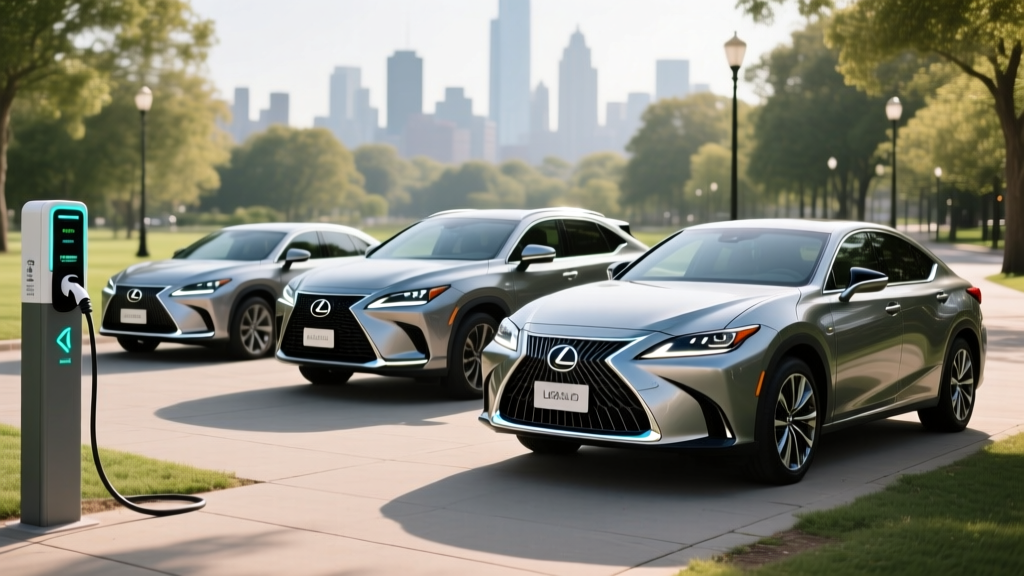
Lexus has built one of the most comprehensive hybrid lineups in the luxury segment, spanning conventional hybrids (HEVs) that never need a plug and plug-in hybrids (PHEVs) offering meaningful electric-only commuting range. For 2025, the brand fields six hybrid models and one PHEV, each targeting a different buyer profile — from the compact UX Hybrid crossover to the flagship TX 500h three-row SUV.
This guide breaks down every 2025 Lexus hybrid with exact EPA fuel economy figures, powertrain specs, real-world efficiency expectations, battery warranty coverage, and current federal tax credit eligibility. Whether you're comparing a Lexus HEV against a full battery-electric vehicle (BEV) or deciding which Lexus PHEV fits your commute, the numbers below will anchor your decision.
2025 Lexus Hybrid Lineup: HEV vs PHEV at a Glance
Before diving into individual models, it's critical to understand the distinction between the two electrified powertrains Lexus offers:
Conventional Hybrid (HEV)
How it works: A small battery (typically 1.0–2.0 kWh) paired with electric motor(s) assists the gasoline engine. The battery recharges through regenerative braking and the engine — you never plug it in.
Best for: Drivers without home charging access, those who want maximum simplicity, and buyers who want better MPG without changing their fueling routine.
2025 Lexus HEV models: UX 300h, NX 350h, RX 350h, RX 500h, TX 500h, LC 500h, ES 300h, LS 500h
Plug-In Hybrid (PHEV)
How it works: A larger battery (18.1 kWh usable in the NX 450h+) provides 30+ miles of electric-only driving. You plug in to recharge (Level 1 or Level 2). Once the battery depletes, the vehicle operates as a conventional hybrid.
Best for: Drivers with home Level 2 charging who commute under 40 miles daily and want EV-like running costs on weekdays with gas-engine flexibility for road trips.
2025 Lexus PHEV model: NX 450h+ (the only Lexus PHEV currently available)
Every 2025 Lexus Hybrid: EPA MPG & Powertrain Specs
| Model | Type | EPA City / Hwy / Combined MPG | Combined HP | Powertrain | 0-60 mph | Base MSRP |
|---|---|---|---|---|---|---|
| UX 300h | HEV | 43 / 41 / 42 | 198 hp | 2.0L 4-cyl + 2 motors (AWD) | 7.8 sec | $39,590 |
| NX 350h | HEV | 41 / 37 / 39 | 244 hp | 2.5L 4-cyl + 3 motors (AWD) | 7.2 sec | $43,965 |
| NX 450h+ | PHEV | 38 combined (hybrid) / 84 MPGe (electric) | 304 hp | 2.5L 4-cyl + 2 motors (AWD) | 6.0 sec | $59,905 |
| RX 350h | HEV | 37 / 34 / 36 | 250 hp | 2.5L 4-cyl + 2 motors (AWD) | 7.4 sec | $53,155 |
| RX 500h | HEV | 27 / 28 / 27 | 371 hp | 2.4L turbo 4-cyl + hybrid (AWD) | 5.9 sec | $62,900 |
| TX 500h | HEV | 27 / 28 / 27 | 371 hp | 2.4L turbo 4-cyl + hybrid (AWD) | 5.9 sec | $75,905 |
| ES 300h | HEV | 43 / 44 / 44 | 215 hp | 2.5L 4-cyl + 1 motor (FWD) | 8.1 sec | $47,290 |
| LS 500h | HEV | 25 / 33 / 28 | 354 hp | 3.5L V6 + 2 motors (AWD) | 5.2 sec | $84,550 |
| LC 500h | HEV | 26 / 33 / 29 | 354 hp | 3.5L V6 + 2 motors (RWD) | 4.9 sec | $101,500 |
Source: fueleconomy.gov and Lexus USA 2025 model specifications. MSRP excludes destination charges. Specs may vary by trim.
NX 450h+ PHEV Deep Dive: Electric Range, Battery & Charging
The NX 450h+ is the sole plug-in hybrid in the 2025 Lexus lineup, and it's a compelling option for buyers who want electric commuting without range anxiety on longer trips.
| Spec | NX 450h+ Value |
|---|---|
| Battery capacity (usable) | 18.1 kWh lithium-ion |
| EPA electric-only range | 37 miles |
| Total combined range (electric + gas) | ~550 miles |
| MPGe (electric mode) | 84 MPGe combined |
| MPG (hybrid mode, battery depleted) | 38 combined |
| Level 1 charging (120V, ~1.4 kW) | ~12 hours (0–100%) |
| Level 2 charging (240V, 6.6 kW onboard) | ~2.5 hours (0–100%) |
| DC fast charging | Not available |
| Combined system output | 304 hp |
| 0-60 mph | 6.0 seconds |
PHEV Battery Warranty
Lexus covers the NX 450h+ hybrid battery for 10 years or 150,000 miles (whichever comes first), transferable to subsequent owners. The broader hybrid system components carry the same 10-year/150,000-mile coverage. This is among the strongest PHEV battery warranties in the luxury segment.
Real-world range note: The EPA's 37-mile electric range estimate is achievable in moderate temperatures with mixed city/suburban driving. Expect 30–33 miles in cold weather (below 40°F) due to cabin heating demand and reduced battery efficiency. Highway-speed electric-only driving at 70+ mph will also reduce range to roughly 28–30 miles. The NX 450h+ does not support DC fast charging, which is typical for PHEVs in this class — Level 2 overnight charging is the intended use case.
Real-World MPG: What Lexus Hybrid Owners Actually Report
Lexus hybrids consistently perform at or above their EPA estimates in city driving, thanks to Toyota's hybrid synergy system that maximizes regenerative braking and electric motor assist at lower speeds. However, highway-heavy driving can produce slightly lower numbers than the EPA sticker suggests.
Here's what to expect from the most popular models based on owner-reported data and real-world testing:
- UX 300h (EPA 42 combined): City drivers regularly report 44–47 MPG. Highway cruising at 75+ mph drops to 37–39 MPG. Real-world combined: 40–44 MPG.
- NX 350h (EPA 39 combined): City driving yields 40–43 MPG. Highway: 34–36 MPG. Real-world combined: 37–40 MPG.
- ES 300h (EPA 44 combined): The efficiency standout. City: 45–48 MPG in stop-and-go traffic. Highway: 40–42 MPG. Real-world combined: 42–45 MPG.
- RX 350h (EPA 36 combined): City: 36–39 MPG. Highway: 31–34 MPG. Real-world combined: 34–37 MPG.
- RX 500h / TX 500h (EPA 27 combined): These performance-oriented turbo hybrids prioritize power over efficiency. Expect 25–28 MPG combined in mixed driving, with city numbers occasionally touching 29 MPG.
Key insight: Unlike gas-only vehicles, Lexus hybrids deliver their best MPG in city traffic where regenerative braking and electric-motor assist do the most work. If your commute is stop-and-go, expect to beat the EPA estimate. If it's 80% highway, expect to fall slightly short.
Hybrid Battery Reliability, Warranty & Replacement Costs
Battery longevity is the single most common concern among first-time hybrid buyers. Lexus (and parent company Toyota) has the longest track record in hybrid technology, with over 25 years of production hybrid data.
| Coverage | Terms |
|---|---|
| Hybrid battery warranty | 10 years / 150,000 miles |
| Hybrid system components | 10 years / 150,000 miles |
| Basic vehicle warranty | 4 years / 50,000 miles |
| Powertrain warranty | 6 years / 70,000 miles |
Real-world battery lifespan: Lexus hybrid batteries routinely last 150,000–200,000+ miles before significant degradation. Toyota's hybrid battery design uses nickel-metal hydride (NiMH) in most HEV models and lithium-ion in PHEVs and some newer HEVs. The system's conservative state-of-charge window (never fully charging or fully depleting the battery) is the primary reason for this longevity.
Replacement cost if out of warranty: A Lexus hybrid battery replacement typically costs between $3,000 and $5,500 depending on the model, including parts and labor. The NX 450h+ PHEV battery, being larger (18.1 kWh), sits at the higher end of that range ($4,500–$6,000). Independent hybrid battery shops can sometimes refurbish or replace individual modules for $1,500–$2,500.
For context, Lexus hybrid battery failure rates within the warranty period are extremely low based on NHTSA complaint data and long-term owner surveys. This is mature technology, not early-adopter risk.
Tax Credit Eligibility for 2025 Lexus Hybrids and PHEVs
Federal tax credit eligibility under IRS §30D is one of the most misunderstood aspects of buying an electrified vehicle. Here's the current landscape for 2025 Lexus models:
- Conventional hybrids (UX 300h, NX 350h, RX 350h, RX 500h, TX 500h, ES 300h, LS 500h, LC 500h): Do NOT qualify for the federal §30D Clean Vehicle Credit. This credit requires a minimum 7 kWh battery and plug-in capability.
- NX 450h+ (PHEV): May qualify for up to $7,500 in federal tax credits, but eligibility depends on multiple factors that change frequently.
For the NX 450h+ to qualify for the full §30D credit, all of the following must be met (per IRS guidelines):
- MSRP cap: The vehicle's MSRP must not exceed $80,000 for SUVs (the NX qualifies).
- Buyer income limits: Modified AGI must not exceed $150,000 (single), $225,000 (head of household), or $300,000 (joint filers).
- Battery sourcing requirements: Critical minerals and battery components must meet phased-in domestic/free-trade sourcing thresholds that tighten annually. This is the most volatile requirement and can change mid-year.
- Point-of-sale transfer: As of 2024, buyers can transfer the credit to the dealer at purchase, reducing the sale price directly rather than waiting for a tax refund.
Critical caveat: Battery component and critical mineral sourcing rules are subject to change. Some Lexus PHEVs have seen their credit eligibility fluctuate between $3,750, $7,500, and $0 depending on the current sourcing compliance determination. Always verify current eligibility on fueleconomy.gov and consult a tax professional before relying on the credit in your purchase decision.
Who Should Choose a Lexus Hybrid vs PHEV vs Full EV?
Choose a Lexus HEV (UX 300h, NX 350h, RX 350h, ES 300h) if:
- You don't have access to home or workplace charging
- You want better fuel economy without changing any habits
- Your daily driving exceeds 50 miles and varies unpredictably
- You want the lowest purchase price and simplest ownership experience
- Priority: maximum MPG per dollar with zero lifestyle adjustment
Choose the Lexus NX 450h+ PHEV if:
- You have Level 2 home charging (or can install it)
- Your weekday commute is under 37 miles round-trip
- You take regular road trips where EV charging infrastructure is sparse
- You want EV-like daily costs with gas-engine backup for long drives
- Priority: minimize fuel spending on commutes while retaining road-trip flexibility
Choose a full BEV (e.g., Tesla Model Y, BMW iX, Hyundai Ioniq 5) if:
- You have reliable home charging and your daily driving is under 250 miles
- You want the lowest per-mile energy cost and minimal maintenance
- You want the full federal tax credit without battery-sourcing ambiguity
- You're ready to plan around DC fast charging on road trips
- Priority: zero tailpipe emissions and the lowest operating cost
Pros and Cons of the 2025 Lexus Hybrid Lineup
Pros
- Class-leading reliability reputation backed by 25+ years of hybrid data
- 10-year/150,000-mile hybrid battery warranty across all models
- ES 300h and UX 300h deliver 42–44 MPG combined — best in luxury segment
- NX 450h+ offers 37 miles of electric-only range with 304 hp
- No plug-in required for HEVs — seamless for apartment/condo dwellers
- Lexus Safety System+ 3.0 standard on all models
- Strong resale value; Lexus hybrids historically depreciate less than gas counterparts
Cons
- Only one PHEV option (NX 450h+) — no plug-in RX, TX, or sedan
- RX 500h and TX 500h achieve only 27 MPG combined despite hybrid badge (performance tuning)
- NX 450h+ starts near $60K and lacks DC fast charging
- HEV models do not qualify for any federal purchase tax credit
- CVT-like driving feel in non-turbo HEVs may disappoint driving enthusiasts
- LS 500h and LC 500h pricing pushes into six-figure territory with modest MPG gains over turbo V6s
Frequently Asked Questions
How many MPG does the most efficient 2025 Lexus hybrid get?
The 2025 Lexus ES 300h leads the lineup with an EPA-estimated 44 MPG combined (43 city / 44 highway). The UX 300h follows closely at 42 MPG combined. In real-world city driving, owners frequently report exceeding these EPA numbers by 2–4 MPG thanks to aggressive regenerative braking in stop-and-go traffic.
How far can the Lexus NX 450h+ go on electric only?
The EPA rates the NX 450h+ at 37 miles of electric-only range. In real-world conditions, expect 30–37 miles depending on temperature, terrain, and driving speed. Cold weather (below 40°F) and sustained highway speeds above 65 mph will reduce this to roughly 28–33 miles. Once the battery depletes, the NX 450h+ seamlessly transitions to hybrid mode at 38 MPG combined.
Do Lexus conventional hybrids need to be plugged in?
No. Lexus HEVs (UX 300h, NX 350h, RX 350h, ES 300h, etc.) charge their small batteries entirely through regenerative braking and the gasoline engine. You fuel them exactly like a conventional gas car — the hybrid system operates automatically with no driver intervention required. Only the NX 450h+ PHEV requires (and benefits from) plug-in charging.
Are Lexus hybrids reliable, and what does a battery replacement cost?
Lexus hybrids are among the most reliable electrified vehicles on the road, benefiting from Toyota's 25-year hybrid development history. The hybrid battery is warranted for 10 years or 150,000 miles, and real-world data shows most batteries last well beyond 200,000 miles. If replacement is needed out of warranty, expect to pay $3,000–$5,500 for HEV batteries and $4,500–$6,000 for the NX 450h+ PHEV battery, including labor.
Does any 2025 Lexus hybrid qualify for a federal tax credit?
Only the NX 450h+ PHEV is eligible for the federal §30D Clean Vehicle Credit, potentially up to $7,500. Conventional Lexus HEVs do not qualify because they lack plug-in capability and sufficient battery capacity. However, PHEV credit eligibility depends on buyer income limits, battery sourcing compliance, and MSRP caps — all of which can change. Verify current status at fueleconomy.gov and consult a tax professional before purchase.
Which 2025 Lexus hybrid is best for a family?
The TX 500h is the only three-row hybrid in the lineup, seating up to seven with 371 hp and 27 MPG combined. For smaller families, the RX 350h offers excellent cargo space (32.7 cu ft behind the second row) and 36 MPG combined at a more accessible price point starting around $53,000.
Can I tow with a Lexus hybrid?
Yes, with limits. The RX 350h and RX 500h are rated for up to 3,500 lbs of towing capacity when properly equipped. The TX 500h can tow up to 5,000 lbs. The NX 350h and NX 450h+ are rated for 2,000 lbs. Towing will reduce fuel economy by approximately 30–40% depending on trailer weight and terrain.
Editor's note: Pricing, tax credit eligibility, and specifications reflect 2025 model year data available at time of publication. Federal §30D credit rules are subject to change. Always confirm current eligibility with the IRS and your tax advisor. Real-world MPG and range estimates are based on aggregated owner reports and independent testing; individual results will vary based on driving style, climate, and conditions.