Quick Verdict: Who the RAV4 Plug-In Is Actually For
The Toyota RAV4 Plug-In Hybrid (formerly known as the RAV4 Prime through the 2024 model year) occupies a narrow but compelling lane: it's a compact SUV that handles most daily commutes on electricity alone, then seamlessly switches to a proven hybrid powertrain for road trips — no range anxiety, no charging-desert stress, no behavioral change required. For the 2026 model year, Toyota continues to refine the formula with a 18.1 kWh battery pack, an EPA-estimated 42 miles of electric-only range, and a combined 302 horsepower that makes it the quickest RAV4 in the lineup.
But the RAV4 Plug-In isn't cheap, and federal tax credit eligibility under §30D has become significantly more restrictive. Before you visit a dealer, you need to understand what this vehicle actually delivers — and whether a conventional RAV4 Hybrid or a full battery-electric vehicle might serve you better.
A conventional hybrid (HEV) like the standard RAV4 Hybrid uses a small battery recharged by regenerative braking and the gas engine. You never plug it in. It delivers strong fuel economy (around 39-41 MPG combined) but has no meaningful electric-only range.
A plug-in hybrid (PHEV) like the RAV4 Plug-In carries a much larger battery (18.1 kWh) that you charge from a wall outlet or Level 2 station. It can drive 42 miles on electricity alone before the gas engine engages. Think of it as an EV for your commute and a hybrid for everything else.
Powertrain and Performance Specs
The 2026 RAV4 Plug-In pairs a 2.5-liter four-cylinder Atkinson-cycle engine with front and rear electric motors to produce a combined 302 horsepower. The front motor delivers 134 kW (180 hp) and the rear motor contributes 40 kW (54 hp), giving the vehicle standard electronic all-wheel drive (AWD-i). This isn't just about efficiency — the instant torque from the electric motors makes the RAV4 Plug-In genuinely quick off the line.
| Specification | Value |
|---|---|
| Combined Horsepower | 302 hp |
| Engine | 2.5L 4-cyl Atkinson + dual electric motors |
| Battery Capacity | 18.1 kWh (lithium-ion, NMC chemistry) |
| Electric-Only Range (EPA) | 42 miles |
| Total Combined Range | ~480 miles |
| MPGe (Electric + Gas Combined) | 94 MPGe |
| MPG (Hybrid Mode, Gas Only) | 38 city / 35 hwy / 36 combined |
| 0–60 mph | 5.7 seconds |
| Drivetrain | AWD-i (electronic AWD) |
| Max Level 2 Charge Rate | 6.6 kW |
| DC Fast Charging | Not available |
| Level 2 Charge Time (0–100%) | ~2.5 hours at 240V/32A |
| Level 1 Charge Time (120V) | ~10 hours |
| Cargo Volume (behind rear seats) | 33.5 cu ft |
One important note: the RAV4 Plug-In does not support DC fast charging. This is typical for PHEVs — the battery is small enough that Level 2 charging at 6.6 kW fully replenishes it in roughly 2.5 hours, which covers overnight home charging and workplace top-ups. If you need DC fast charging capability, you're looking at a full BEV.
Electric Range and Real-World Efficiency
The EPA rates the 2026 RAV4 Plug-In at 42 miles of electric-only range and 94 MPGe when operating in EV mode. Once the battery is depleted and the vehicle switches to hybrid mode, the EPA estimates 38 city / 35 highway / 36 combined MPG.
In mixed suburban driving with moderate temperatures (60–75°F), owners consistently report achieving the full 42 miles of electric range, and some exceed it slightly with conservative throttle use and regen-heavy routes. However, expect the following reductions:
- Cold weather (below 30°F): Electric range drops to approximately 32–36 miles due to cabin heating demands and reduced battery efficiency.
- Highway-speed EV driving (70+ mph): Electric range may fall to 34–38 miles as aerodynamic drag increases energy consumption.
- Hybrid mode highway driving: Expect 33–35 MPG on sustained highway trips, slightly below the EPA city figure — this is normal for hybrids, which excel in stop-and-go traffic where regen braking recovers energy.
For context, the average American commute is roughly 16 miles each way according to the U.S. Census Bureau. That means most RAV4 Plug-In owners can complete their daily commute entirely on electricity — plugging in at home each evening and rarely burning gasoline on weekdays. Weekend road trips use the hybrid powertrain seamlessly, with no range limitation beyond the 14.5-gallon fuel tank.
Charging: What You Need at Home
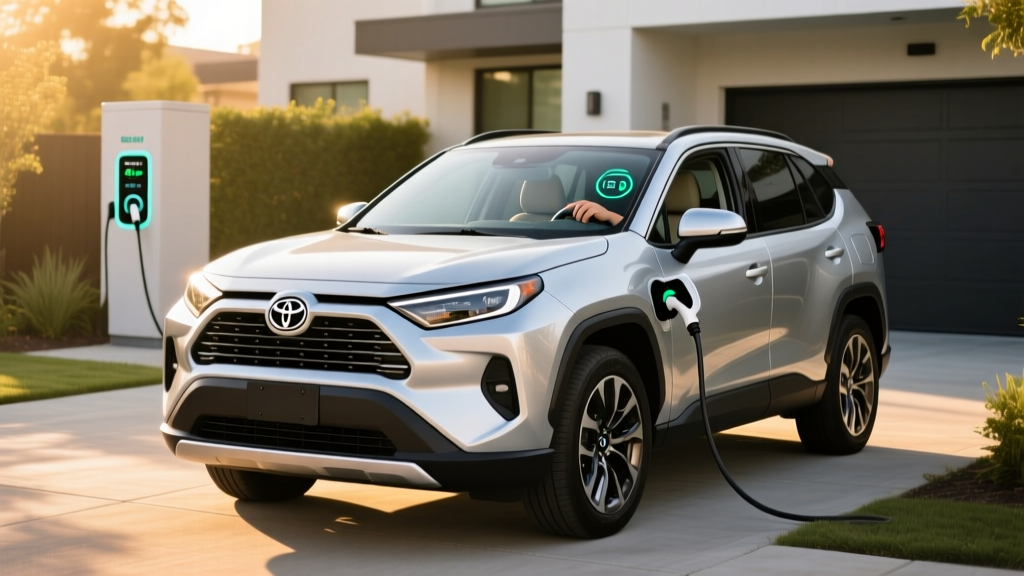
Charging the RAV4 Plug-In is straightforward because the battery is relatively small. Here's what each charging level delivers:
| Charging Level | Voltage / Amperage | Power (kW) | 0–100% Time | Miles of EV Range per Hour |
|---|---|---|---|---|
| Level 1 (standard outlet) | 120V / 12A | ~1.4 kW | ~10 hours | ~4 miles/hr |
| Level 2 (home wall charger) | 240V / 16A | 3.3 kW | ~5.5 hours | ~8 miles/hr |
| Level 2 (dedicated 32A circuit) | 240V / 32A | 6.6 kW | ~2.5 hours | ~17 miles/hr |
Most PHEV owners find that a standard 120V outlet (Level 1) is sufficient for overnight charging if the battery isn't fully depleted — plugging in at 8 PM yields a full charge by 6 AM for typical daily use. However, a Level 2 home charger is strongly recommended if you want to maximize EV driving, especially if you make multiple short trips throughout the day and want to top up between drives.
The RAV4 Plug-In uses a standard J1772 connector for Level 1 and Level 2 charging. No proprietary connector is needed, and any public Level 2 station with a J1772 plug will work. Since there's no DC fast charging port, you won't be using CCS or NACS connectors with this vehicle.
Pricing, Trims, and Tax Credit Eligibility
The 2026 RAV4 Plug-In is offered in two trims:
- SE: Starting at approximately $44,500 MSRP (including destination). Includes 18-inch alloy wheels, SofTex-trimmed seats, 8-inch touchscreen, wireless Apple CarPlay/Android Auto, Toyota Safety Sense 3.0, and heated front seats.
- XSE: Starting at approximately $48,000 MSRP. Adds 19-inch wheels, panoramic moonroof, 10.5-inch touchscreen with navigation, premium JBL audio, heated and ventilated front seats, and a bird's-eye-view camera.
Both trims are well-equipped, but the SE represents the stronger value proposition unless you specifically want the XSE's premium features.
Federal §30D Tax Credit: Does the RAV4 Plug-In Qualify?
This is where 2026 buyers need to pay close attention. Under current IRS §30D rules, the RAV4 Plug-In's eligibility for the up-to-$7,500 federal tax credit depends on three strict criteria that must all be met:
- MSRP Cap: SUVs must have an MSRP at or below $80,000. ✅ Both RAV4 Plug-In trims qualify.
- Buyer Income Cap: Modified adjusted gross income (MAGI) must not exceed $150,000 (single), $225,000 (head of household), or $300,000 (married filing jointly). Check your tax situation.
- Battery Sourcing Requirements: The vehicle must meet critical mineral and battery component sourcing thresholds that increase each year. For 2026, the thresholds are stringent, and many Toyota PHEVs assembled in Japan or with Japan-sourced battery components may not meet the full requirement. The credit may be reduced to $3,750 or eliminated entirely depending on the specific build.
- Point-of-Sale Transfer: If eligible, you can transfer the credit to the dealer at purchase for an immediate price reduction rather than waiting to claim it on your tax return.
Always verify current eligibility on IRS.gov's qualified vehicle list before purchasing. Tax rules change frequently — consult a tax professional for your specific situation.
Even without the full federal credit, some states offer additional incentives for PHEV purchases. Check your state's energy office or Alternative Fuels Data Center for local rebates, HOV lane access, or reduced registration fees.
Battery Warranty, Reliability, and Replacement Cost
Toyota covers the RAV4 Plug-In's hybrid battery and hybrid system components for 10 years or 150,000 miles (whichever comes first) in all 50 states. This is among the strongest hybrid battery warranties in the industry and reflects Toyota's decades of hybrid system experience. The standard vehicle warranty is 3 years/36,000 miles bumper-to-bumper and 5 years/60,000 miles powertrain.
Toyota's hybrid reliability track record is well-established. The company has produced millions of hybrid vehicles since the original Prius in 1997, and hybrid battery failures within the warranty period are relatively uncommon. The RAV4 Plug-In's larger battery pack operates within a conservative state-of-charge window (it never fully charges to 100% or discharges to 0% at the cell level), which significantly reduces degradation stress.
If a hybrid battery replacement is needed out of warranty — typically after 15+ years of service — expect a cost in the range of $4,000 to $6,500 including parts and labor at a Toyota dealer. Third-party hybrid battery refurbishment services can reduce this to roughly $2,500–$4,000. However, given the 10-year/150,000-mile warranty and Toyota's track record, most original owners will never face this expense.
For broader reliability context, the RAV4 consistently earns strong marks from IIHS and typically receives favorable reliability ratings from consumer testing organizations. Toyota Safety Sense 3.0 is standard and includes pre-collision braking with pedestrian detection, lane departure alert with steering assist, full-speed-range adaptive cruise control, and lane tracing assist.
RAV4 Plug-In vs. RAV4 Hybrid vs. Full EV
The most common cross-shopping dilemma for RAV4 Plug-In buyers is whether to save money with the conventional RAV4 Hybrid or spend more on a full battery-electric vehicle like the Tesla Model Y, Hyundai Ioniq 5, or Toyota bZ4X. Here's a practical decision framework:
| Attribute | RAV4 Hybrid (HEV) | RAV4 Plug-In (PHEV) | Full EV (e.g., Ioniq 5) |
|---|---|---|---|
| Starting MSRP | ~$33,000 | ~$44,500 | ~$42,000–$47,000 |
| Electric-Only Range | None (EV mode is trivial) | 42 miles | 250–310 miles |
| Fuel Economy | 41 city / 38 hwy / 39 combined | 94 MPGe (EV) / 36 MPG (hybrid) | 110–132 MPGe |
| Home Charging Needed | No | Recommended | Essential |
| DC Fast Charging | N/A | No | Yes (150–350 kW) |
| Road Trip Convenience | Excellent (gas only) | Excellent (gas + electric) | Requires route planning |
| Annual Fuel/Energy Cost | ~$1,600 | ~$900–$1,200* | ~$600–$900* |
| Maintenance Cost | Low | Low | Very low |
*Annual energy cost depends heavily on electricity rates, commute distance, and how often you charge. Assumes 15,000 miles/year with regular PHEV charging.
Choose the RAV4 Hybrid (HEV) if: You don't have access to home or workplace charging, your budget is under $38,000, or your daily driving exceeds 50+ miles and the PHEV premium wouldn't pay back in fuel savings.
Choose the RAV4 Plug-In (PHEV) if: You have reliable Level 1 or Level 2 home charging, your daily commute is under 40 miles round-trip, you want to drive on electricity most days but need gas-engine flexibility for road trips, and the ~$11,000 premium over the HEV is justified by your fuel savings and environmental goals.
Choose a full BEV if: You have Level 2 home charging, your daily driving is predictable, you're comfortable with DC fast charging for road trips, and you want zero tailpipe emissions and the lowest operating costs.
Pros and Cons at a Glance
- 42 miles of real-world EV range covers most commutes
- 302 hp makes it the quickest RAV4 available
- Standard AWD with no drivetrain hump compromise
- No range anxiety — gas engine for road trips
- 10-year/150,000-mile hybrid battery warranty
- Strong resale value typical of Toyota hybrids
- Level 1 (120V) charging is adequate for daily use
- $44,500+ starting price — significant premium over HEV
- No DC fast charging capability
- Federal tax credit eligibility uncertain due to sourcing rules
- Cargo volume slightly reduced vs. non-hybrid RAV4 (33.5 vs 37.6 cu ft)
- Hybrid-mode highway MPG (35) is lower than city MPG — normal but worth noting
- Dealer markups have been common due to high demand and limited supply
Frequently Asked Questions
How many MPG does the RAV4 Plug-In get?
In hybrid mode (after the battery is depleted), the EPA rates the 2026 RAV4 Plug-In at 38 city / 35 highway / 36 combined MPG. When operating on battery charge, it achieves 94 MPGe. In real-world city driving, many owners report slightly exceeding the EPA city figure thanks to aggressive regenerative braking in stop-and-go traffic. Highway MPG typically runs 1–3 MPG below the EPA estimate at sustained 70+ mph speeds.
How far can the RAV4 Plug-In go on electric only?
The EPA estimates 42 miles of electric-only range. In moderate temperatures with mixed suburban driving, most owners achieve the full 42 miles. In cold weather (below freezing), expect roughly 32–36 miles due to cabin heating demands. At highway speeds above 70 mph, expect 34–38 miles.
Does the RAV4 Plug-In qualify for the $7,500 federal tax credit?
Possibly, but it depends on your income, the vehicle's battery sourcing compliance, and current IRS rules. The MSRP cap is met, but the critical mineral and battery component sourcing requirements under §30D have become increasingly strict. Check the IRS qualified vehicle list for the specific model year and build, and consult a tax professional. Point-of-sale transfer is available if you qualify.
Is the RAV4 Plug-In reliable, and what does a battery replacement cost?
Toyota's hybrid systems are among the most proven in the industry, with decades of real-world data supporting their longevity. The hybrid battery is warrantied for 10 years/150,000 miles. Out-of-warranty replacement, if needed after many years of service, typically costs $4,000–$6,500 at a dealer or $2,500–$4,000 through a third-party refurbisher. Most original owners will never need a replacement.
Do I need to install a Level 2 charger at home?
Not necessarily. The RAV4 Plug-In's 18.1 kWh battery charges fully in about 10 hours on a standard 120V outlet (Level 1), which is sufficient for overnight replenishment if you drive less than 42 miles daily. A Level 2 charger (240V) reduces charge time to 2.5 hours at 6.6 kW and is recommended if you make multiple trips per day or want to maximize EV-mode driving. Level 2 home installation typically costs $500–$2,000 depending on your electrical panel's capacity and the run distance from panel to charger location.
How does the RAV4 Plug-In compare to the standard RAV4 Hybrid?
The Plug-In costs roughly $11,000 more than the HEV but adds 42 miles of electric range, 84 more horsepower (302 vs. 219), and significantly lower per-mile energy costs if you charge regularly. If you can charge at home and your daily driving is under 42 miles, the Plug-In will use very little gasoline on weekdays. If you can't charge at home or your budget is tight, the conventional Hybrid at ~39 MPG combined is an excellent, lower-cost alternative that requires no behavioral change.