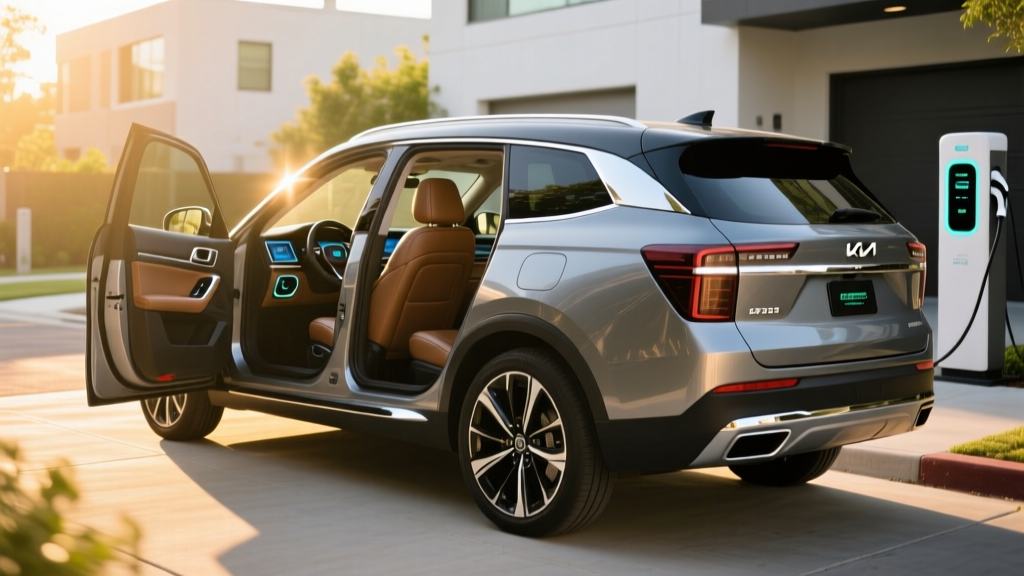
Three-row SUVs that can run on electricity for daily commutes and gasoline for road trips occupy a narrow but increasingly popular niche. The 2025 Kia Sorento Plug-In Hybrid (PHEV) slots directly into that space, offering 32 miles of electric-only driving, standard all-wheel drive, and seating for up to six — all before the turbocharged gas engine ever fires up. For families not ready to commit to a full battery-electric vehicle but unwilling to ignore fuel costs, it presents a compelling middle ground.
This guide breaks down everything that matters: real-world efficiency versus EPA stickers, charging logistics, powertrain specs, tax credit eligibility under current IRS §30D rules, and how the Sorento PHEV compares to both its conventional hybrid sibling and full-electric alternatives.
HEV vs PHEV: Which Sorento Are You Actually Looking At?
Kia sells the Sorento in three powertrain flavors for 2025: a conventional gasoline model, a standard hybrid (HEV), and the plug-in hybrid (PHEV). The distinction between the HEV and PHEV matters enormously for your fuel bill and daily routine.
| Feature | Sorento HEV (Standard Hybrid) | Sorento PHEV (Plug-In Hybrid) |
|---|---|---|
| Battery Size | 1.49 kWh | 13.8 kWh (usable) |
| Needs to Plug In? | No — self-charging via regen & engine | Yes — plug in to unlock EV range |
| Electric-Only Range | ~1 mile at low speed | 32 miles (EPA) |
| Combined Horsepower | 227 hp | 261 hp |
| EPA Combined MPG/MPGe | 36 MPG combined | 79 MPGe (electric+gas) / 34 MPG (gas only) |
| Drivetrain | AWD | AWD |
| Starting MSRP | ~$38,390 | ~$50,290 |
| Federal Tax Credit | None | Check §30D eligibility (see below) |
The HEV works like a traditional Prius-style hybrid: a small battery buffers energy from regenerative braking and the engine, providing brief electric assist but never meaningful electric-only driving. You never plug it in. The PHEV carries a much larger 13.8 kWh battery and a more powerful electric motor, enabling genuine zero-emission commuting for most daily trips under 30 miles. Once the battery depletes, it operates as a conventional hybrid.
Electric-Only Range and Total Driving Range
The EPA rates the 2025 Sorento PHEV at 32 miles of electric-only range. In real-world driving, expect that number to fluctuate:
EPA Electric Range: 32 miles
Real-World Expectation: 26–30 miles in mixed driving; as low as 22–24 miles in sustained cold weather (below 35°F) or at highway speeds above 65 mph.
Total Combined Range (EV + Gas): Approximately 420–440 miles with a full tank and full charge.
The Sorento PHEV's electric range is best leveraged for commutes, school runs, and grocery trips under 30 miles. If your daily round trip fits within that envelope and you charge at home overnight, you could go weeks without burning gasoline. For longer road trips, the 1.6-liter turbocharged engine takes over seamlessly, and you'll see the 34 MPG combined gas-only figure — respectable for a 4,600-pound three-row SUV.
Fuel Economy Breakdown: MPGe and MPG
Understanding PHEV fuel economy requires two metrics: MPGe (miles-per-gallon-equivalent, measuring efficiency when running on electricity) and standard MPG (when the battery is depleted and the engine runs).
| Mode | City | Highway | Combined |
|---|---|---|---|
| Electric + Gas (MPGe) | 79 MPGe | 79 MPGe | 79 MPGe |
| Gas Only (MPG, battery depleted) | 33 MPG | 34 MPG | 34 MPG |
Source: EPA Fuel Economy
Real-world note: Hybrids and PHEVs tend to meet or slightly exceed EPA city estimates because regenerative braking recaptures energy in stop-and-go traffic. Highway driving is less efficient — expect 30–32 MPG gas-only at 75 mph on the interstate. If you rarely charge the battery and drive it like a standard hybrid, plan on 32–34 MPG combined, which still beats most non-hybrid midsize SUVs by a wide margin.
Powertrain, Battery, and Charging Specs
| Specification | 2025 Kia Sorento PHEV |
|---|---|
| Engine | 1.6L Turbocharged 4-cylinder |
| Electric Motor | 90 kW permanent-magnet synchronous |
| Combined System Output | 261 hp / 258 lb-ft torque |
| Transmission | 6-speed automatic |
| Battery Capacity | 13.8 kWh (lithium-ion polymer) |
| Drivetrain | AWD (electronically controlled) |
| 0–60 mph | ~7.6 seconds (est.) |
| Level 1 Charging (120V) | ~11 hours (full charge) |
| Level 2 Charging (240V, 3.3 kW) | ~3 hours 45 minutes (full charge) |
| DC Fast Charging | Not supported |
| Charge Port | J1772 (Level 2) |
| Towing Capacity | 2,000 lbs |
| Cargo Volume (behind 3rd row) | 12.6 cu ft |
| Cargo Volume (behind 2nd row) | 45.0 cu ft |
The Sorento PHEV does not support DC fast charging — a limitation common among PHEVs with smaller batteries. The onboard charger maxes out at 3.3 kW, meaning a Level 2 home charger (240V) will replenish the battery from empty to full in under four hours. A standard 120V household outlet works but takes roughly 11 hours, which still covers overnight charging for most owners.
Practical charging insight: Because the battery is only 13.8 kWh, you don't need an expensive 48-amp Level 2 charger. A basic 16-amp, 3.3 kW Level 2 unit (~$250–$400 for the equipment) will max out the Sorento's onboard charger. Spending more on a 40-amp or 48-amp unit won't charge this vehicle any faster, though it may be worthwhile if you plan to own a full EV in the future.
Pricing, Trims, and Tax Credit Eligibility
The 2025 Sorento PHEV is offered in two trims:
- SX: ~$50,290 MSRP (includes destination)
- SX Prestige: ~$54,590 MSRP (adds Nappa leather, head-up display, surround-view monitor, highway driving assist)
Both trims come well-equipped with the PHEV powertrain, AWD, and a robust feature list. The SX Prestige pushes into luxury-adjacent territory but remains significantly less expensive than comparable plug-in offerings from European brands.
Federal Tax Credit (§30D) — Current Rules
The Sorento PHEV's eligibility for the federal §30D Clean Vehicle Credit (up to $7,500) depends on several factors that change periodically. As of current IRS guidance, check the following:
- MSRP Cap: SUVs must be under $80,000 MSRP — both Sorento PHEV trims qualify.
- Buyer Income Cap: Modified AGI must not exceed $150,000 (single), $225,000 (head of household), or $300,000 (joint).
- Battery Sourcing: Critical minerals and battery component requirements phase in progressively. Verify current-year compliance on the vehicle's Monroney label and at IRS.gov's qualified vehicle list.
- Point-of-Sale Transfer: If eligible, you can transfer the credit to the dealer at purchase, reducing your out-of-pocket cost immediately rather than waiting for tax filing.
- Assembly: Final assembly must occur in North America. The Sorento is assembled in West Point, Georgia — this requirement is met.
Always verify current eligibility with your tax professional and the IRS qualified vehicle list before purchasing. Sourcing requirements tighten annually and can affect credit amounts ($3,750 vs. $7,500).
Real-World Ownership: What to Actually Expect
Spec sheets tell only part of the story. Here's what matters once you take delivery:
Daily commuting on electricity: If your round-trip commute is 25 miles or less and you charge nightly at home, you'll burn very little gasoline. Many PHEV owners report visiting gas stations once a month or less for local driving. The Sorento PHEV's 32-mile range covers the median US commute (roughly 16 miles each way) with margin to spare.
Cold-weather impact: Lithium-ion batteries lose efficiency in cold temperatures. Expect 15–25% range reduction when temperatures drop below freezing — that 32-mile EV range could shrink to 22–26 miles. The Sorento PHEV uses engine heat for cabin warming, which can further reduce electric range in winter if you run the heater heavily. A heated steering wheel and heated seats (standard on both trims) help reduce HVAC load.
Highway road trips: Once the battery depletes, you're driving a 4,600-pound hybrid SUV getting 32–34 MPG. That's meaningfully better than the gas-only Sorento (26 MPG combined) and competitive with the standard Sorento HEV. You'll notice no performance degradation when the battery is empty — the system transitions seamlessly.
Third-row practicality: The PHEV battery packaging does not significantly compromise interior space. The third row fits children or shorter adults for brief trips, matching the gas and HEV Sorento. Cargo volume behind the third row (12.6 cu ft) is tight but typical for the segment.
Battery Warranty, Reliability, and Replacement Cost
Hybrid/PHEV Battery Warranty: 10 years / 100,000 miles (whichever comes first)
Coverage: Defects and capacity loss below a defined threshold
Powertrain Warranty: 10 years / 100,000 miles
Basic Warranty: 5 years / 60,000 miles
Kia's 10-year/100,000-mile PHEV battery warranty is among the strongest in the industry and should ease the primary concern for hybrid buyers: battery degradation and replacement cost. Modern lithium-ion PHEV batteries are engineered for longevity — the 13.8 kWh pack in the Sorento is relatively small and conservatively managed, meaning it operates within a narrow state-of-charge window that minimizes stress.
Expected degradation: Industry data suggests PHEV batteries typically lose 10–15% capacity over 10 years of normal use. For the Sorento, that might mean the 32-mile EV range drops to 27–29 miles after a decade — noticeable but not debilitating.
Out-of-warranty replacement cost: If a battery replacement is needed beyond the warranty period, expect a dealer-installed PHEV battery pack to cost between $4,000 and $7,000 depending on labor rates and parts availability. Independent hybrid battery specialists may offer refurbished units for $2,500–$4,000. However, widespread reports of premature PHEV battery failure in modern Kia/Hyundai vehicles are rare — these packs are lasting well in the field.
For reliability ratings, check the latest data from IIHS and owner surveys. The Sorento platform has been in production since 2021, and the PHEV variant benefits from several years of powertrain refinement.
Sorento PHEV vs. Full EV vs. Gas SUV: Which Fits You?
Choose the Sorento PHEV if:
- Your daily driving is under 30 miles round-trip and you can charge at home
- You need a third row for family hauling
- You take road trips where charging infrastructure is sparse or unreliable
- You want EV-like commuting without range anxiety on long drives
Choose a full EV (e.g., Kia EV9, Hyundai Ioniq 5) if:
- You have reliable home charging and your trips rarely exceed 250 miles
- You want to eliminate gasoline entirely and minimize maintenance
- You qualify for the full $7,500 federal credit on an eligible EV
- You don't need a third row (or can accept the EV9's higher price)
Choose the Sorento HEV (standard hybrid) if:
- You cannot charge at home (apartment, no garage, no outlet access)
- You want lower upfront cost (~$12,000 less than the PHEV)
- Your daily mileage is high and mostly highway (where PHEV EV-range advantage disappears)
- You want simplicity — no plug, no charging routine, just drive
Choose a gas-only SUV if:
- You drive very few miles annually and fuel cost is negligible
- Upfront purchase price is the primary constraint
Pros and Cons at a Glance
Pros
- 32 miles of real, usable EV range covers most commutes
- Standard AWD with no EV-range penalty
- 261 hp provides confident merging and passing power
- 10-year/100,000-mile battery and powertrain warranty
- Third-row seating rare in the PHEV segment
- Eligible for potential $7,500 federal tax credit (verify sourcing)
- 34 MPG gas-only is excellent for the class when battery is depleted
Cons
- 3.3 kW onboard charger means slow Level 2 charging (no DC fast charge)
- $50,290 starting price is steep vs. HEV and gas variants
- EV range drops notably in cold weather and at highway speeds
- Third row is best suited for children only
- 2,000-lb towing capacity trails V6 competitors
- Only two trims available — limited configuration flexibility
Frequently Asked Questions
How many MPG does the 2025 Kia Sorento Plug-In Hybrid get?
The EPA rates it at 79 MPGe combined when operating on both electricity and gasoline, and 34 MPG combined (33 city / 34 highway) when running on gasoline alone after the battery is depleted. Real-world gas-only driving typically lands between 31–35 MPG depending on driving style and conditions.
How far can the Sorento PHEV go on electric only?
The EPA rates it at 32 miles of electric-only range. Real-world results typically fall between 26–30 miles in moderate weather and mixed driving. Cold weather (below 35°F) and sustained highway speeds above 65 mph can reduce this to 22–25 miles.
Does the 2025 Sorento PHEV qualify for a federal tax credit?
It may qualify for up to $7,500 under IRS §30D, depending on your income, the vehicle's battery sourcing compliance, and current-year rules. The MSRP is under the $80,000 SUV cap, and it's assembled in Georgia. However, critical-mineral and battery-component sourcing requirements change annually. Always verify on the IRS qualified vehicles list and consult a tax professional before relying on credit eligibility.
Is the Sorento PHEV reliable, and what does battery replacement cost?
Kia's PHEV powertrain has proven reliable in field use since the platform's introduction, and it's backed by a 10-year/100,000-mile battery warranty. Out-of-warranty battery replacement, should it ever be needed, typically costs $4,000–$7,000 at a dealer or $2,500–$4,000 from independent hybrid specialists. Most modern PHEV batteries last well beyond their warranty period with minimal degradation.
Can I charge the Sorento PHEV at a DC fast charger?
No. The 2025 Sorento PHEV does not support DC fast charging. It charges via J1772 at up to 3.3 kW on Level 2 (240V), taking about 3 hours 45 minutes for a full charge. Level 1 (120V) charging takes approximately 11 hours.
Should I get the Sorento PHEV or the standard Sorento Hybrid?
If you can charge at home and your daily driving is under 30 miles, the PHEV's electric-only range will dramatically cut your fuel costs and the higher MSRP may be offset by the federal tax credit. If you can't charge at home, drive mostly highway miles, or want to save ~$12,000 upfront, the standard HEV at 36 MPG combined is the smarter financial choice.
What's the total driving range?
With a fully charged battery and a full 13.7-gallon fuel tank, expect approximately 420–440 miles of total range in mixed driving — more than sufficient for any road trip without range anxiety.