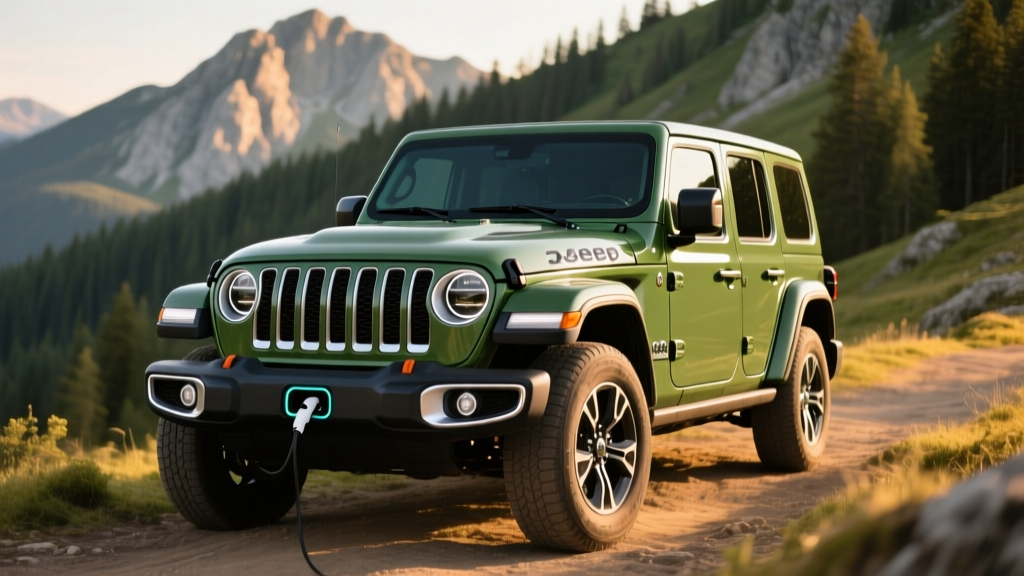
The Jeep Wrangler 4xe occupies a rare position in the electrified-vehicle market: it's a body-on-frame, solid-axle off-roader that also delivers 22 miles of electric-only driving and nearly 50 MPGe when its battery is charged. For the 2025 model year, the Wrangler plug-in hybrid continues with its proven powertrain, updated infotainment, and a starting MSRP that still qualifies certain buyers for federal tax incentives. But the 4xe is also heavier, more expensive, and more complex than the standard gas Wrangler — trade-offs every prospective buyer needs to weigh with hard numbers.
This guide breaks down the 2025 Jeep Wrangler 4xe's real-world fuel economy, electric range, charging logistics, powertrain specs, tax-credit eligibility, and long-term reliability outlook. Whether you're cross-shopping a PHEV against a full EV or a conventional hybrid, we'll help you decide if the electrified Wrangler fits your driving life.
HEV vs. PHEV: Where the Wrangler 4xe Fits
Before diving into specs, it's worth clarifying the distinction between the two hybrid architectures available in the Jeep lineup, because they serve fundamentally different use cases.
| Feature | Conventional Hybrid (HEV) | Plug-In Hybrid (PHEV) — Wrangler 4xe |
|---|---|---|
| Battery size | Small (~1–2 kWh) | 17.3 kWh total (usable ~14.5 kWh) |
| Electric-only driving | No (motor assists engine only) | Yes — 22 miles EPA |
| Plug-in charging | Not required; regenerates while driving | Required to access electric range (Level 2 AC) |
| DC fast charging | N/A | No — AC only |
| Fuel economy (combined) | Higher MPG for non-plug-in driving | 49 MPGe (electric + gas); 20 MPG gas-only |
| Best for | Drivers who can't charge at home | Drivers with home/work charging and short commutes |
The Wrangler is not offered as a conventional HEV in the U.S. — your choice is the 3.6L V6 mild-hybrid (eTorque, gas-only refuel) or the 4xe PHEV. The mild-hybrid system recovers energy during braking and assists the engine, but it cannot propel the vehicle on electricity alone. The 4xe, by contrast, has a much larger battery and a dedicated electric motor capable of moving the Wrangler at highway speeds without the gas engine firing — as long as the battery has charge.
2025 Wrangler 4xe: Powertrain and Performance Specs
| Specification | 2025 Jeep Wrangler 4xe |
|---|---|
| Engine | 2.0L turbocharged inline-4 |
| Electric motor | Integrated between engine and transmission |
| Combined system output | 375 hp / 470 lb-ft torque |
| Transmission | 8-speed automatic (TorqueFlite) |
| Battery (total / usable) | 17.3 kWh / ~14.5 kWh (NMC lithium-ion) |
| EPA electric-only range | 22 miles |
| EPA MPGe (electric + gas) | 49 MPGe combined |
| EPA MPG (gas-only, battery depleted) | 20 MPG combined (19 city / 22 hwy — Rubicon trim) |
| Total driving range | ~370 miles (gas + electric) |
| 0–60 mph | ~6.0 seconds |
| Towing capacity | 3,500 lbs |
| Drivetrain | 4WD (part-time or full-time depending on trim) |
| Ground clearance (Rubicon) | 10.8 inches |
The 470 lb-ft of combined torque is the headline figure — it's more than the 392 V8 Wrangler produces, and it arrives instantly from the electric motor. Off-road, this means precise low-speed crawling with immediate throttle response. On-road, it means confident passing power even with the Wrangler's aerodynamic profile of a brick wall.
Three drive modes manage the powertrain: Hybrid (default, blends electric and gas for efficiency), Electric (prioritizes battery-only driving until depleted or heavy throttle demand), and e-Save (reserves battery charge for later use — useful if you're highway-commuting and want electric miles for a zero-emission zone at your destination).
Fuel Economy: EPA Numbers vs. Real-World Expectations
The Wrangler 4xe's fuel economy story depends entirely on your charging habits. Here's the breakdown per fueleconomy.gov:
| Driving Mode | City | Highway | Combined |
|---|---|---|---|
| Electric + Gas (MPGe) | 52 MPGe | 47 MPGe | 49 MPGe |
| Gas-only (battery depleted) — Sahara | 20 MPG | 22 MPG | 21 MPG |
| Gas-only (battery depleted) — Rubicon | 19 MPG | 22 MPG | 20 MPG |
The 49 MPGe figure only applies when you start with a full battery and drive within the 22-mile electric window. In practice:
- Short commutes (under 20 miles) with daily charging: Expect 40–50+ MPGe equivalent. You may use almost no gasoline for weeks.
- Mixed driving without regular charging: Once the battery depletes, you're in a 4,800-lb vehicle with a turbo-four and the aerodynamics of a shed. Expect 18–21 MPG in real-world mixed driving — roughly on par with the non-hybrid 2.0L Wrangler.
- Highway road trips: 17–20 MPG at 75+ mph. The 4xe's extra ~600 lbs of battery and motor weight is a penalty once the electric range is exhausted.
- Cold weather: Expect 15–20% reduction in electric range (roughly 17–18 miles instead of 22) and 1–2 MPG less in gas-only mode due to cabin heating load and battery resistance.
The bottom line: the Wrangler 4xe rewards owners who charge regularly and have commutes within its electric range. If you can't or won't plug in, the 4xe's efficiency advantage disappears, and you're carrying dead battery weight.
Electric Range, Charging Speed, and Logistics
The 2025 Wrangler 4xe stores 17.3 kWh total in its NMC (nickel-manganese-cobalt) lithium-ion battery pack, with approximately 14.5 kWh usable before the system switches to hybrid mode. That translates to the EPA-rated 22 miles of electric-only driving.
| Charging Level | Power (kW) | Connector | 0–100% Time | Miles of EV Range per Hour |
|---|---|---|---|---|
| Level 1 (120V household) | ~1.4 kW | Standard outlet | ~12 hours | ~2 miles |
| Level 2 (240V home/public) | ~6.6 kW (onboard charger max) | J1772 / NACS (with adapter) | ~2.5–3 hours | ~8–9 miles |
| DC Fast Charge | N/A | N/A | Not supported — AC charging only | |
The Wrangler 4xe's onboard charger is limited to 6.6 kW, which means even at a public Level 2 station delivering 19.2 kW, the 4xe will only pull 6.6 kW. A full charge from empty takes roughly 2.5 to 3 hours on Level 2. There is no DC fast-charging capability — the battery is too small to justify the hardware cost and packaging, which is typical for PHEVs in this class.
Home charging setup: A standard 120V outlet will technically recharge the 4xe overnight, but barely — you'll recover about 14–16 miles of EV range in 8 hours. For the full 22 miles every morning, a 240V Level 2 home charger is strongly recommended. Installation costs for a Level 2 circuit (240V/40A–50A) typically range from $500 to $2,000 depending on panel proximity and local permitting. Consult a licensed electrician for your specific setup.
For 2025, Jeep has expanded NACS (Tesla-style) adapter compatibility, allowing Wrangler 4xe owners to use Tesla Wall Connectors and destination chargers with the appropriate J1772-to-NACS adapter. This does not grant Supercharger access for AC-only PHEVs.
Pricing, Trims, and Federal Tax Credit Eligibility
The 2025 Jeep Wrangler 4xe is available across several trims, with pricing that reflects its dual personality as off-roader and electrified commuter:
| Trim | Starting MSRP |
|---|---|
| Willys 4xe | $51,790 |
| Sahara 4xe | $54,790 |
| Rubicon 4xe | $58,790 |
| High Altitude 4xe | $62,790 |
| Moab 4xe (limited) | $65,290 |
All prices include destination. Options packages, soft-top vs. hardtop, and accessory groups can push well-equipped Rubicons past $70,000.
The Wrangler 4xe has historically qualified for a partial or full federal tax credit, but eligibility under current IRS rules depends on several factors that change periodically. Here's the checklist per IRS.gov:
- MSRP cap: SUVs must have an MSRP at or below $80,000. Most Wrangler 4xe trims qualify; heavily optioned models may approach the limit.
- Buyer income cap: Modified AGI must not exceed $150,000 (single), $225,000 (head of household), or $300,000 (joint).
- Battery component sourcing: A percentage of battery components must be manufactured or assembled in North America, and critical minerals must be sourced from the U.S. or FTA partners. These thresholds increase annually. The 4xe's battery sourcing has been a moving target — verify current-year compliance on the IRS qualified vehicles list before purchasing.
- Point-of-sale transfer: As of 2024, eligible buyers can transfer the credit to the dealer at purchase, reducing the upfront price rather than waiting for a tax refund. This is available for the 4xe if it qualifies in the purchase year.
- Credit amount: Up to $7,500 maximum ($3,750 for battery components + $3,750 for critical minerals). The 4xe may qualify for the full $7,500, half ($3,750), or none depending on current sourcing rules.
Always verify eligibility on the IRS qualified clean vehicles list and consult a tax professional before relying on the credit in your purchase decision.
Battery Warranty, Reliability, and Replacement Costs
- High-voltage battery: 8 years / 100,000 miles (whichever comes first)
- Capacity retention threshold: Stellantis warrants the battery against falling below 70% of original capacity during the warranty period
- Powertrain (engine, motor, transmission): 5 years / 60,000 miles
- Bumper-to-bumper: 3 years / 36,000 miles
The 8-year/100,000-mile battery warranty is federally mandated for PHEVs and EVs, and it's the most important coverage to understand. If your 4xe's battery degrades below 70% usable capacity within that window, Stellantis will repair or replace it at no cost. In practice, NMC batteries in PHEV applications tend to degrade slowly — most owners report minimal range loss in the first 3–4 years because the battery is rarely cycled to full depth (the system reserves a buffer at top and bottom).
Out-of-warranty replacement cost: If the high-voltage battery needs replacement after the warranty expires, expect a dealer quote in the range of $8,000 to $12,000 for the battery pack alone, plus $1,500–$2,500 in labor. Third-party EV battery repair shops are emerging and may offer module-level repair for $3,000–$5,000, but this is still a niche market for the 4xe.
Reliability considerations: The Wrangler platform has historically scored average to below-average in reliability surveys from Consumer Reports and J.D. Power. The 4xe adds complexity — a turbocharged engine, high-voltage battery, electric motor, and power electronics — on top of the Wrangler's already complex 4WD systems. Common owner-reported issues include infotainment glitches, 12V battery drain (the 4xe has a conventional 12V battery that can be depleted if the vehicle sits unplugged for extended periods), and occasional software-related drivetrain warnings that require dealer resets. The powertrain itself has proven durable in fleet use, but the surrounding electronics remain a weak point.
Who Should Buy the Wrangler 4xe — And Who Shouldn't
- 470 lb-ft of instant torque — exceptional off-road and on-road performance
- 22-mile EV range covers most daily commutes gasoline-free
- Full Wrangler capability: removable doors/top, solid axles, Trail Rated
- Potential $3,750–$7,500 federal tax credit reduces effective price
- No range anxiety — gas engine provides 370+ total miles
- Quiet electric-only operation in neighborhoods and trails
- $10,000+ premium over equivalent gas Wrangler trims
- Only 20 MPG gas-only — worse than many midsize SUVs when battery is depleted
- 6.6 kW AC charging only — no DC fast charge, 2.5+ hour recharge
- 600+ lbs of added weight affects handling and braking
- Cargo space reduced by battery packaging under rear seat
- Average reliability ratings; complex systems increase long-term risk
Choose the Wrangler 4xe if:
- You have home or workplace Level 2 charging access
- Your daily round-trip commute is 20 miles or less
- You want Wrangler off-road capability but also want to minimize weekday fuel costs
- You qualify for the federal tax credit and can apply it at point of sale
- You regularly tow or take road trips where full EV range would be impractical
Choose the gas Wrangler (3.6L V6 eTorque) instead if:
- You cannot charge at home or work
- Your daily driving exceeds 30 miles (the electric range won't offset the price premium)
- You want the lowest purchase price and simplest long-term maintenance
Choose a full EV (e.g., Ford Bronco Mach-E, Rivian R1S) instead if:
- You want zero tailpipe emissions and don't need removable doors/soft top
- You have reliable home charging and your trips rarely exceed 250 miles
- You want lower per-mile energy costs and less drivetrain maintenance
Wrangler 4xe vs. the Competition
The 4xe doesn't have a direct rival — no other PHEV offers solid axles, a disconnecting sway bar, and removable doors. But if you're cross-shopping by use case:
| Vehicle | EV Range | Gas-Only MPG | Combined HP | Starting MSRP |
|---|---|---|---|---|
| 2025 Jeep Wrangler 4xe (Rubicon) | 22 mi | 20 MPG | 375 hp | $58,790 |
| 2025 Jeep Grand Cherokee 4xe | 25 mi | 23 MPG | 375 hp | $60,490 |
| 2025 Toyota RAV4 Prime (PHEV) | 42 mi | 38 MPG | 302 hp | $44,935 |
| 2025 Ford Escape PHEV | 37 mi | 40 MPG | 210 hp | $39,500 |
The RAV4 Prime and Escape PHEV crush the Wrangler 4xe on efficiency and electric range — but they can't ford 30 inches of water or disconnect their sway bars. The Grand Cherokee 4xe shares the powertrain and offers more refinement, but it's not a Trail Rated rock crawler. The Wrangler 4xe is the only choice if your priority list starts with off-road capability and ends with electrified commuting.
Frequently Asked Questions
How many MPG does the 2025 Jeep Wrangler 4xe get?
When driven with a charged battery within its electric range, the Wrangler 4xe achieves 49 MPGe combined (52 city / 47 highway). Once the battery depletes and the vehicle operates as a conventional hybrid, it returns 20 MPG combined (19 city / 22 highway for the Rubicon trim). Real-world gas-only driving typically yields 18–21 MPG depending on speed, terrain, and temperature.
How far can the Wrangler 4xe go on electric only?
The EPA rates the 2025 Wrangler 4xe at 22 miles of electric-only range. In real-world conditions, expect 18–20 miles in warm weather with moderate driving, and 15–18 miles in cold weather (below 40°F) due to battery resistance and cabin heating demand. Highway speeds above 65 mph will deplete the battery faster than the EPA test cycle suggests.
Does the Wrangler 4xe qualify for a federal tax credit?
The Wrangler 4xe may qualify for up to $7,500 under the IRS §30D Clean Vehicle Credit, but eligibility depends on current-year battery sourcing requirements, the vehicle's MSRP (must be under $80,000 for SUVs), and the buyer's income (under $150K single / $300K joint). The credit can be transferred to the dealer at point of sale. Always check the IRS qualified vehicles list for the specific model year and build date before purchasing.
Is the Wrangler 4xe reliable, and what does battery replacement cost?
The 4xe's powertrain has proven mechanically sound, but the Wrangler platform's overall reliability ratings remain average to below average due to electronics and build-quality issues. The high-voltage battery is warrantied for 8 years / 100,000 miles against degradation below 70% capacity. Out-of-warranty battery replacement costs approximately $8,000–$12,000 for the pack plus $1,500–$2,500 in labor.
Can I charge the Wrangler 4xe at a Tesla Supercharger?
No. The Wrangler 4xe supports only AC charging (Level 1 and Level 2) via a J1772 inlet. While a J1772-to-NACS adapter allows use of Tesla Wall Connectors and destination chargers, Tesla Superchargers deliver DC power, which the 4xe cannot accept. You can charge at any public Level 2 station (ChargePoint, EVgo, Electrify America Level 2, etc.).
Hybrid vs. PHEV vs. full EV — which is right for me?
A conventional hybrid (HEV) is best if you have no charging access and want better MPG without plugging in. A plug-in hybrid (PHEV) like the Wrangler 4xe is ideal if you can charge at home, have a short commute, but also need long-range capability for road trips or towing. A full EV (BEV) makes sense if you want the lowest operating costs, have reliable charging, and rarely drive more than 250 miles in a day. The 4xe bridges the gap for drivers who need off-road capability and can't yet commit to a full EV lifestyle.