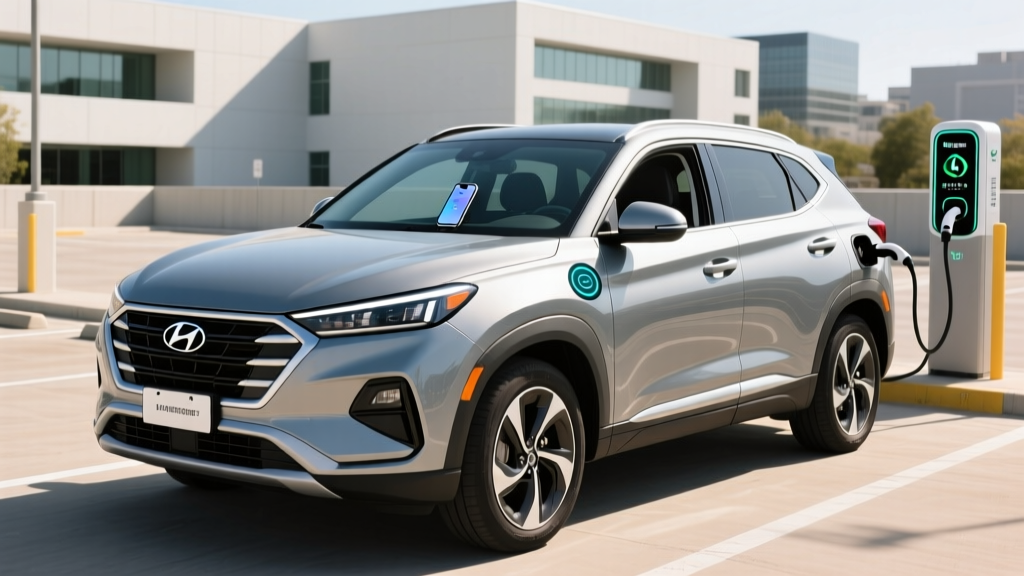
The 2025 Hyundai Tucson PHEV occupies a precise niche: a compact SUV that covers most daily commutes on electricity alone while retaining a gasoline engine for longer trips. With 33 miles of EPA-rated electric-only range and a combined 80 MPGe, it targets buyers who want EV-like daily driving without committing to a full battery-electric vehicle. But how do those numbers translate to real-world ownership, and does the math still work after federal tax credits?
2025 Hyundai Tucson PHEV: Core Specifications
| Specification | Value |
|---|---|
| EPA Electric-Only Range | 33 miles |
| EPA Combined MPGe (EV mode) | 80 MPGe |
| EPA Combined MPG (gas-hybrid mode) | 35 MPG |
| Total Driving Range (est.) | ~400 miles |
| Battery Capacity | 13.8 kWh (usable) |
| Battery Chemistry | NMC (Nickel Manganese Cobalt) |
| Combined System Horsepower | 261 hp |
| Combined System Torque | 258 lb-ft |
| Gasoline Engine | 1.6L turbocharged 4-cylinder (178 hp) |
| Electric Motor | 66.9 kW (90 hp) |
| Transmission | 6-speed automatic |
| Drivetrain | HTRAC AWD (standard) |
| Max Level 2 Charge Rate | 7.2 kW |
| DC Fast Charging | Not supported |
| Level 2 Charge Time (0–100%) | ~2 hours |
| Level 1 Charge Time (120V, 0–100%) | ~11 hours |
| 0–60 mph | ~7.1 seconds |
| Cargo Volume (behind rear seats) | 38.7 cu ft |
| Starting MSRP (SEL Convenience) | $39,590 |
| Limited Trim MSRP | $45,140 |
| Hybrid Battery Warranty | 10 years / 100,000 miles |
| Powertrain Warranty | 10 years / 100,000 miles |
HEV vs. PHEV: Understanding the Tucson Lineup
Hyundai sells three Tucson powertrains: a conventional gasoline model, a standard hybrid (HEV), and the plug-in hybrid (PHEV) covered here. The distinction matters for your wallet and your daily routine.
Conventional Hybrid (Tucson HEV)
The Tucson Hybrid pairs a 1.6L turbo engine with a smaller electric motor and a ~1.5 kWh battery. It never needs to be plugged in — the battery recharges through regenerative braking and the engine. EPA ratings land at 38 MPG combined. You simply drive it like a gas car and enjoy better fuel economy, particularly in stop-and-go city traffic where the electric motor does more work.
Plug-in Hybrid (Tucson PHEV)
The Tucson PHEV uses a much larger 13.8 kWh battery and a more powerful electric motor. You plug it in to unlock the 33-mile electric-only range. Once the battery depletes, it seamlessly transitions to hybrid mode at 35 MPG combined. The PHEV requires access to a 120V or 240V outlet to realize its efficiency advantage. Without regular charging, you're carrying extra battery weight for marginal gains over the HEV.
The decision between HEV and PHEV hinges on one question: Can you charge at home or work? If yes, and your daily round-trip commute falls under 33 miles, the PHEV will run predominantly on electricity for months at a time. If you lack reliable charging access, the HEV is the smarter financial choice.
Fuel Economy: EPA Ratings vs. Real-World MPG
| Mode | City | Highway | Combined |
|---|---|---|---|
| Electric-Only (MPGe) | 85 MPGe | 75 MPGe | 80 MPGe |
| Hybrid (MPG, after battery depletion) | 35 MPG | 35 MPG | 35 MPG |
According to fueleconomy.gov, the Tucson PHEV achieves 80 MPGe combined in charge-depleting (electric) mode and 35 MPG combined once operating as a conventional hybrid.
Real-World Expectations
EPA electric range: 33 miles. In practice, expect 28–32 miles in mild weather with moderate speeds. Highway driving at 70+ mph, aggressive acceleration, and cold temperatures (below 40°F) can reduce electric-only range to 22–26 miles. The battery's usable capacity shrinks in cold weather because the chemistry becomes less efficient and cabin heating draws significant energy.
EPA hybrid MPG: 35 combined. Real-world hybrid-mode fuel economy tends to run 33–37 MPG depending on driving style and terrain. City driving with frequent stops lets regenerative braking recover energy, often pushing the number slightly above the EPA estimate. Sustained highway driving at high speed typically lands around 32–34 MPG.
For a driver who charges nightly and commutes 25 miles round-trip, gasoline consumption drops to near zero on weekdays. Weekend road trips use the engine, but overall annual fuel consumption can fall below 200 gallons — roughly $600–$800 in fuel costs depending on local gas prices, compared to $1,800–$2,200 for a comparable gas-only compact SUV averaging 25 MPG.
Charging the Tucson PHEV: What You Need to Know
The 2025 Tucson PHEV charges via a J1772 connector (the standard for all non-Tesla plug-in vehicles in the US). It accepts up to 7.2 kW on Level 2 and approximately 1.4 kW on Level 1 (standard 120V household outlet). DC fast charging is not supported — this is typical for PHEVs, as the battery is too small to benefit from high-power DC charging infrastructure.
| Charging Level | Power (kW) | Time (0–100%) | Miles of EV Range per Hour |
|---|---|---|---|
| Level 1 (120V, 12A) | ~1.4 kW | ~11 hours | ~3 miles/hr |
| Level 2 (240V, 32A) | 7.2 kW | ~2 hours | ~16 miles/hr |
Practical charging advice: A standard 120V outlet works if you park for 10+ hours overnight and your commute stays under 30 miles. You'll replenish roughly 30 miles of range in that window — just enough to refill the battery. However, a 240V Level 2 home charger is strongly recommended. At 7.2 kW, a full recharge takes about two hours, meaning you can top up during shorter stops or easily recharge between morning and evening drives.
Level 2 home charger installation typically costs $500–$1,500 for the equipment and electrician labor if your electrical panel has capacity. A panel upgrade (200A service) can add $1,500–$3,000. Always get a quote from a licensed electrician before purchasing equipment.
Performance and Powertrain
The Tucson PHEV's powertrain combines a 1.6-liter turbocharged four-cylinder engine (178 hp, 195 lb-ft) with a 66.9 kW electric motor integrated into the 6-speed automatic transmission. Combined system output is 261 hp and 258 lb-ft of torque, routed through Hyundai's HTRAC all-wheel-drive system.
The result is a 0–60 mph time of approximately 7.1 seconds — noticeably quicker than the non-turbo Tucson Hybrid (around 8.0 seconds) and adequate for confident highway merging. The electric motor provides immediate torque at low speeds, making the Tucson PHEV feel responsive around town even before the turbo spools up.
In EV mode, the Tucson PHEV can sustain highway speeds up to about 75 mph on electric power alone, though range drops sharply at higher speeds. The transition from electric to hybrid mode is seamless — most drivers won't notice the engine engaging unless they're watching the power-flow display.
Pricing, Trims, and Tax Credit Eligibility
The 2025 Tucson PHEV is offered in two trims:
- SEL Convenience: $39,590 MSRP (includes destination)
- Limited: $45,140 MSRP (includes destination)
Both trims come standard with HTRAC AWD, a 10.25-inch touchscreen, wireless Apple CarPlay and Android Auto, heated front seats, and Hyundai's SmartSense suite of driver-assistance features (forward collision-avoidance, lane-keeping assist, blind-spot monitoring, adaptive cruise control).
Federal Tax Credit (§30D) — Key Requirements
The 2025 Tucson PHEV may qualify for up to $3,750 in federal tax credits under IRS §30D, but eligibility depends on several factors that change periodically. As of current rules:
- Vehicle MSRP cap: SUVs must be under $80,000 (Tucson PHEV qualifies)
- Buyer income cap: Modified AGI ≤ $150,000 (single), ≤ $225,000 (head of household), ≤ $300,000 (joint)
- Battery sourcing: The credit splits into two halves ($3,750 each) based on critical-mineral and battery-component sourcing requirements — the Tucson PHEV's eligibility for each half depends on current supply-chain compliance, which shifts annually
- Point-of-sale transfer: Eligible buyers can transfer the credit to the dealer for an upfront price reduction rather than claiming it at tax time
- Assembly: Vehicle must be assembled in North America (Tucson PHEV is assembled in the US)
Always verify current eligibility on IRS.gov and with your tax professional before purchasing, as critical-mineral sourcing rules are updated periodically and can change mid-year.
After a potential $3,750 credit, the effective price of the SEL Convenience trim drops to approximately $35,840 — competitive with well-equipped compact SUVs in the segment. Several states also offer additional PHEV rebates (California's Clean Fuel Reward, Colorado's state credit, etc.), but amounts vary by jurisdiction and change frequently. Check your state's energy office for current programs.
Battery Longevity, Warranty, and Replacement Costs
Hyundai's Hybrid Battery Warranty
Coverage: 10 years / 100,000 miles (whichever comes first) for the high-voltage battery pack. Hyundai warrants the battery against defects and excessive capacity loss. If the battery falls below a specified state-of-health threshold (typically ~70% of original capacity), Hyundai will repair or replace it at no cost to the original owner.
The standard powertrain warranty also runs 10 years / 100,000 miles, covering the engine, transmission, and electric motor.
PHEV battery degradation is generally modest. The 13.8 kWh pack is relatively small and Hyundai's thermal management system keeps the cells within optimal temperature ranges. Based on data from earlier Hyundai/Kia PHEV models (Ioniq PHEV, Niro PHEV), owners typically see 5–10% capacity loss over the first five years — meaning the 33-mile electric range might drop to 30–31 miles by year five under normal use.
Out-of-warranty replacement cost: If the battery fails after the warranty period, a replacement pack for the Tucson PHEV currently runs approximately $4,000–$6,500 including parts and labor. This figure is expected to decline as battery costs continue their downward trend, but it remains a consideration for second owners or high-mileage drivers. The conventional hybrid (HEV) uses a much smaller, less expensive battery (~$1,500–$2,500 replacement) because its pack is roughly one-tenth the size.
Reliability context: Hyundai's turbocharged 1.6L engine and 6-speed automatic are well-established components shared across the Hyundai/Kia lineup. The PHEV-specific additions (larger battery, electric motor, power electronics) add complexity compared to the HEV, but Hyundai's track record with these systems has been solid. IIHS has tested the Tucson favorably for crashworthiness, and the model carries strong safety ratings across the board.
Who Should Choose the Tucson PHEV?
Choose the Tucson PHEV if:
- You can charge at home (garage, driveway, or dedicated outlet)
- Your daily commute is under 33 miles round-trip
- You want EV-like daily driving but still take road trips without planning charging stops
- You live in a region with extreme cold that significantly reduces BEV range
- You want AWD as standard equipment
Choose the Tucson HEV instead if:
- You cannot charge at home or work
- Your daily driving exceeds 40+ miles (you'll be in hybrid mode most of the time anyway)
- You want a lower purchase price (the HEV starts ~$5,000 less)
Choose a full BEV (e.g., Hyundai Ioniq 5) if:
- You want zero gasoline use and minimal maintenance
- You have home charging and your daily driving stays under 250 miles
- You want access to DC fast charging for road trips
- You qualify for the full $7,500 federal tax credit (many BEVs qualify for more than PHEVs)
Pros
- 33 miles of electric-only range covers most daily commutes
- Standard HTRAC AWD — no FWD-only compromise
- 261 hp combined provides confident acceleration
- 10-year/100,000-mile battery and powertrain warranty
- No range anxiety — gas engine covers long trips seamlessly
- Well-equipped at SEL Convenience trim level
Cons
- No DC fast charging — public charging limited to Level 2
- Only two trims available (no base model under $39K)
- Electric range drops noticeably in cold weather and at highway speeds
- Partial federal tax credit eligibility (up to $3,750, not the full $7,500)
- Premium over the HEV takes years of fuel savings to recoup
- Cargo space slightly reduced vs. gas Tucson due to battery placement
Frequently Asked Questions
How many MPG does the 2025 Hyundai Tucson PHEV get?
The Tucson PHEV achieves 80 MPGe combined when operating on its electric charge, and 35 MPG combined once the battery is depleted and it operates as a conventional hybrid. City and highway ratings are both 35 MPG in hybrid mode. Real-world results vary from 33–37 MPG depending on conditions.
How far can the Tucson PHEV go on electric only?
The EPA rates the Tucson PHEV at 33 miles of electric-only range. In real-world driving, expect 28–32 miles in moderate temperatures at mixed speeds, and 22–26 miles in cold weather or sustained highway driving above 70 mph.
Does the 2025 Tucson PHEV qualify for a federal tax credit?
It may qualify for up to $3,750 under IRS §30D, depending on current battery-sourcing requirements and your income level. The full $7,500 credit requires meeting both critical-mineral and battery-component thresholds, and PHEVs often qualify for only one half. Always verify on IRS.gov at the time of purchase.
Is the Tucson PHEV reliable, and what does battery replacement cost?
Hyundai's hybrid and PHEV systems have demonstrated solid reliability based on data from earlier models. The high-voltage battery is covered by a 10-year/100,000-mile warranty. Out-of-warranty replacement costs approximately $4,000–$6,500, though this figure is expected to decrease over time.
Do I need to plug in the Tucson PHEV?
To get the benefit of the 33-mile electric range and 80 MPGe rating, yes — you should plug it in regularly. If you never charge it, the Tucson PHEV operates as a conventional hybrid at 35 MPG, but you're carrying 400+ pounds of battery you're not utilizing. If you can't plug in, the Tucson HEV is a better choice.
Can the Tucson PHEV use DC fast chargers?
No. The Tucson PHEV only accepts AC charging: Level 1 (120V) at ~1.4 kW and Level 2 (240V) at up to 7.2 kW. This is standard for PHEVs — the battery is too small to benefit from DC fast charging, and manufacturers omit the hardware to save cost and weight.
How does the Tucson PHEV compare to a full EV like the Ioniq 5?
The Ioniq 5 offers 260–320 miles of EPA range, DC fast charging up to 235 kW, and potentially the full $7,500 tax credit. If you have reliable home charging and rarely drive more than 250 miles in a day, a BEV like the Ioniq 5 provides lower operating costs and less maintenance. The Tucson PHEV makes sense if you regularly exceed 250 miles, lack charging access on road trips, or live in extreme cold where BEV range loss is a concern.