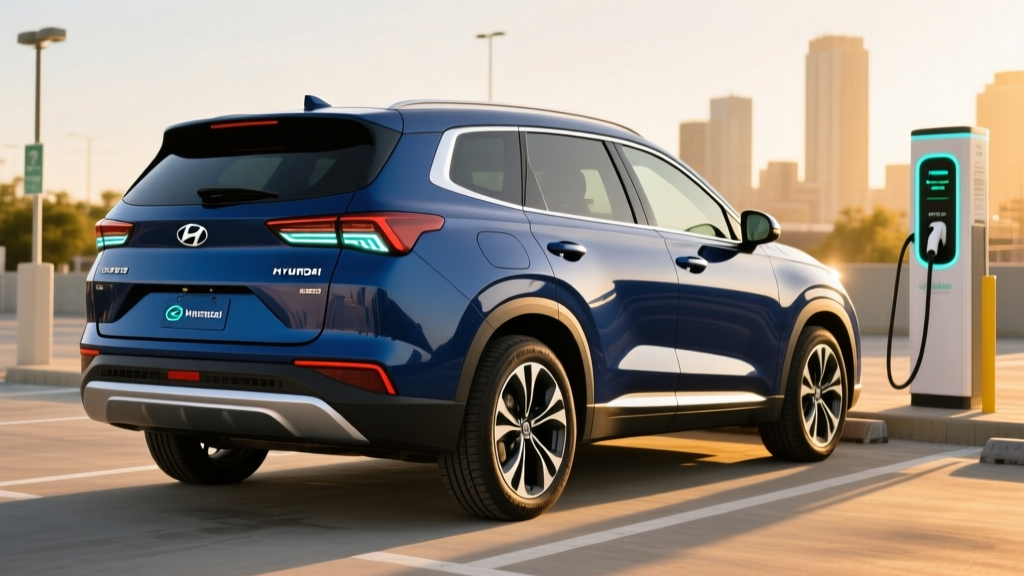
The 2025 Hyundai Santa Fe Hybrid arrives with a boxy redesign, standard all-wheel drive, and a turbocharged 1.6-liter hybrid powertrain that delivers three-row versatility without the fuel thirst of a body-on-frame SUV. For buyers researching the 2025 Hyundai Santa Fe Hybrid MPG, the headline number is an EPA-estimated 36 MPG combined — but the real-world story is more nuanced depending on whether you choose the conventional hybrid (HEV) or the plug-in hybrid (PHEV) variant.
This guide breaks down every efficiency figure, battery spec, charging requirement, and ownership cost you need to make an informed decision between the Santa Fe HEV, the Santa Fe PHEV, and competing electrified SUVs.
2025 Hyundai Santa Fe Hybrid MPG: EPA Numbers and Real-World Expectations
The conventional 2025 Santa Fe Hybrid pairs a 1.6-liter turbocharged four-cylinder engine with a 47.7 kW electric motor integrated into a six-speed automatic transmission. Combined output is 232 horsepower and 271 lb-ft of torque, routed through standard HTRAC all-wheel drive.
| Trim | City MPG | Highway MPG | Combined MPG |
|---|---|---|---|
| SEL Premium | 35 | 31 | 33 |
| Limited | 35 | 31 | 33 |
Source: EPA / fueleconomy.gov
Santa Fe PHEV: Electric-Only Range, Battery Size, and Charging Specs
If you want electric-only commuting with the option of gas-powered road trips, the 2025 Santa Fe Plug-in Hybrid is the answer. Hyundai equips the PHEV with a larger 22.8 kWh battery pack (18.0 kWh usable) and a more powerful 74 kW electric motor, combined with the same 1.6-liter turbo engine for a total system output of 261 horsepower.
| Specification | Value |
|---|---|
| EPA Electric-Only Range | 33 miles |
| Total Combined Range (Electric + Gas) | ~430 miles |
| Battery Capacity (Gross / Usable) | 22.8 kWh / 18.0 kWh |
| Battery Chemistry | NMC (Nickel Manganese Cobalt) |
| Level 1 Charging (120V) | ~11 hours (full) |
| Level 2 Charging (240V, 7.2 kW) | ~2 hours 45 minutes (full) |
| DC Fast Charging | Not available |
| Combined System Horsepower | 261 hp / 271 lb-ft |
| Charge Port | J1772 (Level 2) |
The PHEV's 33-mile electric range covers most daily commutes without a drop of gasoline. Once the battery depletes, the Santa Fe PHEV operates as a conventional hybrid, returning an EPA-estimated 33 MPG combined in charge-sustaining mode. The vehicle cannot DC fast charge — a limitation common to most PHEVs in this class, since the relatively small battery doesn't justify the cost and weight of DC hardware.
Source: Hyundai Newsroom
HEV vs PHEV: Which Santa Fe Hybrid Fits Your Driving Pattern?
Conventional Hybrid (HEV)
- No plug required — refuel at any gas station
- 33–36 MPG combined depending on trim
- Lower starting price (~$3,500 less than PHEV)
- Lighter curb weight, slightly more cargo space
- Best for: apartment dwellers, high-mileage drivers, those without home charging
Plug-in Hybrid (PHEV)
- 33 miles electric-only for daily commuting
- Gas engine for road trips — no range anxiety
- Eligible for federal §30D tax credit (up to $7,500)
- Requires home Level 2 charging for best experience
- Best for: homeowners with garage charging, commuters under 30 miles round-trip
The decision comes down to one question: Can you charge at home? If you have a garage or driveway where you can install a 240V Level 2 charger, the PHEV effectively becomes an EV for weekday commuting and a hybrid for weekend trips. If you rely on street parking or lack charging access, the conventional HEV delivers strong efficiency with zero lifestyle change.
Pricing, Trims, and Federal Tax Credit Eligibility
| Model / Trim | MSRP (incl. destination) | Federal Tax Credit |
|---|---|---|
| Santa Fe HEV SEL Premium | $39,415 | Not eligible |
| Santa Fe HEV Limited | $44,265 | Not eligible |
| Santa Fe PHEV SEL Premium | $43,415 | Up to $7,500 (§30D) |
| Santa Fe PHEV Limited | $47,915 | Up to $7,500 (§30D) |
Pricing source: Hyundai Newsroom. Tax credit eligibility subject to IRS §30D rules.
- Credit amount: Up to $7,500, split between critical minerals ($3,750) and battery component sourcing ($3,750). The PHEV's partial credit eligibility depends on current-year sourcing rules.
- Income caps: AGI must not exceed $150,000 (single), $225,000 (head of household), or $300,000 (joint).
- MSRP cap: SUVs/vans capped at $80,000 — the Santa Fe PHEV qualifies.
- Point-of-sale transfer: You can transfer the credit to the dealer at purchase for an immediate price reduction.
- Battery sourcing: Requirements tighten annually. Check the latest eligibility at IRS.gov before purchasing.
The conventional HEV does not qualify for the §30D federal tax credit because it lacks the minimum battery capacity and plug-in capability required by the statute. However, some states and utilities offer rebates for hybrid purchases — check your local programs.
Battery Warranty, Reliability, and Replacement Cost
Hyundai Hybrid & PHEV Battery Warranty
Hybrid battery: 10 years / 100,000 miles (whichever comes first)
Capacity retention guarantee: If the battery falls below approximately 70% of original capacity during the warranty period, Hyundai will repair or replace it.
Powertrain warranty: 10 years / 100,000 miles — covers the engine, electric motor, and transmission.
Bumper-to-bumper: 5 years / 60,000 miles.
Hyundai's hybrid battery warranty is among the longest in the industry, matching Toyota and exceeding most domestic competitors. The NMC lithium-ion pack in both the HEV and PHEV is sealed, liquid-cooled, and designed to last the life of the vehicle under normal use.
Real-world degradation: Hybrid batteries experience far less stress than full EV batteries because they operate in a narrow state-of-charge window (typically 30–70%), avoiding the deep cycles that accelerate wear. Most Hyundai hybrid owners report negligible capacity loss over 5–7 years of ownership.
Out-of-warranty replacement cost: If a hybrid battery fails after the warranty expires, replacement typically costs between $2,500 and $4,500 depending on whether you go through a dealer (new OEM pack) or an independent hybrid specialist (refurbished cells). The PHEV's larger battery may run $5,000–$7,000 for a full replacement.
Driving Experience and Powertrain Performance
The Santa Fe Hybrid isn't designed for performance driving, but its powertrain is competent for daily use:
- 0–60 MPH (HEV): Approximately 7.5 seconds
- 0–60 MPH (PHEV): Approximately 7.0 seconds (more electric torque off the line)
- Towing capacity: 2,000 lbs (HEV) / 2,000 lbs (PHEV)
- Drive modes: Eco, Smart, Sport, Snow, with regenerative braking adjustable via paddle shifters
The six-speed automatic — rather than a CVT — gives the Santa Fe Hybrid a more natural acceleration feel than many competitors. The electric motor fills in torque at low RPM before the turbo spools up, eliminating the sluggishness that plagues some small-displacement hybrid setups. Highway passing is confident, and the HTRAC AWD system can shift torque rearward for light snow and rain traction.
One practical note: the PHEV's heavier battery pack adds approximately 300 lbs over the HEV, slightly reducing cargo volume behind the third row and making the ride marginally firmer over rough pavement.
Santa Fe Hybrid vs. the Competition
| Model | Combined MPG | Horsepower | Starting MSRP | EV Mode (PHEV) |
|---|---|---|---|---|
| Hyundai Santa Fe HEV | 33–36 | 232 hp | $39,415 | N/A |
| Toyota Highlander Hybrid | 35–36 | 243 hp | $42,815 | N/A |
| Kia Sorento HEV | 34–37 | 227 hp | $39,490 | N/A |
| Toyota Grand Highlander Hybrid | 34–36 | 243–362 hp | $45,120 | N/A |
| Hyundai Santa Fe PHEV | 33 (gas) / 83 MPGe | 261 hp | $43,415 | 33 miles |
The Santa Fe Hybrid's main advantage is its combination of standard AWD, boxy cargo-friendly design, and one of the lowest entry prices in the three-row hybrid segment. The Toyota Highlander Hybrid edges it out slightly on highway MPG, while the Sorento HEV (its platform-mate) offers nearly identical specs in a slightly smaller package.
Who Should Buy the Santa Fe Hybrid — and Who Should Look Elsewhere?
Choose the Santa Fe Hybrid If:
- You need three rows but don't want a minivan
- You want 33+ MPG without plugging in
- You drive 12,000–18,000 miles/year and want to cut fuel costs
- You value a long powertrain warranty (10yr/100k)
- You want a turbo hybrid with real passing power
Look Elsewhere If:
- You only need two rows (consider Tucson Hybrid for better MPG)
- You want full EV operation (Ioniq 5 offers 303 mi range, no gas)
- You tow more than 2,000 lbs regularly
- You need maximum third-row space (Grand Highlander is roomier)
- You prioritize resale value above all (Toyota leads here)
Frequently Asked Questions
How many MPG does the 2025 Hyundai Santa Fe Hybrid actually get?
The EPA rates the Santa Fe HEV at 35 city / 31 highway / 33 combined MPG. In real-world driving, expect 34–38 MPG in city-heavy commuting and 28–31 MPG on sustained highway trips. Cold weather and aggressive driving can reduce these figures by 5–10%.
How far can the Santa Fe PHEV go on electric only?
The EPA rates the Santa Fe PHEV at 33 miles of electric-only range. In mild weather with gentle acceleration, some owners report 35–37 miles. In cold weather or at highway speeds, expect 25–28 miles before the gas engine engages.
Does the Santa Fe Hybrid qualify for a federal tax credit?
The conventional HEV does not qualify. The PHEV may qualify for up to $7,500 under the IRS §30D Clean Vehicle Credit, subject to buyer income limits ($150K single / $300K joint), MSRP caps ($80K for SUVs), and battery sourcing requirements that tighten annually. The credit can be transferred to the dealer at point of sale. Always verify current eligibility at IRS.gov before purchasing.
Is the Santa Fe Hybrid reliable? What does a battery replacement cost?
Hyundai's hybrid system has proven reliable across the Tucson, Sonata, and Santa Fe lineups, with no widespread failure patterns reported. The hybrid battery is covered by a 10-year/100,000-mile warranty. Out-of-warranty replacement runs $2,500–$4,500 for the HEV and $5,000–$7,000 for the PHEV, though most packs outlast the vehicle.
Do I need to plug in the Santa Fe Hybrid?
The conventional HEV never needs plugging in — it charges its small battery through regenerative braking and the gas engine. Only the PHEV requires plug-in charging to access its 33-mile electric range. If you can't charge at home, the HEV is the better choice.
Should I get the Santa Fe Hybrid or a full EV like the Ioniq 5?
If you have reliable home charging, drive under 250 miles/day, and want to eliminate gas entirely, a full EV like the Hyundai Ioniq 5 (303 miles EPA range) offers lower per-mile energy costs and minimal maintenance. If you take frequent road trips beyond charging infrastructure, lack home charging, or want a three-row layout, the Santa Fe Hybrid is the more practical choice. The PHEV splits the difference — electric commuting with gas backup.