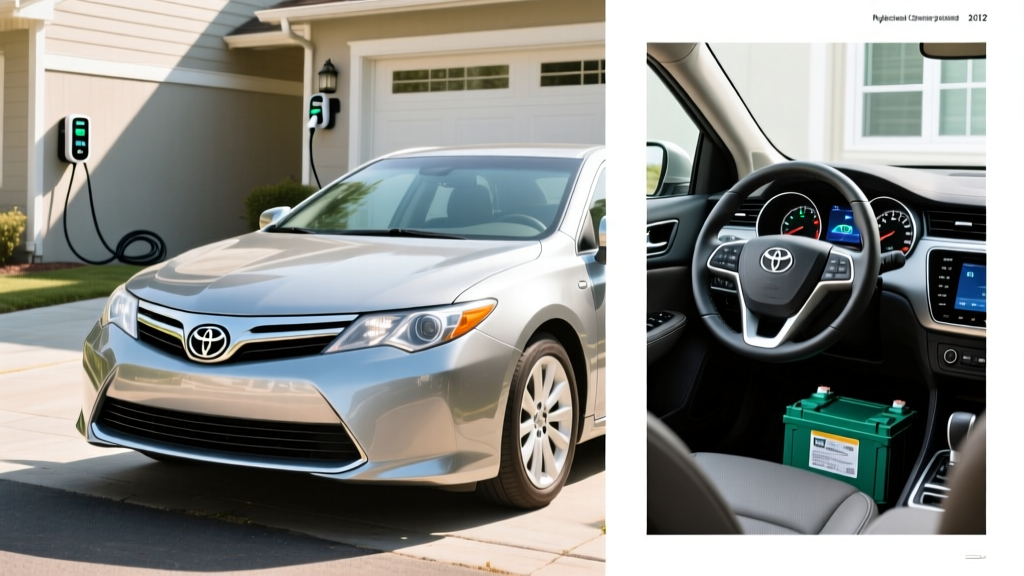
The 2012 Toyota Camry Hybrid represents a pivotal year for Toyota's midsize hybrid sedan. It was the first model year of the XV50 generation, bringing a redesigned body, a more efficient Hybrid Synergy Drive powertrain, and a notable split in trim offerings. For used-car shoppers in 2026 evaluating fuel-efficient vehicles without plugging in, the 2012 Camry Hybrid remains a benchmark for proven hybrid reliability, strong city MPG, and low running costs.
This guide covers the exact EPA figures, real-world fuel economy behavior, hybrid battery longevity data, replacement costs, and how the 2012 Camry Hybrid stacks up against modern PHEVs and full EVs for today's buyers.
2012 Camry Hybrid EPA Fuel Economy and Real-World MPG
The 2012 Camry Hybrid was offered in two trims with different fuel economy ratings due to wheel and tire differences. According to fueleconomy.gov, here are the official EPA numbers:
| Trim | City MPG | Highway MPG | Combined MPG |
|---|---|---|---|
| LE (16" wheels) | 43 | 39 | 41 |
| XLE (17" wheels) | 40 | 38 | 39 |
The LE trim's 41 MPG combined was class-leading for 2012 and still competitive against many modern hybrids. The 4 MPG city advantage of the LE over the XLE traces directly to lower rolling resistance tires and reduced rotational mass.
Toyota's Hybrid Synergy Drive system excels in stop-and-go city driving, where the electric motor handles low-speed propulsion and regenerative braking recaptures energy. Many owners report exceeding the EPA city estimate — 44-47 MPG in warm-weather urban driving is well-documented on owner forums and Fuelly data. However, sustained highway driving at 75+ MPH can drop efficiency to 35-37 MPG due to the 2.5L Atkinson-cycle engine operating outside its optimal efficiency band at higher loads. In cold weather (below 35°F), expect a 5-10% reduction as the engine runs more frequently to maintain cabin heat and battery temperature.
Powertrain Specs: Engine, Motor, and Combined Output
The 2012 Camry Hybrid uses Toyota's third-generation Hybrid Synergy Drive, pairing a gasoline engine with two motor-generators and a nickel-metal hydride (NiMH) battery pack.
| Component | Specification |
|---|---|
| Gasoline Engine | 2.5L 4-cyl Atkinson-cycle (2AR-FXE) |
| Engine Power | 156 hp @ 5,700 rpm / 156 lb-ft torque |
| Electric Motor (MG2) | 105 kW (141 hp) |
| Net System Horsepower | 200 hp combined |
| Transmission | eCVT (planetary gearset, no belt) |
| Hybrid Battery | 1.6 kWh NiMH (244.8V nominal) |
| 0-60 mph | ~7.6 seconds (Motor Trend tested) |
| Curb Weight | ~3,435 lbs (LE) |
The 200 hp combined output made the 2012 Camry Hybrid one of the quickest hybrid sedans of its era. The eCVT is not a traditional belt-and-cone CVT — it uses a planetary gearset to blend engine and motor power with no fixed gear ratios, contributing to its reputation for durability since there are no clutch packs or bands to wear.
HEV vs. PHEV vs. EV: Which Powertrain Fits Your Driving?
The 2012 Camry Hybrid is a conventional hybrid electric vehicle (HEV). It does not plug in. The battery charges exclusively through regenerative braking and engine-driven generation. This is fundamentally different from a plug-in hybrid (PHEV) or a battery electric vehicle (BEV).
| Factor | HEV (2012 Camry Hybrid) | PHEV (e.g., RAV4 Prime) | BEV (e.g., Model Y) |
|---|---|---|---|
| Plug-in Required? | No | Yes (Level 1 or 2) | Yes (Level 2 or DC fast) |
| Electric-Only Range | ~0.5 mi at low speed | 25-42 mi typical | 250-350 mi typical |
| Fuel/Energy Source | Gasoline only | Gasoline + electricity | Electricity only |
| Federal Tax Credit (§30D) | Not eligible | Up to $7,500 (if qualified) | Up to $7,500 (if qualified) |
| Home Charging Needed? | No | Recommended | Essential |
| Best For | No charging access; city-heavy driving | Home charging + occasional road trips | Home charging + daily commuting |
If you live in an apartment without charging access, or if your daily driving pattern includes unpredictable long trips, a conventional HEV like the 2012 Camry Hybrid eliminates range and charging considerations entirely while still delivering meaningful fuel savings over a gas-only Camry (25 MPG combined for the 2012 gas 4-cylinder, per fueleconomy.gov).
Hybrid Battery Lifespan, Warranty, and Replacement Cost
The 2012 Camry Hybrid's 1.6 kWh NiMH battery pack is far smaller and less stressed than a BEV battery. It operates in a narrow state-of-charge window (roughly 40-80% SoC) managed by the hybrid control computer, which significantly reduces degradation compared to full EVs that cycle through wider charge ranges.
Toyota's original hybrid battery warranty for the 2012 Camry Hybrid was 8 years / 100,000 miles in most states, and 10 years / 150,000 miles in California Air Resources Board (CARB) states (CA, CT, ME, MD, MA, NJ, NY, OR, RI, VT, WA). By 2026, original warranty coverage has expired for all examples regardless of mileage.
Real-world longevity data is encouraging. Toyota's NiMH hybrid batteries in the Camry and Prius lines have demonstrated a strong track record of lasting 150,000-200,000+ miles before requiring replacement, with many documented cases exceeding 250,000 miles on the original pack. Key degradation factors include:
- Heat exposure: Vehicles in hot climates (AZ, TX, FL) see faster NiMH degradation. The battery is located under the rear seat, and cabin heat soak accelerates cell aging.
- Usage patterns: Regular driving actually benefits NiMH health. Vehicles that sit unused for weeks at a time are more prone to cell imbalance.
- Age-related chemistry loss: Even with low miles, 14-year-old NiMH cells will have lost some capacity. However, because the hybrid system only uses a small window of total capacity, moderate degradation is often imperceptible to the driver.
Hybrid Battery Replacement Cost in 2026
| Option | Cost Range | Warranty | Notes |
|---|---|---|---|
| New OEM Toyota battery | $3,500 – $4,500 (installed) | 3 yr / 36,000 mi | Available through Toyota dealers; part # G9510-06100 |
| Remanufactured battery | $1,800 – $2,800 (installed) | 1-3 yr varies | Reconditioned cells; quality varies by supplier |
| Individual cell/module replacement | $500 – $1,200 (specialist shop) | 6-12 mo typical | Only failed modules replaced; requires voltage-matching expertise |
| Used/salvage yard battery | $400 – $800 (uninstalled) | None / 30-day | Highest risk; unknown remaining life |
For a used 2012 Camry Hybrid valued at roughly $8,000-$12,000 in 2026, a full OEM battery replacement at $4,000+ represents a significant percentage of vehicle value. Most buyers should budget for a remanufactured pack or module-level repair, or seek an example with a recently replaced battery and documentation.
Pricing and Tax Credit Eligibility
The 2012 Camry Hybrid originally started at an MSRP of approximately $26,050 for the LE trim and $27,400 for the XLE (including destination). In the 2026 used market, expect to pay:
- $8,000 – $10,000 for examples with 130,000-170,000 miles
- $10,000 – $13,000 for lower-mileage examples (80,000-120,000 miles) in good condition
- $13,000+ for exceptionally maintained, low-mileage, single-owner vehicles
Federal Tax Credit Status
The 2012 Camry Hybrid does not qualify for the federal §30D clean vehicle tax credit. Under current IRS rules, the §30D credit applies only to plug-in electric vehicles (PHEVs and BEVs) with a battery capacity of at least 7 kWh. The Camry Hybrid's 1.6 kWh NiMH pack falls well below this threshold, and conventional HEVs have never been eligible for §30D. Additionally, the §30D credit for new vehicles applies only to the original purchaser of a new qualifying vehicle — it does not transfer to used vehicle purchases of discontinued models. There is a separate used clean vehicle credit (up to $4,000 or 30% of sale price) under §25E, but it also requires the vehicle to be a qualifying plug-in EV or fuel cell vehicle. The 2012 Camry Hybrid does not qualify under either provision. Consult a tax professional for your specific situation, and review current rules at IRS.gov.
Reliability Record and Ownership Costs
The 2012 Camry Hybrid benefits from Toyota's strong reputation for hybrid powertrain durability. The 2AR-FXE engine is a derivative of the widely used 2AR-FE, and its Atkinson-cycle operation (late intake valve closing) reduces thermal stress compared to conventional engines. The eCVT planetary gearset has no friction materials to wear, and Toyota's hybrid transaxles routinely reach 200,000+ miles without major service.
Key reliability considerations specific to the 2012 model year:
- Hybrid brake actuator: Some 2012-2014 Camry Hybrids experienced premature wear of the brake booster pump/actuator assembly. Toyota issued a warranty enhancement program (ZE6) for certain vehicles. Check if the recall/service campaign was performed. Replacement cost out of warranty: $1,200-$1,800.
- Hybrid battery cooling fan: The battery cooling fan filter (located under the rear seat) should be cleaned or replaced periodically. A clogged filter causes the battery to overheat, accelerating degradation. This is a $15-$25 maintenance item often overlooked.
- 12V auxiliary battery: Like all hybrids, the Camry Hybrid has a conventional 12V battery (located in the trunk) that powers electronics and boots the hybrid system. It typically lasts 4-6 years and costs $180-$250 to replace with the correct AGM-type unit.
- Water pump (electric): The hybrid system uses an electric water pump for the inverter cooling circuit. Failure is uncommon but can trigger a check-engine/hybrid-system warning. Replacement: ~$400-$600.
Annual maintenance costs are lower than a gas-only Camry because regenerative braking extends brake pad life significantly (60,000-100,000 miles on original pads is common), and there are no spark plug changes at typical intervals (the Atkinson-cycle 2AR-FXE uses iridium plugs rated to 120,000 miles).
2012 Camry Hybrid vs. Modern Alternatives
For buyers considering a 2012 Camry Hybrid, it's worth understanding how it compares to newer options across price points:
| Vehicle | Type | Combined MPG / MPGe | Approx. 2026 Cost | Plug Required? |
|---|---|---|---|---|
| 2012 Camry Hybrid LE | HEV | 41 MPG | $8K-$13K (used) | No |
| 2025 Camry Hybrid LE | HEV | 52 MPG | $29,495 (new MSRP) | No |
| 2025 RAV4 Prime | PHEV | 94 MPGe / 38 MPG gas | $44,000+ (new MSRP) | Yes |
| 2025 Prius LE | HEV | 57 MPG | $28,545 (new MSRP) | No |
| 2025 Hyundai Ioniq 6 SE | BEV | 140 MPGe | $38,650 (new MSRP) | Yes |
The 2025 Camry Hybrid's jump to 52 MPG combined (via Toyota's fifth-generation hybrid system with a lithium-ion battery) is significant. However, a budget-constrained buyer who needs a reliable midsize sedan today can access 41 MPG for roughly one-third the cost of a new model — with the trade-off of higher miles, an expired battery warranty, and older safety technology (the 2012 model lacks standard automatic emergency braking or lane-keeping assist).
Who Should Buy the 2012 Camry Hybrid?
- You want 40+ MPG without changing your fueling habits or installing a charger
- Your budget is under $13,000 and you need a reliable daily driver
- Your commute is city-heavy (stop-and-go traffic maximizes hybrid efficiency)
- You drive 10,000-15,000 miles annually and want to minimize fuel cost (at $3.20/gal and 41 MPG, annual fuel cost is ~$1,170 vs. ~$1,920 for a 25 MPG gas sedan)
- You value a spacious midsize sedan with a large trunk (14.1 cu ft) and comfortable rear seat
- You want plug-in electric range or eligibility for federal tax credits — consider a used PHEV like the Prius Prime or a new BEV
- Modern driver-assistance features (AEB, lane centering, adaptive cruise) are priorities — the 2012 model predates these standard features
- You primarily drive highway miles at 75+ MPH — the hybrid advantage shrinks to roughly 35-37 MPG, narrowing the gap with efficient gas sedans
- You cannot budget $2,000-$4,000 for a potential hybrid battery replacement within your ownership period
Frequently Asked Questions
How many MPG does the 2012 Camry Hybrid actually get?
The EPA rates the LE trim at 43 city / 39 highway / 41 combined, and the XLE at 40/38/39. In real-world city driving, many owners report 44-47 MPG. Highway driving at 75+ MPH typically yields 35-37 MPG. Cold weather reduces efficiency by 5-10%.
Does the 2012 Camry Hybrid need to be plugged in?
No. The 2012 Camry Hybrid is a conventional hybrid (HEV). It charges its battery entirely through regenerative braking and the gasoline engine. There is no plug, no charging cable, and no electric-only driving range beyond very low-speed maneuvering (~0.5 miles at under 25 MPH).
How long does the hybrid battery last, and what does replacement cost?
Toyota's NiMH hybrid batteries commonly last 150,000-200,000+ miles. A new OEM replacement costs $3,500-$4,500 installed. Remanufactured batteries run $1,800-$2,800, and individual module repairs can be done for $500-$1,200 at specialist shops. The original 8yr/100K-mile warranty (10yr/150K in CARB states) has expired for all 2012 examples.
Does the 2012 Camry Hybrid qualify for any tax credit?
No. The federal §30D clean vehicle credit requires a plug-in vehicle with at least 7 kWh of battery capacity. The Camry Hybrid has a 1.6 kWh NiMH battery and does not plug in. It is not eligible for §30D (new vehicle credit) or §25E (used clean vehicle credit). Some states may have offered hybrid rebates at the time of original purchase, but these are no longer available for used purchases.
Is the 2012 Camry Hybrid reliable compared to a gas Camry?
Yes. The hybrid powertrain has fewer wear items (no traditional transmission clutches, extended brake pad life, long-life spark plugs). The main risk unique to the hybrid is the high-voltage battery, which may require replacement after 150,000-200,000 miles. The brake actuator issue (ZE6 warranty enhancement) is the other hybrid-specific concern to verify before purchase.
How does the 2012 Camry Hybrid compare to a used Prius?
The 2012 Prius achieves 50 MPG combined vs. the Camry Hybrid's 41, but the Prius is a compact liftback with less rear-seat room, a firmer ride, and lower power (134 hp combined vs. 200 hp). The Camry Hybrid trades ~9 MPG for significantly more cabin space, a smoother ride, and stronger acceleration — a worthwhile trade-off for midsize sedan buyers who prioritize comfort over maximum efficiency.