The 2025 Hyundai Hybrid Lineup at a Glance
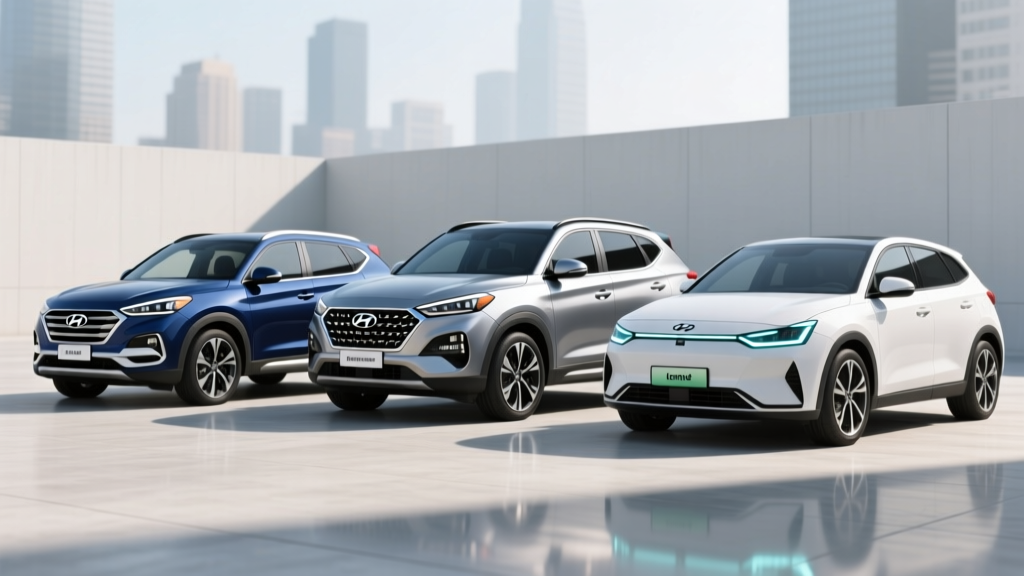
Hyundai offers one of the broadest electrified portfolios in the mainstream market, and for 2025 the automaker fields both conventional hybrids (HEVs) that never need plugging in and plug-in hybrids (PHEVs) that deliver meaningful electric-only commuting range. Whether you're cross-shopping a Toyota RAV4 Hybrid or wondering if a PHEV makes sense without home charging, this guide breaks down every 2025 Hyundai hybrid with exact EPA numbers, real-world expectations, and ownership costs.
HEV vs PHEV — What's the Difference?
Conventional Hybrid (HEV): Uses a small battery (typically 1–2 kWh) charged entirely by the gas engine and regenerative braking. You never plug it in. It improves fuel economy by 30–50% over a gas-only equivalent. Think of it as a more efficient gas car.
Plug-In Hybrid (PHEV): Carries a larger battery (13–28 kWh) that you can charge from a wall outlet or public charger, giving 25–40+ miles of electric-only driving before the gas engine takes over. After the battery depletes, it operates like a regular hybrid. Ideal for short commutes with occasional road trips.
2025 Hyundai Tucson Hybrid & PHEV: MPG, Range, and Specs
The Tucson remains Hyundai's volume leader, and its hybrid variants are among the best-selling electrified compact SUVs in the U.S. For 2025, Hyundai offers both a conventional Tucson Hybrid and a Tucson Plug-In Hybrid.
| Spec | Tucson Hybrid (HEV) | Tucson Plug-In Hybrid (PHEV) |
|---|---|---|
| Powertrain | 1.6L turbo I4 + electric motor | 1.6L turbo I4 + larger electric motor |
| Combined Horsepower | 226 hp | 261 hp |
| Battery Capacity | 1.49 kWh (lithium-ion) | 13.8 kWh (lithium-ion polymer) |
| EPA Combined MPG | 38 MPG (Blue trim) / 37 MPG (SEL/Limited) | 35 MPG (gas-only after depletion) |
| EPA City / Highway | 38 city / 38 hwy (Blue) | 33 city / 36 hwy (charge-sustaining) |
| Electric-Only Range | N/A (not plug-in) | 33 miles (EPA) |
| MPGe (electric mode) | N/A | 80 MPGe combined |
| Total Range | ~430 miles | ~400+ miles (electric + gas) |
| Level 2 Charging Time | N/A | ~2 hours (7.2 kW onboard charger) |
| DC Fast Charging | No | No |
| Drivetrain | AWD (standard) | AWD (standard) |
| 0–60 mph | ~7.1 seconds | ~6.3 seconds |
| Starting MSRP | $32,975 (Blue) | $39,855 (SEL) |
Real-World MPG vs. EPA Sticker
The Tucson Hybrid Blue's EPA rating of 38 MPG combined is one of the better numbers in the compact hybrid SUV segment, rivaling the Toyota RAV4 Hybrid's 39 MPG. In real-world driving, owners frequently report exceeding the EPA city figure — a common trait of hybrids, which recapture energy through regenerative braking in stop-and-go traffic. Expect 40–43 MPG in urban commuting and 34–36 MPG on sustained highway trips at 70+ mph. The AWD system adds a slight efficiency penalty compared to FWD-only competitors.
For the Tucson PHEV, the 33-mile electric-only range is EPA-certified and achievable in mild weather with moderate speeds. In cold conditions (below 35°F), expect that range to drop to roughly 25–28 miles due to cabin heating demands and reduced battery efficiency. Once the battery depletes, 35 MPG combined is realistic for mixed driving.
2025 Hyundai Santa Fe Hybrid: Three-Row Efficiency
The redesigned Santa Fe Hybrid targets families who need three rows but want to cut fuel costs without range anxiety. For 2025, Hyundai offers the Santa Fe exclusively as a conventional hybrid in the U.S. market — there is no PHEV variant currently available.
| Trim | City MPG | Highway MPG | Combined MPG |
|---|---|---|---|
| Premium (FWD) | 36 | 35 | 36 |
| Premium (AWD) | 35 | 34 | 34 |
| Calligraphy (AWD) | 35 | 33 | 34 |
Powertrain: The Santa Fe Hybrid pairs a 1.6L turbocharged four-cylinder with a 47.7 kW electric motor for a combined output of 230 hp and 271 lb-ft of torque. A 6-speed automatic transmission routes power to the front or all four wheels.
Real-world expectations: Owners report 33–36 MPG in mixed driving. The boxy styling and 4,000+ lb curb weight work against highway efficiency, so expect closer to 30–32 MPG on long interstate trips at 75 mph. Around town, regenerative braking helps push figures to 37–39 MPG.
Starting MSRP: $39,400 (Premium FWD) to $48,750 (Calligraphy AWD).
Battery Warranty and Long-Term Reliability
Hyundai Hybrid Battery Warranty Coverage
- Hybrid/EV Battery: 10 years / 100,000 miles (whichever comes first)
- Hybrid System Components: 10 years / 100,000 miles — includes electric motor, inverter, and converter
- Capacity Retention Threshold: Hyundai typically warrants against defects and abnormal degradation; normal wear is not covered, but failure within the warranty period triggers a free replacement
- Transferability: The 10-year powertrain warranty transfers to the second owner but reduces to 5 years / 60,000 miles upon transfer
Source: Hyundai USA Warranty
How Long Do Hyundai Hybrid Batteries Actually Last?
Modern Hyundai hybrid batteries are designed to last the life of the vehicle. Data from owners of earlier-generation Sonata and Ioniq hybrids shows minimal degradation — typically 5–10% capacity loss over 150,000+ miles. The 1.49 kWh battery in the Tucson Hybrid is small and rarely cycled to full depth, which dramatically extends cycle life.
Replacement cost if out of warranty: A hybrid battery replacement for the Tucson or Santa Fe Hybrid runs approximately $2,500–$4,000 including labor at a dealership. Third-party rebuilds can reduce this to $1,500–$2,500. For context, Toyota's RAV4 Hybrid battery replacement costs a similar $3,000–$4,500. Given the 10-year warranty and real-world longevity data, battery replacement is rarely an ownership concern.
2025 Hyundai Hybrid Tax Credit Eligibility
This is where HEVs and PHEVs diverge sharply on the financial side.
Conventional Hybrids (Tucson Hybrid, Santa Fe Hybrid)
Standard hybrids do not qualify for the federal §30D Clean Vehicle Credit. The IRS requires a minimum 7 kWh battery capacity and plug-in charging capability — neither of which applies to HEVs. There is no federal tax incentive for purchasing a conventional hybrid in 2025.
Plug-In Hybrids (Tucson PHEV)
The Tucson PHEV's eligibility for the federal tax credit is complicated under current IRS §30D rules. To qualify for up to $7,500 (applied as a point-of-sale rebate through a registered dealer), the vehicle must meet:
- MSRP cap: SUVs must have an MSRP at or below $80,000 (Tucson PHEV qualifies)
- Buyer income cap: Modified AGI must not exceed $150,000 (single), $225,000 (head of household), or $300,000 (joint filing)
- Battery sourcing: Critical minerals and battery components must meet escalating domestic/free-trade-agreement percentages — for 2025, 80% of critical minerals and 100% of battery components must comply, which has disqualified many PHEVs
- Assembly: Final assembly must occur in North America (the Tucson PHEV is assembled in the U.S.)
Current status: As of 2025, the Tucson PHEV's eligibility for the full $7,500 credit depends on the latest IRS battery-sourcing determinations, which are updated periodically. Check the DOE's fueleconomy.gov qualified vehicle list before purchasing, as eligibility can change mid-year. Some buyers may qualify for a reduced $3,750 credit if only one of the two sourcing requirements (minerals or components) is met.
Hybrid vs PHEV vs Full EV: Which 2025 Hyundai Fits You?
Choose the Tucson Hybrid (HEV) If:
- You have no access to home or workplace charging
- You want maximum simplicity — no plugs, no charging apps
- Your budget is under $38,000
- You drive mostly city miles where hybrids shine (40+ MPG achievable)
- You take frequent long road trips and don't want to plan charging stops
Choose the Tucson PHEV If:
- You have Level 2 home charging and a commute under 30 miles
- You want to drive electric daily but need gas flexibility for weekend trips
- You can take advantage of the potential $3,750–$7,500 tax credit
- You want the stronger 261 hp powertrain
- You live in a state with HOV lane access for PHEVs
Consider a Full EV (like the Ioniq 5) Instead If:
- You have reliable home Level 2 charging
- Your daily driving is under 250 miles
- You want to eliminate oil changes, spark plugs, and transmission fluid entirely
- You want the full $7,500 federal credit (Ioniq 5 eligibility is more straightforward)
- You're ready to use DC fast charging for road trips (Ioniq 5 peaks at 240 kW, 10–80% in ~18 minutes)
2025 Hyundai Hybrid Pricing and Trim Breakdown
| Model | Trim | MSRP | Drivetrain |
|---|---|---|---|
| Tucson Hybrid | Blue | $32,975 | AWD |
| Tucson Hybrid | SEL Convenience | $36,485 | AWD |
| Tucson Hybrid | Limited | $40,635 | AWD |
| Tucson PHEV | SEL | $39,855 | AWD |
| Tucson PHEV | Limited | $44,505 | AWD |
| Santa Fe Hybrid | Premium | $39,400 | FWD |
| Santa Fe Hybrid | Premium | $41,400 | AWD |
| Santa Fe Hybrid | Calligraphy | $48,750 | AWD |
Frequently Asked Questions
How many MPG does the 2025 Hyundai Tucson Hybrid get?
The EPA rates the 2025 Tucson Hybrid Blue at 38 MPG combined (38 city / 38 highway). SEL Convenience and Limited trims are rated at 37 MPG combined due to added weight from features. In real-world city driving, many owners report 40–43 MPG thanks to regenerative braking. Highway cruising at 75 mph typically yields 34–36 MPG.
How far can the Tucson PHEV go on electric only?
The EPA rates the 2025 Tucson PHEV at 33 miles of electric-only range. In mild weather (55–75°F) at moderate speeds, you can achieve the full 33 miles. In cold weather (below 35°F), expect 25–28 miles due to battery chemistry limitations and cabin heating loads. After the battery depletes, the vehicle operates as a conventional hybrid at 35 MPG combined.
Is the 2025 Hyundai hybrid reliable?
Hyundai's hybrid powertrains have demonstrated strong reliability in recent model years. The 1.6L turbo hybrid system is now in its second generation with proven durability. Hyundai backs all hybrid components with a 10-year/100,000-mile warranty — one of the longest in the industry. According to IIHS data, the Tucson and Santa Fe also earn top safety ratings, adding to the ownership case.
What does a Hyundai hybrid battery replacement cost?
Out-of-warranty hybrid battery replacement for the Tucson or Santa Fe Hybrid typically costs $2,500–$4,000 at a dealership. Independent hybrid specialists may offer rebuilds for $1,500–$2,500. However, real-world data shows Hyundai hybrid batteries lasting 150,000+ miles with only 5–10% degradation, and the 10-year/100,000-mile warranty covers premature failures.
Does the 2025 Hyundai hybrid qualify for a tax credit?
Conventional hybrids (Tucson Hybrid, Santa Fe Hybrid) do not qualify for any federal tax credit. The Tucson PHEV may qualify for up to $7,500 under the §30D Clean Vehicle Credit, but eligibility depends on strict battery-sourcing requirements that have disqualified many PHEVs. Check the current qualified vehicle list on fueleconomy.gov and consult a tax professional before relying on the credit. Income caps also apply: $150K single / $300K joint filers.
Do I need to plug in the Tucson Hybrid or Santa Fe Hybrid?
No. Conventional hybrids (HEVs) charge their small batteries entirely through the gas engine and regenerative braking. You simply fill up with gas and drive. Only the Tucson Plug-In Hybrid (PHEV) benefits from being plugged in — using a standard 120V outlet (Level 1) it charges overnight in about 7 hours, or in roughly 2 hours with a 240V Level 2 home charger.
Hyundai hybrid vs Toyota hybrid — which gets better MPG?
The Toyota RAV4 Hybrid edges the Tucson Hybrid slightly at 39 MPG combined vs. 38 MPG for the Tucson Blue. However, the Tucson PHEV offers 33 miles of electric range that the RAV4 Prime (42 miles electric) competes with at a higher price point ($44,000+). For three-row hybrids, the Santa Fe Hybrid's 36 MPG combined compares favorably to the Toyota Highlander Hybrid's 35–36 MPG.