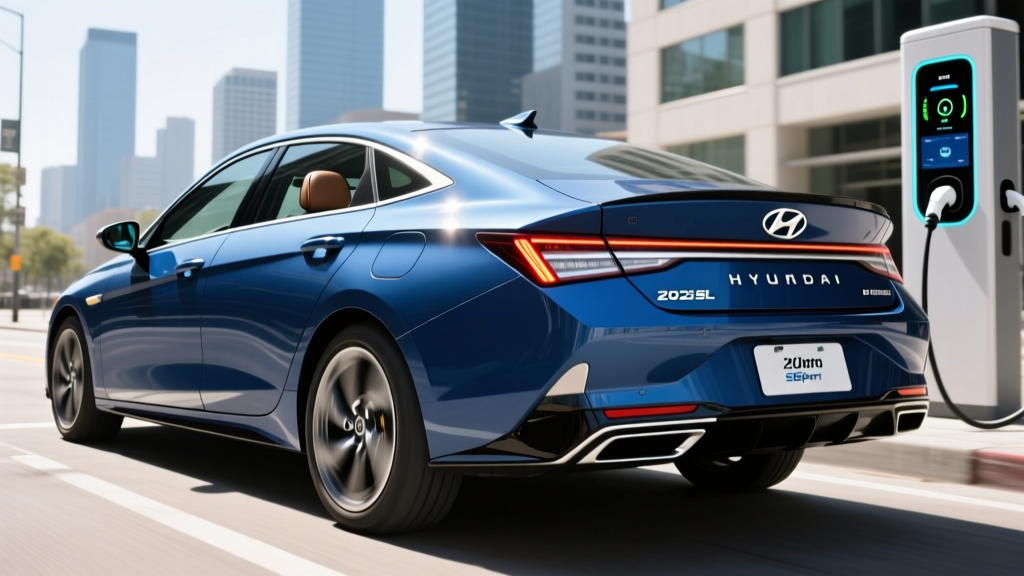
The 2025 Hyundai Elantra Hybrid SEL Sport occupies a narrow but compelling lane in the compact sedan market: a conventional hybrid (HEV) that delivers over 50 MPG combined without requiring a plug, a charging routine, or any change to your daily driving habits. For buyers weighing the fuel savings of electrification against the simplicity of a gas-and-go sedan, this trim level hits the sweet spot between the base Blue model's maximum efficiency and the Limited's premium pricing.
Below, we dissect every number that matters — EPA fuel economy, real-world MPG expectations, powertrain output, battery warranty coverage, and total cost of ownership — so you can decide whether the Elantra Hybrid SEL Sport earns a spot in your driveway or whether a PHEV or full BEV better suits your commute.
EPA Fuel Economy and Real-World MPG
The headline number for the 2025 Elantra Hybrid SEL Sport is its EPA-estimated fuel economy. Hyundai equips this trim with 17-inch alloy wheels (heavier and higher rolling resistance than the Blue trim's 16-inch wheels), which drops efficiency slightly compared to the range-topping Blue model.
| Trim | City MPG | Highway MPG | Combined MPG |
|---|---|---|---|
| Blue | 53 | 56 | 54 |
| SEL Sport | 49 | 52 | 50 |
| Limited | 49 | 52 | 50 |
Source: EPA fueleconomy.gov
The SEL Sport's 50 MPG combined is a 4-MPG drop from the Blue trim, attributable entirely to the larger wheels and tires. That said, 50 MPG combined still places the Elantra Hybrid SEL Sport among the most efficient non-plug-in vehicles on the US market.
Real-World MPG: What to Actually Expect
Hybrids consistently outperform their EPA city estimates in stop-and-go driving because regenerative braking recovers energy that a gas car wastes as heat. In real-world mixed driving, owners and testers routinely report 48–54 MPG from the SEL Sport trim, with city-heavy commutes sometimes exceeding 52 MPG. Highway-only driving at 75+ MPH tends to drop efficiency to 44–48 MPG, as the electric motor contributes less at sustained high speeds and aerodynamic drag dominates.
In cold weather (below 35°F), expect a 5–10% reduction in fuel economy. The engine runs more often to generate cabin heat and maintain battery temperature, reducing the hybrid system's electric-motor assistance. This penalty is far smaller than the 20–30% range loss a full EV experiences in the same conditions.
Powertrain: Engine, Motor, and Combined Output
The Elantra Hybrid pairs a 1.6-liter GDI inline-four engine with a permanent-magnet synchronous electric motor, both driving the front wheels through a 6-speed dual-clutch automatic transmission (DCT). Unlike Toyota's planetary-gear e-CVT approach, Hyundai's DCT delivers more direct, gear-driven acceleration feel — a trade-off that prioritizes engagement over the seamless smoothness of an e-CVT.
| Component | Specification |
|---|---|
| Gas Engine | 1.6L GDI I-4, 104 hp / 109 lb-ft |
| Electric Motor | 32 kW (43 hp) / 125 lb-ft |
| Combined System Output | 139 hp / 195 lb-ft |
| Transmission | 6-speed dual-clutch automatic (DCT) |
| Drivetrain | Front-wheel drive |
| 0–60 MPH | ~8.5 seconds (est.) |
The 139-hp combined output is modest by modern compact-sedan standards — the gas-only Elantra N Line produces 201 hp — but the electric motor's instant torque (125 lb-ft available from zero RPM) gives the hybrid respectable responsiveness in city driving. Highway passing maneuvers require planning; the DCT downshifts competently but the engine's power ceiling is noticeable above 65 MPH on inclines.
HEV vs PHEV vs EV: Which Powertrain Fits You?
The Elantra Hybrid is a conventional hybrid (HEV), not a plug-in. This distinction matters because Hyundai does not currently offer a plug-in hybrid (PHEV) variant of the Elantra for the US market — the PHEV was discontinued after the 2022 model year. Here's how the three electrified powertrain types compare for a buyer cross-shopping this segment:
| Factor | HEV (Elantra Hybrid) | PHEV (e.g., Prius Prime) | BEV (e.g., Bolt EV) |
|---|---|---|---|
| Plug-in Required? | No — gas only | Yes, for EV mode benefit | Yes, always |
| Electric-Only Range | 0 miles (motor assists only) | 25–44 miles typical | 200–350+ miles |
| Home Charging Needed | No | Recommended (Level 2) | Essential (Level 2) |
| Fuel Cost Per Mile | ~$0.07 (at 50 MPG, $3.50/gal) | ~$0.03–0.07 (varies) | ~$0.03–0.05 (home charging) |
| Federal Tax Credit | None (§30D requires plug-in) | Up to $7,500 (if eligible) | Up to $7,500 (if eligible) |
| Upfront Price Premium | Low (~$1,500 over gas) | Medium (~$4,000–$6,000) | High (~$8,000–$15,000) |
| Best For | No home charging access, long highway commutes | Short commute + home charger, occasional road trips | Home charger, daily commute < 200 mi |
The Elantra Hybrid SEL Sport is the right call if: you lack reliable home or workplace charging, you drive a mix of city and highway miles, and you want fuel savings without altering your refueling routine. Consider a PHEV or BEV instead if: you have Level 2 charging access, your daily commute is under 40 miles round-trip, and you want to minimize or eliminate gasoline consumption.
Pricing, Trims, and Tax Credit Eligibility
The 2025 Elantra Hybrid SEL Sport carries an MSRP of approximately $27,475 (including destination charge). This positions it roughly $1,400 above the Blue trim and $2,800 below the Limited.
| Trim | MSRP (incl. destination) |
|---|---|
| Blue | ~$26,100 |
| SEL Sport | ~$27,475 |
| Limited | ~$30,250 |
Federal Tax Credit: Does It Qualify?
No. The Elantra Hybrid is a conventional HEV. The IRS §30D Clean Vehicle Credit applies exclusively to plug-in electric vehicles (BEVs and PHEVs) with a minimum battery capacity of 7 kWh. Conventional hybrids do not qualify for any federal purchase incentive under current law.
Some states and municipalities offer rebates or reduced registration fees for hybrids, but these vary widely by jurisdiction. Check your state's energy office or AFDC state incentive database for local programs. A tax professional can advise on any applicable state-level credits.
Hybrid Battery Warranty and Longevity
Hybrid battery longevity is consistently the top concern among first-time hybrid buyers. Hyundai addresses this with one of the strongest warranty packages in the segment.
- Hybrid Battery: 10 years / 100,000 miles (original owner); 10 years / 100,000 miles for subsequent owners on 2020+ models
- Hybrid System Components (motor, inverter, converter): 10 years / 100,000 miles
- New Vehicle Limited Warranty: 5 years / 60,000 miles
- Powertrain Warranty: 10 years / 100,000 miles
Source: Hyundai USA Warranty
Hyundai's lithium-ion hybrid battery pack in the Elantra Hybrid is approximately 1.56 kWh — far smaller than a PHEV or BEV battery. This small capacity means lower stress per cycle and generally excellent longevity. Industry data from fleet and taxi applications shows Hyundai/Kia hybrid batteries routinely exceeding 150,000 miles with minimal degradation. The 10-year/100,000-mile warranty provides substantial protection.
Battery Replacement Cost
If the hybrid battery fails outside warranty coverage, replacement costs for the Elantra Hybrid typically range from $2,000 to $3,500 (parts and labor) at a dealership. Independent hybrid specialists may offer refurbished packs for $1,200–$2,000. Given the battery's small size and the maturity of Hyundai's hybrid system, out-of-warranty failures remain uncommon based on current owner-reported data.
SEL Sport Equipment: What You Get for the Price
The SEL Sport sits in the middle of the Elantra Hybrid lineup and adds meaningful equipment over the Blue trim without the Limited's price jump. Key standard features on the SEL Sport include:
- 17-inch alloy wheels (vs. 16-inch on Blue)
- Hyundai SmartSense ADAS suite: forward collision-avoidance assist, lane keeping assist, blind-spot collision-avoidance, rear cross-traffic collision-avoidance, driver attention warning
- 10.25-inch digital instrument cluster
- 8-inch touchscreen infotainment with wireless Apple CarPlay and Android Auto
- Proximity key with push-button start
- Dual-zone automatic climate control
- Heated front seats
- LED daytime running lights
Notable omissions relative to the Limited: the SEL Sport does not include the 10.25-inch navigation touchscreen (it uses the 8-inch unit), ventilated front seats, leather seating surfaces, Bose premium audio, or the Digital Key smartphone-as-a-key feature. The Highway Driving Assist (HDA) adaptive cruise with lane centering is available on the SEL Sport via the Convenience Package.
A note on ADAS: Hyundai SmartSense is an SAE Level 1–2 driver-assistance suite. It provides steering, braking, and acceleration support under specific conditions, but you must remain fully engaged with hands on the wheel and eyes on the road. It is not autonomous driving.
Driving Impressions and Ownership Practicality
The Elantra Hybrid SEL Sport prioritizes comfort and efficiency over sportiness. The ride quality is compliant over rough pavement — the independent rear suspension absorbs impacts more gracefully than the torsion-beam setups in some competitors. Cabin noise is well-managed at city speeds; tire noise from the 17-inch wheels becomes audible above 60 MPH on coarse-surface highways.
The 6-speed DCT is a differentiator. Where Toyota's Prius e-CVT drones under hard acceleration, the Elantra Hybrid shifts through defined gears with a satisfying mechanical directness. The trade-off: low-speed shifts (1st to 2nd gear, parking-lot maneuvers) can feel slightly abrupt compared to an e-CVT's smoothness. Most drivers acclimate within a day.
Interior space is generous for the segment. Rear legroom measures 38.0 inches, outclassing the Prius (35.2 in) and rivaling midsize sedans. The trunk offers 14.2 cubic feet — slightly reduced from the gas Elantra's 14.7 cu ft due to the hybrid battery's placement under the rear seat, but still practical for weekly groceries or two carry-on suitcases.
Total Cost of Ownership: 5-Year Estimate
| Category | Elantra Hybrid SEL Sport | Gas Elantra SEL (2.0L) |
|---|---|---|
| Purchase Price (MSRP) | $27,475 | $24,100 |
| Fuel (75,000 mi) | $5,250 (50 MPG, $3.50/gal) | $7,940 (33 MPG, $3.50/gal) |
| Fuel Savings vs. Gas | +$2,690 saved over 5 years | |
| Estimated Maintenance | $2,100 | $2,400 |
| Insurance (avg.) | $7,500 | $7,200 |
| 5-Year Depreciation (est.) | ~$12,000 | ~$11,500 |
| Net 5-Year Cost | ~$30,325 | ~$30,140 |
The hybrid's fuel savings nearly close the $3,375 price gap with the gas model over five years. If you plan to keep the car 8–10 years (well within the hybrid warranty window), the fuel savings compound significantly — roughly $5,400 in fuel savings over 150,000 miles. Hybrids also benefit from reduced brake wear thanks to regenerative braking; expect brake pad life of 60,000–80,000 miles versus 30,000–50,000 on the gas model.
Pros and Cons
- 50 MPG combined — top-tier efficiency in the segment
- No plug-in charging required
- 10-year / 100,000-mile hybrid battery warranty
- Spacious rear seat and trunk for the class
- DCT avoids the CVT "drone" under acceleration
- Comprehensive SmartSense ADAS standard
- 139 hp feels modest for highway merging
- 4-MPG penalty vs. Blue trim (17-inch wheels)
- No federal tax credit (HEV, not PHEV)
- Smaller infotainment screen than Limited trim
- No PHEV or AWD option available
- DCT can feel abrupt in low-speed parking maneuvers
Frequently Asked Questions
How many MPG does the 2025 Elantra Hybrid SEL Sport get?
The EPA rates it at 49 MPG city, 52 MPG highway, and 50 MPG combined. In real-world city-heavy driving, many owners report 48–54 MPG. Highway-only driving at 75+ MPH typically yields 44–48 MPG.
Does the Elantra Hybrid need to be plugged in?
No. The Elantra Hybrid is a conventional hybrid (HEV). It charges its small battery through regenerative braking and the gas engine. You refuel it exclusively at gas stations, just like a standard car.
Hybrid vs PHEV vs EV — which should I choose?
Choose the Elantra Hybrid (HEV) if you lack home charging and want maximum simplicity with strong fuel economy. Choose a PHEV (like the Toyota Prius Prime) if you have home charging and a short daily commute you can cover on electric-only miles. Choose a full EV (BEV) if you have reliable Level 2 charging, want zero tailpipe emissions, and your daily driving is within the vehicle's range.
Is the Elantra Hybrid reliable, and what does a battery replacement cost?
Hyundai's hybrid system has demonstrated strong reliability across multiple model years. The 10-year / 100,000-mile hybrid battery warranty is among the best in the industry. Out-of-warranty battery replacement costs $2,000–$3,500 at a dealer, though failures before 150,000 miles are uncommon based on current data.
Does the 2025 Elantra Hybrid qualify for any tax credit?
No federal tax credit applies. The IRS §30D Clean Vehicle Credit requires a plug-in vehicle (PHEV or BEV) with at least 7 kWh of battery capacity. The Elantra Hybrid's ~1.56 kWh battery and lack of a plug-in port make it ineligible. Check your state's incentive database for any local hybrid rebates.
How does the SEL Sport compare to the Blue trim?
The Blue trim achieves 54 MPG combined (vs. 50 MPG for the SEL Sport) and starts about $1,400 lower. The SEL Sport adds 17-inch wheels, heated front seats, proximity key, dual-zone climate, and a 10.25-inch digital cluster. If maximum MPG is your only priority, the Blue wins. If you want a more feature-rich daily driver and accept a 4-MPG trade-off, the SEL Sport is the better all-around pick.