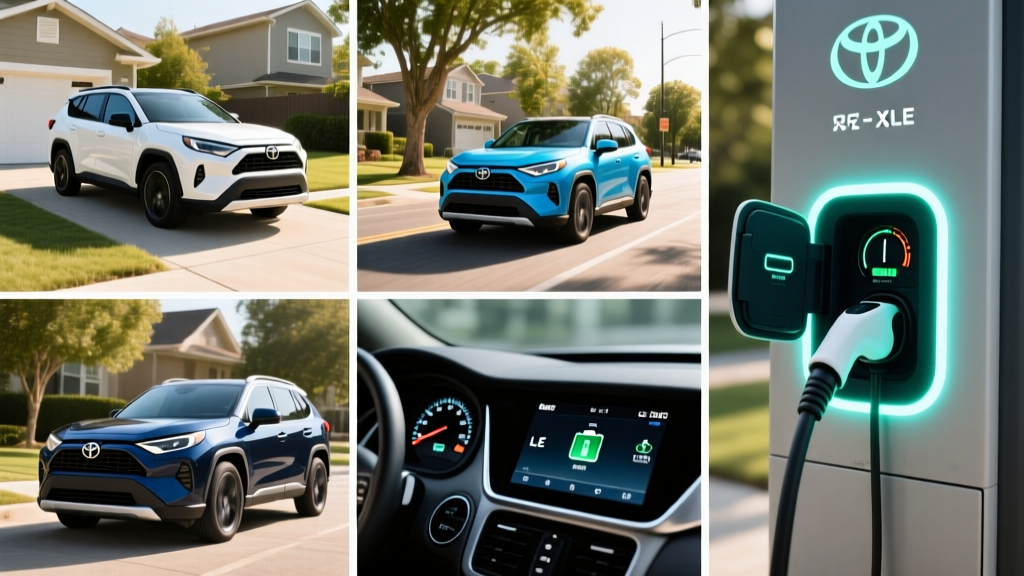
Quick Verdict: The 2025 Hybrid RAV-4 Still Sets the Compact SUV Benchmark
Toyota's 2025 RAV4 Hybrid remains one of the most practical, fuel-efficient compact SUVs you can buy without plugging in. With an EPA-estimated 41 MPG city and 38 MPG highway, it delivers real-world fuel savings that consistently exceed its sticker numbers in stop-and-go driving — the exact scenario where conventional gas SUVs guzzle the most. For buyers who want electric-only commuting capability, the RAV4 Prime plug-in hybrid variant extends the formula with 42 miles of pure electric range and 94 MPGe combined.
This guide covers every 2025 Hybrid RAV-4 variant — the conventional hybrid (HEV) and the plug-in hybrid RAV4 Prime (PHEV) — with exact specs, pricing, tax credit eligibility, battery warranty details, and a framework to help you decide which version fits your driving life.
HEV vs PHEV: Which 2025 Hybrid RAV-4 Are We Talking About?
Before diving into numbers, it's critical to distinguish the two powertrains Toyota offers under the "Hybrid RAV-4" umbrella. They operate very differently and serve different buyers.
| Attribute | RAV4 Hybrid (HEV) | RAV4 Prime (PHEV) |
|---|---|---|
| Powertrain type | Conventional hybrid — no plug | Plug-in hybrid — charges from grid |
| Electric-only range | Not applicable (EV assist only) | 42 miles (EPA) |
| Combined horsepower | 219 hp | 302 hp |
| Battery capacity | 1.6 kWh (NiMH, self-charging) | 18.1 kWh (lithium-ion, plug-in) |
| Needs to be plugged in? | No — regenerates via braking/engine | Yes, for full electric range benefit |
| DC fast charging | No | No (Level 2 AC only) |
| Drivetrain | AWD standard (eAWD) | AWD standard (eAWD) |
| Base MSRP (2025) | $33,595 (LE trim) | $44,905 (SE trim) |
The conventional RAV4 Hybrid is a self-charging hybrid. It uses a small battery that recovers energy from braking and the gas engine — you never plug it in. The RAV4 Prime is a plug-in hybrid (PHEV) with a much larger battery you charge at home or at a public Level 2 station, giving you a meaningful electric-only commute before the gas engine kicks in.
Fuel Economy: Real-World MPG vs EPA Estimates
Fuel economy is the primary reason buyers choose the 2025 Hybrid RAV-4 over the gas-only model. Here's how each variant performs according to EPA data from fueleconomy.gov:
| Model | City MPG / MPGe | Highway MPG | Combined | Annual Fuel Cost* |
|---|---|---|---|---|
| RAV4 Hybrid (HEV) AWD | 41 MPG | 38 MPG | 40 MPG | ~$1,550 |
| RAV4 Prime (PHEV) — Electric mode | 94 MPGe combined (electric only) | Varies by electricity rate | ||
| RAV4 Prime (PHEV) — Gas mode (battery depleted) | 40 MPG | 36 MPG | 38 MPG | ~$1,650 |
| Gas RAV4 AWD (baseline) | 27 MPG | 34 MPG | 30 MPG | ~$2,100 |
*Based on 15,000 miles/year, $3.50/gallon regular unleaded, 55% city / 45% highway driving.
Real-World MPG: Hybrids Often Beat the EPA in the City
One of the most consistent patterns we see with Toyota's hybrid system: city MPG often exceeds the EPA estimate in real-world driving. The EPA city test cycle includes significant stop-and-go driving, which is exactly where regenerative braking recaptures the most energy. Owners in urban and suburban environments regularly report 42–45 MPG in mixed city commuting.
Highway driving tells a different story. At sustained 70–80 MPH speeds, the electric motor contributes less and aerodynamic drag dominates. Expect 35–37 MPG on long highway trips in the HEV — slightly below the 38 MPG EPA highway figure. In cold weather (below 30°F), plan for a 5–10% reduction across the board as the engine runs more frequently to provide cabin heat and maintain battery temperature.
The RAV4 Prime's 42-mile electric range holds up well in mild weather, but cold temperatures can cut that to 32–36 miles due to cabin heating demands and reduced battery efficiency. If your commute is under 35 miles round-trip and you charge nightly, you may go months between fill-ups.
Powertrain Specs: 219 HP or 302 HP
Both hybrid variants use Toyota's 2.5-liter Dynamic Force 4-cylinder engine paired with electric motors, but the output difference is substantial.
| Spec | RAV4 Hybrid (HEV) | RAV4 Prime (PHEV) |
|---|---|---|
| Engine | 2.5L I4 Atkinson-cycle | 2.5L I4 Atkinson-cycle |
| Front electric motor | 118 hp / 149 lb-ft | 174 hp / 199 lb-ft |
| Rear electric motor (eAWD) | 54 hp / 89 lb-ft | 54 hp / 89 lb-ft |
| Combined net horsepower | 219 hp | 302 hp |
| 0–60 MPH | 7.4 seconds | 5.7 seconds |
| Transmission | eCVT (planetary gearset) | eCVT (planetary gearset) |
| Towing capacity | 1,750 lbs | 2,500 lbs |
The RAV4 Prime's 302 hp makes it the quickest RAV4 Toyota sells — quicker than the gas-only Turbo model and most competitors in the compact SUV segment. The HEV's 219 hp is more than adequate for daily driving, highway merging, and loaded cargo runs, though it won't feel sporty.
Toyota's eCVT is not a belt-and-cone CVT like you'd find in a Nissan or Subaru. It uses a planetary gearset that seamlessly blends engine and motor power with no shifting sensation. Reliability is excellent — this is one of the most proven hybrid transmissions on the road.
RAV4 Prime PHEV: Charging, Battery, and Electric Range
If you're considering the RAV4 Prime, understanding the charging picture is essential to capturing its value.
| Charging Level | Power (kW) | Time to Full Charge | Miles Added per Hour |
|---|---|---|---|
| Level 1 (120V household outlet) | ~1.4 kW | ~12 hours (0–100%) | ~4 miles |
| Level 2 (240V, 3.3 kW onboard charger) | 3.3 kW | ~5.5 hours (0–100%) | ~8 miles |
| Level 2 (240V, 6.6 kW onboard charger — Premium trim) | 6.6 kW | ~2.5 hours (0–100%) | ~17 miles |
| DC Fast Charging | Not supported — AC charging only | ||
The RAV4 Prime's 18.1 kWh lithium-ion battery pack is sized for daily commuting, not road-trip fast charging. Toyota deliberately omitted DC fast charging to keep weight, cost, and complexity down. For a PHEV with a ~42-mile electric envelope, this is the right engineering call: you charge at home overnight and wake up to a full "tank" of electrons every morning.
Important trim distinction: Lower RAV4 Prime trims (SE) include a 3.3 kW onboard charger, meaning a full charge takes about 5.5 hours on a 240V Level 2 station. The XSE Premium package upgrades to a 6.6 kW onboard charger, cutting that to roughly 2.5 hours. If you plan to "opportunity charge" at work or public Level 2 stations during the day, the 6.6 kW charger is worth the upgrade.
Hybrid Battery Warranty — What Toyota Covers
Both the RAV4 Hybrid (HEV) and RAV4 Prime (PHEV) come with Toyota's hybrid battery warranty:
- Hybrid battery: 10 years / 150,000 miles (whichever comes first)
- Hybrid system components (inverter, motor, control module): 8 years / 100,000 miles
- Transferable: Yes — the hybrid battery warranty transfers to subsequent owners at no cost
Toyota's hybrid batteries have an outstanding longevity track record. The NiMH pack in the standard HEV and the lithium-ion pack in the Prime both routinely exceed 150,000 miles with minimal degradation. Full hybrid battery replacement (rare before 200,000 miles) runs approximately $2,500–$4,000 at a Toyota dealer, including labor. Independent hybrid specialists often perform the same service for $1,800–$3,000.
Pricing, Trims & Tax Credit Eligibility
The 2025 Hybrid RAV-4 lineup spans a wide price range depending on whether you choose the conventional hybrid or the Prime PHEV.
| Model / Trim | MSRP | Federal Tax Credit Eligibility |
|---|---|---|
| RAV4 Hybrid LE | $33,595 | Not eligible (§30D is for PHEVs/EVs only) |
| RAV4 Hybrid XLE | $35,120 | Not eligible |
| RAV4 Hybrid Woodland Edition | $36,850 | Not eligible |
| RAV4 Hybrid XLE Premium | $37,450 | Not eligible |
| RAV4 Hybrid SE | $37,950 | Not eligible |
| RAV4 Hybrid Limited | $41,150 | Not eligible |
| RAV4 Prime SE | $44,905 | Up to $7,500 (see eligibility below) |
| RAV4 Prime XSE | $48,305 | Up to $7,500 (see eligibility below) |
Federal Tax Credit: Only the RAV4 Prime Qualifies
Under IRS §30D clean vehicle credit rules, only plug-in electric vehicles and PHEVs with a battery capacity of at least 7 kWh are eligible for the federal tax credit. The conventional RAV4 Hybrid (HEV) has a 1.6 kWh battery and does not qualify for any federal purchase incentive.
The RAV4 Prime, with its 18.1 kWh battery, can qualify for up to $7,500 — but eligibility depends on several requirements that change periodically:
- MSRP cap: SUVs must have an MSRP at or below $80,000 (both Prime trims qualify)
- Buyer income cap: Modified AGI must not exceed $150,000 (single), $225,000 (head of household), or $300,000 (joint)
- Battery component sourcing: A percentage of battery components must be manufactured or assembled in North America (phasing thresholds increase annually)
- Critical minerals: A percentage of critical minerals must be sourced from the U.S. or FTA-partner countries
- Point-of-sale transfer: As of 2024, eligible buyers can transfer the credit to the dealer for an immediate price reduction at purchase, rather than waiting to claim it on their tax return
Critical caveat: Battery sourcing requirements have tightened significantly since the Inflation Reduction Act took effect. The RAV4 Prime's credit eligibility — whether it receives the full $7,500, a partial $3,750, or nothing — depends on Toyota's supply chain compliance for the specific build month of your vehicle. Always verify current eligibility on fueleconomy.gov's tax credit tracker using the exact VIN before purchase. Consult a tax professional for your personal situation.
Hybrid vs PHEV vs Full EV: Which Is Right for You?
The 2025 Hybrid RAV-4 lineup forces a three-way decision that every electrified-vehicle shopper faces. Here's a practical framework:
Choose the RAV4 Hybrid (HEV) if:
- You cannot install a home charger (apartment, street parking, no garage)
- You want maximum simplicity — no plug, no charging apps, no range planning
- Your budget is under $40,000
- You drive 30–60 miles daily in mixed city/highway conditions
- You want proven, 20-year Toyota Hybrid System reliability
Choose the RAV4 Prime (PHEV) if:
- You have access to Level 2 charging at home or work
- Your daily commute is under 42 miles round-trip (you'll rarely burn gas on weekdays)
- You want 302 hp and 5.7-second 0–60 performance
- You take road trips and need gas-engine range flexibility
- You qualify for the federal tax credit (effectively bringing the Prime SE close to the Hybrid Limited in net price)
Choose a full BEV (like the Toyota bZ4X or Tesla Model Y) if:
- You have reliable home Level 2 charging
- Your daily driving is under 250 miles and you're comfortable planning road-trip charging stops
- You want zero tailpipe emissions and minimal drivetrain maintenance (no oil changes, no spark plugs)
- You want to maximize fuel cost savings (electricity at $0.13/kWh is roughly equivalent to $1.10/gallon gas)
Reliability & Long-Term Ownership Costs
Toyota's Hybrid Synergy Drive is one of the most proven electrified powertrains ever produced. The Prius, Camry Hybrid, and RAV4 Hybrid share core architecture that has been in continuous production since 1997. Here's what the data tells us about long-term ownership:
Hybrid battery longevity: Toyota's NiMH hybrid batteries (used in the HEV) routinely last 180,000–250,000 miles before needing replacement. The lithium-ion pack in the Prime has a shorter track record but benefits from active thermal management and a conservative state-of-charge window (Toyota never lets you use 100% of the pack, preserving cycle life).
Brake wear: Regenerative braking handles most deceleration, dramatically extending brake pad life. Many RAV4 Hybrid owners report original brake pads at 80,000–100,000 miles.
Maintenance: The hybrid system adds no additional scheduled maintenance. You still follow the standard Toyota maintenance schedule — oil changes every 10,000 miles, fluid checks, tire rotations. The eCVT transmission has no belts or clutches to replace.
Insurance: Expect premiums 5–12% higher than the gas RAV4 AWD, driven by higher replacement parts costs for the hybrid system. Get a quote before purchasing — the difference varies significantly by insurer and ZIP code.
| Cost Category | Gas RAV4 AWD | RAV4 Hybrid (HEV) | RAV4 Prime (PHEV) |
|---|---|---|---|
| Purchase price (base MSRP) | $30,095 | $33,595 | $44,905 |
| Federal tax credit | $0 | $0 | Up to $7,500 |
| Effective purchase price | $30,095 | $33,595 | ~$37,405 |
| Fuel cost (5 yr / 75,000 mi) | ~$10,500 | ~$7,750 | ~$4,200* |
| Maintenance (5 yr) | ~$3,200 | ~$2,800 | ~$2,800 |
| Insurance (5 yr avg) | ~$8,500 | ~$9,200 | ~$9,800 |
| Estimated 5-yr total | ~$52,295 | ~$53,345 | ~$54,205 |
*Prime fuel cost assumes 70% of miles driven on electricity at $0.14/kWh and 30% on gasoline. Your ratio depends on commute length and charging habits.
The Hybrid HEV breaks even with the gas model around year 4–5 through fuel savings. The Prime's economics depend heavily on tax credit eligibility and how much of your driving is electric-powered.
Pros & Cons at a Glance
Pros — 2025 RAV4 Hybrid & Prime
- 41/38 MPG EPA (HEV) — among the best in the compact SUV class
- Standard eAWD on every hybrid trim — no FWD penalty model
- 42-mile electric range (Prime) covers most daily commutes
- 302 hp (Prime) — quickest RAV4 in the lineup
- 10-year / 150,000-mile hybrid battery warranty
- Excellent cargo space: 37.5 cu ft behind rear seats (HEV), 33.5 cu ft (Prime)
- Proven reliability — minimal unscheduled hybrid system repairs
- Strong resale value — RAV4 Hybrids hold value better than most electrified vehicles
Cons — 2025 RAV4 Hybrid & Prime
- Prime pricing starts near $45K — steep premium over the HEV
- No DC fast charging on the Prime — Level 2 only
- 3.3 kW onboard charger on base Prime SE is slow for public charging
- Tax credit eligibility for Prime is uncertain due to battery sourcing rules
- HEV highway MPG (38) trails its city number — less impressive on road trips
- Interior materials and infotainment lag behind Hyundai Tucson Hybrid and Kia Sportage Hybrid
- Cabin noise under hard acceleration (eCVT drone)
- Prime cargo floor is slightly raised to accommodate the larger battery pack
Frequently Asked Questions
How many MPG does the 2025 Hybrid RAV-4 get?
The conventional RAV4 Hybrid (HEV) achieves an EPA-estimated 41 MPG city, 38 MPG highway, and 40 MPG combined. In real-world city driving with frequent stops, many owners report 42–45 MPG thanks to aggressive regenerative braking. Highway-only driving at 75+ MPH typically returns 35–37 MPG. The RAV4 Prime PHEV gets 94 MPGe in electric mode and 38 MPG combined once the battery is depleted.
How far can the RAV4 Prime go on electric only?
The EPA rates the 2025 RAV4 Prime at 42 miles of electric-only range. In mild weather (50–80°F) with moderate climate control use, expect 38–42 real-world electric miles. In cold weather (below 30°F), that range can drop to 32–36 miles as the system uses battery energy for cabin heating and battery thermal management. At highway speeds above 70 MPH, electric range also decreases — plan for roughly 30–34 electric miles in sustained highway driving.
Does the conventional RAV4 Hybrid need to be plugged in?
No. The RAV4 Hybrid (HEV) is a self-charging hybrid. Its 1.6 kWh battery charges through regenerative braking and the gasoline engine. You simply drive it like a normal car and fill up at the gas station — there is no plug, no charging cable, and no charging station dependency. The electric motor assists the engine for improved fuel economy, but the vehicle cannot drive on electricity alone for any meaningful distance.
Is the 2025 Hybrid RAV-4 reliable, and what does battery replacement cost?
Yes — Toyota's hybrid system has one of the strongest reliability records in the automotive industry. The Hybrid Synergy Drive has been in continuous production since 1997, and the eCVT planetary gearset has no wear components like belts or clutch packs. The hybrid battery is warranted for 10 years / 150,000 miles. Full battery replacement (uncommon before 200,000 miles) costs approximately $2,500–$4,000 at a dealer, or $1,800–$3,000 at an independent hybrid specialist. Many original Prius batteries from 2004–2009 are still in service today.
Does the 2025 Hybrid RAV-4 qualify for any tax credit?
The conventional RAV4 Hybrid (HEV) does not qualify for the federal §30D clean vehicle tax credit — it applies only to plug-in vehicles. The RAV4 Prime (PHEV) may qualify for up to $7,500, but eligibility depends on your income (AGI caps: $150K single / $300K joint), the vehicle's MSRP (under $80K for SUVs — both trims qualify), and current battery sourcing compliance. Sourcing rules have tightened annually, and the credit amount available for the Prime can vary by build date. Always check the latest status on IRS.gov and fueleconomy.gov before purchasing. Some states offer additional hybrid or PHEV rebates — check your state energy office for local programs.
Should I buy the RAV4 Hybrid or the RAV4 Prime?
If you have access to home Level 2 charging and your daily commute is under 42 miles, the Prime offers a transformative experience — most weekday driving happens on electricity, with the gas engine available for weekend road trips. The performance bump (302 hp vs 219 hp) is a meaningful bonus. If you lack home charging access, drive long distances regularly, or want to keep your purchase price under $40,000, the conventional HEV is the smarter financial choice with nearly identical day-to-day usability and outstanding fuel economy.
How does the RAV4 Hybrid compare to competitors?
The closest rivals are the Hyundai Tucson Hybrid (38 MPG combined, 226 hp, starts ~$34,000) and the Honda CR-V Hybrid (40 MPG combined, 204 hp, starts ~$35,400). The RAV4 Hybrid leads on highway fuel economy and resale value. The Tucson Hybrid offers a more modern interior and a conventional 6-speed automatic instead of an eCVT. The CR-V Hybrid delivers a smoother ride and more rear-seat legroom. All three are strong choices — the RAV4 Hybrid's edge is Toyota's long-term reliability reputation and the Prime PHEV option, which neither competitor currently matches in electric range.