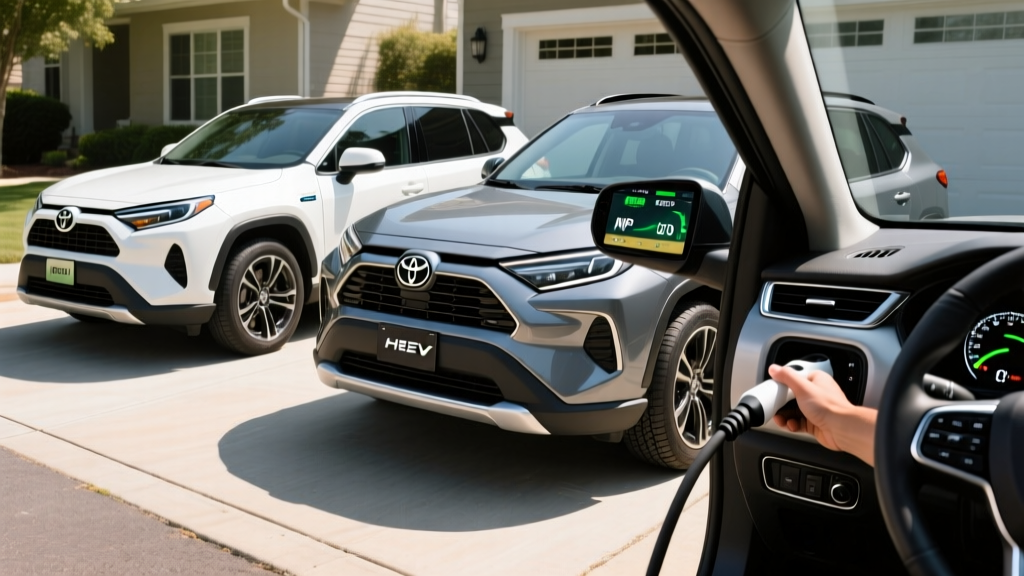
The Toyota RAV4 Hybrid has been America's best-selling hybrid SUV for years, and the 2025 Hybrid RAV4 lineup continues that dominance with two distinct electrified flavors: the conventional Hybrid (HEV) that never needs plugging in, and the RAV4 Prime plug-in hybrid (PHEV) that delivers meaningful electric-only driving. Both share Toyota's proven hybrid synergy drive architecture, but their ownership experiences, fuel savings, and tax-credit eligibility diverge sharply. This guide breaks down every number that matters — EPA MPG, real-world fuel economy, electric-only range, powertrain output, battery warranties, and total cost — so you can choose the right RAV4 Hybrid for your commute and budget.
2025 RAV4 Hybrid (HEV) vs RAV4 Prime (PHEV): What's the Difference?
Before comparing specs, it's critical to understand the mechanical distinction between these two vehicles, because confusing them is the single most common mistake buyers make.
RAV4 Hybrid (HEV)
A conventional hybrid. It pairs a 2.5-liter four-cylinder gasoline engine with two electric motors and a small 1.6 kWh nickel-metal hydride (NiMH) battery. You never plug it in — the battery recharges via regenerative braking and the gas engine. It operates like a standard car: fill up at the pump, drive, repeat. The electric motors assist the engine for better fuel economy, but the RAV4 Hybrid cannot drive on electricity alone for more than about a mile at very low speeds.
RAV4 Prime (PHEV)
A plug-in hybrid. It uses the same 2.5-liter engine but pairs it with more powerful electric motors and a much larger 18.1 kWh lithium-ion battery. You plug it into a wall outlet or Level 2 charger to fill the battery, which gives you up to 42 miles of pure electric driving. Once the battery depletes, it seamlessly transitions to hybrid mode and operates like the standard HEV — no range anxiety, no behavior change required.
The HEV is the simpler, lower-cost play. The Prime is for drivers who want EV-like commuting with gas-engine backup for road trips.
Fuel Economy: EPA MPG and Real-World Results
Fuel efficiency is the headline reason most buyers consider the 2025 Hybrid RAV4. Here's the EPA-certified breakdown for both powertrains, sourced from fueleconomy.gov:
| Model | City MPG | Highway MPG | Combined MPG | Combined MPGe (EV Mode)* |
|---|---|---|---|---|
| RAV4 Hybrid (HEV) AWD | 41 | 38 | 39 | N/A |
| RAV4 Hybrid (HEV) FWD | 27 | 35 | 30 | N/A |
| RAV4 Prime (PHEV) AWD | 40 | 36 | 38 | 94 MPGe |
*MPGe applies only when the Prime is operating on its charged battery in EV mode. Once the battery depletes, the Prime reverts to its 38 MPG combined gas rating.
Real-World MPG: What Owners Actually See
Toyota's hybrid system is one of the few powertrains where real-world fuel economy often exceeds EPA estimates in city driving. The EPA city test cycle involves frequent stops, which is exactly where regenerative braking recovers the most energy. Owners on fuel-tracking platforms like Fuelly regularly report 40-43 MPG in mixed suburban and city driving with the AWD Hybrid.
Highway driving tells a different story. At sustained 70-75 mph speeds, the gas engine does most of the work, and real-world highway MPG for the Hybrid AWD typically lands between 34-37 MPG — slightly below the 38 MPG EPA highway figure. Cold weather (below 35°F) can drop combined real-world economy by 3-5 MPG due to reduced battery efficiency and increased engine idling for cabin heat.
For the RAV4 Prime, real-world electric-only range varies with conditions. The 42-mile EPA EV range is achievable in mild weather (55-75°F) with moderate acceleration. In freezing temperatures or at sustained highway speeds, expect 32-36 miles before the gas engine kicks in. Once operating as a hybrid, the Prime delivers roughly 35-38 MPG combined in gas-only mode — very close to the standard Hybrid.
Powertrain Specs: Horsepower, Acceleration, and Drivetrain
| Specification | RAV4 Hybrid (HEV) | RAV4 Prime (PHEV) |
|---|---|---|
| Engine | 2.5L 4-cyl Atkinson cycle | 2.5L 4-cyl Atkinson cycle |
| Combined System Horsepower | 219 hp | 302 hp |
| 0-60 mph | 7.4 seconds | 5.7 seconds |
| Drivetrain | AWD (e-motor rear axle) or FWD | AWD (e-motor rear axle) standard |
| Transmission | eCVT | eCVT |
| Towing Capacity | 1,750 lbs | 2,500 lbs |
| Battery Capacity | 1.6 kWh (NiMH) | 18.1 kWh (Lithium-ion) |
The RAV4 Prime's 302 combined horsepower makes it the quickest RAV4 Toyota sells — quicker than the gas-only turbo four-cylinder and significantly quicker than the standard Hybrid. The 5.7-second 0-60 time puts it in hot-hatch territory, which is genuinely surprising for a compact SUV. The standard Hybrid's 219 hp and 7.4-second sprint are perfectly adequate for daily driving and highway merging, if unremarkable.
Both AWD models use Toyota's electronic on-demand all-wheel drive: a separate rear electric motor powers the rear axle when slip is detected or during hard acceleration. There's no mechanical driveshaft connecting front to rear. This system is effective for rain, snow, and light off-road use but isn't designed for serious trail work.
RAV4 Prime Electric-Only Range and Charging
The RAV4 Prime's 42 miles of EPA-rated electric-only range is the longest of any compact PHEV SUV in its class. That distance covers the average American's one-way commute (roughly 16 miles each way, per Census Bureau data) with room to spare — meaning many Prime owners run on electricity all week and only burn gas on longer weekend trips.
Charging the RAV4 Prime
The Prime uses a standard J1772 connector for AC charging. Here's what to expect:
- Level 1 (120V household outlet): ~5.5 hours from empty to full using the included charging cord. Plugging in overnight is sufficient for most owners.
- Level 2 (240V, 16A): ~2.5 hours from empty to full. A home Level 2 charger (like a ChargePoint Home Flex or Toyota's optional wall connector) is the sweet spot for daily use.
- DC Fast Charging: The RAV4 Prime does not support DC fast charging. This is common for PHEVs — the 18.1 kWh battery is small enough that Level 2 charging fills it quickly, and adding DC fast-charge hardware would increase cost and weight for minimal benefit.
One practical note: Toyota caps the Prime's usable battery at roughly 84% of total capacity to preserve long-term battery health. You'll see approximately 15.2 kWh of the 18.1 kWh available for driving. This buffer management is standard practice across the industry and contributes to the battery's longevity.
Pricing, Trims, and Tax Credit Eligibility
2025 RAV4 Hybrid (HEV) Pricing
The 2025 RAV4 Hybrid starts at approximately $33,550 MSRP (LE AWD trim, including destination). Higher trims — XLE, XLE Premium, SE, XSE, Woodland Edition, and Limited — range from roughly $35,000 to $42,000. The Hybrid is available across nearly every trim level, and dealer markups have largely normalized after the inventory shortages of 2022-2023.
2025 RAV4 Prime (PHEV) Pricing
The RAV4 Prime carries a significant premium. The SE trim starts around $44,660 MSRP, and the XSE trim starts around $48,075. Fully loaded with the Premium package, a Prime can exceed $52,000. Availability has improved, but some dealers still apply markups to the Prime due to sustained demand.
Federal Tax Credit: What Qualifies?
RAV4 Hybrid (HEV): Does not qualify for the federal §30D clean vehicle tax credit. The §30D credit applies only to plug-in electric vehicles (BEVs and PHEVs), not conventional hybrids. No federal incentive is available.
RAV4 Prime (PHEV): Under current IRS §30D rules, the RAV4 Prime is not eligible for the full $7,500 credit. The credit has been significantly restricted by battery component and critical mineral sourcing requirements that took effect in 2024 and tightened further in 2025. The RAV4 Prime's battery components are sourced from supply chains that do not meet current domestic-content thresholds. As of 2025, the Prime may qualify for $3,750 (half-credit for meeting one of two sourcing requirements) or $0, depending on the specific model year's battery sourcing certification. Always verify current eligibility on IRS.gov before purchasing.
Additional §30D requirements: Buyer adjusted gross income must not exceed $150,000 (single) or $300,000 (joint). The vehicle MSRP must not exceed $80,000 for SUVs. The Prime clears the MSRP cap. Point-of-sale transfer of the credit to the dealer is available if eligible.
Some states offer additional rebates or HOV lane access for PHEVs. California's CVRP rebate program, for example, has been restructured and funding varies — check your state energy office for current programs.
Battery Warranty, Reliability, and Replacement Cost
Hybrid Battery Warranty
- RAV4 Hybrid (HEV): Toyota covers the hybrid battery for 10 years or 150,000 miles (whichever comes first) in all 50 states. This was extended from the earlier 8-year/100,000-mile coverage starting with the 2020 model year.
- RAV4 Prime (PHEV): The lithium-ion traction battery is also covered for 10 years or 150,000 miles. Toyota warrants that the battery will retain at least 70% of its original capacity during the warranty period under normal use.
- Hybrid system components (inverter, transaxle, control module): 8 years / 100,000 miles.
Real-World Reliability
Toyota's hybrid system is among the most proven in the automotive industry, with over 25 years of continuous production since the original Prius in 1997. The RAV4 Hybrid uses the fifth generation of Toyota's Hybrid Synergy Drive. Failure rates for the hybrid battery pack are low — Consumer Reports and J.D. Power consistently rate the RAV4 Hybrid at or near the top of compact SUV reliability rankings.
The NiMH battery in the standard Hybrid is particularly robust. Nickel-metal hydride chemistry is less energy-dense than lithium-ion but degrades more slowly and tolerates temperature extremes well. Many Toyota hybrids from the 2005-2010 era (Prius, Camry Hybrid) are still running on their original batteries at 200,000+ miles.
Battery Replacement Cost
If the hybrid battery does fail outside warranty, here's what to budget:
- RAV4 Hybrid (NiMH): A new OEM replacement battery from Toyota costs approximately $2,500-$3,500 including labor. Refurbished or aftermarket NiMH packs are available for $1,500-$2,200. Independent hybrid-specialty shops often perform this service at lower labor rates.
- RAV4 Prime (Lithium-ion): The larger lithium-ion pack is more expensive — expect $6,000-$8,500 for OEM replacement at a dealership. However, lithium-ion PHEV battery failures have been rare in Toyota's fleet, and individual module replacement (rather than the full pack) may be possible at lower cost.
For context, a conventional gasoline vehicle will likely need $3,000-$5,000 in transmission service, timing components, and exhaust repairs over the same 150,000-mile period — costs the hybrid largely avoids due to its simpler eCVT transaxle and regenerative braking (which reduces brake wear significantly).
Who Should Buy the 2025 Hybrid RAV4 — and Which Version?
Choose the RAV4 Hybrid (HEV) if:
- You don't have access to home or workplace charging and don't want to rely on it
- Your budget is under $40,000 and you want maximum value per dollar
- You drive 12,000-15,000 miles per year in mixed city/highway conditions
- You want a simple ownership experience identical to a gas car — just add fuel
- You prioritize low cost of entry over electric-only commuting
Choose the RAV4 Prime (PHEV) if:
- You have a garage or driveway where you can install a Level 2 charger or use a 120V outlet overnight
- Your daily round-trip commute is under 40 miles (meaning you can drive mostly on electricity)
- You want EV-like fuel costs for daily driving but need gas-engine range for road trips without planning charging stops
- You value the 302 hp performance advantage and quicker acceleration
- You want to reduce gas consumption by 60-80% without any range anxiety
Consider a Full EV (like the Toyota bZ4X, Hyundai Ioniq 5, or Tesla Model Y) if:
- Your daily driving is under 250 miles and you can charge at home reliably
- You want to eliminate gasoline entirely and minimize maintenance (no oil changes, no gas engine)
- You qualify for the full $7,500 federal tax credit on an eligible BEV, which can close the price gap with the Prime
- You're comfortable planning DC fast-charging stops on road trips (15-25 minute stops every 200-250 miles)
Pros and Cons at a Glance
Pros
- Class-leading 39 MPG combined (HEV) / 42-mile EV range (Prime)
- Proven, reliable hybrid system with 10-year/150,000-mile battery warranty
- Standard electronic AWD on most trims — effective in rain and snow
- RAV4 Prime's 302 hp and 5.7s 0-60 make it the quickest compact PHEV SUV
- No range anxiety — gas engine provides 400+ mile total range on both models
- Strong resale value; RAV4 Hybrid holds value better than most competitors
- Regenerative braking extends brake pad life (often 80,000+ miles on original pads)
Cons
- RAV4 Prime's $44,660+ starting price is $11,000 more than the Hybrid — payback takes years
- No DC fast charging on the Prime — Level 2 only
- Federal tax credit for the Prime is restricted or unavailable under current §30D sourcing rules
- HEV FWD trim drops to 30 MPG combined — AWD is the efficiency sweet spot
- Cargo space slightly reduced in Prime due to larger battery (33.5 cu ft vs 37.5 cu ft in HEV)
- Infotainment system lags behind competitors in responsiveness and UI design
- Dealer markups on the Prime persist in some markets despite improved supply
Frequently Asked Questions
How many MPG does the 2025 RAV4 Hybrid get?
The 2025 RAV4 Hybrid AWD achieves an EPA-estimated 41 city / 38 highway / 39 combined MPG. The FWD variant rates lower at 27 city / 35 highway / 30 combined. Real-world owners typically report 40-43 MPG in city and suburban driving with the AWD model, with highway economy dropping to 34-37 MPG at sustained speeds above 70 mph.
How far can the RAV4 Prime go on electric only?
The RAV4 Prime delivers an EPA-estimated 42 miles of electric-only range on a full charge. In mild weather at moderate speeds, this figure is achievable. In cold weather (below freezing) or at sustained highway speeds, expect 32-36 miles before the gasoline engine engages. Total combined range (electric + gas) exceeds 600 miles.
Does the RAV4 Hybrid need to be plugged in?
No. The standard RAV4 Hybrid (HEV) never needs plugging in. Its small battery recharges automatically through regenerative braking and the gasoline engine. Only the RAV4 Prime (PHEV) benefits from plugging in — and even the Prime drives perfectly fine as a conventional hybrid if you skip charging.
Is the RAV4 Hybrid reliable and what does battery replacement cost?
The RAV4 Hybrid is one of the most reliable compact SUVs available, with Toyota's hybrid system backed by over 25 years of production data. The hybrid battery is warranted for 10 years or 150,000 miles. Out-of-warranty replacement costs approximately $2,500-$3,500 for the HEV's NiMH battery and $6,000-$8,500 for the Prime's lithium-ion pack. Actual failure rates are low, and many Toyota hybrids exceed 200,000 miles on the original battery.
Does the 2025 RAV4 Hybrid or Prime qualify for a federal tax credit?
The standard RAV4 Hybrid (HEV) does not qualify for any federal tax credit — §30D applies only to plug-in vehicles. The RAV4 Prime (PHEV) may qualify for a partial $3,750 credit depending on battery sourcing certification for the specific model year, but under tightened 2025 critical-mineral and component rules, eligibility is not guaranteed. Check the fueleconomy.gov tax credit database and IRS.gov for the most current information. Buyer income caps ($150,000 single / $300,000 joint) also apply.
What's the total cost of ownership advantage vs. the gas RAV4?
Over 5 years and 75,000 miles, the RAV4 Hybrid AWD saves approximately $3,500-$4,500 in fuel costs compared to the gas-only RAV4 AWD (at $3.50/gallon), based on the ~10 MPG combined advantage. Add in reduced brake wear ($400-$600 savings from regenerative braking) and the Hybrid typically breaks even on its ~$1,500 price premium within 2-3 years. The Prime's savings are larger if you charge daily and drive primarily on electricity, but the higher purchase price means break-even takes 5-7 years for most buyers without a tax credit.