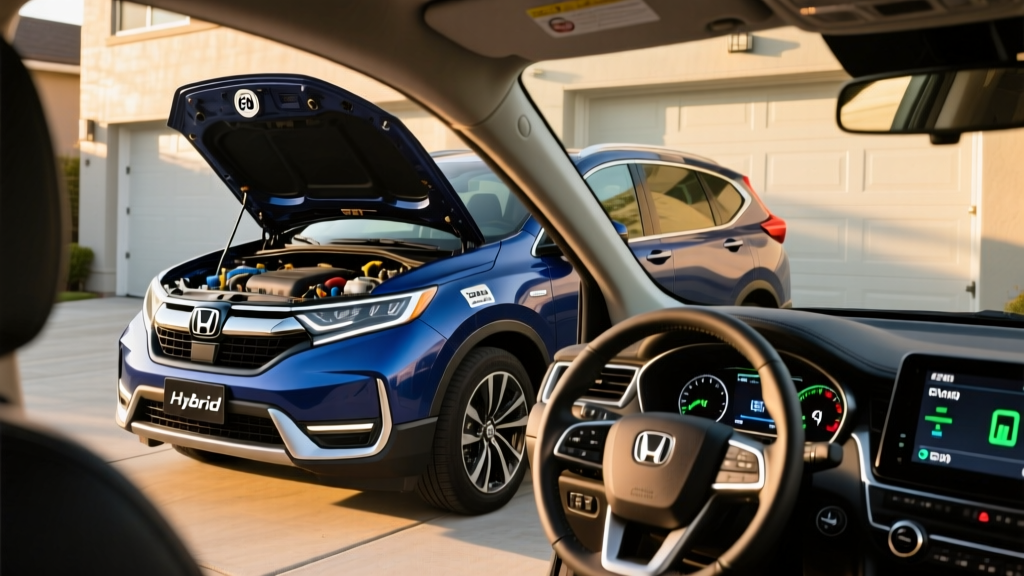
If you own or are shopping for a 2025 Honda CR-V Hybrid, one of the first maintenance questions you'll encounter is straightforward but critical: how much oil does it take, and what kind? Despite its electrified powertrain, the CR-V Hybrid still relies on a gasoline engine that demands proper lubrication. This guide covers the 2025 Honda CR-V Hybrid oil capacity, the full maintenance picture, real-world fuel economy, powertrain specs, and whether this conventional hybrid (HEV) is the right fit versus a plug-in hybrid or full EV.
2025 Honda CR-V Hybrid Oil Capacity: Exact Specs
The 2025 Honda CR-V Hybrid uses Honda's fourth-generation two-motor hybrid system paired with a 2.0-liter Atkinson-cycle inline-4 engine. Here are the precise oil specifications you need:
| Specification | Value |
|---|---|
| Oil capacity (with filter change) | 3.7 quarts (3.5 liters) |
| Oil capacity (without filter change) | 3.4 quarts (3.2 liters) |
| Recommended oil viscosity | 0W-20 full synthetic |
| Oil type requirement | API SP certified, ILSAC GF-6A |
| Recommended oil change interval | Every 7,500–10,000 miles (Maintenance Minder) |
| Oil filter part number | Honda 15400-PLM-A02 (or equivalent) |
The 3.7-quart capacity is relatively modest compared to many turbocharged or larger-displacement engines, which reflects the efficiency-focused 2.0L Atkinson-cycle design. Honda's Maintenance Minder system monitors actual driving conditions — frequent short trips, extreme temperatures, and towing will trigger earlier service alerts than steady highway driving.
CR-V Hybrid vs. CR-V PHEV: Which Electrified CR-V Exists in 2025?
Before diving deeper into fuel economy and powertrain details, it's essential to clarify what Honda actually offers. The 2025 CR-V lineup includes a conventional hybrid (HEV) and, in select markets, Honda has offered a plug-in hybrid variant internationally. However, for the U.S. market, the 2025 Honda CR-V is available only as a conventional hybrid (HEV) — it does not plug in, has no electric-only driving mode, and carries no battery you can charge from a wall outlet.
HEV vs. PHEV — Quick Distinction
| Feature | Conventional Hybrid (HEV) | Plug-In Hybrid (PHEV) |
|---|---|---|
| Plugs in to charge? | No — charges via regenerative braking and engine | Yes — Level 1 or Level 2 charging |
| Electric-only range | Less than 1 mile at very low speeds | Typically 20–45 miles |
| Battery size | ~1.0–1.3 kWh (small buffer) | ~13–20 kWh usable |
| Federal tax credit (§30D) | Not eligible | Up to $7,500 if requirements met |
| Driving experience | Seamless gas + electric assist | EV-like until battery depletes, then operates as hybrid |
If you're looking for a Honda plug-in hybrid in the compact SUV segment, Honda currently does not offer one in the U.S. The closest Honda PHEV option was the Clarity PHEV (discontinued after 2021). Competitors offering PHEV compact SUVs include the Toyota RAV4 Prime (42 miles electric-only) and the Hyundai Tucson PHEV (33 miles electric-only).
Fuel Economy: EPA MPG and Real-World Results
The 2025 Honda CR-V Hybrid's fuel economy is one of its strongest selling points. Here's the official EPA breakdown, sourced from fueleconomy.gov:
| Drivetrain | City MPG | Highway MPG | Combined MPG |
|---|---|---|---|
| FWD (Sport, Sport-L, Sport Touring) | 43 | 36 | 40 |
| AWD (Sport, Sport-L, Sport Touring) | 40 | 34 | 37 |
Real-World MPG: What to Actually Expect
Hybrids typically exceed their EPA city estimates in stop-and-go driving because regenerative braking recovers energy that a gas-only vehicle wastes as heat. On the highway, however, hybrids lose some of their advantage because the engine runs more continuously and regenerative braking opportunities are fewer.
Based on owner-reported data and independent testing, here's what to expect from the 2025 CR-V Hybrid in real-world conditions:
- City/suburban driving: 38–45 MPG (FWD). Many owners report exceeding the EPA city estimate in warm weather with moderate driving.
- Highway cruising (70–75 mph): 32–36 MPG (AWD). Expect the lower end in winter or with roof cargo.
- Cold weather impact: Hybrids lose roughly 10–15% fuel economy in freezing temperatures because the engine runs more often to generate cabin heat and maintain battery temperature.
- Mixed real-world average: Most owners report 36–41 MPG combined across varied driving, aligning closely with EPA estimates.
Powertrain: Engine, Motors, and Combined Output
The 2025 CR-V Hybrid uses Honda's two-motor hybrid system, which operates differently from a traditional parallel hybrid like Toyota's system. Here's the full powertrain breakdown:
| Component | Specification |
|---|---|
| Engine | 2.0L Atkinson-cycle DOHC inline-4 |
| Engine horsepower | 145 hp @ 6,100 rpm |
| Engine torque | 134 lb-ft @ 4,500 rpm |
| Drive motor output | 181 hp / 247 lb-ft |
| Combined system output | 204 hp / 247 lb-ft |
| Transmission | Direct-drive (no traditional gearbox; e-CVT behavior) |
| Drivetrain options | FWD or AWD (torque-vectoring rear motor on AWD) |
| 0–60 mph (est.) | ~7.6 seconds (FWD), ~7.8 seconds (AWD) |
| Towing capacity | 1,000 lbs (all hybrid trims) |
Honda's hybrid system primarily drives the wheels through the electric motor at low and moderate speeds. The gasoline engine acts as a generator in most conditions, only engaging a lock-up clutch to directly drive the wheels at sustained highway speeds where it's most efficient. This means the CR-V Hybrid drives more like an EV around town than a conventional gas car — with smooth, linear torque delivery and no shift shock.
Pricing, Trims, and Tax Credit Eligibility
The 2025 Honda CR-V Hybrid is offered in three trims, all badged under the "Sport" designation. Pricing from Honda's official specifications:
| Trim | FWD MSRP | AWD MSRP |
|---|---|---|
| Sport | $34,050 | $35,550 |
| Sport-L | $37,050 | $38,550 |
| Sport Touring | — | $40,850 |
Destination charge of $1,350 additional. Prices per Honda's official site.
Federal Tax Credit: Does the CR-V Hybrid Qualify?
No. The 2025 Honda CR-V Hybrid is a conventional hybrid (HEV), not a plug-in hybrid or battery electric vehicle. Under IRS §30D clean vehicle credit rules, only plug-in electric vehicles (PHEVs and BEVs) with sufficient battery capacity qualify for the federal tax credit of up to $7,500. Conventional hybrids like the CR-V Hybrid do not meet the minimum 7 kWh battery capacity threshold and cannot be charged from an external source.
- ❌ Not a plug-in vehicle (no external charging capability)
- ❌ Battery capacity below 7 kWh threshold
- ❌ Does not meet §30D "new clean vehicle" definition
- ✅ May qualify for certain state rebate programs (varies by jurisdiction — check your state energy office)
Some states offer rebates or HOV lane access for conventional hybrids, but these programs vary widely and change frequently. Consult your state's energy or transportation department for current eligibility.
Hybrid Battery: Warranty, Lifespan, and Replacement Cost
One of the most common concerns among hybrid buyers is battery longevity. Honda addresses this with a robust warranty, and real-world data is reassuring.
- Hybrid battery warranty: 8 years / 100,000 miles (10 years / 150,000 miles in CARB states including CA, NY, MA, and others adopting California emissions standards)
- Capacity retention threshold: Honda covers the battery if it fails to hold sufficient charge to operate the hybrid system — typically defined as below ~60–70% state of health
- Powertrain warranty: 5 years / 60,000 miles (covers engine, motors, transmission)
- Basic vehicle warranty: 3 years / 36,000 miles
Battery Lifespan and Replacement Cost
Honda's hybrid battery pack in the CR-V Hybrid is a lithium-ion unit with approximately 1.1 kWh of total capacity (roughly 0.6–0.8 kWh usable). Because the battery is small and the system manages charge/discharge cycles conservatively — never fully depleting or fully charging the pack — degradation is minimal in practice.
- Expected battery lifespan: 150,000–200,000+ miles before significant degradation, based on historical Honda hybrid data (Insight, Accord Hybrid, previous-gen CR-V Hybrid).
- Replacement cost (out of warranty): Approximately $2,000–$4,000 for the hybrid battery pack, including labor. This is significantly less than full EV battery replacements ($5,000–$20,000+) because the pack is much smaller.
- 12V auxiliary battery: The CR-V Hybrid also has a standard 12V battery (AGM type in some trims) that may need replacement every 3–5 years at a cost of $150–$300.
Reliability and Ownership Costs
The CR-V Hybrid carries Honda's reputation for reliability, and the hybrid powertrain has proven durable across multiple model years. According to NHTSA, the 2025 CR-V Hybrid has no significant pattern of powertrain complaints as of early reporting.
Maintenance Advantages Over Gas-Only Models
Ironically, owning a hybrid can reduce certain maintenance costs compared to a conventional gas vehicle:
- Brake pad life: Regenerative braking handles most deceleration, so friction brake pads often last 60,000–100,000+ miles.
- Engine wear: The engine runs fewer total hours because the electric motor handles low-speed driving. Combined with the low-stress Atkinson cycle, engine longevity is excellent.
- Oil change intervals: The Maintenance Minder system often extends intervals to 7,500–10,000 miles under normal driving conditions, meaning fewer oil changes per year.
- No transmission fluid service: Honda's direct-drive hybrid system eliminates the traditional multi-gear transmission and its associated fluid changes.
Total 5-Year Ownership Cost Estimate
| Category | Estimated Cost |
|---|---|
| Fuel (at $3.50/gal, 37 MPG combined) | $7,095 |
| Oil changes (5–7 services at $50–$75 each) | $300–$525 |
| Tires (1 replacement set) | $800–$1,200 |
| Brake pads (likely not needed in 75k miles) | $0–$250 |
| Insurance (national avg. for compact SUV) | $7,500–$10,000 |
| Depreciation (est. 45–50% over 5 years) | $17,000–$20,000 |
Compared to the gas-only 2025 CR-V (rated at 29 MPG combined AWD), the hybrid saves approximately $2,400–$3,000 in fuel costs over 5 years / 75,000 miles at $3.50/gallon — enough to offset its roughly $1,500 price premium over the equivalent gas EX-L trim.
CR-V Hybrid vs. RAV4 Hybrid vs. Full EV: Decision Framework
Choose the CR-V Hybrid (HEV) if:
- You want 37–40 MPG without any change to your fueling routine — no plugging in, no range planning
- You don't have access to home or workplace charging
- You want a proven, low-risk hybrid system with strong resale value
- Your daily driving is a mix of city and highway, and you value smooth, EV-like low-speed behavior
Consider a PHEV (like the RAV4 Prime or Tucson PHEV) if:
- You can charge at home (Level 2) and want 30–42 miles of electric-only commuting
- You want to qualify for the $7,500 federal tax credit (§30D) — subject to MSRP caps, income limits, and battery sourcing rules per IRS guidelines
- You want near-silent, zero-tailpipe-emission driving for daily commutes while retaining gas flexibility for road trips
Consider a full EV (like the Hyundai Ioniq 5 or Tesla Model Y) if:
- You have reliable home charging (Level 2) and your daily driving is under 250 miles
- You want to eliminate oil changes, engine maintenance, and gasoline entirely
- You want maximum federal and state incentives and the lowest per-mile "fuel" cost
Frequently Asked Questions
How many MPG does the 2025 Honda CR-V Hybrid get?
The EPA rates the 2025 CR-V Hybrid at 43 city / 36 highway / 40 combined MPG for FWD models, and 40 city / 34 highway / 37 combined MPG for AWD models. Real-world results typically align closely with these figures, with many owners exceeding the city estimate in warm-weather stop-and-go driving.
Does the CR-V Hybrid need to be plugged in?
No. The 2025 CR-V Hybrid is a conventional hybrid (HEV). Its small lithium-ion battery charges entirely through regenerative braking and the gasoline engine. You fuel it exactly like a regular gas car — there is no plug, no charging cable, and no electric-only driving range to manage.
Is the CR-V Hybrid reliable, and what does battery replacement cost?
Honda's hybrid system has a strong reliability track record across multiple model lines. The hybrid battery is warrantied for 8 years/100,000 miles (10 years/150,000 miles in CARB states). Out-of-warranty replacement costs approximately $2,000–$4,000. Most Honda hybrid batteries last 150,000–200,000+ miles based on historical data.
Does the 2025 CR-V Hybrid qualify for any tax credit?
No federal tax credit is available. The §30D clean vehicle credit applies only to plug-in electric vehicles (PHEVs and BEVs). As a conventional hybrid, the CR-V Hybrid does not qualify. Some state-level programs may offer small rebates or incentives for hybrids — check your state's energy office for current programs.
What oil does the 2025 CR-V Hybrid use, and how often should I change it?
The 2025 CR-V Hybrid requires 3.7 quarts of 0W-20 full synthetic oil (API SP certified). Honda's Maintenance Minder system determines change intervals based on driving conditions — typically every 7,500–10,000 miles under normal use. Short-trip, extreme-temperature, or towing driving will trigger earlier alerts.
How does the CR-V Hybrid compare to the Toyota RAV4 Hybrid?
The 2025 Toyota RAV4 Hybrid is rated at 41 city / 38 highway / 40 combined MPG (AWD standard). The CR-V Hybrid AWD rates 40/34/37. The RAV4 Hybrid has a slight highway MPG advantage, while the CR-V Hybrid offers a more refined interior, slightly more cargo space (36.3 vs. 37.6 cu ft behind the rear seats), and a more EV-like driving feel at low speeds. Both are excellent choices — the decision often comes down to styling preference and dealer pricing in your area.