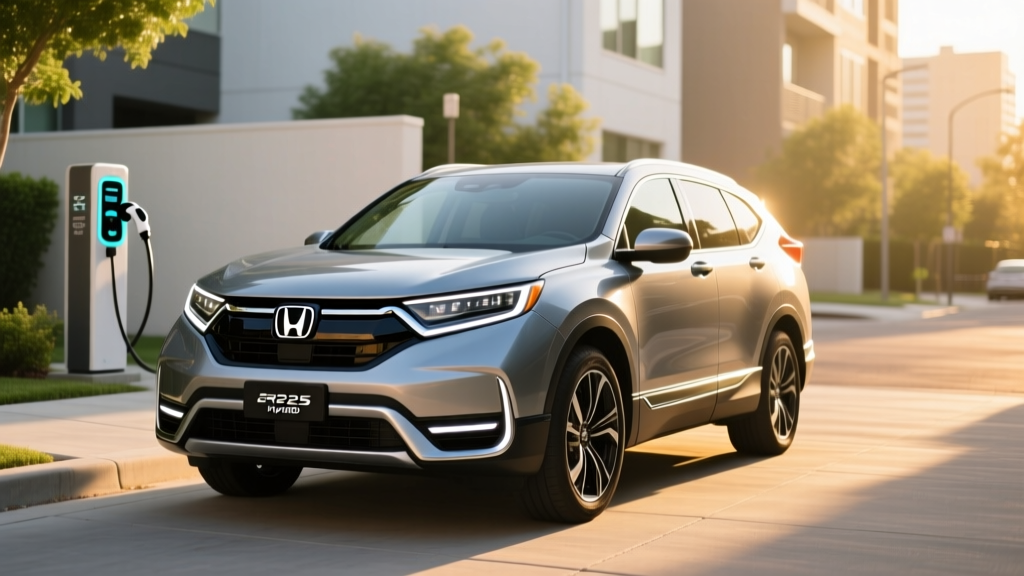
If you've been searching for the 2025 Honda CR-V Hybrid MPG numbers, you've likely seen the headline figure: 40 MPG combined. That's a compelling number for a compact SUV with standard all-wheel drive, generous cargo space, and a starting price under $36,000. But EPA estimates only tell part of the story. Real-world hybrid fuel economy varies significantly based on driving style, climate, and whether you spend most of your miles in stop-and-go traffic or on the open highway.
This guide breaks down every efficiency figure Honda publishes for the 2025 CR-V Hybrid, compares them against what owners actually report, and explains where this conventional hybrid (HEV) fits relative to a plug-in hybrid or a full battery-electric vehicle.
EPA Fuel Economy: 2025 Honda CR-V Hybrid MPG by Trim
The 2025 CR-V Hybrid uses Honda's fourth-generation two-motor hybrid system paired with a 2.0-liter Atkinson-cycle four-cylinder engine. Every hybrid trim comes standard with Real Time AWD. Front-wheel drive is not offered on the hybrid powertrain for 2025.
| Trim | Drivetrain | City MPG | Highway MPG | Combined MPG |
|---|---|---|---|---|
| Sport Hybrid | AWD | 40 | 34 | 37 |
| Sport-L Hybrid | AWD | 40 | 34 | 37 |
| Sport Touring Hybrid | AWD | 40 | 34 | 37 |
Source: EPA fueleconomy.gov. Note: Earlier model-year CR-V Hybrid FWD trims (2023–2024) posted up to 43 city / 36 highway / 40 combined, but Honda consolidated the 2025 hybrid lineup to AWD only, which carries a slight efficiency penalty.
The city-biased split (40 city vs. 34 highway) is characteristic of series-parallel hybrids. At low speeds, the CR-V Hybrid operates primarily as a series hybrid — the gasoline engine acts as a generator, and the electric traction motor drives the wheels. This eliminates idle fuel burn and captures energy through regenerative braking. On the highway, the engine engages directly through a lock-up clutch, operating more like a conventional powertrain, which reduces the hybrid advantage.
Real-World MPG: What Owners Actually Report
EPA numbers are measured under controlled laboratory conditions. Real-world results depend on ambient temperature, terrain, speed, and accessory load. Here's what the data shows for the CR-V Hybrid platform:
- City / suburban commuting: 38–43 MPG (many owners exceed the 40 EPA city figure in warm weather with moderate stop-and-go)
- Highway cruising (70–75 mph): 30–33 MPG (aerodynamic drag and sustained engine operation reduce hybrid benefit)
- Mixed driving (50/50): 35–38 MPG
- Cold weather (below 32°F): 31–35 MPG combined (engine runs more frequently for cabin heat and battery warming; winter fuel blends have lower energy density)
- Mountainous terrain: 28–33 MPG (sustained climbs); regenerative braking on descents partially offsets losses
The CR-V Hybrid's 1.3 kWh lithium-ion traction battery is small by EV standards — it exists to buffer energy, not to drive long distances on electricity alone. You cannot plug this vehicle in. The battery charges exclusively through regenerative braking and the onboard engine-generator. If you want plug-in capability, you need to look at a PHEV alternative like the Toyota RAV4 Prime or the Hyundai Tucson PHEV.
HEV vs. PHEV vs. EV: Which Powertrain Fits Your Driving?
The 2025 CR-V Hybrid is a conventional hybrid (HEV). It requires no plug, no home charger installation, and no change in refueling habits. You fill it at a gas station like any other vehicle. The hybrid system simply makes that gasoline go further.
| Factor | HEV (CR-V Hybrid) | PHEV (e.g., RAV4 Prime) | BEV (e.g., Ioniq 5) |
|---|---|---|---|
| Plug-in required? | No | Yes (Level 2 recommended) | Yes (Level 2 essential) |
| Electric-only range | ~1 mile (low-speed creep) | 35–42 miles typical | 250–320+ miles |
| Combined efficiency | 37 MPG (EPA) | 94 MPGe (electric) / 38 MPG (gas) | 110–132 MPGe |
| Home charging install | None | $500–$2,000 (240V outlet) | $800–$2,500+ (Level 2 station) |
| Starting MSRP (2025) | ~$35,950 | ~$44,500 | ~$42,400 |
| Federal tax credit (§30D) | Not eligible | Up to $7,500 (sourcing-dependent) | Up to $7,500 (sourcing-dependent) |
| Best for | No home charging access; wants simplicity | Short commute + home charging; occasional road trips | Home charging available; wants lowest running cost |
The CR-V Hybrid occupies a specific niche: buyers who want better fuel economy than a gas-only compact SUV (the non-hybrid CR-V AWD rates at 28 MPG combined) but who cannot install a home charger or don't want to think about plugging in. If you have a garage or driveway with 240V access and a commute under 40 miles, a PHEV will save more fuel on a daily basis. If you can charge at home and rarely drive over 250 miles in a day, a BEV eliminates gasoline entirely.
Powertrain and Performance Specs
| Specification | 2025 Honda CR-V Hybrid |
|---|---|
| Engine | 2.0L Atkinson-cycle DOHC 4-cylinder |
| Engine output | 145 hp @ 6,100 rpm / 138 lb-ft torque |
| Electric motors | Two-motor hybrid system (one generator, one traction) |
| Traction motor output | 181 hp / 247 lb-ft torque |
| Combined system output | 204 hp / 247 lb-ft torque |
| Traction battery | 1.3 kWh lithium-ion (gross) |
| Drivetrain | Real Time AWD (mechanical rear axle coupling) |
| 0–60 mph (est.) | ~7.5 seconds |
| Towing capacity | 1,000 lbs |
| Fuel tank | 14.0 gallons |
| Total driving range (est.) | ~518 miles (14.0 gal × 37 MPG combined) |
The 247 lb-ft of torque from the traction motor is available from near-zero RPM, which gives the CR-V Hybrid strong initial acceleration that feels more responsive than its 0–60 time suggests. The two-motor system seamlessly transitions between EV drive (motor only, engine generating), engine drive (direct mechanical connection at highway speeds), and combined mode. Most drivers never notice these transitions.
Pricing, Trims, and Tax Credit Eligibility
The 2025 CR-V Hybrid is offered in three trims, all with AWD:
- Sport Hybrid: ~$35,950 MSRP (includes destination)
- Sport-L Hybrid: ~$38,100 MSRP
- Sport Touring Hybrid: ~$41,100 MSRP
These prices represent a premium of approximately $1,500–$2,000 over equivalent non-hybrid trims. At current fuel prices ($3.40/gal national average) and 12,000 miles per year, the hybrid's 9 MPG combined advantage over the gas CR-V AWD saves roughly $680 annually in fuel. That means the hybrid premium pays for itself in approximately 2.5–3 years for an average driver.
The 2025 Honda CR-V Hybrid is a conventional HEV and does not qualify for the IRS §30D Clean Vehicle Credit. That credit applies only to plug-in electric vehicles (BEVs and PHEVs) with a minimum 7 kWh battery capacity. The CR-V Hybrid's 1.3 kWh battery falls well below this threshold.
For current §30D rules on eligible plug-in vehicles — including MSRP caps ($80,000 SUVs / $55,000 sedans), buyer income limits ($150K single / $300K joint), and critical mineral/battery component sourcing requirements — consult IRS.gov §30D guidance or a qualified tax professional. Rules are subject to change.
Some states offer separate incentives for hybrids, but these are increasingly rare as programs shift focus to plug-in vehicles. Check your state's energy office or DMV for current programs.
Battery Warranty, Reliability, and Replacement Costs
- Duration: 8 years / 100,000 miles (whichever comes first)
- Coverage: Defects and capacity loss below a defined threshold (typically ~60–70% of original capacity)
- Extended in CARB states: 10 years / 150,000 miles in California and states that follow CARB emissions standards (CT, ME, MD, MA, NJ, NY, OR, RI, VT, WA, and others adopting CARB rules)
Honda's hybrid system has matured considerably since its introduction. The fourth-generation two-motor design uses a relatively small, conservatively managed battery pack that avoids the deep discharge cycles that accelerate degradation. The 1.3 kWh battery operates within a narrow state-of-charge window — the system never fully charges or fully depletes it, which significantly extends cell life.
Based on long-term data from earlier CR-V Hybrid and Accord Hybrid models, most Honda hybrid batteries retain functional capacity well beyond the warranty period. Out-of-warranty replacement, should it ever be needed, typically ranges from $2,000 to $4,000 including labor, depending on whether you use a new OEM pack, a refurbished unit, or an independent hybrid specialist. For context, most conventional automatic transmission replacements cost $3,500–$5,500, so the hybrid battery is not an outsized financial risk relative to the mechanical components it replaces.
The CR-V Hybrid earned a TOP SAFETY PICK designation from the IIHS (testing varies by model year; confirm current status for 2025). Honda Sensing — the brand's ADAS suite including adaptive cruise control, lane-keeping assist, and automatic emergency braking — is standard on every trim. This is SAE Level 1–2 driver assistance, meaning the driver must remain fully engaged at all times.
Who Should Choose the CR-V Hybrid?
- You want 35–40 MPG without changing your refueling routine
- You don't have access to home or workplace charging (apartment, street parking)
- You regularly drive in cold climates where BEV range drops 20–30%
- You take frequent road trips exceeding 300+ miles and don't want to plan charging stops
- You want AWD capability with strong low-end torque for snow and rain
- You have home charging and a commute under 40 miles (a PHEV covers most trips on electricity)
- You want to minimize or eliminate gasoline use and tailpipe emissions
- You qualify for the §30D tax credit (up to $7,500), which can offset a PHEV/BEV's higher MSRP
- You want access to HOV lanes (available in some states for PHEVs and BEVs, not HEVs)
- You prioritize lowest per-mile operating cost (electricity at $0.04–$0.14/mile vs. gas at $0.12–$0.18/mile for the CR-V Hybrid)
- 37 MPG combined with AWD — no plug required
- 518-mile total range eliminates range anxiety entirely
- Strong 247 lb-ft electric torque for confident merging
- 76 cu ft cargo volume (rear seats folded) — class-competitive
- 8-year/100,000-mile hybrid battery warranty
- Hybrid premium pays back in ~2.5–3 years at average mileage
- No federal tax credit eligibility (HEV, not plug-in)
- AWD-only hybrid trims lose ~3 MPG vs. prior FWD hybrid
- Highway MPG drops to 34 — less impressive on road trips
- 1,000-lb towing capacity limits utility (non-hybrid tows 1,500 lbs)
- No DC fast charging capability (not applicable — no plug)
- Cold weather can reduce real-world MPG to low 30s
Frequently Asked Questions
How many MPG does the 2025 Honda CR-V Hybrid actually get?
The EPA rates the 2025 CR-V Hybrid AWD at 40 city / 34 highway / 37 combined. In real-world mixed driving, most owners report 35–38 MPG. City-heavy commuters in warm weather often see 38–43 MPG, while sustained highway driving at 75+ mph may drop to 30–33 MPG.
Does the CR-V Hybrid need to be plugged in?
No. The 2025 CR-V Hybrid is a conventional hybrid (HEV). Its 1.3 kWh battery charges exclusively through regenerative braking and the onboard engine-generator. You refuel at a gas station like any other car. Honda does not currently offer a plug-in hybrid (PHEV) version of the CR-V in the US market.
How far can the CR-V Hybrid drive on electric power alone?
Less than one mile, and only at very low speeds (under 25 mph in favorable conditions). The hybrid system uses electric-only mode for brief low-speed maneuvers — pulling out of a driveway, creeping in traffic — before the engine seamlessly starts. This is fundamentally different from a PHEV, which can drive 30–40+ miles at highway speeds on electricity alone.
Is the CR-V Hybrid reliable, and what does a battery replacement cost?
Honda's hybrid system has proven reliable across multiple model generations. The CR-V Hybrid's battery is covered by an 8-year/100,000-mile warranty (10 years/150,000 miles in CARB states). Out-of-warranty battery replacement typically costs $2,000–$4,000. Based on historical data, most Honda hybrid batteries last well beyond the warranty period without significant issues.
Does the 2025 CR-V Hybrid qualify for any tax credit?
No. The federal §30D Clean Vehicle Credit applies only to plug-in electric vehicles (BEVs and PHEVs) meeting battery capacity, sourcing, MSRP, and buyer income requirements. The CR-V Hybrid's 1.3 kWh battery does not meet the 7 kWh minimum threshold. Some states may offer minor incentives for hybrids, but these programs are increasingly uncommon. Check your state energy office for current offerings.
How does the CR-V Hybrid compare to the Toyota RAV4 Hybrid?
The 2025 Toyota RAV4 Hybrid AWD rates at 41 city / 38 highway / 39 combined — slightly better highway efficiency due to its different hybrid system tuning. The RAV4 Hybrid starts around $33,500, making it roughly $2,400 less expensive at the base trim. The CR-V Hybrid counters with a more refined ride, slightly more cargo volume, and a more modern interior. Both are strong choices; the decision often comes down to which driving experience and dealership network you prefer.