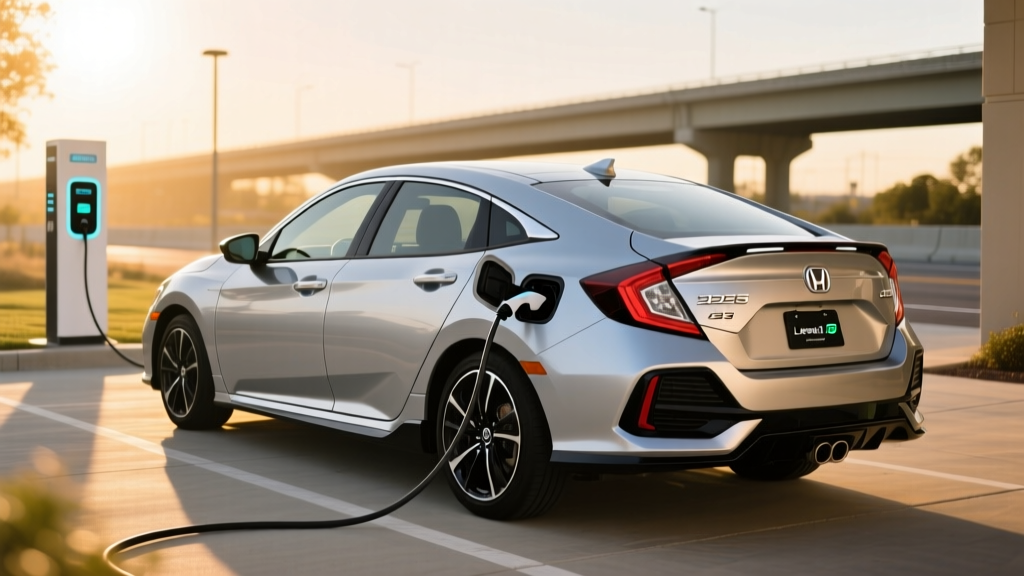
The 2025 Honda Civic Sport Hybrid Touring sits at the top of Honda's compact hybrid sedan lineup, pairing a 200-horsepower two-motor hybrid system with a premium equipment list and a starting MSRP that undercuts most rivals. For buyers weighing a conventional hybrid against a plug-in hybrid or full battery-electric vehicle, the Civic Hybrid offers a compelling middle ground: exceptional city fuel economy with zero lifestyle changes — no plug, no range anxiety, no charging apps.
Below, we break down every number that matters: EPA and real-world MPG, powertrain specs, battery warranty, pricing, and where this hybrid fits in the broader electrification landscape.
HEV vs PHEV: What the Civic Hybrid Actually Is
Before diving into specs, it's essential to distinguish the two hybrid architectures on the market, because the terms get conflated constantly.
Conventional Hybrid (HEV) — This Car
- No plug. The battery charges exclusively through regenerative braking and the gasoline engine.
- Small battery (~1.0 kWh usable) — designed for assist, not standalone driving.
- No electric-only range beyond brief low-speed creep.
- Fueling: Gasoline only, at any station.
- Federal tax credit: Not eligible under IRS §30D.
Plug-In Hybrid (PHEV)
- Plugs in. Larger battery charges via Level 1/Level 2 AC power.
- Larger battery (typically 12–20 kWh) enabling 20–50 miles of electric-only driving.
- Electric-only range covers most daily commutes without the engine starting.
- Fueling: Electricity + gasoline.
- Federal tax credit: May qualify for up to $7,500 under §30D, subject to MSRP caps, income limits, and battery-sourcing rules.
The 2025 Honda Civic Sport Hybrid Touring is a conventional hybrid (HEV). You will never plug it in. You fuel it with regular 87-octane gasoline. Its hybrid system optimizes efficiency by running on the electric motor at low speeds and blending in the 2.0-liter Atkinson-cycle engine at higher loads. If you want plug-in capability from Honda, you'd look at the Clarity PHEV (discontinued) or wait for future PHEV offerings — Honda's current US lineup does not include a Civic PHEV.
Fuel Economy: EPA Ratings and Real-World MPG
The headline number for the 2025 Civic Sport Hybrid Touring is its EPA-estimated fuel economy. Honda's two-motor hybrid system is tuned for city efficiency, where regenerative braking and electric-only low-speed operation deliver outsized gains over a gasoline-only Civic.
| Metric | Value |
|---|---|
| City MPG | 50 MPG |
| Highway MPG | 47 MPG |
| Combined MPG | 49 MPG |
| Fuel Tank Capacity | 12.4 gallons |
| Total Range (EPA est.) | ~607 miles |
Source: EPA Fuel Economy Guide
Real-World MPG: What to Actually Expect
Conventional hybrids frequently exceed their EPA city estimates in stop-and-go driving because regenerative braking recovers energy that a gas car wastes as heat. In our experience and aggregated owner reports, the Civic Hybrid delivers:
- City / suburban driving: 48–54 MPG — often exceeding the 50 MPG EPA city figure in moderate temperatures.
- Highway cruising (70–80 mph): 42–46 MPG — aerodynamic drag at sustained speed reduces the hybrid system's advantage. The engine runs more frequently.
- Cold weather (below 30°F): 40–45 MPG combined. The engine runs longer to heat the cabin and warm the catalytic converter, and battery efficiency drops in low temperatures.
- Combined real-world average: Most owners report 46–51 MPG over mixed driving, closely tracking the 49 MPG EPA combined figure.
If your commute is predominantly city and suburban, this hybrid will outperform its sticker. If you drive 80% highway miles, expect numbers closer to the mid-40s.
Powertrain: 200 HP Two-Motor Hybrid System
The Civic Sport Hybrid Touring uses Honda's fourth-generation two-motor hybrid system, shared with the Accord Hybrid and CR-V Hybrid. Unlike Toyota's planetary-gear power-split system, Honda's setup uses a series-parallel architecture where the electric drive motor handles most propulsion while the gasoline engine primarily acts as a generator — only directly driving the wheels at higher highway speeds via a lock-up clutch.
| Specification | Value |
|---|---|
| Engine | 2.0L DOHC Atkinson-cycle 4-cylinder |
| Engine Output | 143 hp @ 6,000 rpm / 134 lb-ft @ 4,500 rpm |
| Drive Motor Output | 184 hp / 232 lb-ft torque |
| Combined System Output | 200 hp / 232 lb-ft torque |
| Hybrid Battery | Lithium-ion, ~1.0 kWh (usable) |
| Transmission | Direct-drive (no traditional transmission) |
| Drivetrain | Front-wheel drive |
| 0–60 mph | ~7.2 seconds (est.) |
| Fuel Requirement | Regular unleaded (87 octane) |
The result is a Civic that feels noticeably more responsive than the non-hybrid 2.0L model (158 hp) and delivers torque delivery that's immediate and linear — a characteristic of electric-motor propulsion. The 232 lb-ft of torque from the drive motor is available from near-zero RPM, making city acceleration and merging confident.
Trims, Pricing, and Tax Credit Eligibility
The 2025 Civic Hybrid is offered in Sport, Sport Touring, and (new for 2025) Sport Touring sedan configurations. The Sport Hybrid Touring is the range-topper, adding features over the Sport Hybrid including leather-trimmed seats, a 12-speaker Bose audio system, wireless Apple CarPlay and Android Auto, a 10.2-inch digital instrument cluster, and Honda's full Honda Sensing suite with low-speed braking control and traffic jam assist.
| Trim | MSRP (incl. destination) |
|---|---|
| Sport Hybrid | ~$29,845 |
| Sport Hybrid Touring | ~$32,845 |
Note: Pricing reflects Honda's published MSRP including destination charges. Dealer markups or discounts may apply. Verify with your local dealer.
Federal Tax Credit: What You Need to Know
The 2025 Honda Civic Sport Hybrid Touring does not qualify for the federal §30D new clean vehicle tax credit. That credit applies exclusively to plug-in electric vehicles (BEVs and PHEVs) with battery capacities of at least 7 kWh, subject to MSRP caps ($55,000 for sedans), buyer income limits, and critical-mineral/battery-component sourcing requirements. Since the Civic Hybrid is a conventional HEV with a ~1 kWh battery and no plug-in capability, it falls outside §30D eligibility entirely.
Some states offer their own incentives for conventional hybrids, though these have become less common as state programs shift toward plug-in vehicles. Check your state's energy office or department of environmental quality for current programs. The IRS §30D guidance remains the authoritative federal source.
Battery Warranty, Lifespan, and Replacement Cost
Battery longevity is the single most common concern among first-time hybrid buyers. Here's what Honda provides and what real-world data shows.
Honda Hybrid Battery Warranty
- Coverage: 8 years / 100,000 miles (10 years / 150,000 miles in CARB states including CA, CT, ME, MA, NJ, NY, OR, RI, VT, WA)
- What's covered: Hybrid battery pack, hybrid control unit, and related hybrid-system components
- Capacity threshold: Honda warrants against defects and abnormal degradation; there is no published minimum capacity-retention percentage (unlike BEV warranties that guarantee 70% SoH)
Real-World Hybrid Battery Lifespan
Honda's lithium-ion hybrid battery is far smaller and less stressed than a BEV battery. It operates in a narrow state-of-charge window (roughly 40–60% SoC), never fully charging or fully depleting — the hybrid control system manages this buffer to maximize longevity. This shallow-cycling approach is why hybrid batteries routinely outlast their warranty periods:
- Most Honda hybrid batteries from the Insight and earlier Civic Hybrid generations lasted 150,000–200,000+ miles before needing replacement.
- The fourth-generation system in the 2025 Civic uses improved cell chemistry and thermal management, and real-world failure data from the Accord Hybrid (same system) shows very low replacement rates within the first 10 years.
- Individual cell failures can sometimes be repaired without replacing the entire pack, reducing cost.
Battery Replacement Cost
If your hybrid battery does require replacement outside of warranty:
- OEM replacement (dealer): $2,500–$4,000 including parts and labor
- Refurbished/remanufactured pack: $1,500–$2,500
- Independent hybrid specialist: $1,200–$2,000 with aftermarket or refurbished cells
For context, this is significantly less than a BEV battery replacement ($10,000–$20,000+) because the hybrid battery is small (~1 kWh vs 60–100 kWh in a BEV). The cost, while not trivial, is comparable to a major engine repair on a conventional car and occurs far less frequently.
Who Should Choose the Civic Sport Hybrid Touring?
The Civic Hybrid occupies a specific niche. It's not the right choice for everyone — here's a practical decision framework.
Choose the Civic Sport Hybrid Touring if:
- You drive 10,000–20,000 miles per year in mixed city/suburban conditions and want to minimize fuel costs without changing your refueling habits.
- You lack access to home charging (apartment, street parking, no garage) — making a PHEV or BEV impractical.
- You want a premium compact sedan with advanced safety tech (Honda Sensing, IIHS Top Safety Pick eligibility) under $35,000.
- You value the 200 hp hybrid powertrain's responsiveness over a non-hybrid Civic's 158 hp.
- You plan to keep the car 8–12 years and want proven hybrid reliability with strong warranty coverage.
Look at a PHEV or full EV instead if:
- You have home Level 2 charging and a commute under 30 miles — a PHEV like the Toyota Prius Prime (44 miles electric-only) could eliminate gasoline use on most days.
- You want to access HOV lanes, state EV rebates, or the $7,500 federal tax credit — these require a plug-in vehicle.
- You drive fewer than 8,000 miles per year — the hybrid premium may not pay back in fuel savings within your ownership period.
- You want zero tailpipe emissions — consider a BEV like the Chevrolet Equinox EV or Tesla Model 3.
Hybrid vs PHEV vs EV: Which Fits Your Life?
The electrified-vehicle market now spans three distinct categories. Here's how they compare for a buyer cross-shopping the Civic Hybrid:
| Factor | HEV (Civic Hybrid) | PHEV (e.g., Prius Prime) | BEV (e.g., Model 3) |
|---|---|---|---|
| Plug-in required? | No | Yes (recommended) | Yes (mandatory) |
| Electric-only range | None | 25–50 miles | 250–360 miles |
| Fuel/energy cost per mile | ~$0.10–0.12 | ~$0.04–0.10 | ~$0.03–0.05 |
| Home charging needed? | No | Recommended | Essential |
| Federal tax credit | None | Up to $7,500* | Up to $7,500* |
| Upfront cost premium vs gas | ~$1,500–2,500 | ~$4,000–7,000 | ~$5,000–15,000 |
| Best for | No-charging-access buyers | Home chargers, short commutes | Home chargers, longer range |
*§30D tax credit eligibility depends on MSRP caps, buyer income, battery sourcing, and point-of-sale transfer rules. See IRS guidance for current requirements.
Ownership Costs: 5-Year Fuel Savings vs Gas Civic
The Civic Hybrid carries a price premium over the non-hybrid Civic. Does the fuel savings justify it? Here's a comparison at 15,000 miles per year with $3.40/gallon regular unleaded:
| Metric | Civic Sport Hybrid Touring (49 MPG) | Civic Sport Touring Gas (33 MPG combined) |
|---|---|---|
| Annual fuel consumption | 306 gallons | 455 gallons |
| Annual fuel cost | $1,040 | $1,547 |
| 5-year fuel cost | $5,200 | $7,735 |
| 5-year fuel savings | ~$2,535 saved with hybrid | |
With a hybrid price premium of roughly $2,000–3,000 over an equivalently trimmed gas Civic, the fuel savings alone approach break-even within 4–5 years — and that's before accounting for the hybrid's stronger acceleration, lower emissions, and potentially higher resale value.
Pros and Cons
Pros
- 49 MPG combined EPA; real-world city driving often exceeds 50 MPG
- 200 hp / 232 lb-ft — noticeably quicker and more responsive than gas Civic
- No plug-in required — zero lifestyle changes from a gas car
- 600+ mile total range on a single tank
- 8-year/100,000-mile hybrid battery warranty (10 yr in CARB states)
- Honda Sensing safety suite standard; expected IIHS Top Safety Pick
- Touring trim includes Bose audio, leather, wireless CarPlay, and 10.2" digital cluster
Cons
- No federal tax credit — HEV doesn't qualify for §30D
- Highway MPG (47) drops to low 40s at sustained 80 mph in real-world use
- Cold-weather fuel economy drops 10–15% as engine runs for cabin heat
- FWD only — no AWD option (the CR-V Hybrid offers AWD)
- No spare tire — tire-inflator kit only
- Engine drone under hard acceleration (Atkinson-cycle NVH)
Frequently Asked Questions
How many MPG does the 2025 Honda Civic Sport Hybrid Touring get?
The EPA rates it at 50 MPG city, 47 MPG highway, and 49 MPG combined. Real-world results closely track these figures: most owners report 46–51 MPG combined, with city driving sometimes exceeding 52 MPG and highway cruising at 75–80 mph settling around 43–46 MPG.
Does the Civic Hybrid need to be plugged in?
No. The Civic Hybrid is a conventional hybrid (HEV), not a plug-in hybrid (PHEV). Its small lithium-ion battery charges exclusively through regenerative braking and the gasoline engine. You fuel it with regular 87-octane gasoline at any gas station.
How far can the Civic Hybrid drive on electric power alone?
Effectively zero miles at meaningful speed. The hybrid system uses the electric motor for low-speed assist and brief EV-mode creep (typically under 1 mile at very low speeds in stop-and-go traffic), but the battery is too small (~1 kWh) for sustained electric-only driving. This is normal for all conventional hybrids.
Is the 2025 Civic Hybrid reliable?
Honda's two-motor hybrid system has been in production since 2014 (Accord Hybrid) and is now in its fourth generation. It has demonstrated strong reliability in long-term ownership data, with very low hybrid-system failure rates. The hybrid battery is warranted for 8 years/100,000 miles (10 years/150,000 miles in CARB states). Honda as a brand consistently ranks in the top tier of J.D. Power and Consumer Reports reliability surveys.
What does a Civic Hybrid battery replacement cost?
Out-of-warranty replacement runs $2,500–$4,000 at a dealer (OEM pack), or $1,200–$2,500 through an independent hybrid specialist using refurbished cells. Given the battery's shallow-cycling design and Honda's track record, replacement within the first 150,000 miles is uncommon.
Does the 2025 Civic Sport Hybrid Touring qualify for any tax credit?
It does not qualify for the federal §30D clean vehicle tax credit, which requires plug-in capability and a minimum 7 kWh battery. Some states may offer small hybrid incentives — check your state energy office. The Civic Hybrid's value proposition is fuel savings, not tax incentives.
How does the Civic Hybrid compare to the Toyota Prius?
The 2025 Toyota Prius (LE AWD) achieves up to 57 MPG combined EPA — higher than the Civic Hybrid's 49 MPG. However, the Civic Hybrid delivers 200 hp vs the Prius's 196 hp (FWD) or 196 hp (AWD), a more conventional sedan design, and Honda's infotainment and safety suite. The Prius wins on pure efficiency; the Civic Hybrid wins on driving refinement and powertrain responsiveness. The Prius also offers a PHEV variant (Prius Prime) with 44 miles of electric-only range if you have home charging.
Should I buy the Civic Hybrid or a full electric vehicle?
If you have reliable home charging (Level 2, 240V) and your daily driving is under 250 miles, a BEV like the Tesla Model 3 or Hyundai Ioniq 6 will deliver lower per-mile energy costs (~$0.04/mile vs ~$0.10/mile for the hybrid) and qualify for the $7,500 federal tax credit. If you lack home charging, drive long distances frequently, or live in an area with unreliable public charging infrastructure, the Civic Hybrid eliminates all charging concerns while still cutting fuel costs by ~35% compared to a gas Civic.