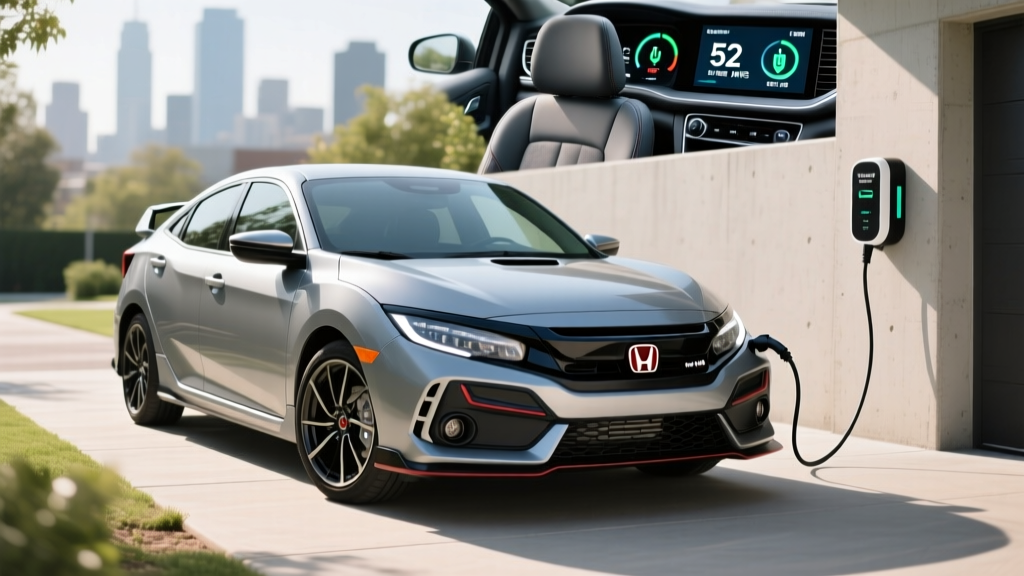
The 2025 Honda Civic Hatchback Hybrid Sport occupies a specific niche: a practical, efficient hatchback that doesn't require a charging routine or a lifestyle change. Honda's two-motor hybrid system pairs a 2.0-liter Atkinson-cycle engine with electric motors for a combined 200 horsepower and an EPA-estimated 50 MPG combined. For buyers weighing a conventional hybrid against a plug-in hybrid (PHEV) or a full battery-electric vehicle (BEV), the Civic Hatchback Hybrid Sport offers a compelling, low-friction entry into electrified driving.
This guide covers the exact specifications, real-world fuel economy expectations, battery longevity data, and the ownership calculus that separates this HEV from plug-in alternatives.
HEV vs. PHEV vs. EV: Where the Civic Hatchback Hybrid Fits
Before evaluating the Civic Hatchback Hybrid Sport, it's essential to understand what it is—and what it isn't. This is a conventional hybrid electric vehicle (HEV), sometimes called a "self-charging" hybrid. It has no plug, no electric-only driving mode of meaningful distance, and no external charging requirement. The small lithium-ion battery (approximately 1.1 kWh usable capacity) recovers energy through regenerative braking and the gasoline engine, then deploys it to assist acceleration and enable brief engine-off coasting.
Conventional Hybrid (HEV) vs. Plug-In Hybrid (PHEV) vs. Battery Electric (BEV)
| Attribute | HEV (Civic Hybrid) | PHEV (e.g., Toyota Prius Prime) | BEV (e.g., Chevy Bolt EV) |
|---|---|---|---|
| Plug-in charging required | No | Yes (Level 1 or 2) | Yes (Level 2 or DC fast) |
| Electric-only range | <1 mile (low-speed creep) | 25–45 miles typical | 200–350+ miles |
| Battery size | ~1.1 kWh | 10–18 kWh | 55–100+ kWh |
| Fuel backup | Gasoline engine (full-time) | Gasoline engine (backup) | None (electric only) |
| Best for | No home charging access; long trips | Short commute + home charging | Home charging + predictable routes |
The Civic Hatchback Hybrid Sport is purpose-built for drivers who want maximum fuel efficiency without altering their refueling habits. If you can't install a Level 2 charger at home, live in an apartment, or regularly drive 400+ miles between fill-ups, an HEV eliminates the range and infrastructure concerns that accompany PHEVs and BEVs.
Powertrain and Performance Specs
Honda's fourth-generation two-motor hybrid system is the heart of the Civic Hatchback Hybrid Sport. Unlike traditional parallel hybrids that blend engine and motor power through a mechanical transmission, Honda's system operates primarily as a series hybrid at low-to-moderate speeds: the gasoline engine drives a generator, which feeds electricity to the propulsion motor. At highway speeds, a lock-up clutch connects the engine directly to the wheels for efficiency.
| Specification | 2025 Civic Hatchback Hybrid Sport |
|---|---|
| Engine | 2.0L DOHC Atkinson-cycle 4-cylinder |
| Engine output | 146 hp / 134 lb-ft torque |
| Propulsion motor output | 184 hp / 232 lb-ft torque |
| Combined system output | 200 hp / 232 lb-ft torque |
| Transmission | Direct-drive (no conventional gearbox) |
| Drivetrain | Front-wheel drive |
| Hybrid battery | Lithium-ion, ~1.1 kWh usable |
| 0–60 mph (est.) | ~7.1 seconds |
| Curb weight | ~3,155 lbs |
| Cargo volume (rear seats up) | 24.5 cu ft |
| Cargo volume (rear seats folded) | 46.2 cu ft |
The 200-horsepeak combined output gives the Sport trim genuine passing power—a notable upgrade over the non-hybrid Civic's 158 hp 2.0L engine. The instant torque from the electric motor (232 lb-ft available from near-zero RPM) makes the car feel quicker than its 0–60 time suggests in city driving. Honda's hybrid system also supports a "Sport" drive mode that sharpens throttle response and holds the engine at higher RPM for more aggressive acceleration.
Fuel Economy: EPA Ratings vs. Real-World MPG
The headline number is what draws most buyers to this car. According to EPA data on fueleconomy.gov, the 2025 Honda Civic Hatchback Hybrid Sport (with 18-inch alloy wheels on the Sport trim) carries the following ratings:
| Driving Cycle | EPA MPG Estimate |
|---|---|
| City | 50 MPG |
| Highway | 45 MPG |
| Combined | 47 MPG |
Note: The Sport Touring Hybrid variant with identical 18-inch wheels shares these ratings. The base Hybrid with 16-inch wheels achieves a slightly higher 51 city / 48 highway / 50 combined due to reduced rolling resistance and weight.
Real-World MPG Expectations
Real-World MPG vs. EPA Sticker: Honda's hybrid system, like Toyota's, tends to exceed its EPA city rating in moderate-temperature urban driving. Owner-reported data on fuel-tracking platforms consistently shows 52–56 MPG in city/suburban conditions at 50–70°F. However, expect the following reductions:
- Highway-dominant driving (75+ mph): 39–43 MPG. Hybrids lose their city advantage at sustained high speed, where the engine runs continuously and aerodynamic drag dominates.
- Cold weather (below 30°F): 40–44 MPG combined. The engine runs more frequently to maintain cabin heat and catalytic converter temperature, reducing electric-motor assist time.
- Mountainous terrain: 38–42 MPG on sustained climbs, partially offset by regenerative braking on descents.
For a mixed-driving owner in a temperate climate, 47–52 MPG combined is a realistic annual average. With a 12.4-gallon fuel tank, that translates to approximately 580–645 miles between fill-ups.
Pricing, Trims, and Tax Credit Eligibility
The 2025 Honda Civic Hatchback Hybrid is available in two trims, with the Sport positioned as the value-oriented sport-appearance model:
| Trim | MSRP (incl. destination) | Key Features |
|---|---|---|
| Hybrid Sport | $30,750 | 18" alloy wheels, sport appearance package, Honda Sensing suite, 7" touchscreen, wireless Apple CarPlay/Android Auto, heated front seats |
| Hybrid Sport Touring | $33,750 | All Sport features + leather-trimmed seats, 9" touchscreen, Bose 12-speaker audio, wireless phone charger, navigation, heated rear seats, low-speed braking control |
Does the Civic Hatchback Hybrid Qualify for a Federal Tax Credit?
No. The 2025 Honda Civic Hatchback Hybrid Sport is a conventional HEV and does not qualify for the federal IRS §30D Clean Vehicle Credit (up to $7,500). That credit is reserved for plug-in electric vehicles—BEVs and PHEVs—that meet battery capacity, critical-mineral sourcing, MSRP, and buyer income requirements.
Conventional hybrids like the Civic Hatchback Hybrid are also ineligible for most state EV rebates and HOV lane access programs that require plug-in capability. A few states offer modest hybrid incentives (typically $250–$500), but these are uncommon and change frequently. Check your state's energy office or DOE's Alternative Fuels Data Center for current local incentives.
The economic case for this HEV rests entirely on fuel savings, not purchase incentives. At $3.30/gallon and 12,000 miles/year, a driver upgrading from a 28 MPG compact car to the Civic Hybrid at 47 MPG combined saves approximately $950 annually on fuel—a payback period of roughly 3–4 years over a comparably priced gas-only Civic.
Hybrid Battery Longevity, Warranty, and Replacement Cost
Battery degradation is the single most common concern among first-time hybrid buyers. Honda addresses this with a robust warranty and a track record of long-lasting hybrid battery packs.
Honda Hybrid Battery Warranty
- Coverage period: 8 years / 100,000 miles (10 years / 150,000 miles in CARB states including CA, NY, MA, and others that follow California emissions standards)
- What's covered: Defects in materials/workmanship and capacity loss below a functional threshold (Honda does not publish a specific percentage, but warranty claims are honored when the battery can no longer hold sufficient charge for normal hybrid operation)
- Transferable: Yes, the hybrid battery warranty transfers to subsequent owners at no cost
How Long Do Honda Hybrid Batteries Last?
Honda's lithium-ion hybrid battery packs are engineered for the life of the vehicle. Real-world data from third-generation Honda hybrids (2017–2021 Insight, Accord Hybrid) indicates that the majority of packs retain functional capacity well beyond 150,000 miles. Unlike BEV batteries, which cycle deeply (10–80% State of Charge daily), hybrid batteries operate in a narrow state-of-charge window (roughly 40–60% SoC), which dramatically reduces chemical degradation.
Replacement cost if out of warranty: A replacement hybrid battery pack for a Honda Civic Hybrid typically costs between $2,000 and $3,500 installed at a dealership, depending on labor rates. Independent hybrid specialists often offer refurbished packs for $1,200–$2,000 installed. Given the narrow SoC operating window and Honda's thermal management, most owners will never face this expense.
Driving Impressions and Daily Ownership
The Civic Hatchback Hybrid Sport drives like a slightly heavier, noticeably smoother Civic. The transition between electric-motor propulsion and gasoline-engine engagement is seamless in normal driving—you'll rarely notice the engine starting or stopping unless you're stationary in a quiet garage. Honda has refined the "drone" effect common to CVT-like hybrid systems; under hard acceleration, the engine RPM rises linearly rather than hanging at a fixed point, which reduces the rubber-band sensation.
The Sport trim's 18-inch wheels and sport-tuned suspension deliver firmer ride quality than the base Hybrid, with sharper turn-in at the cost of some highway compliance. Road noise is well-managed but present on coarse surfaces—a common Civic trait. The hatchback body style's 24.5 cu ft cargo area (46.2 cu ft with rear seats folded) makes this one of the most practical vehicles in its class, swallowing a week's groceries or a bicycle without folding seats.
Honda Sensing, the brand's Level 2 driver-assistance suite, is standard and includes adaptive cruise control with low-speed follow, lane-keeping assist, lane-departure warning, and collision-mitigation braking. It's competent for highway cruising but requires continuous driver engagement—it is not a hands-free or self-driving system. The steering wheel must remain held, and the system will issue escalating warnings if it detects inattention.
Who Should Choose the Civic Hatchback Hybrid Sport?
Decision Framework: Is This Hybrid Right for You?
Choose the Civic Hatchback Hybrid Sport if:
- You lack access to home or workplace Level 2 charging and don't want to rely on public infrastructure.
- Your driving is a mix of city and highway, and you want 580+ miles of range between fill-ups.
- You want lower fuel costs without the upfront premium of a PHEV or BEV.
- You regularly take road trips exceeding 300 miles and don't want to plan charging stops.
- You live in an extreme climate (very cold or very hot) where BEV range loss is a concern.
Consider a PHEV instead if:
- You have home Level 2 charging and a commute under 30 miles—you could drive months without visiting a gas station.
- You want electric-only driving for local trips and qualify for the $7,500 federal tax credit on a qualifying PHEV.
Consider a full BEV instead if:
- You have reliable home charging, drive under 250 miles daily, and want zero tailpipe emissions and minimal maintenance.
- You want the lowest per-mile "fuel" cost (home electricity at $0.13/kWh is roughly equivalent to $1.10/gallon gasoline).
Pros
- 50 MPG city / 47 combined — among the best in its class
- 200 hp combined output — genuinely quick for a compact hybrid
- No plug-in charging required — works with existing gas-station infrastructure
- Hatchback utility: 24.5 cu ft cargo, 46.2 cu ft max
- 8-year/100,000-mile hybrid battery warranty (10/150k in CARB states)
- Standard Honda Sensing ADAS suite
Cons
- No federal tax credit eligibility (HEV, not PHEV/BEV)
- Highway MPG drops to ~40 at 75+ mph
- Sport trim's 18" wheels reduce efficiency vs. 16" base Hybrid
- No all-wheel-drive option
- Infotainment screen is small (7") on the Sport trim
- Road noise on coarse pavement
Frequently Asked Questions
How many MPG does the 2025 Honda Civic Hatchback Hybrid Sport get?
The EPA rates it at 50 MPG city, 45 MPG highway, and 47 MPG combined. In real-world city driving at moderate temperatures, owners commonly report 52–56 MPG. Highway driving at 75+ mph typically yields 39–43 MPG. Cold weather reduces combined efficiency to approximately 40–44 MPG.
Can I plug in the Civic Hatchback Hybrid to charge?
No. The Civic Hatchback Hybrid is a conventional HEV, not a plug-in hybrid. It charges its small lithium-ion battery exclusively through regenerative braking and the gasoline engine. There is no charging port and no electric-only driving mode of meaningful distance. If you want plug-in capability, look at PHEVs like the Toyota Prius Prime or the upcoming Honda Clarity successor.
How far can the Civic Hybrid drive on electric power alone?
Less than one mile, and only at very low speeds (under 25 mph) in stop-and-go traffic. The electric motor assists the gasoline engine continuously, but the ~1.1 kWh battery is too small to sustain electric-only propulsion. This is normal for conventional hybrids—the efficiency gains come from the engine shutting off at stops, regenerative braking, and electric-motor torque assist, not from electric-only range.
Is the Honda hybrid system reliable, and what does battery replacement cost?
Honda's hybrid system has a strong reliability record across the Accord Hybrid, Insight, and CR-V Hybrid lineages. The hybrid battery is warrantied for 8 years/100,000 miles (10 years/150,000 miles in CARB states). Most packs last well beyond 150,000 miles due to the narrow state-of-charge operating window. Out-of-warranty replacement costs $2,000–$3,500 at a dealer, or $1,200–$2,000 from an independent hybrid specialist with a refurbished pack.
Does the 2025 Civic Hatchback Hybrid qualify for any tax credits?
It does not qualify for the federal IRS §30D Clean Vehicle Credit, which is limited to plug-in vehicles (BEVs and PHEVs) that meet battery sourcing, MSRP, and buyer income requirements. Most state EV incentives also require plug-in capability. The Civic Hybrid's economic benefit comes entirely from fuel savings—approximately $950/year vs. a 28 MPG gas compact at 12,000 miles/year and $3.30/gallon.
How does the Civic Hatchback Hybrid compare to the Toyota Prius?
The Toyota Prius (redesigned for 2023) achieves 57 MPG combined on the LE trim and offers an available all-wheel-drive powertrain, but delivers only 194 hp and less cargo space (20.2 cu ft behind rear seats). The Civic Hatchback Hybrid Sport trades a few MPG for 200 hp, a more engaging driving experience, and significantly more hatchback cargo volume (24.5 cu ft). If maximum efficiency is your priority, the Prius wins. If you want a more practical, quicker hatchback, the Civic is the stronger choice.
What maintenance does the Civic Hatchback Hybrid require?
Routine maintenance mirrors the gas-only Civic: oil changes (every 7,500–10,000 miles using 0W-20 synthetic), tire rotations, brake fluid, and cabin/engine air filters. Hybrids typically experience less brake wear due to regenerative braking handling most deceleration—brake pads often last 80,000+ miles. There is no hybrid-specific maintenance required; the system is sealed and self-monitoring.