Quick Verdict: The 2025 CR-V Hybrid Sport at a Glance
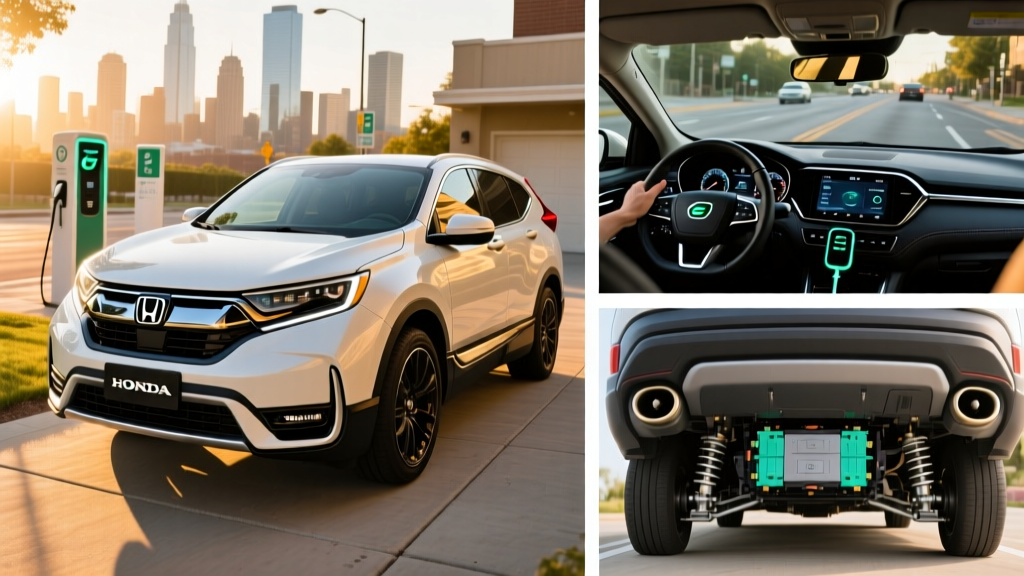
The 2025 Honda CR-V Hybrid Sport occupies a specific niche in the compact crossover segment: it's a conventional hybrid (HEV) that requires no plug, no charging routine, and no lifestyle change compared to a gas car. You simply fuel it and drive. The Sport trim adds aesthetic upgrades — black 19-inch wheels, dark chrome grille accents, gloss-black trim — over the base Hybrid Sport Touring's more restrained look, while sharing the same proven two-motor hybrid powertrain that Honda has refined over multiple generations.
For buyers weighing a mid-step between a pure gas CR-V and a full battery-electric vehicle, the CR-V Hybrid Sport delivers meaningful fuel savings — especially in city driving — without range anxiety, charging infrastructure dependence, or a price premium that takes a decade to recoup. It does not qualify for the federal §30D EV tax credit because it lacks a plug, but its lower sticker price and strong resale value make the math work for many buyers.
| Specification | 2025 CR-V Hybrid Sport (FWD) | 2025 CR-V Hybrid Sport (AWD) |
|---|---|---|
| Powertrain | 2.0L Atkinson-cycle I4 + 2 electric motors | 2.0L Atkinson-cycle I4 + 2 electric motors |
| Combined Horsepower | 204 hp | 204 hp |
| Combined Torque | 247 lb-ft (electric motors) | 247 lb-ft (electric motors) |
| EPA City MPG | 43 | 40 |
| EPA Highway MPG | 36 | 34 |
| EPA Combined MPG | 40 | 37 |
| Drivetrain | Front-wheel drive | Real-time AWD |
| 0–60 mph (est.) | ~7.6 sec | ~7.8 sec |
| Cargo Volume (rear seats up) | 36.3 cu ft | 36.3 cu ft |
| Cargo Volume (rear seats folded) | 76.5 cu ft | 76.5 cu ft |
| Towing Capacity | 1,000 lbs | 1,000 lbs |
| Base MSRP | $36,545 | $38,045 |
HEV vs PHEV: Why the CR-V Hybrid Sport Is Not a Plug-In
A common source of confusion among hybrid shoppers is the distinction between a conventional hybrid (HEV) and a plug-in hybrid (PHEV). The 2025 CR-V Hybrid Sport is an HEV. It has no charging port. Its small lithium-ion battery (approximately 1.1 kWh usable) recharges exclusively through regenerative braking and the gasoline engine. You never plug it in.
| Feature | Conventional Hybrid (HEV) | Plug-In Hybrid (PHEV) |
|---|---|---|
| Plug-in charging? | No — self-charging via regen + engine | Yes — Level 1/Level 2 AC charging |
| Battery size | ~1–2 kWh | ~13–20+ kWh |
| Electric-only range | Less than 1 mile at low speed | 20–45 miles typical |
| Federal tax credit (§30D) | Not eligible | Up to $7,500 if battery sourcing/income/MSRP rules met |
| Driving experience | Seamless gas/electric blending, no behavior change | EV mode for daily commuting, gas for longer trips |
| Example | Honda CR-V Hybrid, Toyota RAV4 Hybrid | Toyota RAV4 Prime, Jeep Wrangler 4xe |
Honda does not currently offer a plug-in CR-V in the US market. If you need electric-only commuting capability in a Honda, the closest option is the discontinued Clarity PHEV (used market) or stepping up to a full BEV like the Prologue. For the CR-V lineup, every Hybrid variant — including the Sport — is strictly an HEV.
Fuel Economy: EPA Ratings vs Real-World MPG
The EPA rates the 2025 CR-V Hybrid Sport at 43 city / 36 highway / 40 combined MPG with front-wheel drive, and 40 city / 34 highway / 37 combined MPG with all-wheel drive. These figures come from Honda's fourth-generation two-motor hybrid system, which uses the gasoline engine primarily as a generator at low-to-moderate speeds while the electric motors drive the wheels directly. The engine only mechanically connects to the wheels at sustained highway cruising speeds via a lock-up clutch.
| Driving Scenario | EPA Estimate (FWD) | Expected Real-World (FWD) |
|---|---|---|
| City / stop-and-go | 43 MPG | 40–45 MPG (hybrids often beat EPA in city) |
| Highway (70 mph) | 36 MPG | 32–35 MPG (aero drag + engine-direct drive) |
| Combined mixed | 40 MPG | 36–40 MPG |
| Cold weather (below 30°F) | — | 33–37 MPG (engine runs more for cabin heat) |
Real-world note: Conventional hybrids like the CR-V Hybrid Sport frequently exceed their EPA city rating in actual stop-and-go driving because regenerative braking recaptures energy that a gas car wastes as heat. On highway-heavy commutes, however, expect MPG to dip below the combined rating. Cold weather further reduces efficiency because the gasoline engine must run more frequently to provide cabin heat — the CR-V Hybrid does not use a heat pump (that's a BEV feature). Owners who drive mostly in town will see the best results; road-trippers should budget for 33–35 MPG on long interstate runs.
For comparison, the non-hybrid 2025 CR-V with the 1.5L turbocharged engine is rated at 29 city / 36 highway / 32 combined (FWD). The hybrid's advantage is most pronounced in urban environments, where it delivers roughly 48% better city fuel economy.
Powertrain Deep Dive: How Honda's Two-Motor System Works
The 2025 CR-V Hybrid Sport uses a 2.0-liter Atkinson-cycle four-cylinder engine paired with two electric motors integrated into the transmission housing. Combined system output is 204 horsepower and 247 lb-ft of torque — the latter figure coming primarily from the electric drive motor, which delivers peak torque from zero RPM.
Here's the operating logic that makes this system efficient:
- EV Drive: At low speeds and light loads, the drive motor powers the wheels using battery energy alone. The engine stays off. This mode covers short distances — typically under 1 mile — at parking-lot speeds.
- Hybrid Drive: During normal acceleration and cruising, the engine spins a generator motor that produces electricity to feed the drive motor. The engine is not mechanically connected to the wheels. This is how the system operates most of the time in city and suburban driving.
- Engine Drive: At steady highway speeds (roughly 50–80 mph), a lock-up clutch mechanically connects the engine directly to the wheels. This is more efficient than converting mechanical energy to electrical and back again.
- Regenerative Braking: During deceleration, the drive motor reverses function to act as a generator, sending energy back into the battery. Steering-wheel paddles let you select from four levels of regen intensity, though the CR-V Hybrid does not offer true one-pedal driving to a complete stop.
The AWD version adds a rear-mounted electric motor that provides torque to the rear axle when slip is detected or during hard acceleration. Unlike mechanical AWD systems, there is no driveshaft connecting the front and rear axles — the rear motor is electrically powered by the hybrid battery and generator.
Pricing, Trims, and Tax Credit Eligibility
The 2025 CR-V Hybrid Sport starts at $36,545 for FWD and $38,045 for AWD, including Honda's $1,350 destination charge. The Sport Touring trim — which adds a wireless phone charger, heated rear seats, a hands-free power tailgate, and a premium Bose audio system — starts at $40,850 (AWD only).
Pros
- 40 MPG combined (FWD) with no plug-in requirement
- Strong low-end torque (247 lb-ft) from electric motors
- Spacious cargo area: 36.3 cu ft behind rear seats
- Honda Sensing safety suite standard on all trims
- Proven hybrid reliability with 8-year/100,000-mile battery warranty
- Sport trim's 19-inch black wheels and dark accents look premium
Cons
- Not eligible for the federal §30D EV tax credit (HEV, not PHEV/BEV)
- Highway MPG drops to 34–36 — less advantage over gas models
- 1,000-lb towing capacity limits utility for trailer owners
- No plug means no electric-only commuting capability
- Road noise is noticeable on coarse pavement at highway speed
- Infotainment on Sport trim uses a 7-inch screen (9-inch on Touring)
Federal tax credit: The 2025 CR-V Hybrid Sport does not qualify for the IRS §30D Clean Vehicle Credit. That credit applies only to plug-in electric vehicles (BEVs and PHEVs) meeting specific battery-sourcing, critical-mineral, MSRP-cap, and buyer-income requirements. Because the CR-V Hybrid is a conventional HEV with no plug-in capability, it falls outside §30D eligibility entirely. Some states may offer minor incentives for hybrid purchases — check your state's energy or DMV website — but these are typically small ($250–$500 rebates) compared to the federal credit.
For a complete breakdown of current §30D rules, see the IRS Clean Vehicle Tax Credits page.
Hybrid Battery Warranty, Lifespan, and Replacement Cost
Honda Hybrid Battery Warranty: 8 years or 100,000 miles (whichever comes first) in most states. In California Air Resources Board (CARB) states — including CA, CT, ME, MA, NJ, NY, OR, RI, VT, and WA — the warranty extends to 10 years or 150,000 miles under CARB emissions-component coverage.
What's covered: Defects in materials or workmanship, and capacity loss below a functional threshold (Honda does not publish a specific percentage, but warranty claims are evaluated based on the battery's ability to support normal hybrid operation).
Honda's hybrid battery packs have demonstrated strong longevity in real-world use. The lithium-ion cells used in the CR-V Hybrid are relatively small (~1.1 kWh usable) and are managed conservatively — the system never fully charges or fully depletes the pack, keeping the state of charge in a middle band that minimizes degradation. This is fundamentally different from a BEV battery, which cycles through a much larger energy window daily.
Replacement cost: If the hybrid battery does fail outside warranty, a new OEM replacement pack for the CR-V Hybrid currently costs between $2,500 and $4,000 including labor, based on dealer pricing and independent hybrid-repair shop data. Refurbished or salvaged packs can be sourced for $1,500–$2,500. This is dramatically less than a BEV battery replacement ($10,000–$20,000+) and is comparable to a major engine repair on a conventional gas car.
For long-term ownership peace of mind, Honda's hybrid system has been in production since the early 2000s (starting with the Insight and Civic Hybrid), and the current two-motor architecture debuted in 2014. There are no widespread reports of premature battery failures in the current-generation CR-V Hybrid, which launched for the 2023 model year. The EPA's fueleconomy.gov listing for the 2025 CR-V Hybrid confirms the powertrain configuration and efficiency ratings.
Who Should Choose the CR-V Hybrid Sport — And Who Shouldn't
Choose the 2025 CR-V Hybrid Sport if:
- You drive primarily in city or suburban environments where regenerative braking maximizes fuel savings
- You want better fuel economy without changing your refueling habits (no plug, no charging apps, no route planning)
- You don't have access to home or workplace charging infrastructure
- You want Honda's reliability reputation and strong resale value
- The $3,000–$4,000 premium over a gas CR-V EX is justified by 5+ years of ownership and 12,000+ annual miles
Look elsewhere if:
- You want electric-only commuting — consider a PHEV like the Toyota RAV4 Prime (42 mi electric) or a full BEV
- You tow regularly — the 1,000-lb capacity is limiting; a gas CR-V AWD is rated at 1,500 lbs
- Your driving is 90%+ highway — the hybrid's advantage shrinks, and a gas or diesel alternative may be equally efficient
- You need the federal tax credit — only plug-in vehicles qualify under §30D
The CR-V Hybrid Sport makes the most financial sense for owners who accumulate significant city miles. At 15,000 miles per year with a 60/40 city/highway split, the FWD Hybrid Sport would consume roughly 375 gallons annually at 40 MPG combined. A comparable gas CR-V (32 MPG combined) would burn about 469 gallons — a difference of 94 gallons. At $3.40 per gallon, that's approximately $320 in annual fuel savings. The hybrid premium over a similarly equipped gas CR-V EX (approximately $3,500) would be recouped in roughly 11 years at this driving pattern. If your city proportion is higher, or if gas prices rise, the payback period shortens.
For buyers who can charge at home and want maximum efficiency gains, a plug-in hybrid or full EV delivers larger savings — but requires infrastructure the CR-V Hybrid Sport deliberately avoids.
Frequently Asked Questions
How many MPG does the 2025 CR-V Hybrid Sport get?
The EPA rates it at 43 city / 36 highway / 40 combined with FWD, and 40 city / 34 highway / 37 combined with AWD. Real-world city driving often matches or slightly exceeds the EPA city figure thanks to regenerative braking. Highway-heavy trips typically yield 32–35 MPG.
Does the CR-V Hybrid Sport need to be plugged in?
No. It is a conventional hybrid (HEV), not a plug-in hybrid (PHEV). The battery recharges through regenerative braking and the gasoline engine. There is no charging port on the vehicle.
How far can the CR-V Hybrid go on electric power alone?
Less than one mile at very low speeds (under 25 mph). The system uses EV mode briefly during stop-and-go traffic and parking-lot maneuvers, but the gasoline engine engages quickly for any meaningful acceleration or sustained speed. This is normal for HEVs — electric-only range is a PHEV feature, not an HEV feature.
Is the CR-V Hybrid reliable, and what does a battery replacement cost?
Honda's hybrid system has a strong reliability track record across multiple model lines. The hybrid battery is warrantied for 8 years/100,000 miles (10 years/150,000 miles in CARB states). Out-of-warranty replacement costs approximately $2,500–$4,000 for a new OEM pack, significantly less than a BEV battery replacement.
Does the 2025 CR-V Hybrid Sport qualify for a federal tax credit?
No. The federal §30D Clean Vehicle Credit applies only to plug-in electric vehicles (BEVs and PHEVs). Because the CR-V Hybrid is a conventional HEV with no plug-in capability, it does not qualify. Check your state's energy office for any local hybrid incentives, which are typically modest.
How does the CR-V Hybrid Sport compare to the Toyota RAV4 Hybrid?
The RAV4 Hybrid (XLE trim) is rated at 41 city / 38 highway / 40 combined with standard AWD and starts around $34,000. The CR-V Hybrid Sport offers a slightly more upscale interior and a sportier aesthetic, while the RAV4 Hybrid provides marginally better highway MPG and a lower entry price. Both use proven two-motor hybrid systems with similar power outputs (219 hp for Toyota, 204 hp for Honda). The IIHS ratings for the 2025 CR-V show top safety marks, matching the RAV4's strong crash-test performance.
Can I tow with the CR-V Hybrid Sport?
Yes, but with limitations. The maximum towing capacity is 1,000 lbs — suitable for a small utility trailer or a couple of dirt bikes, but not for a boat or camper. If towing is a priority, the gas CR-V AWD is rated for 1,500 lbs.