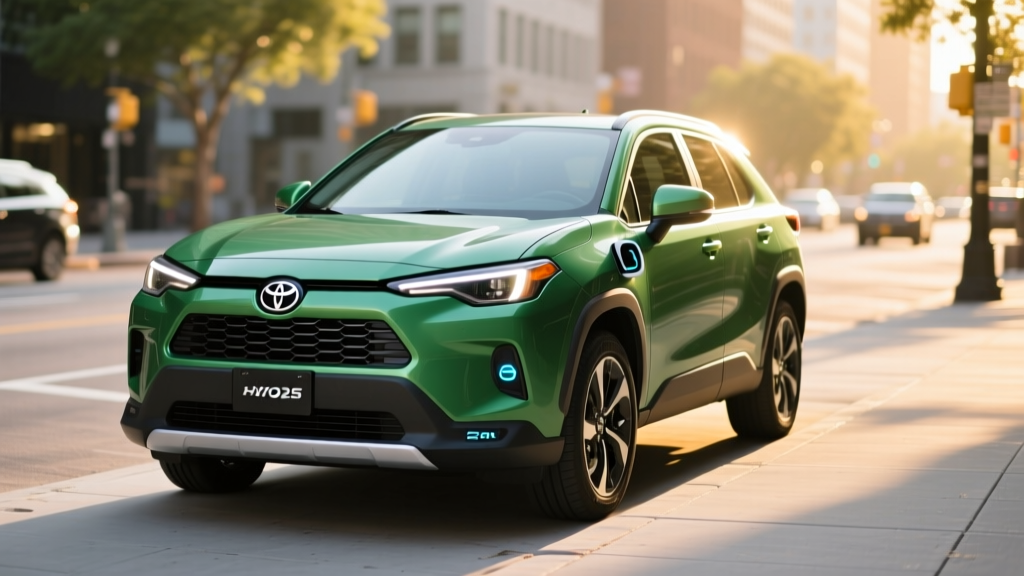
Quick Verdict: The 2025 Corolla Cross Hybrid at a Glance
The 2025 Toyota Corolla Cross Hybrid is a compact crossover that prioritizes fuel efficiency and everyday practicality over performance theatrics. With an EPA-estimated 42 MPG combined and standard all-wheel drive, it occupies a narrow but compelling lane: buyers who want crossover utility, hybrid efficiency, and Toyota's reliability reputation — without plugging in or paying an EV premium.
Starting at approximately $28,595 for the S trim (including destination), the Corolla Cross Hybrid undercuts most AWD compact crossovers on fuel cost while offering a proven fifth-generation Toyota Hybrid System. It is strictly a conventional hybrid (HEV), not a plug-in — meaning no electric-only range, no charging cord, and no federal EV tax credit. For many buyers, that simplicity is the point.
HEV vs PHEV: Where the Corolla Cross Hybrid Fits
Before diving into specs, it's worth clarifying the distinction that trips up many shoppers:
| Feature | Corolla Cross Hybrid (HEV) | Typical PHEV (e.g., RAV4 Prime) |
|---|---|---|
| Plug-in required? | No — self-charging via regen & engine | Yes — plug in for EV range |
| Electric-only range | None (EV assist only at low speeds) | 25–42 miles typical |
| Battery size | ~1.0 kWh (small NiMH/Li-ion pack) | 13–18 kWh lithium-ion |
| Federal tax credit | Not eligible | Up to $7,500 if eligible |
| Complexity | Low — drive like a gas car | Higher — manage charging for max benefit |
The Corolla Cross Hybrid never needs to be plugged in. Its small battery recharges through regenerative braking and the gasoline engine. If you want plug-in electric range for short commutes, Toyota's RAV4 Prime (PHEV) is the logical step up — but at a $10,000+ premium.
Fuel Economy: EPA Ratings and Real-World MPG
The headline number is what draws buyers to this vehicle. Here's the official EPA breakdown:
| Driving Cycle | EPA MPG Estimate |
|---|---|
| City | 45 MPG |
| Highway | 38 MPG |
| Combined | 42 MPG |
Source: fueleconomy.gov
Real-World MPG Expectations: Toyota's hybrid system excels in stop-and-go city driving, where regenerative braking and electric-motor assist do the heavy lifting. Owners consistently report matching or slightly exceeding the 45 MPG city figure in warm-weather urban commutes. Highway driving at 70–80 MPH typically yields 34–37 MPG due to aerodynamic drag and the engine operating more frequently. In cold weather (below 30°F), expect a 5–10% drop across the board as the engine runs longer to heat the cabin and warm the catalytic converter.
For context, the non-hybrid Corolla Cross AWD achieves 29 MPG combined — meaning the hybrid saves roughly 4.4 gallons per 100 miles driven, or about $450–$550 annually at 15,000 miles and $3.50/gallon.
Powertrain and Performance Specs
| Specification | 2025 Corolla Cross Hybrid |
|---|---|
| Engine | 2.0L 4-cylinder Atkinson-cycle |
| Combined System Horsepower | 196 hp |
| Electric Motors | Front + rear (eAWD) |
| Drivetrain | Electronic AWD (standard on all trims) |
| Transmission | eCVT (electronically controlled) |
| 0–60 MPH (est.) | ~7.5 seconds |
| Towing Capacity | Not rated (not recommended) |
| Fuel Tank | 11.4 gallons |
| Total Driving Range | ~478 miles (combined EPA) |
The fifth-generation Toyota Hybrid System pairs a 2.0-liter Atkinson-cycle engine with two motor-generators up front and a dedicated rear-axle electric motor for AWD traction. The rear motor engages automatically when slip is detected — there's no mechanical driveshaft connecting front and rear axles. This "eAWD" system is effective for rain, light snow, and gravel roads, but it is not designed for serious off-road use.
The 196 combined horsepower represents a meaningful upgrade over the non-hybrid Corolla Cross (169 hp), and the electric motor's instant torque makes the hybrid feel noticeably quicker in city acceleration despite the similar 0–60 times on paper.
Pricing, Trims, and Tax Credit Eligibility
The 2025 Corolla Cross Hybrid is offered in three trims:
| Trim | MSRP (incl. destination) | Key Features |
|---|---|---|
| S | $28,595 | 8" touchscreen, wireless CarPlay/Android Auto, TSS 3.0 |
| SE | $30,025 | SofTex seats, heated front seats, sport-tuned suspension |
| XSE | $31,945 | Power liftgate, JBL audio, ambient lighting, 18" alloys |
Federal Tax Credit: Not Eligible. The Corolla Cross Hybrid is a conventional HEV, not a plug-in vehicle. Under current IRS §30D rules, only battery electric vehicles (BEVs) and plug-in hybrids (PHEVs) with sufficient battery capacity qualify for the federal clean vehicle credit. The Corolla Cross Hybrid's sub-2 kWh battery does not meet the threshold. Some states may offer minor hybrid incentives — check your state energy office for current programs.
For buyers seeking federal tax-credit savings, the step up to a PHEV like the RAV4 Prime or a BEV like the bZ4X would be necessary — but both carry significantly higher starting prices ($43,000+ and $37,000+ respectively).
Battery Warranty, Reliability, and Replacement Costs
Hybrid Battery Warranty: Toyota covers the Corolla Cross Hybrid's battery pack for 10 years or 150,000 miles (whichever comes first) under its Hybrid Battery Warranty. This applies to all 50 states. Additionally, all hybrid-system components (inverter, motor-generators, control modules) are covered for 8 years or 100,000 miles.
Toyota's hybrid battery track record is among the strongest in the industry. The Prius, now in its fifth generation, has demonstrated that Toyota hybrid battery packs routinely exceed 200,000 miles with minimal degradation. The Corolla Cross Hybrid uses a smaller, less stressed battery pack than a PHEV or BEV — it never deep-cycles and operates within a narrow state-of-charge window managed by the hybrid control system. This conservative approach is a key reason Toyota hybrid batteries last so long.
Battery Replacement Cost: If a hybrid battery replacement is needed out of warranty (rare before 200k miles based on historical data), expect a range of $2,000–$3,500 for a Toyota hybrid battery pack, including labor. Third-party remanufactured packs and individual cell-module replacements are increasingly available for $1,000–$2,000, bringing costs down further. This is a fraction of the $8,000–$20,000+ that BEV battery replacements can cost.
According to reliability data tracked by sources like Consumer Reports and J.D. Power, the Corolla Cross Hybrid benefits from a powertrain architecture (the THS-V system) shared with the Prius and Corolla Hybrid — both of which score well above average in long-term reliability.
Corolla Cross Hybrid vs EV vs Gas: Which Should You Choose?
Choose the Corolla Cross Hybrid (HEV) if:
- You don't have access to home or workplace charging (apartment, street parking)
- You want AWD and crossover ground clearance on a sub-$32,000 budget
- You drive a mix of city and highway and want 42 MPG without behavior changes
- You plan to keep the vehicle 8–10+ years and value Toyota's reliability record
- You don't want to manage charging routines or worry about plug-in infrastructure
Choose a PHEV (e.g., RAV4 Prime) if:
- You can charge at home and most daily trips are under 30 miles
- You want electric-only commuting with gas-engine backup for road trips
- You may qualify for the $7,500 federal tax credit (income and sourcing rules apply)
Choose a full EV (e.g., Hyundai Ioniq 5, Tesla Model Y) if:
- You have reliable home Level 2 charging access
- Your daily commute is under 200 miles and you road-trip infrequently
- You want to eliminate gasoline entirely and minimize maintenance costs
- You qualify for federal/state EV incentives that close the price gap
Pros and Cons
Pros
- 42 MPG combined EPA — best in the AWD compact crossover segment
- Standard electronic AWD across all trims
- 196 hp is a meaningful upgrade over the gas-only model
- No plug-in required — zero behavior change from a gas car
- 10-year/150,000-mile hybrid battery warranty
- Toyota Safety Sense 3.0 standard (pre-collision, lane tracing, adaptive cruise)
- Competitive starting price under $29,000
Cons
- No federal tax credit eligibility
- Cargo space is modest (~25 cu ft behind rear seats) due to hybrid battery placement
- eCVT drone under hard acceleration — typical Toyota hybrid characteristic
- No DC fast charging capability (not applicable — HEV)
- Rear-seat legroom is tighter than RAV4 or Honda HR-V
- Base S trim uses cloth seats and lacks some convenience features
Frequently Asked Questions
How many MPG does the 2025 Corolla Cross Hybrid get?
The EPA rates the 2025 Corolla Cross Hybrid at 45 MPG city, 38 MPG highway, and 42 MPG combined. Real-world city driving often matches or slightly exceeds the 45 MPG figure in warm weather, while sustained highway driving at higher speeds typically returns 34–37 MPG. Cold weather reduces efficiency by approximately 5–10%.
Does the Corolla Cross Hybrid need to be plugged in?
No. The Corolla Cross Hybrid is a conventional hybrid (HEV). Its battery recharges automatically through regenerative braking and the gasoline engine. You fuel it at a gas station like any other car — there is no plug, no charging cord, and no electric-only driving range.
Is the Corolla Cross Hybrid reliable, and what does a battery replacement cost?
Toyota's hybrid systems have one of the strongest long-term reliability records in the industry, with many Prius and Camry Hybrid owners reporting 200,000+ miles on original battery packs. The Corolla Cross Hybrid battery is covered by a 10-year/150,000-mile warranty. Out-of-warranty replacement, if ever needed, typically costs $2,000–$3,500 — far less than a full EV battery replacement.
Does the 2025 Corolla Cross Hybrid qualify for any tax credit?
It does not qualify for the federal §30D clean vehicle tax credit, which is reserved for plug-in vehicles (BEVs and PHEVs) meeting battery-capacity, sourcing, MSRP, and income requirements. Some states may offer small hybrid incentives or HOV lane access — check your state's energy or transportation department for current programs.
How does the Corolla Cross Hybrid compare to the RAV4 Hybrid?
The RAV4 Hybrid is larger, offers more cargo room (~37.5 cu ft), and gets 39 MPG combined — slightly less than the Corolla Cross Hybrid's 42 MPG. The RAV4 Hybrid starts around $33,000, roughly $4,500 more. If you need the extra space and don't mind the price premium, the RAV4 is the more versatile vehicle. If fuel economy and budget are your top priorities, the Corolla Cross Hybrid wins on both counts.
What is the total driving range on a full tank?
With an 11.4-gallon fuel tank and a 42 MPG combined EPA rating, the Corolla Cross Hybrid delivers approximately 478 miles of total range. In city-heavy driving at 45 MPG, you could see up to ~513 miles. This is competitive with or better than most compact crossovers and eliminates any range concern.