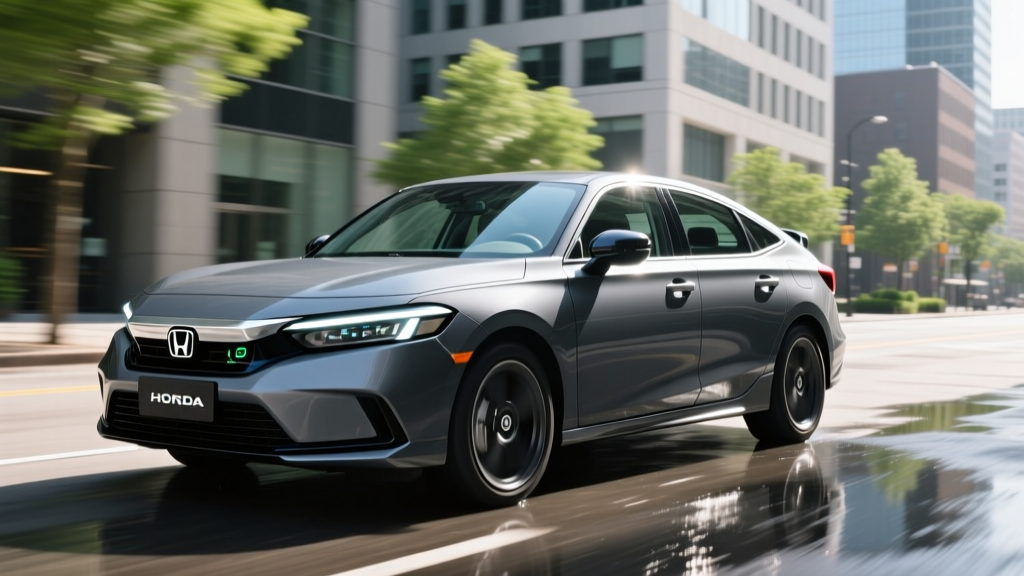
The 2025 Honda Civic Sport Touring Hybrid Hatchback occupies a precise niche: it delivers near-Prius efficiency in a package that actually looks and drives like a conventional compact car. With an EPA-estimated 50 MPG combined, a 200-horsepower two-motor hybrid system, and a starting MSRP of $31,450, it targets buyers who want electrified fuel savings without plugging in, range-counting, or paying a premium for a full EV. This guide breaks down every spec that matters—from real-world MPG to battery warranty to how it stacks up against PHEVs and BEVs.
Quick Verdict: Who Is the Civic Sport Touring Hybrid For?
The Sport Touring Hybrid is Honda's top-trim Civic hatchback, bundling the two-motor hybrid powertrain with leather seats, a Bose 12-speaker audio system, wireless Apple CarPlay/Android Auto, a 9-inch touchscreen, and the full Honda Sensing ADAS suite. It is a conventional hybrid (HEV)—meaning it charges its small lithium-ion battery exclusively through regenerative braking and the gasoline engine. You never plug it in.
This car is ideal if you want 450+ miles of total range, low fuel costs, and zero charging logistics, but you're not ready (or able) to install a home charger or rely on public DC fast-charging infrastructure. It is not ideal if you want electric-only commuting— for that, you need a PHEV like the Toyota Prius Prime or a full BEV.
Powertrain & Performance Specs
Honda's fourth-generation two-motor hybrid system pairs a 2.0-liter Atkinson-cycle inline-four with two electric motors. Unlike Toyota's planetary-gear power-split device, Honda's system operates primarily in series-hybrid mode at low and medium speeds (the engine acts as a generator while the drive motor propels the car) and switches to direct engine drive via a lock-up clutch at highway cruising speeds.
| Specification | Value |
|---|---|
| Engine | 2.0L Atkinson-cycle DOHC inline-4 |
| Engine Power | 143 hp @ 6,000 rpm |
| Drive Motor Power | 181 hp / 232 lb-ft torque |
| Combined System Output | 200 hp / 232 lb-ft torque |
| Transmission | e-CVT (no traditional gears) |
| Drivetrain | Front-wheel drive |
| 0–60 mph | ~7.3 seconds (est.) |
| Hybrid Battery | ~1.1 kWh lithium-ion (non-plug-in) |
| Cargo Volume | 24.4 cu ft (rear seats up) |
The 200 hp combined output makes this the quickest Civic hatchback short of the Type R. The instant torque from the drive motor gives it strong city acceleration, and the lock-up clutch engagement above ~45 mph eliminates the rubber-band feel that plagues some e-CVTs on the highway.
Fuel Economy: EPA Ratings vs. Real-World MPG
The EPA rates the 2025 Civic Sport Touring Hybrid Hatchback at 50 MPG city, 47 MPG highway, and 48 MPG combined, per fueleconomy.gov. (Note: the sedan variant achieves slightly higher figures at 51/44/49; the hatchback's added weight and less aerodynamic rear profile account for the small difference.)
| Driving Cycle | EPA Rating | Real-World Expectation |
|---|---|---|
| City | 50 MPG | 50–55 MPG (hybrids often exceed EPA city) |
| Highway | 47 MPG | 42–46 MPG (sustained 75+ mph reduces regen benefit) |
| Combined | 48 MPG | 45–50 MPG (depends on driving mix) |
Real-world nuance: Honda's hybrid system excels in city and suburban driving, where frequent deceleration feeds energy back into the battery via regen. On a 200-mile highway trip at 78 mph, expect fuel economy to dip into the low-to-mid 40s. In cold weather (below 30°F), the engine runs more often to provide cabin heat, which can drop city MPG into the mid-40s until the powertrain reaches operating temperature. Unlike a PHEV or BEV, there is no pre-conditioning from a wall outlet to mitigate this.
With a 12.4-gallon fuel tank, the practical range sits around 550–600 miles per fill-up in mixed driving—substantially more than any current BEV and comparable to the Toyota Prius.
HEV vs. PHEV vs. BEV: Which Electrified Option Fits You?
The Civic Sport Touring Hybrid is an HEV. Understanding how it differs from plug-in hybrids and full battery-electric vehicles is essential before purchasing.
HEV vs. PHEV vs. BEV — At a Glance
| Factor | HEV (this Civic) | PHEV (e.g., Prius Prime) | BEV (e.g., Chevy Equinox EV) |
|---|---|---|---|
| Plug in to charge? | No | Yes (Level 1/2) | Yes (Level 1/2/DC) |
| Electric-only range | ~1 mile (low-speed creep) | 25–44 miles typical | 200–350+ miles |
| Total range | 550–600 miles | 400–500 miles | 200–350 miles |
| Home charging needed? | No | Recommended | Essential |
| Federal tax credit (§30D) | No | Up to $7,500 (if eligible) | Up to $7,500 (if eligible) |
| Best for | No home charger access; road-trip heavy | Short commute + road trips | Home charging + daily driving |
Choose the Civic HEV if: you lack access to home or workplace charging, drive a mix of city and highway miles, take frequent road trips, and want maximum simplicity. There is zero lifestyle change from a gas car—you just fill up less often.
Choose a PHEV if: you can charge at home overnight, your daily commute is under 40 miles, and you still want gas-engine range for longer trips without charging stops.
Choose a BEV if: you have reliable home Level 2 charging, want the lowest per-mile fuel cost, and your daily driving falls within the vehicle's range.
Pricing, Trims & Tax Credit Eligibility
The 2025 Honda Civic Hybrid is offered in two hatchback trims: the Sport Hybrid and the Sport Touring Hybrid. The Sport Touring is the fully loaded variant.
| Trim | MSRP | Key Additions Over Sport |
|---|---|---|
| Sport Hybrid | $29,850 | Base hybrid hatch: cloth seats, 7" display, Honda Sensing |
| Sport Touring Hybrid | $31,450 | Leather, Bose 12-speaker, 9" touchscreen, wireless CarPlay/Android Auto, heated rear seats, low-speed braking control |
Destination charge adds $1,095, bringing the Sport Touring Hybrid Hatchback to approximately $32,545 out the door before dealer fees or options.
Federal Tax Credit: Does the Civic Hybrid Qualify?
No. The 2025 Honda Civic Hybrid is a conventional HEV, not a plug-in vehicle. Under IRS §30D rules, only plug-in electric vehicles (PHEVs and BEVs) with sufficient battery capacity qualify for the federal Clean Vehicle Credit of up to $7,500. Conventional hybrids are ineligible for §30D.
Some states offer separate rebates or HOV-lane access for hybrids, but these vary by jurisdiction. Check your state's energy or DMV website for current programs. A tax professional can advise on any applicable local incentives.
Battery Warranty, Longevity & Replacement Cost
Hybrid battery longevity is the single most common concern among first-time hybrid buyers. Honda addresses this with a comprehensive warranty.
Honda Hybrid Battery Warranty
- Hybrid battery: 8 years / 100,000 miles (10 years / 150,000 miles in CARB states including CA, NY, MA, and others that follow California emissions standards)
- Hybrid system components (inverter, motors): 8 years / 100,000 miles
- Capacity retention threshold: Honda does not publish a specific SoH percentage, but warranty covers defects and abnormal degradation
- Powertrain warranty: 5 years / 60,000 miles
How long will the battery actually last? Honda's lithium-ion hybrid battery pack is approximately 1.1 kWh—a very small pack that cycles shallowly (it rarely drops below 40% or above 80% state of charge). This shallow cycling is the key to longevity. Based on data from Honda's hybrid fleet (Insight, CR-V Hybrid, Accord Hybrid), these batteries routinely exceed 150,000 miles with minimal capacity loss. Third-generation Civic Hybrids from 2012–2015 are still on the road with original batteries past 200,000 miles in many cases.
Replacement cost if out of warranty: A Honda hybrid battery replacement runs approximately $2,000–$3,500 at a dealership, including labor. Independent hybrid specialists often offer refurbished packs for $1,200–$2,000. Given the shallow cycling and robust warranty, unplanned replacement within the first decade of ownership is uncommon.
Charging, Tech & Daily Ownership Practicalities
Since this is an HEV, there is no plug, no home charger to install, and no public charging network to navigate. The only "charging" happens internally: the engine and regenerative braking replenish the ~1.1 kWh battery automatically. This is simultaneously the Civic Hybrid's greatest advantage (zero infrastructure dependency) and its limitation (no electric-only commuting).
Technology highlights on the Sport Touring trim:
- 9-inch touchscreen with wireless Apple CarPlay and Android Auto
- 10.2-inch digital instrument cluster with hybrid power-flow display
- Bose 12-speaker premium audio
- Wireless phone charging pad
- Wi-Fi hotspot capability
- Remote start via HondaLink app
Honda Sensing ADAS suite (standard on all trims):
- Adaptive Cruise Control with Low-Speed Follow
- Lane Keeping Assist System (LKAS)
- Road Departure Mitigation
- Collision Mitigation Braking System (CMBS)
- Traffic Sign Recognition
- Blind Spot Information System (Sport Touring exclusive)
- Low-Speed Braking Control (Sport Touring exclusive)
SAE Automation Level: Level 1–2
Honda Sensing is a Level 1–2 driver-assistance system per SAE J3016 classification. It can manage steering and speed simultaneously under driver supervision, but it does not drive itself. The driver must keep hands on the wheel and eyes on the road at all times. This is not an autonomous or "self-driving" system.
Pros, Cons & the Competition
Pros
- 48 MPG EPA combined (50+ in city driving)
- 200 hp — strongest non-Type-R Civic hatch
- No plug-in required; zero infrastructure dependency
- 550+ mile total range per tank
- Sport Touring trim is well-equipped for the price
- Strong reliability history; 8–10 yr battery warranty
- Honda Sensing ADAS standard on all trims
Cons
- No electric-only driving range (HEV limitation)
- No federal tax credit eligibility
- Highway MPG drops to low 40s at sustained 75+ mph
- FWD only — no AWD option (unlike Prius)
- Modest 1.1 kWh battery limits regen capacity on long descents
- CVT drone under hard acceleration (improved vs. prior gen but present)
- Cargo space (24.4 cu ft) trails some crossover alternatives
Key competitors:
- Toyota Prius (HEV): 57 MPG combined, AWD available, lower starting price, but less cargo space and less engaging to drive.
- Toyota Prius Prime (PHEV): 44 miles electric-only, up to $7,500 tax credit if eligible, but requires home charging to maximize value.
- Hyundai Elantra Hybrid: 54 MPG combined, strong warranty, but sedan-only (no hatchback).
- Toyota Corolla Cross Hybrid: AWD, crossover ride height, 42 MPG combined, but less efficient and more expensive.
Frequently Asked Questions
How many MPG does the 2025 Civic Sport Touring Hybrid Hatchback get?
The EPA rates it at 50 MPG city, 47 MPG highway, and 48 MPG combined. In real-world city driving, many owners report exceeding 50 MPG thanks to frequent regenerative braking. Highway-heavy drivers should expect 42–46 MPG at sustained speeds above 70 mph.
Can I plug in the Civic Hybrid to charge?
No. The 2025 Civic Hybrid is a conventional HEV, not a plug-in hybrid. The battery charges exclusively through the gasoline engine and regenerative braking. There is no charging port and no electric-only driving mode beyond very low-speed creep.
Does the 2025 Civic Hybrid qualify for a federal tax credit?
No. Under current IRS §30D regulations, only plug-in electric vehicles (PHEVs and BEVs) qualify for the federal Clean Vehicle Credit. Conventional hybrids like the Civic Hybrid are ineligible. Check your state for any local hybrid incentives.
How long will the hybrid battery last?
Honda warranties the hybrid battery for 8 years/100,000 miles (10 years/150,000 miles in CARB states). Real-world data from Honda's hybrid lineup shows these batteries commonly lasting 150,000–200,000+ miles. The small 1.1 kWh pack cycles very shallowly, which extends its lifespan significantly compared to larger PHEV or BEV batteries.
What does it cost to replace the hybrid battery?
Dealer replacement runs $2,000–$3,500 including labor. Independent hybrid shops offer refurbished packs for $1,200–$2,000. Given the shallow cycling and long warranty, most owners never face an out-of-pocket battery replacement.
Is the Civic Hybrid Hatchback better than a full EV?
It depends on your situation. If you lack home charging, drive long distances frequently, or live in an area with sparse DC fast-charging infrastructure, the Civic Hybrid is more practical than a BEV. If you have home Level 2 charging and a predictable daily commute under 250 miles, a BEV offers lower per-mile fuel costs and zero tailpipe emissions. The Civic Hybrid is the pragmatic choice for drivers who want fuel savings with zero lifestyle disruption.
How does the Civic Hybrid compare to the Toyota Prius?
The Prius achieves 57 MPG combined (9 MPG more than the Civic) and offers AWD. However, the Civic Hybrid produces 200 hp versus the Prius's 194 hp (AWD), has a more refined interior on the Sport Touring trim, and offers hatchback cargo versatility the Prius sedan lacks. If maximum efficiency is your priority, the Prius wins. If driving dynamics and interior quality matter, the Civic Sport Touring Hybrid is the stronger pick.