Quick Verdict: The Sweet Spot Between Gas and Electric
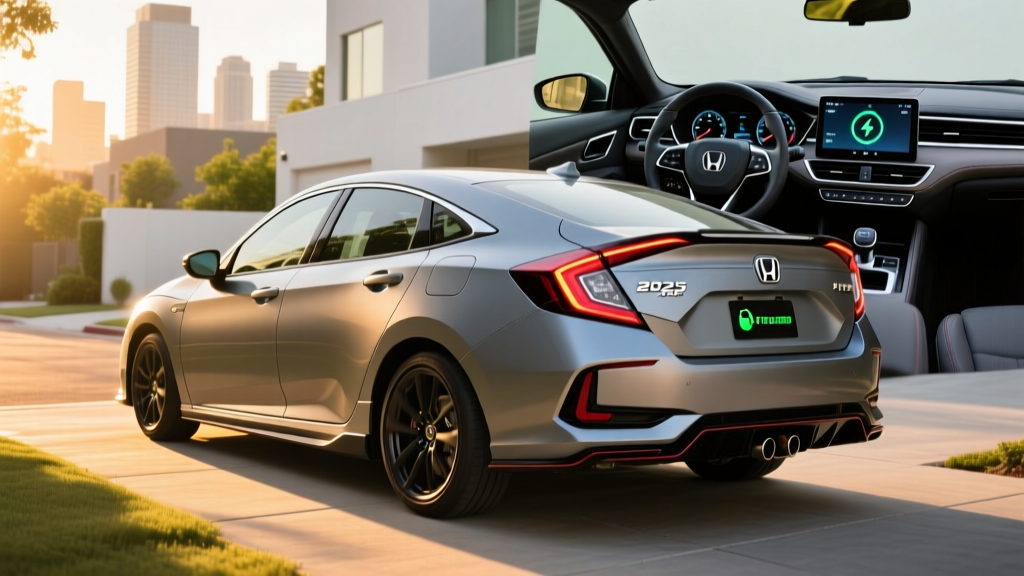
The 2025 Honda Civic Hybrid Sport occupies a precise niche: it delivers near-EV efficiency in stop-and-go traffic without ever needing a plug. With an EPA-estimated 50 MPG combined and a combined output of 200 horsepower from its two-motor hybrid system, it threads the needle between the Civic's traditional gas trims and fully electrified alternatives. For buyers who lack home charging access but want to cut fuel costs dramatically, this is one of the strongest conventional hybrid (HEV) options in the compact segment.
Before we get into the numbers, let's clear up a common confusion: the 2025 Civic Hybrid is not a plug-in hybrid (PHEV). It has no electric-only driving range to speak of, no charging port, and no battery you can recharge from a wall outlet. It generates and recovers all its electricity internally through regenerative braking and its gasoline engine. This is a critical distinction that affects everything from daily driving habits to tax credit eligibility.
HEV vs. PHEV: What's the Difference?
| Feature | Conventional Hybrid (HEV) — Civic Hybrid | Plug-in Hybrid (PHEV) |
|---|---|---|
| Plug-in charging? | No — self-charging via engine + regen | Yes — Level 1/Level 2 charging port |
| Electric-only range | ~1 mile at low speed (EV mode) | Typically 20–50 miles |
| Battery size | ~1.1 kWh (small buffer) | 10–25 kWh usable |
| Federal tax credit (§30D) | Not eligible | Up to $7,500 if eligible |
| Home charger needed? | No | Recommended (Level 2) |
Fuel Economy: EPA Numbers and Real-World MPG
The 2025 Civic Hybrid Sport carries an EPA-estimated 50 MPG city / 47 MPG highway / 49 MPG combined (figures for the Sport trim with 18-inch wheels; the Sport Touring trim is rated identically). These are among the highest numbers in the compact hybrid segment, rivaling the Toyota Prius and surpassing the Hyundai Elantra Hybrid.
| Trim | City MPG | Highway MPG | Combined MPG |
|---|---|---|---|
| Civic Hybrid Sport | 50 | 47 | 49 |
| Civic Hybrid Sport Touring | 50 | 47 | 49 |
| Gas Civic Sport (2.0L) | 30 | 37 | 33 |
Real-World MPG: What to Actually Expect
Hybrids like the Civic tend to exceed their EPA city estimate in real-world stop-and-go driving because regenerative braking recaptures energy that a gas car wastes as heat. Owners reporting on fuel-tracking platforms commonly log 52–55 MPG in urban and suburban commutes during mild weather. Highway driving is where hybrids lose their advantage somewhat — sustained high speeds reduce the regen benefit, and you can expect closer to 42–46 MPG at 75 mph on the interstate.
Cold weather impacts any vehicle's efficiency, but hybrids are hit harder than gas-only cars because the engine must run more often to provide cabin heat (unless equipped with a heat pump, which the Civic Hybrid is not). Expect a 5–10% fuel economy drop in sub-freezing temperatures, bringing combined real-world figures to roughly 44–47 MPG in winter conditions.
Powertrain: 200 HP from Honda's Two-Motor System
The 2025 Civic Hybrid uses Honda's fourth-generation two-motor hybrid system, pairing a 2.0-liter Atkinson-cycle four-cylinder engine with two electric motors. The combined system output is 200 horsepower and 232 lb-ft of torque. That torque figure is significant — it's available nearly instantaneously from the electric drive motor, giving the Civic Hybrid noticeably stronger low-end pull than the gas-only 2.0L Civic (150 hp, 133 lb-ft).
| Specification | 2025 Civic Hybrid Sport |
|---|---|
| Engine | 2.0L Atkinson-cycle I-4 |
| Combined System HP | 200 hp |
| Combined System Torque | 232 lb-ft |
| Transmission | e-CVT (direct drive) |
| Drivetrain | Front-wheel drive |
| Hybrid Battery | Lithium-ion, ~1.1 kWh |
| 0–60 mph (est.) | ~6.8 seconds |
| EPA Combined MPG | 49 MPG |
| Fuel Tank | 12.4 gallons |
| Total Driving Range | ~607 miles |
The e-CVT here is not a traditional belt-and-pulley CVT. Honda's system uses a direct-drive architecture where the electric motor handles most propulsion duties at low and moderate speeds, while the gasoline engine primarily acts as a generator. At highway cruising speeds, a lock-up clutch connects the engine directly to the wheels for efficiency. The result is smoother and more responsive than the rubber-band feel associated with older CVTs.
Pricing, Trims, and Tax Credit Eligibility
The 2025 Civic Hybrid is available in two trims:
- Civic Hybrid Sport: MSRP starting at $28,750 (including destination)
- Civic Hybrid Sport Touring: MSRP starting at $31,750 (including destination)
The Sport trim includes 18-inch alloy wheels, a 7-inch touchscreen with Apple CarPlay and Android Auto, Honda Sensing safety suite, and dual-zone climate control. The Sport Touring adds a 9-inch touchscreen with wireless CarPlay/Android Auto, Bose premium audio, wireless phone charging, leather-trimmed seats, and a power moonroof.
Federal Tax Credit: Not Eligible
Because the 2025 Civic Hybrid is a conventional hybrid (HEV), it does not qualify for the federal §30D Clean Vehicle Credit. That credit — up to $7,500 for new vehicles — applies only to plug-in electric vehicles (BEVs and PHEVs) meeting battery sourcing, MSRP caps, and buyer income requirements per current IRS rules. Conventional hybrids have not qualified for federal purchase incentives since the original Hybrid Tax Credit phased out years ago.
Some states offer their own incentives for hybrids, though these are increasingly rare and typically favor PHEVs and BEVs. Check your state's energy or DMV website for current programs. A few states offer reduced registration fees or HOV lane access for hybrids, but these vary by jurisdiction and change frequently.
Reliability, Battery Lifespan, and Warranty
Honda's hybrid systems have a strong track record. The two-motor architecture used in the Civic Hybrid is a mature design that has been refined across multiple generations of the Accord Hybrid, CR-V Hybrid, and now the Civic. There is no high-voltage battery degradation concern comparable to what BEV owners monitor — the ~1.1 kWh hybrid battery operates within a narrow state-of-charge window managed by the powertrain computer, which dramatically reduces wear.
Hybrid Battery & Powertrain Warranty
- Hybrid Battery: 8 years / 100,000 miles (10 years / 150,000 miles in CARB states including CA, CO, CT, ME, MA, NJ, NY, OR, RI, VT, WA)
- Powertrain: 5 years / 60,000 miles
- Limited Vehicle: 3 years / 36,000 miles
Hybrid battery replacement cost if out of warranty: approximately $2,000–$3,500 based on current Honda parts pricing and independent shop labor rates. Dealer replacement may run higher. However, hybrid battery failures before 150,000+ miles are uncommon in Honda's system.
For context, Honda's hybrid battery warranty meets the federal mandate for emissions-related components (8yr/100k), and in states that follow California Air Resources Board (CARB) standards, that extends to 10 years / 150,000 miles. This is important: if you live in a CARB state, your hybrid battery is covered for a full decade.
Who Should Buy the Civic Hybrid Sport — And Who Shouldn't
Not every driver is best served by a conventional hybrid. Here's a practical decision framework based on driving patterns, charging access, and budget:
Choose the 2025 Civic Hybrid Sport If:
- You don't have access to home or workplace Level 2 charging (apartment, street parking, no garage outlet)
- Your commute is city-heavy or mixed — the hybrid system shines in stop-and-go traffic
- You want a ~$29K starting price with no charging infrastructure investment
- You drive 12,000–15,000 miles/year and want to cut fuel costs by ~35–40% versus the gas Civic
- You want a conventional ownership experience — no new charging habits to learn
Consider a PHEV Instead If:
- You have home Level 2 charging and a short commute (under 30 miles round-trip) — a PHEV can do most trips on electricity alone
- You want to qualify for the $7,500 federal §30D credit (subject to eligibility requirements)
- You want the option of zero-emission local driving with the backup of a gas engine for road trips
Consider a Full BEV Instead If:
- You have reliable home charging and drive under 250 miles/day
- You want zero tailpipe emissions and the lowest per-mile fuel cost
- You want to maximize federal and state incentives
- You're ready to plan around DC fast charging on road trips
Annual Fuel Cost: Hybrid vs. Gas Civic
The financial case for the Civic Hybrid is straightforward. Based on 15,000 miles/year and the EPA combined figures:
| Metric | Civic Hybrid Sport (49 MPG) | Gas Civic Sport 2.0L (33 MPG) |
|---|---|---|
| Gallons per year (15k mi) | 306 gal | 455 gal |
| Annual fuel cost ($3.50/gal) | $1,071 | $1,592 |
| Annual savings | $521/year with the Hybrid | |
| 5-year fuel savings | ~$2,605 | |
The Civic Hybrid Sport costs approximately $2,200 more than the equivalent gas Civic Sport at MSRP. At current fuel prices, the hybrid pays for its price premium in roughly 4–5 years through fuel savings alone. If gas prices rise above $4.00/gallon in your area, the payback period shortens to 3–4 years. Factor in potentially higher resale value for the hybrid trim and the economics tilt further in the hybrid's favor.
Driving Impressions and Everyday Practicality
The 200 hp combined output makes the Civic Hybrid Sport genuinely quick off the line. The 232 lb-ft of electric motor torque fills in the low-end gap that makes the base 2.0L feel underwhelming in city driving. Merging onto highways and climbing grades requires none of the downshift-and-wait behavior of the gas model's CVT. The steering is weighted appropriately, and the ride quality on the Sport's 18-inch wheels is firm but controlled — you feel road imperfections but they don't crash through the chassis.
Practically, the Civic Hybrid sacrifices nothing in cargo space compared to the gas Civic. The trunk offers 14.8 cubic feet, and the rear seats fold in a 60/40 split. The hybrid battery is packaged under the rear seats, preserving the full trunk volume. The 12.4-gallon fuel tank delivers an estimated total range of roughly 607 miles — meaning most drivers will visit a gas station once every two to three weeks.
The Honda Sensing suite comes standard on both hybrid trims: adaptive cruise control, lane-keeping assist, collision mitigation braking, and traffic sign recognition. This is an IIHS-rated system with strong safety scores. Note: Honda Sensing is a Level 2 driver-assist system under SAE automation levels — it requires continuous driver attention and hands-on-wheel engagement. It is not autonomous driving.
Pros
- 50 MPG city EPA — among the best in the compact segment
- 200 hp / 232 lb-ft feels genuinely quick in daily driving
- No plug-in charging required — zero infrastructure investment
- No cargo space compromise vs. gas Civic
- 8yr/100k hybrid battery warranty (10yr/150k in CARB states)
- Honda Sensing safety suite standard on all trims
Cons
- No federal tax credit eligibility
- Highway MPG drops to ~42–46 real-world at sustained 75 mph
- Only two trims available (Sport, Sport Touring) — no base LX hybrid
- Cold-weather fuel economy penalty of 5–10%
- Not a PHEV — no meaningful electric-only driving capability
- 18-inch wheels standard; no option for a softer ride on smaller wheels
Frequently Asked Questions
How many MPG does the 2025 Civic Hybrid Sport get?
The EPA rates the 2025 Civic Hybrid Sport at 50 MPG city, 47 MPG highway, and 49 MPG combined. Real-world city driving often exceeds the EPA estimate — many owners report 52–55 MPG in urban conditions. Highway driving at sustained high speeds typically yields 42–46 MPG.
Does the Civic Hybrid need to be plugged in?
No. The 2025 Civic Hybrid is a conventional hybrid (HEV). It charges its small lithium-ion battery internally through regenerative braking and the gasoline engine. There is no charging port and no plug-in capability. You fuel it exclusively at gas stations.
How far can the Civic Hybrid drive on electric only?
Effectively about 1 mile at very low speeds (under 25 mph) in EV mode, which the car activates selectively in parking lots or stop-and-go traffic. This is not a meaningful electric-only range for commuting. If electric-only driving is a priority, you need a PHEV or a full BEV.
Is the 2025 Civic Hybrid reliable, and what does battery replacement cost?
Honda's two-motor hybrid system has a strong reliability record across multiple model lines. The hybrid battery is warrantied for 8 years/100,000 miles (10 years/150,000 miles in CARB states). Out-of-warranty replacement costs approximately $2,000–$3,500. Hybrid battery failures before 150,000 miles are uncommon based on long-term data from the Accord Hybrid and CR-V Hybrid platforms.
Does the 2025 Civic Hybrid qualify for any tax credit?
No. The federal §30D Clean Vehicle Credit applies only to plug-in electric vehicles (BEVs and PHEVs) that meet specific battery sourcing, MSRP, and buyer income requirements. The Civic Hybrid, as a conventional HEV, does not qualify for federal purchase incentives. Some states may offer minor incentives for hybrids — check your state's energy office for current programs.
Hybrid vs. PHEV vs. EV — which should I choose?
It depends on your charging access and driving pattern. If you cannot charge at home or work, a conventional hybrid like the Civic Hybrid is the most practical choice — you get excellent MPG with no behavioral change. If you have home Level 2 charging and a short commute, a PHEV lets you drive most days on electricity while keeping a gas engine for road trips. If you have home charging, drive under 250 miles daily, and want the lowest operating cost, a full BEV offers the strongest economics with available tax credits. See our fuel economy comparison tool at fueleconomy.gov to run the numbers for your specific situation.
What's the difference between the Sport and Sport Touring trims?
The Sport Touring ($31,750 MSRP) adds a 9-inch touchscreen with wireless Apple CarPlay/Android Auto, a 12-speaker Bose audio system, wireless phone charging, leather-trimmed seats, heated front seats, a power moonroof, and low-speed braking control. Both trims share the identical 200 hp hybrid powertrain and 49 MPG combined EPA rating.