Quick Verdict: The 2025 Civic Hatchback Hybrid Is the Efficiency Sweet Spot
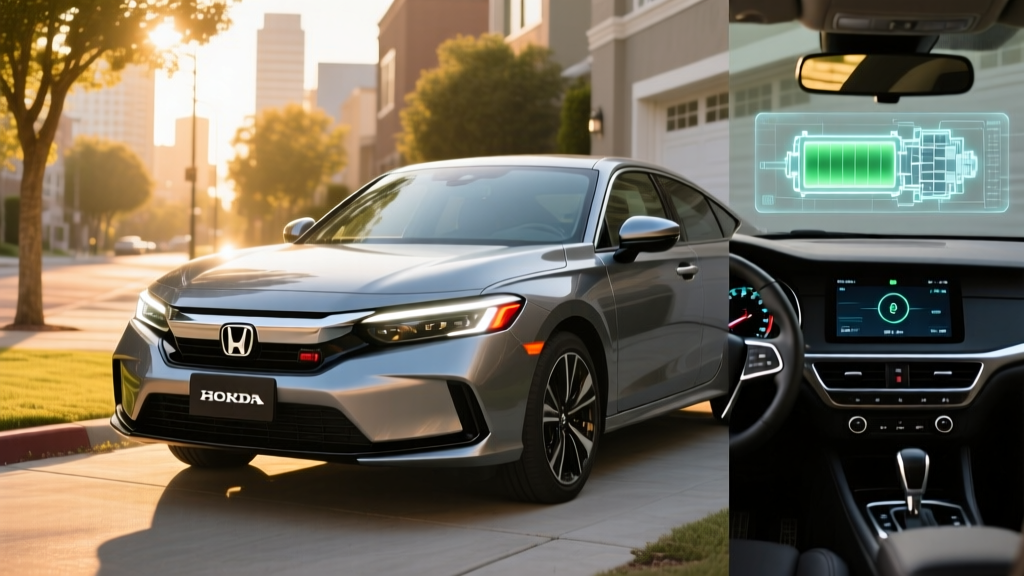
Honda's two-motor hybrid system finally arrived in the Civic Hatchback for the 2025 model year, pairing a 2.0-liter Atkinson-cycle engine with dual electric motors for a combined 200 horsepower and an EPA-estimated 50 MPG combined. Unlike a plug-in hybrid, the 2025 Civic Hatchback Hybrid never needs to be plugged in — it recovers energy through regenerative braking and the engine to charge its small lithium-ion battery automatically.
For buyers cross-shopping between a conventional hybrid, a PHEV, and a full battery-electric vehicle, the Civic Hatchback Hybrid occupies a practical middle ground: you get meaningful fuel savings without range anxiety, charging infrastructure dependency, or a steep price premium. Here is exactly what you need to know before buying.
EPA Fuel Economy and Real-World MPG
The 2025 Civic Hatchback Hybrid is rated by the EPA at 50 MPG combined, with 53 MPG city and 46 MPG highway across the Sport and Sport Touring trims. These figures place it among the most efficient non-plug-in compact hatchbacks on the market.
| Trim | City MPG | Highway MPG | Combined MPG | Fuel Tank (gal) | Total Range (mi) |
|---|---|---|---|---|---|
| Sport Hybrid | 53 | 46 | 50 | 12.4 | ~620 |
| Sport Touring Hybrid | 53 | 46 | 50 | 12.4 | ~620 |
Powertrain: 200 HP From Honda's Two-Motor System
The Civic Hatchback Hybrid uses Honda's fourth-generation two-motor hybrid system, which is fundamentally different from the single-motor assist systems found in older hybrids. Here is the hardware breakdown:
| Specification | Detail |
|---|---|
| Engine | 2.0L DOHC Atkinson-cycle 4-cylinder |
| Engine Output | 143 hp / 134 lb-ft torque |
| Drive Motor | 174 hp / 232 lb-ft torque |
| Combined System Output | 200 hp / 232 lb-ft torque |
| Transmission | e-CVT (no fixed gears; direct clutch at highway speed) |
| Drivetrain | Front-wheel drive |
| Hybrid Battery | Lithium-ion, ~1.1 kWh (not plug-in) |
| 0–60 MPH | ~7.3 seconds (est.) |
| Curb Weight | ~3,100 lbs |
The drive motor handles acceleration from a stop and low-speed cruising, while the gasoline engine primarily acts as a generator to feed the motor. At highway speeds (roughly above 45 MPH under light load), a lock-up clutch connects the engine directly to the wheels for better efficiency. The result is a powertrain that feels electric around town but seamlessly transitions to engine power on the highway.
With 200 combined horsepower, the Civic Hatchback Hybrid is notably quicker than the Toyota Prius (196 hp combined) and significantly more powerful than the base non-hybrid Civic (150 hp from its 2.0L engine). Throttle response from the electric motor is immediate, giving it a peppy feel in urban driving that the horsepower number alone does not convey.
HEV vs. PHEV vs. EV: Which Powertrain Fits You?
The 2025 Civic Hatchback Hybrid is a conventional hybrid (HEV). It has no plug, no electric-only driving range to speak of, and no eligibility for the federal §30D EV tax credit. Understanding this distinction is critical before comparing it to plug-in alternatives.
| Feature | HEV (Civic Hybrid) | PHEV (e.g., Toyota Prius Prime) | BEV (e.g., Chevy Equinox EV) |
|---|---|---|---|
| Plugs In? | No | Yes | Yes |
| Electric-Only Range | ~1 mi (low speed) | 20–44 mi | 250–350+ mi |
| Total Range | ~620 mi | ~600+ mi | 250–350 mi |
| Home Charging Needed? | No | Recommended | Essential |
| Federal Tax Credit (§30D) | Not eligible | Up to $7,500 (if eligible) | Up to $7,500 (if eligible) |
| Best For | No home charger access; simplicity | Short commutes + road trips | Home charging + mostly electric |
- You lack reliable access to home or workplace charging
- You want maximum simplicity — no charging cables, no apps, no plug-in routine
- Your budget is under $33,000 and you want a premium compact hatchback
- You regularly take road trips over 300 miles and don't want to plan charging stops
- You can install a Level 2 charger at home and your daily commute is under 40 miles round-trip
- You want to drive mostly on electricity on weekdays but need gas flexibility for weekends
- You have home Level 2 charging and want the lowest per-mile energy cost
- You want zero tailpipe emissions and access to the full $7,500 federal tax credit (if eligible)
Pricing, Trims, and Tax Credit Eligibility
The 2025 Civic Hatchback Hybrid is offered in two trims. Both use the same powertrain and carry the same EPA ratings.
| Trim | MSRP (incl. destination) | Key Features |
|---|---|---|
| Sport Hybrid | $31,450 | 18" alloy wheels, 7" touchscreen, wireless Apple CarPlay/Android Auto, Honda Sensing suite |
| Sport Touring Hybrid | $34,050 | 9" touchscreen, Bose 12-speaker audio, wireless phone charging, leather-trimmed seats, navigation, heated rear seats |
Does the 2025 Civic Hatchback Hybrid Qualify for a Federal Tax Credit?
No. The federal §30D Clean Vehicle Credit applies only to plug-in electric vehicles — battery-electric vehicles (BEVs) and plug-in hybrids (PHEVs) with a battery capacity of at least 7 kWh. The Civic Hatchback Hybrid's battery is approximately 1.1 kWh and cannot be plugged in. It does not qualify for the federal EV tax credit.
Some states and local utilities offer rebates for conventional hybrids, but these are uncommon and typically small ($250–$500). Check your state's energy office or utility provider for current programs. The IRS §30D guidelines confirm that only plug-in vehicles meeting battery-sourcing, MSRP, and buyer-income thresholds qualify.
Battery Warranty, Reliability, and Replacement Cost
Hybrid battery longevity is the most common concern among first-time hybrid buyers. Here is what Honda covers and what real-world data shows.
- Duration: 8 years / 100,000 miles (10 years / 150,000 miles in CARB states including CA, NY, MA, CT, ME, MD, NJ, OR, RI, VT, WA, CO, MN, NV, NM, and others adopting California emissions standards)
- Coverage: Defects and capacity loss below functional threshold
- Hybrid System Warranty: Same 8 yr / 100k mi (or 10/150k in CARB states) covers the inverter, electric motors, and control units
Is the 2025 Civic Hatchback Hybrid Reliable?
Honda's two-motor hybrid system has been in production since 2014 (Accord Hybrid) and has been refined across four generations. The system used in the 2025 Civic Hatchback is the same architecture proven in the CR-V Hybrid and Accord Hybrid — powertrains with strong reliability track records. Honda consistently ranks in the top third of Consumer Reports' brand reliability rankings.
Because the Civic Hybrid's battery is small (~1.1 kWh) and is constantly cycled within a narrow state-of-charge window (never fully depleted or fully charged), degradation is minimal compared to full EV batteries. The e-CVT design also eliminates the conventional transmission — there are no gears, bands, or torque converters to wear out.
Hybrid Battery Replacement Cost
If the hybrid battery does fail outside of warranty, replacement costs for Honda's hybrid battery packs typically range from $2,000 to $4,000 including labor at a dealership. Independent hybrid specialists may offer refurbished packs for $1,200–$2,500. However, real-world failure rates for modern Honda hybrid batteries before 150,000 miles are very low based on data from the Accord Hybrid and CR-V Hybrid, which use the same chemistry and management approach.
Driving Dynamics, Cargo, and Practicality
The Civic Hatchback Hybrid retains the practical advantages of the standard hatchback body style while adding the efficiency benefits of the hybrid powertrain. Key practicality metrics:
- Cargo Volume: 24.4 cubic feet behind rear seats (vs. 24.4 cu ft for the non-hybrid hatchback — the compact battery does not compromise cargo space)
- Rear Seat Fold-Down: 60/40 split, expanding cargo to approximately 46 cubic feet
- Seating: 5 passengers
- Ground Clearance: ~5.3 inches
- Towing: Not rated for towing
Driving dynamics are a standout. The 2025 Civic Hatchback Hybrid weighs approximately 3,100 lbs — only about 130 lbs more than the non-hybrid Civic Sport. The low-mounted hybrid battery keeps the center of gravity low, and Honda's chassis tuning delivers responsive steering and composed handling that makes this one of the most engaging hybrids in its class. The Sport Touring trim adds adaptive dampers for a slightly firmer, more controlled ride.
Safety and Driver-Assistance Technology
Every 2025 Civic Hatchback Hybrid comes standard with the Honda Sensing suite of driver-assistance features. This is a Level 1–2 SAE driver-assist system — it does not drive the car autonomously and requires the driver to remain fully engaged at all times.
Honda Sensing includes:
- Adaptive Cruise Control (ACC) with Low-Speed Follow
- Lane Keeping Assist System (LKAS)
- Road Departure Mitigation (RDM)
- Collision Mitigation Braking System (CMBS)
- Traffic Sign Recognition
- Blind Spot Information (BSI) with Rear Cross Traffic Monitor (Sport Touring)
The Civic earned top marks from the IIHS, receiving a Top Safety Pick+ rating when equipped with specific headlights. NHTSA testing also awarded the Civic 5 stars overall.
Pros and Cons at a Glance
- 50 MPG combined EPA — among the most efficient in its class
- 200 hp provides strong acceleration for a hybrid
- No plug-in required — zero lifestyle change from a gas car
- ~620 miles of total range on a single tank
- Hatchback practicality with 24.4 cu ft cargo space
- Engaging driving dynamics for a hybrid
- Strong 8 yr/100k mi hybrid battery warranty (10/150k in CARB states)
- Standard Honda Sensing safety suite
- No federal tax credit eligibility (HEV, not PHEV/BEV)
- Only two trims available (Sport and Sport Touring) — no base LX Hybrid
- Highway MPG drops to ~42–45 at 75+ MPH in real-world driving
- No all-wheel-drive option
- Infotainment screen is 7" on Sport trim (small by 2025 standards)
- Not rated for towing
Frequently Asked Questions
How many MPG does the 2025 Civic Hatchback Hybrid get?
The EPA rates the 2025 Civic Hatchback Hybrid at 53 MPG city, 46 MPG highway, and 50 MPG combined. Real-world mixed driving typically returns 48–52 MPG, with highway-heavy trips yielding 42–45 MPG at speeds above 75 MPH.
Does the 2025 Civic Hatchback Hybrid plug in?
No. This is a conventional hybrid (HEV), not a plug-in hybrid (PHEV). The small lithium-ion battery charges through regenerative braking and the gasoline engine. You never plug it in — you simply fuel it at a gas station like any other car.
How far can the 2025 Civic Hatchback Hybrid drive on electric only?
Less than one mile at very low speeds (under 25 MPH) under light load. The electric-only capability is designed for creeping through parking lots and stop-and-go traffic, not for meaningful electric-only commuting. If you need 20–40 miles of electric-only range, consider a PHEV like the Toyota Prius Prime or Hyundai Tucson PHEV.
Is the hybrid battery reliable, and what does replacement cost?
Honda's hybrid battery is covered for 8 years/100,000 miles (10 years/150,000 miles in CARB states). The small ~1.1 kWh battery is managed within a narrow charge window, minimizing degradation. Real-world failure rates before 150,000 miles are very low. Out-of-warranty replacement costs $2,000–$4,000 at a dealer, or $1,200–$2,500 from an independent hybrid specialist.
Does the 2025 Civic Hatchback Hybrid qualify for any tax credit?
It does not qualify for the federal §30D Clean Vehicle Credit, which is limited to plug-in vehicles (BEVs and PHEVs with ≥7 kWh batteries). Some states or utilities may offer small hybrid rebates — check your local programs. Consult a tax professional for eligibility details.
How does the Civic Hatchback Hybrid compare to the Toyota Prius?
The 2025 Toyota Prius (conventional hybrid) is rated at 57 MPG combined (57 city/56 highway for the LE trim) — about 7 MPG higher than the Civic. However, the Civic offers 200 hp vs. the Prius's 196 hp, a more engaging driving experience, and hatchback cargo versatility. The Prius is the efficiency winner; the Civic Hybrid is the driving-dynamics winner. If you need AWD, the Prius offers it on select trims — the Civic does not.
What is the total range of the 2025 Civic Hatchback Hybrid?
With a 12.4-gallon fuel tank and 50 MPG combined, the total driving range is approximately 620 miles. In real-world driving with mixed conditions, expect 550–620 miles between fill-ups.
Is the 2025 Civic Hatchback Hybrid worth it over the gas-only Civic?
The hybrid carries a premium of approximately $2,000–$3,000 over the gas-only Civic Sport. If you drive 15,000 miles per year, the fuel savings at $3.50/gallon would be roughly $600–$800 annually (50 MPG vs. 35 MPG combined), recouping the premium in 3–5 years. The hybrid also delivers stronger low-end torque and a smoother powertrain experience. For most buyers, the hybrid is the better long-term value.