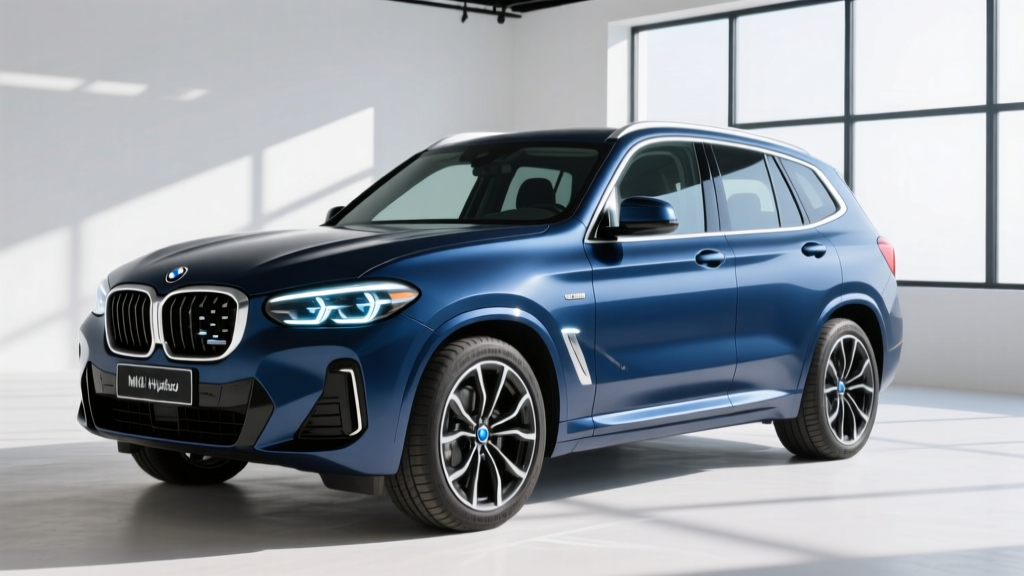
The 2025 BMW X3 enters its fourth generation with a fully redesigned platform, updated styling, and a standard 48-volt mild-hybrid system across the core xDrive30 lineup. If you've been searching for 2025 BMW X3 mild hybrid official specs from BMW USA, you've likely noticed that BMW's marketing materials emphasize the hybrid assist without always spelling out exactly what that means for your fuel bill, your ownership experience, or how this powertrain stacks up against a plug-in hybrid or full EV alternative. This guide breaks down every official figure, fills in the real-world context, and helps you decide whether the mild-hybrid X3 is the right electrified choice for your driveway.
Quick Verdict: What the 2025 BMW X3 Mild Hybrid Actually Is
The 2025 BMW X3 xDrive30 pairs a 2.0-liter turbocharged inline-four engine with a 48-volt mild-hybrid system integrated into its eight-speed automatic transmission. This is a conventional hybrid (HEV), not a plug-in hybrid. You never plug it in — the system recovers energy during braking and deceleration, stores it in a small 48V battery, and deploys it to assist acceleration and enable brief engine-off coasting. The result is smoother stop-start behavior, marginal fuel economy gains, and a slight electric torque fill at low RPMs.
For buyers seeking a plug-in hybrid X3 with meaningful electric-only range, BMW offers the X3 xDrive50e (covered separately). The mild-hybrid xDrive30 is the volume model and the entry point into the X3 lineup.
- X3 xDrive30 (Mild Hybrid / HEV): No plug. 48V system assists the gas engine. You fuel it like any conventional car. Expect ~28 MPG combined.
- X3 xDrive50e (PHEV): Plug-in capable. Larger battery (~19.7 kWh usable). Roughly 35+ miles of electric-only driving before the gas engine engages. Requires home or public charging to maximize value.
If you cannot charge at home or at work, the mild-hybrid xDrive30 is the practical choice. If you have reliable Level 2 charging access and a short commute, the xDrive50e PHEV can eliminate most daily gasoline use.
Official 2025 BMW X3 xDrive30 Specs at a Glance
| Specification | 2025 BMW X3 xDrive30 |
|---|---|
| Powertrain | 2.0L turbo I4 + 48V mild-hybrid system |
| Combined Horsepower | 255 hp @ 4,700–6,000 rpm |
| Combined Torque | 295 lb-ft @ 1,600–4,500 rpm |
| Mild-Hybrid Electric Boost | ~11 hp / 22 lb-ft (integrated starter-generator) |
| Transmission | 8-speed automatic (ZF) with integrated ISG |
| Drivetrain | xDrive all-wheel drive (standard) |
| 0–60 mph | 6.0 seconds (BMW-claimed) |
| EPA Fuel Economy | 25 city / 32 hwy / 28 combined MPG |
| Fuel Tank | 17.7 gallons (premium required) |
| Total Range (est.) | ~496 miles (combined) |
| Cargo Volume | 31.5 cu ft (rear seats up) / 67.1 cu ft (folded) |
| Starting MSRP | $49,900 (before destination) |
| Destination Charge | $1,175 |
Sources: BMW USA Newsroom, fueleconomy.gov
EPA MPG Breakdown and Real-World Fuel Economy
| Cycle | EPA Rating | Real-World Expectation |
|---|---|---|
| City | 25 MPG | 26–28 MPG (mild hybrid excels in stop-and-go) |
| Highway | 32 MPG | 28–30 MPG (at 75+ mph, aero drag dominates) |
| Combined | 28 MPG | 26–29 MPG (varies by driving mix) |
The 48-volt mild-hybrid system provides its biggest efficiency benefit in city driving, where frequent braking regenerates energy and the integrated starter-generator (ISG) enables smooth engine-off coasting and rapid restart at stoplights. In mixed suburban driving, owners commonly report matching or slightly exceeding the 28 MPG combined EPA figure.
Highway driving tells a different story. At sustained 75–80 mph speeds, the mild-hybrid system provides minimal benefit — the turbocharged 2.0L engine is doing the work, and aerodynamic drag is the dominant force. Expect 28–30 MPG on flat interstate runs, dropping to 25–27 MPG in mountainous terrain or when carrying a full load. Cold weather reduces efficiency by roughly 5–8% due to increased engine warm-up time and cabin heating demand.
How the 48-Volt Mild-Hybrid System Works
BMW's 48-volt mild-hybrid architecture uses a belt-driven integrated starter-generator (ISG) mounted between the engine and transmission. This replaces the traditional alternator and starter motor with a single, more powerful unit. Here's what it does in practice:
- Electric torque fill: The ISG adds up to ~11 hp and ~22 lb-ft during initial acceleration, smoothing out turbo lag and making the 2.0L engine feel more responsive from a stop.
- Regenerative braking: During deceleration, the ISG acts as a generator, recovering kinetic energy into the 48V battery rather than wasting it as brake heat.
- Engine-off coasting: Under light load at steady speeds, the engine can shut off completely while the vehicle coasts — reducing fuel consumption on gentle downgrades or when approaching a stop.
- Seamless stop-start: The 48V ISG restarts the engine nearly imperceptibly, eliminating the shudder typical of older 12V stop-start systems.
This is not a system that provides meaningful electric-only driving. You will not creep through a parking lot on battery power alone for any distance. The 48V system is an efficiency and refinement enhancer, not a propulsion alternative.
Pricing, Trims, and Tax Credit Eligibility
The 2025 BMW X3 xDrive30 starts at $49,900 (plus $1,175 destination), bringing the as-delivered base price to approximately $51,075. Key option packages include the Premium Package, M Sport Package, and various standalone features like the panoramic moonroof and adaptive suspension.
The BMW X3 xDrive30 mild hybrid does not qualify for the IRS §30D Clean Vehicle Credit. This credit applies only to battery electric vehicles (BEVs) and plug-in hybrid electric vehicles (PHEVs) that meet specific battery sourcing, critical mineral, MSRP cap, and buyer income requirements. A 48-volt mild hybrid does not have sufficient battery capacity or plug-in capability to qualify.
If you're seeking a BMW X3 with federal tax credit potential, the X3 xDrive50e PHEV may qualify for up to $3,750–$7,500 depending on battery component sourcing and your individual tax situation. Consult a tax professional and verify current-year eligibility at IRS.gov before purchasing.
Reliability, Battery Warranty, and Long-Term Costs
- 48V Mild-Hybrid Battery: Covered under BMW's standard new-vehicle warranty (4 years / 50,000 miles) and powertrain warranty (4 years / 50,000 miles). Unlike full-hybrid and PHEV high-voltage batteries, 48V systems do not carry a separate extended hybrid-component warranty under federal emissions mandates.
- Estimated 48V Battery Replacement Cost: $1,500–$3,000 (dealer pricing). These are relatively small lithium-ion packs, and failure rates in modern 48V systems have been low since BMW's widespread adoption of the architecture in 2020.
- General Reliability: BMW's B48 2.0L turbo engine is well-established with a strong track record since its 2016 introduction. The 48V ISG system has proven robust across BMW's 3 Series, 5 Series, and X5 applications. No widespread failure patterns have been reported as of early 2026.
One practical advantage of the mild-hybrid system over a PHEV or full EV: there is no large, expensive high-voltage traction battery to worry about. The 48V battery is compact, relatively inexpensive, and operates under less thermal stress than the 70–100 kWh packs found in full EVs. Long-term ownership anxiety is significantly lower.
Who Should Choose the X3 Mild Hybrid vs. a PHEV or Full EV
- No charging infrastructure needed — fuel anywhere
- Smooth, refined stop-start and low-speed behavior
- ~496-mile total range eliminates road-trip anxiety
- Lower starting price than xDrive50e PHEV
- Minimal complexity vs. PHEV — fewer failure points
- Competitive 0–60 time (6.0 sec) for the segment
- No electric-only driving — always burns gasoline
- No federal tax credit eligibility
- Modest MPG improvement over prior non-hybrid gen
- Premium fuel required (91+ octane)
- 48V battery not covered by extended hybrid warranty
- Real-world highway MPG underwhelms vs. EPA sticker
- Choose the xDrive30 mild hybrid if: You lack home or workplace charging, take frequent long road trips, want the lowest entry price, and prefer zero lifestyle change from your current gas vehicle.
- Choose the xDrive50e PHEV if: You have Level 2 home charging, your daily commute is under 35 miles round-trip, and you want to drive mostly on electricity while retaining gas-engine flexibility for road trips.
- Choose a full EV (like the BMW iX) if: You have reliable home charging, want zero tailpipe emissions, qualify for the §30D federal tax credit, and are comfortable planning around DC fast-charging stops on road trips.
How the 2025 X3 Mild Hybrid Compares to Rivals
The luxury compact SUV segment is crowded with mild-hybrid competitors. Here's how the X3 xDrive30 stacks up on key metrics:
| Model | HP | EPA Combined | 0–60 mph | Base MSRP |
|---|---|---|---|---|
| 2025 BMW X3 xDrive30 | 255 | 28 MPG | 6.0s | $49,900 |
| Mercedes-Benz GLC 300 4MATIC | 258 | 26 MPG | 6.2s | $48,250 |
| Audi Q5 45 TFSI | 261 | 25 MPG | 5.8s | $47,300 |
| Genesis GV70 2.5T AWD | 300 | 24 MPG | 5.7s | $46,900 |
| Volvo XC60 B5 AWD | 247 | 26 MPG | 6.5s | $47,350 |
The X3 xDrive30's 28 MPG combined is best-in-class among these mild-hybrid rivals, largely due to the efficiency of BMW's updated B48 engine and the 48V system's coasting capability. The Mercedes GLC and Audi Q5 both use similar mild-hybrid architectures but deliver lower EPA ratings, partly due to higher curb weight and different transmission tuning.
Frequently Asked Questions
How many MPG does the 2025 BMW X3 mild hybrid get?
The EPA rates the 2025 X3 xDrive30 at 25 city / 32 highway / 28 combined MPG. In real-world mixed driving, most owners report 26–29 MPG combined. City driving favors the mild-hybrid system, where you may see 26–28 MPG. Sustained highway driving at 75+ mph typically returns 28–30 MPG.
Does the 2025 BMW X3 mild hybrid need to be plugged in?
No. The 48-volt mild-hybrid system charges itself through regenerative braking and engine-driven generation. You fuel the X3 xDrive30 exactly like a conventional gasoline vehicle. Only the X3 xDrive50e plug-in hybrid requires (and benefits from) plugging in.
Is the 2025 BMW X3 mild hybrid reliable, and what does battery replacement cost?
BMW's B48 2.0L turbo engine and 48V ISG system have demonstrated strong reliability since their introduction across the lineup in 2020. No systemic failure patterns have emerged. The 48V battery is covered under the standard 4-year/50,000-mile warranty, and estimated replacement cost is $1,500–$3,000 — far less than the $10,000–$20,000+ associated with full EV or PHEV high-voltage battery packs.
Does the 2025 BMW X3 xDrive30 qualify for a federal tax credit?
No. The IRS §30D Clean Vehicle Credit requires a vehicle to be a plug-in electric vehicle (BEV or PHEV) with a battery capacity of at least 7 kWh. The X3 xDrive30's 48-volt system does not meet this threshold. The X3 xDrive50e PHEV may qualify for partial or full credit depending on battery sourcing and buyer income.
Hybrid vs. PHEV vs. EV — which 2025 X3 should I buy?
It depends on your charging access and driving patterns. If you cannot charge at home, the xDrive30 mild hybrid is your only practical option. If you have Level 2 home charging and a sub-35-mile commute, the xDrive50e PHEV lets you drive electrically most days while keeping a gas engine for road trips. If you want zero gasoline use and qualify for tax credits, consider a full EV like the BMW iX or a competitor like the Tesla Model Y — but ensure you're comfortable with public DC fast-charging logistics on longer trips.
What is the 48-volt mild-hybrid battery size?
BMW does not publish the exact kWh capacity of the X3's 48V battery, but comparable 48V systems across the industry typically use a 0.5–1.0 kWh lithium-ion pack. This is not a traction battery — it exists solely to support the ISG's brief torque-assist bursts, regenerative energy storage, and engine-off coasting functions.
Data sourced from BMW USA Newsroom, fueleconomy.gov, and IRS.gov. Specifications and pricing reflect 2025 model year as published. Tax credit eligibility is subject to change — verify current rules before purchase.