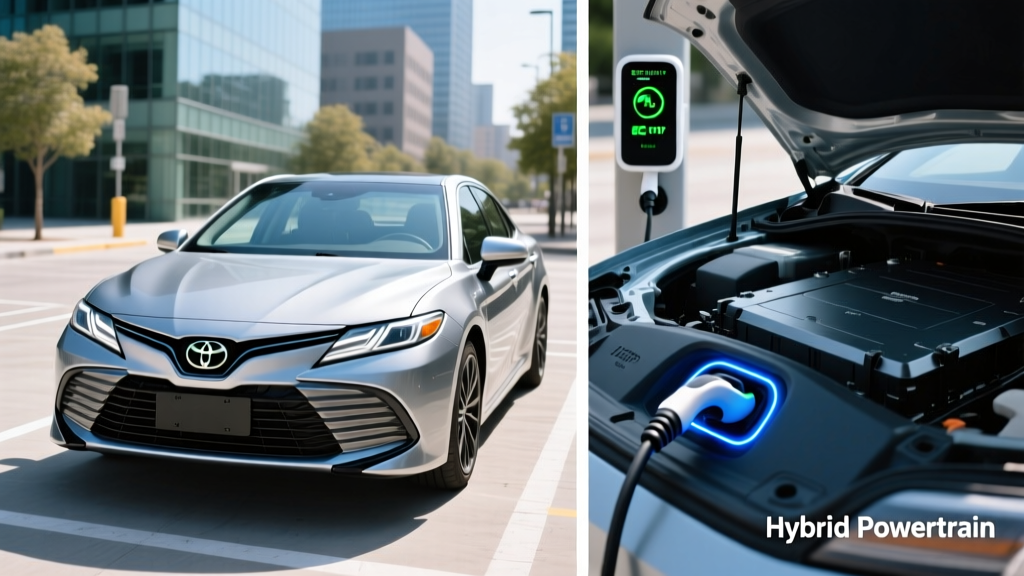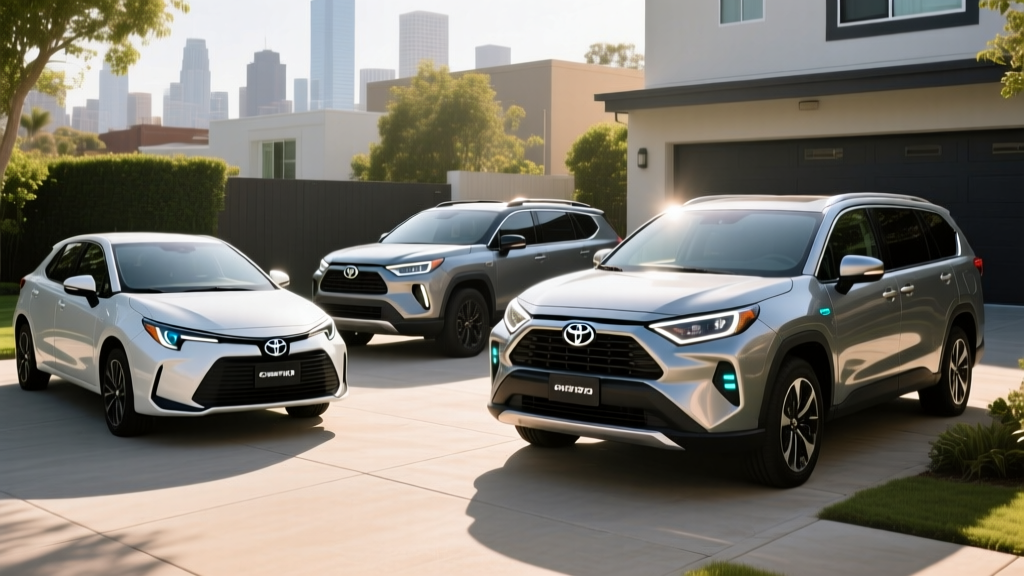
Toyota's hybrid strategy in 2024 is the broadest of any mainstream automaker. From the 57 MPG Prius to the three-row Grand Highlander Hybrid, the lineup covers compacts, sedans, SUVs, minivans, and trucks — almost all offered as conventional hybrids (HEVs) that never need plugging in, with select models also available as plug-in hybrids (PHEVs) for short electric-only commutes.
This guide breaks down every 2024 Toyota hybrid by powertrain type, EPA fuel economy, real-world efficiency, pricing, and tax-credit eligibility so you can match the right model to your driving pattern.
HEV vs PHEV: Understanding Toyota's Two Hybrid Types
Before diving into specific models, the distinction between Toyota's hybrid architectures matters for your wallet and your daily routine.
Conventional Hybrid (HEV)
A standard Toyota hybrid like the Corolla Hybrid or RAV4 Hybrid pairs a gasoline engine with one or more electric motors and a small battery (typically 1.0–1.6 kWh). The battery charges through regenerative braking and the engine — you never plug it in. The electric motor assists during acceleration and enables brief low-speed electric driving, but the engine is always the primary power source. Result: dramatically better fuel economy than a gas-only car, with zero behavior change required.
Plug-In Hybrid (PHEV — Toyota calls it "Prime")
Toyota's Prime models (RAV4 Prime, Prius Prime) carry a much larger battery (13.6–18.1 kWh) and a more powerful electric motor. You plug them in to charge, gaining 25–44 miles of pure electric range before the gas engine starts. Once the battery depletes, they operate exactly like a conventional hybrid. PHEVs suit drivers with short commutes who want electric daily driving but gas-engine flexibility for road trips.
2024 Toyota Hybrid Lineup: MPG and Specs at a Glance
Below is the full 2024 Toyota hybrid lineup with EPA-estimated fuel economy, powertrain output, and starting MSRP. All figures sourced from fueleconomy.gov and Toyota's official specifications.
| Model | Type | Combined HP | EPA City/Hwy/Combined MPG | EV Range (PHEV) | Battery | Starting MSRP |
|---|---|---|---|---|---|---|
| Prius (LE) | HEV | 194 hp | 57 / 62 / 57 MPG | — | ~1.0 kWh Li-ion | $27,950 |
| Prius (XLE/Limited) | HEV | 194 hp | 52 / 52 / 52 MPG | — | ~1.0 kWh Li-ion | $31,450 |
| Prius Prime (SE) | PHEV | 220 hp | 52 MPG (hybrid) / 127 MPGe | 44 mi | 13.6 kWh Li-ion | $32,975 |
| Prius Prime (XSE) | PHEV | 220 hp | 50 MPG (hybrid) / 114 MPGe | 40 mi | 13.6 kWh Li-ion | $36,225 |
| Corolla Hybrid | HEV | 138 hp | 53 / 46 / 50 MPG | — | ~1.3 kWh NiMH | $23,500 |
| Camry Hybrid | HEV | 208 hp | 51 / 53 / 52 MPG | — | ~1.6 kWh Li-ion | $28,855 |
| Crown | HEV | 236 hp | 42 / 41 / 41 MPG | — | ~1.6 kWh NiMH | $40,350 |
| Venza | HEV | 219 hp | 40 / 37 / 39 MPG | — | ~1.6 kWh NiMH | $35,070 |
| RAV4 Hybrid | HEV | 219 hp | 41 / 38 / 40 MPG | — | ~1.6 kWh NiMH | $31,725 |
| RAV4 Prime | PHEV | 302 hp | 38 MPG (hybrid) / 94 MPGe | 42 mi | 18.1 kWh Li-ion | $43,690 |
| Highlander Hybrid | HEV | 243 hp | 36 / 35 / 36 MPG | — | ~1.6 kWh NiMH | $40,220 |
| Grand Highlander Hybrid | HEV | 243 hp | 37 / 34 / 36 MPG | — | ~1.6 kWh NiMH | $45,020 |
| Grand Highlander Hybrid MAX | HEV | 362 hp | 28 / 29 / 28 MPG | — | ~1.4 kWh NiMH | $53,405 |
| Sienna | HEV | 245 hp | 36 / 36 / 36 MPG | — | ~1.6 kWh NiMH | $37,185 |
| Tundra i-FORCE MAX | HEV | 437 hp | 20 / 24 / 22 MPG | — | ~1.9 kWh NiMH | $57,005 |
| Sequoia i-FORCE MAX | HEV | 437 hp | 22 / 25 / 22 MPG | — | ~1.9 kWh NiMH | $60,875 |
Real-World MPG: What Toyota Hybrid Owners Actually See
EPA estimates are measured on a dynamometer under controlled conditions. In real-world driving, Toyota hybrids consistently exceed their EPA city ratings but sometimes fall slightly short on sustained highway driving. This is the opposite of conventional gas cars and is worth understanding.
Why hybrids beat EPA city estimates: City driving involves frequent stops, which triggers regenerative braking to recharge the battery and lets the electric motor handle low-speed propulsion — the exact conditions where hybrids are most efficient. Many Prius and Camry Hybrid owners report 55–62 MPG in mixed urban driving, a few points above the EPA sticker.
Highway reality: At sustained 70–80 mph speeds, the engine does most of the work and aerodynamic drag dominates. Expect the RAV4 Hybrid to deliver roughly 34–36 MPG on the highway (vs. EPA 38) and the Prius LE to return around 55–58 MPG (vs. EPA 62). Cold weather adds another 5–10% reduction as the engine runs longer to provide cabin heat and warm the catalytic converter.
- Prius LE: EPA 57 combined — expect 52–60 MPG depending on city vs. highway mix
- RAV4 Hybrid: EPA 40 combined — expect 36–42 MPG (city-favoring drivers see higher)
- Camry Hybrid LE: EPA 52 combined — expect 48–55 MPG
- Sienna: EPA 36 combined — expect 33–38 MPG (remarkably consistent for a 4,600-lb minivan)
- Tundra i-FORCE MAX: EPA 22 combined — expect 18–22 MPG (towing drops this to 12–15)
PHEV Deep Dive: Prius Prime and RAV4 Prime Electric Range
Toyota's two plug-in hybrids — the Prius Prime and RAV4 Prime — are the models that can genuinely replace a battery-electric vehicle for daily commuting while eliminating range anxiety for longer trips.
Prius Prime: 44 Miles Electric, 127 MPGe
The 2024 Prius Prime uses a 13.6 kWh lithium-ion battery paired with a 2.0L four-cylinder engine for a combined 220 hp. The SE trim achieves 44 miles of EPA-rated electric-only range, while the heavier XSE with larger wheels drops to 40 miles. Once the battery is depleted, it operates as a conventional hybrid at 52 MPG (SE) or 50 MPG (XSE).
Charging: Level 1 (120V household outlet) takes approximately 11 hours for a full charge. Level 2 (240V) reduces this to about 4 hours. The Prius Prime does not support DC fast charging — a deliberate choice to save cost and weight, and reasonable given the small battery size.
RAV4 Prime: 42 Miles Electric, 302 HP
The RAV4 Prime pairs an 18.1 kWh lithium-ion battery with a 2.5L four-cylinder for a combined 302 hp — making it the second-quickest Toyota in the lineup (0–60 mph in 5.7 seconds). EPA electric-only range is 42 miles, enough for most commutes. After battery depletion, it returns 38 MPG as a conventional hybrid.
Charging: Level 1 takes roughly 12 hours. Level 2 (240V, 6.6 kW onboard charger) charges in about 2.5 hours. Like the Prius Prime, no DC fast charging is available. For an 18.1 kWh battery, this is a reasonable trade-off — DC fast infrastructure would add cost and weight for a battery small enough to fill overnight on Level 2.
| PHEV Model | Battery (kWh) | EV Range (mi) | Hybrid MPG | MPGe | L2 Charge Time | DC Fast Charge |
|---|---|---|---|---|---|---|
| Prius Prime SE | 13.6 | 44 | 52 MPG | 127 MPGe | ~4 hours | No |
| Prius Prime XSE | 13.6 | 40 | 50 MPG | 114 MPGe | ~4 hours | No |
| RAV4 Prime SE | 18.1 | 42 | 38 MPG | 94 MPGe | ~2.5 hours | No |
| RAV4 Prime XSE | 18.1 | 42 | 38 MPG | 94 MPGe | ~2.5 hours | No |
Battery Warranty, Reliability, and Replacement Costs
Hybrid battery longevity is the single most common concern among first-time hybrid buyers. Toyota's track record here is among the best in the industry, with Prius taxis routinely surpassing 300,000 miles on original hybrid batteries.
- Hybrid battery: 10 years / 150,000 miles (whichever comes first), transferable to subsequent owners
- Hybrid system components (inverter, motor, control module): 8 years / 100,000 miles
- Standard powertrain: 5 years / 60,000 miles
Toyota extended the hybrid battery warranty from 8 years/100,000 miles to 10 years/150,000 miles starting with 2020 models. If you're buying a 2024, you're fully covered under the longer term.
Battery replacement cost if out of warranty: A Toyota hybrid battery replacement typically runs between $2,000 and $4,500 depending on the model, including labor. The Prius battery is on the lower end (~$2,000–$2,800), while the RAV4 Prime's larger 18.1 kWh pack is more expensive (~$3,500–$4,500). Independent shops and refurbished battery options can reduce these figures by 30–40%.
Degradation reality: Toyota's hybrid batteries are intentionally small and operate within a narrow state-of-charge window (roughly 40–80%) managed by the vehicle's computer. This "buffer" strategy dramatically reduces stress on the cells and is a key reason Toyota hybrid batteries outlast those in many full EVs. Most owners will sell the vehicle before any meaningful capacity loss affects fuel economy.
Tax Credits and Incentives for 2024 Toyota Hybrids
Federal tax credit eligibility is where the HEV vs. PHEV distinction becomes a financial decision.
- Conventional hybrids (HEVs): Do NOT qualify for the federal EV tax credit. No plug, no credit.
- Plug-in hybrids (PHEVs): May qualify for up to $7,500, subject to the following:
- Battery capacity must be ≥ 7 kWh (both Toyota PHEVs qualify)
- Vehicle MSRP must not exceed $80,000 for SUVs/vans/pickups or $55,000 for sedans
- Buyer AGI must not exceed $150K (single) / $300K (joint) / $225K (head of household)
- Critical minerals and battery component sourcing requirements must be met (phased in annually)
- Credit can now be transferred to the dealer as a point-of-sale discount
Source: IRS §30D guidelines. Consult a tax professional for your specific eligibility.
Toyota PHEV credit status for 2024: The Prius Prime (MSRP starting at $32,975, sedan cap $55,000) is eligible for the full $7,500 credit assuming buyer income and battery-sourcing requirements are met. The RAV4 Prime (MSRP starting at $43,690, SUV cap $80,000) may qualify for a partial credit of $3,750 depending on critical-mineral sourcing compliance for the specific build month — Toyota has confirmed partial compliance for 2024 RAV4 Prime production. Always verify with the dealer and IRS before purchasing.
State incentives: Several states offer additional rebates for PHEVs (California's CVRP, for example, has offered up to $1,000–$1,500 for income-qualified PHEV buyers). These vary by jurisdiction and funding availability — check your state's energy office or AFDC incentive database for current programs.
Which 2024 Toyota Hybrid Fits Your Situation?
- You want maximum fuel economy with zero behavior change — no plugs, no charging apps, no range planning
- You don't have access to home or workplace charging
- You drive a mix of city and highway and want consistent 35–57 MPG
- Your budget is under $45,000 and you want the lowest total cost of ownership
- Your daily round-trip commute is under 40 miles and you can charge at home overnight
- You want electric daily driving but need gas-engine flexibility for road trips or towing
- You qualify for the $7,500 federal credit (Prius Prime) or $3,750 partial credit (RAV4 Prime)
- You're not ready to commit to a full BEV due to charging access or trip patterns
- You have reliable home Level 2 charging and your daily driving is under 250 miles
- You want to eliminate gasoline entirely and minimize maintenance (no oil changes, fewer moving parts)
- You're eligible for the full $7,500 credit and your state offers additional BEV incentives
- You want the lowest per-mile "fuel" cost — electricity at $0.13/kWh costs roughly $0.04/mile vs. $0.12–$0.15/mile for a Toyota hybrid on gas
2024 Toyota Hybrid Pricing and Value Breakdown
Toyota's hybrid lineup spans from the budget-friendly Corolla Hybrid to the premium Grand Highlander Hybrid MAX. Here's a value-oriented view of where each model lands after accounting for available credits.
| Model | Starting MSRP | Fed. Credit | Effective Price | Best For |
|---|---|---|---|---|
| Corolla Hybrid | $23,500 | $0 | $23,500 | Budget commuters, ride-share |
| Prius LE | $27,950 | $0 | $27,950 | Maximum MPG, solo drivers |
| Prius Prime SE | $32,975 | Up to $7,500 | ~$25,475 | Short-commute EV + road trips |
| Camry Hybrid LE | $28,855 | $0 | $28,855 | Midsize sedan comfort + 52 MPG |
| RAV4 Hybrid XLE | $33,225 | $0 | $33,225 | Compact SUV families |
| RAV4 Prime SE | $43,690 | Up to $3,750 | ~$39,940 | Performance SUV + 42-mi EV range |
| Sienna XLE | $41,385 | $0 | $41,385 | Family minivan, 36 MPG |
| Grand Highlander Hybrid | $45,020 | $0 | $45,020 | Three-row SUV, adult 3rd row |
| Tundra i-FORCE MAX | $57,005 | $0 | $57,005 | Truck buyers wanting 437 hp + 22 MPG |
Toyota Hybrid Pros
- Class-leading fuel economy across segments (57 MPG Prius, 36 MPG Sienna minivan)
- Proven reliability with 10-year/150,000-mile hybrid battery warranty
- No charging infrastructure needed for HEVs — works with existing gas stations
- Prius Prime eligible for up to $7,500 federal tax credit
- RAV4 Prime delivers 302 hp with 42 miles of EV range
- Strong resale value — Toyota hybrids depreciate slower than most EVs
Toyota Hybrid Cons
- HEVs do not qualify for any federal tax credit
- RAV4 Prime is frequently dealer-marked-up $5,000–$10,000 above MSRP due to demand
- No DC fast charging on PHEVs (acceptable for battery size, but limits public charging utility)
- Tundra and Sequoia hybrids prioritize power over MPG — 22 MPG is modest vs. diesel alternatives
- Hybrid battery replacement costs $2,000–$4,500 out of warranty
- PHEV cargo space slightly reduced vs. HEV counterparts due to larger battery
Frequently Asked Questions
How many MPG does the most efficient 2024 Toyota hybrid get?
The 2024 Toyota Prius LE achieves an EPA-estimated 57 MPG combined (57 city / 62 highway). In real-world mixed driving, owners typically see 52–60 MPG. The Prius is the most fuel-efficient non-plug-in vehicle Toyota sells.
How far can the RAV4 Prime go on electric power alone?
The 2024 RAV4 Prime delivers an EPA-rated 42 miles of electric-only range on a full charge. This is sufficient for most daily commutes. Once depleted, the vehicle seamlessly transitions to hybrid mode at 38 MPG combined.
Do Toyota conventional hybrids need to be plugged in?
No. Toyota's conventional hybrids (HEVs) such as the Corolla Hybrid, Camry Hybrid, RAV4 Hybrid, and Sienna charge their batteries entirely through regenerative braking and the gasoline engine. You fuel them like any other car. Only the Prime (PHEV) models require plugging in to access their electric-only range.
Is the Toyota hybrid battery reliable and what does replacement cost?
Toyota hybrid batteries carry a 10-year/150,000-mile warranty and have an excellent long-term reliability record. Prius batteries routinely last 200,000+ miles. If replacement is needed out of warranty, expect to pay $2,000–$4,500 depending on the model. Toyota's practice of operating hybrid batteries within a narrow charge window (40–80% SoC) significantly extends cell life.
Which 2024 Toyota hybrids qualify for the federal tax credit?
Only Toyota's plug-in hybrids — the Prius Prime and RAV4 Prime — are eligible for the federal §30D Clean Vehicle Credit. The Prius Prime can qualify for the full $7,500 (subject to income limits and battery sourcing rules). The RAV4 Prime may qualify for a partial $3,750 credit. Conventional Toyota hybrids (HEVs) do not qualify for any federal tax credit.
Is a Toyota hybrid better than a full EV for my situation?
A Toyota HEV is better if you lack home charging access, regularly drive over 300 miles between stops, or want the lowest purchase price with no behavior change. A Toyota PHEV (Prime) is better if you can charge at home and commute under 40 miles daily but still need road-trip flexibility. A full BEV (like a Tesla Model Y or Hyundai Ioniq 5) is better if you have reliable home charging, want the lowest per-mile operating cost, and your daily driving stays under 250 miles.
What is the difference in maintenance cost between a Toyota hybrid and a gas car?
Toyota hybrids generally have lower maintenance costs than conventional gas cars. The regenerative braking system reduces brake pad wear (many owners report 80,000+ miles on original brake pads). There is no alternator or starter motor to replace. Oil changes are still required at standard intervals. The hybrid system adds no routine maintenance items beyond the standard powertrain.
Bottom Line
Toyota's 2024 hybrid lineup offers a specific answer for nearly every buyer archetype: the Prius LE for maximum efficiency at under $28,000, the RAV4 Hybrid for family-SUV practicality at 40 MPG, the Sienna for a hybrid-only minivan that returns 36 MPG, and the Prime models for drivers ready to plug in without committing to full electrification. The Prius Prime at ~$25,475 after the federal credit is arguably the best value in the entire lineup for those who qualify.
The consistent thread across every model: Toyota's hybrid system is mature, reliable, and backed by an industry-leading 10-year battery warranty. If your priority is reducing fuel costs today without waiting for charging infrastructure to catch up, a 2024 Toyota hybrid remains one of the most pragmatic choices on the market.