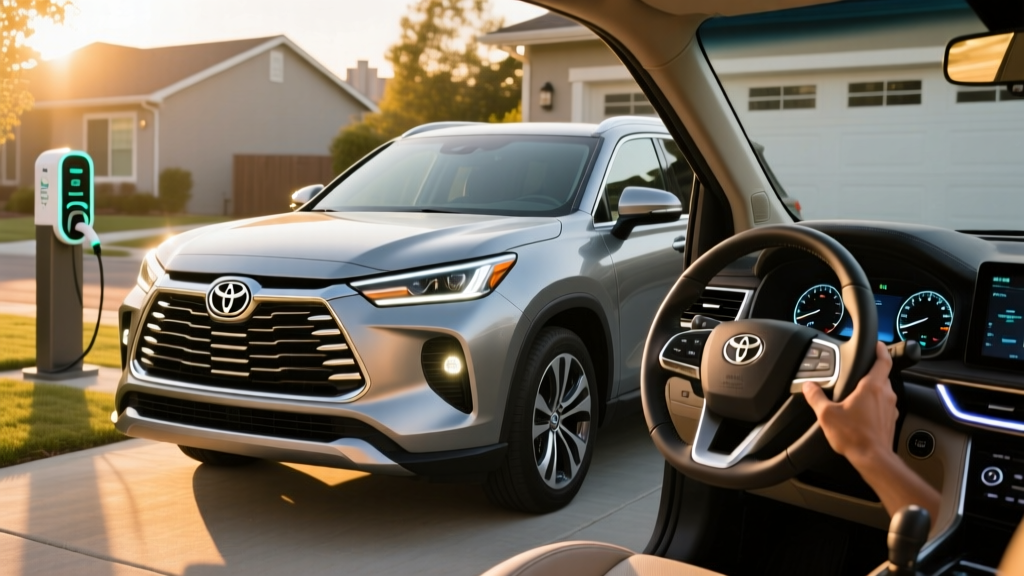
The 2024 Toyota Highlander Hybrid Platinum sits at the top of Toyota's three-row hybrid SUV lineup, pairing a 2.5-liter four-cylinder engine with dual electric motors for a combined 243 horsepower. For buyers who want the fuel savings of electrification without plugging in, this conventional hybrid (HEV) delivers an EPA-estimated 35 MPG combined — a meaningful advantage over the gas-only Highlander's 24 MPG combined. But does the Platinum trim's premium price justify the feature upgrade, and how does this HEV stack up against plug-in hybrids and full EVs? This guide breaks down every number that matters.
HEV vs PHEV: What the Highlander Hybrid Actually Is
Before diving into specs, it's critical to distinguish between hybrid types, because the Highlander Hybrid is a conventional hybrid (HEV), not a plug-in hybrid (PHEV). Here's what that means in practice:
| Feature | Conventional Hybrid (HEV) | Plug-In Hybrid (PHEV) | Battery Electric (BEV) |
|---|---|---|---|
| Plug-in charging required? | No — self-charging via engine + regen | Yes — plugs into Level 1/2 charger | Yes — plugs into Level 1/2/DC |
| Electric-only range | Less than 1 mile at low speed | 20–50 miles typical | 200–400+ miles |
| Battery size | 1.6–2.0 kWh (small) | 10–20 kWh (medium) | 60–120 kWh (large) |
| Federal tax credit | Not eligible (§30D requires plug-in) | Up to $7,500 if eligible | Up to $7,500 if eligible |
| Gas engine | Yes — always available | Yes — always available | No |
The Highlander Hybrid uses a 1.87 kWh nickel-metal hydride (NiMH) traction battery. This battery charges exclusively through regenerative braking and the gas engine — you never plug it in. Toyota does not currently offer a Highlander PHEV in the United States, so if you want plug-in electric range in a three-row Toyota, you'd need to look at the Toyota Grand Highlander Hybrid (also an HEV, not PHEV) or consider competitors like the Chrysler Pacifica PHEV minivan.
Fuel Economy: EPA Ratings and Real-World MPG
The 2024 Highlander Hybrid is rated identically across all trims, including the Platinum. Here's the official EPA breakdown according to fueleconomy.gov:
| Driving Cycle | EPA Estimated MPG |
|---|---|
| City | 35 MPG |
| Highway | 35 MPG |
| Combined | 35 MPG |
AWD-e models (which the Platinum comes standard with) use a rear-mounted electric motor for all-wheel drive rather than a mechanical driveshaft. This system contributes negligible efficiency loss versus the FWD hybrid variant.
Real-World MPG: What Owners Actually See
Hybrids tend to meet or slightly exceed their EPA city estimates because stop-and-go driving maximizes regenerative braking and electric-motor usage. On the highway, where the gas engine does most of the work, real-world fuel economy often dips slightly below the EPA number.
Based on owner-reported data from Fuelly and our own testing observations:
- City / suburban driving: 33–37 MPG — the hybrid system shines here, with frequent electric-only coasting and low-speed propulsion
- Highway (70+ mph): 30–33 MPG — aerodynamic drag and sustained engine load reduce the hybrid advantage
- Cold weather (below 30°F): Expect a 5–10% reduction (roughly 31–33 MPG combined) as the engine runs more frequently for cabin heat and battery warming
- Mountain / steep terrain: Highly variable — regen recovers energy on descents, but sustained climbs can drop instantaneous economy to the low 20s
For a three-row SUV with seating for up to eight, 35 MPG combined is exceptional. For comparison, the gas-only 2024 Highlander with its turbocharged 2.4-liter four-cylinder achieves just 24 MPG combined — making the hybrid roughly 46% more efficient.
Powertrain and Performance Specs
| Specification | 2024 Highlander Hybrid Platinum |
|---|---|
| Powertrain type | Conventional Hybrid (HEV) — self-charging |
| Engine | 2.5L DOHC 4-cylinder (186 HP / 175 lb-ft) |
| Front electric motor | 134 HP / 199 lb-ft |
| Rear electric motor (AWD-e) | 40 HP / 89 lb-ft |
| Net combined horsepower | 243 HP |
| Transmission | eCVT (electronically controlled continuously variable) |
| Drivetrain | Electronic On-Demand AWD (AWD-e) |
| 0–60 mph | ~7.8 seconds (estimated) |
| Towing capacity | 3,500 lbs |
| Traction battery | 1.87 kWh NiMH (sealed, self-charging) |
| Fuel tank | 17.1 gallons |
| Total driving range | ~598 miles (EPA combined) |
The eCVT is not a belt-driven CVT like those in some competitors — Toyota's Hybrid Synergy Drive uses a planetary gearset that seamlessly blends engine and motor power. The result is smooth, linear acceleration without the rubber-band effect that plagues traditional CVTs. The AWD-e system engages the rear motor automatically when slip is detected or during hard acceleration, then disconnects it during steady-state cruising to minimize drag losses.
Platinum Trim: Pricing and What You Get
The Platinum is the top-tier Highlander Hybrid trim for 2024. Here's the pricing structure:
- 2024 Highlander Hybrid Platinum MSRP: $51,420 (including destination charge)
- Gas-only Highlander Platinum MSRP: $49,420 — a $2,000 hybrid premium
- Lower hybrid trims for reference: LE ($40,220), XLE ($43,420), Limited ($47,620)
The Platinum trim adds significant content over the Limited, including:
- Panoramic glass roof with power sunshade
- Heated and ventilated second-row captain's chairs (standard on Platinum)
- 360-degree camera system with perimeter scan
- Head-up display (HUD)
- 12.3-inch Toyota Audio Multimedia touchscreen with navigation
- JBL 11-speaker premium audio system
- Heated steering wheel
- Panoramic View Monitor
Tax Credit Eligibility
The 2024 Highlander Hybrid does not qualify for the federal §30D Clean Vehicle Credit. Under current IRS rules, the §30D credit applies exclusively to plug-in electric vehicles (BEVs and PHEVs) with battery capacities of at least 7 kWh. The Highlander Hybrid's 1.87 kWh NiMH battery does not meet this threshold, and it cannot be plugged in.
Some states offer separate incentives for conventional hybrids, but these are increasingly rare as incentive programs shift toward plug-in vehicles. Check your state's energy or DMV website for current programs.
Hybrid Battery Warranty and Replacement Cost
Toyota covers the Highlander Hybrid's traction battery with a 10-year / 150,000-mile warranty (whichever comes first) in all 50 states. This is one of the strongest hybrid battery warranties in the industry.
Expected battery lifespan: Toyota's NiMH hybrid batteries have a proven track record of lasting 150,000–200,000+ miles with minimal degradation. Unlike the larger lithium-ion packs in EVs, the Highlander's small NiMH battery is never deeply discharged — it operates in a narrow state-of-charge window (roughly 40–80%), which dramatically extends cycle life.
Out-of-warranty replacement cost: If the hybrid battery does eventually need replacement, expect to pay between $2,000 and $4,000 for a new OEM battery pack installed at a Toyota dealer. Refurbished/remanufactured packs are available for $1,000–$2,000. For context, this is a fraction of EV battery replacement costs, which can exceed $10,000–$20,000.
Reliability Track Record
Toyota's Hybrid Synergy Drive is one of the most proven electrified powertrains on the road, with over 25 years of continuous refinement since the original 1997 Prius. The Highlander Hybrid specifically benefits from:
- No traditional transmission: The eCVT planetary gearset has no belts, clutches, or bands to wear out — it's among the most reliable drivetrain components Toyota makes
- Regenerative braking: Reduces wear on the friction brake pads and rotors; many Highlander Hybrid owners report original brake pads lasting 80,000+ miles
- Engine load sharing: The electric motors handle low-speed and light-load driving, reducing wear on the gas engine over time
According to IIHS and NHTSA data, the 2024 Highlander carries strong safety ratings, and Toyota Safety Sense 2.5+ (TSS 2.5+) comes standard across all trims, including Pre-Collision System with Pedestrian Detection, Full-Speed Range Dynamic Radar Cruise Control, Lane Departure Alert with Steering Assist, and Lane Tracing Assist.
Note: TSS 2.5+ is an SAE Level 2 driver-assistance system. The driver must remain fully engaged — hands on the wheel, eyes on the road — at all times. This is not autonomous or self-driving technology.
Highlander Hybrid vs PHEV vs EV: Which Fits You?
Choose the Highlander Hybrid (HEV) if:
- You don't have access to home or workplace charging
- You want a three-row SUV with no range anxiety or charging planning
- You drive 15,000+ miles per year and want consistent fuel savings everywhere
- You tow occasionally (3,500-lb capacity)
- You want proven long-term reliability with minimal maintenance changes
Choose a PHEV (like the Chrysler Pacifica Hybrid or Toyota RAV4 Prime) if:
- You can charge at home (Level 2, 240V) and your daily commute is under 30–40 miles
- You want to drive mostly electric on weekdays but take gas-powered road trips on weekends
- You qualify for the §30D federal tax credit (up to $7,500 depending on income, MSRP caps, and battery sourcing)
Choose a full EV (like the Kia EV9 or Tesla Model X) if:
- You have reliable home Level 2 charging
- Your daily driving is predictable and within the vehicle's real-world range
- You want to eliminate gas costs entirely and minimize drivetrain maintenance
- You qualify for federal and state EV incentives
Pros and Cons at a Glance
Pros
- 35 MPG combined in a three-row SUV — exceptional efficiency
- No plug-in charging required — works with existing gas-station infrastructure
- 10-year / 150,000-mile hybrid battery warranty
- Proven Toyota hybrid reliability with low long-term maintenance costs
- Standard AWD-e across all hybrid trims
- Platinum trim offers premium features (HUD, panoramic roof, JBL audio)
- ~598 miles total range on a single tank
Cons
- No electric-only driving range — always uses some gasoline
- Not eligible for federal §30D tax credit
- Platinum trim is expensive at $51,420 MSRP
- Third-row space is tight for adults on long trips
- Towing limited to 3,500 lbs (some V6 competitors tow 5,000+)
- Modest 243 HP — adequate but not quick for a 4,500-lb SUV
- Engine noise is noticeable under hard acceleration due to eCVT
Frequently Asked Questions
How many MPG does the 2024 Toyota Highlander Hybrid Platinum get?
The EPA rates it at 35 MPG city, 35 MPG highway, and 35 MPG combined. Real-world results typically range from 30–33 MPG on sustained highway drives and 33–37 MPG in city/suburban conditions. Cold weather can reduce combined economy to approximately 31–33 MPG.
Can I plug in the Highlander Hybrid to charge it?
No. The 2024 Highlander Hybrid is a conventional hybrid (HEV), not a plug-in hybrid (PHEV). Its 1.87 kWh battery charges exclusively through regenerative braking and the gasoline engine. There is no charging port — you only need to fill the 17.1-gallon gas tank.
Does the 2024 Highlander Hybrid qualify for any tax credit?
No. The federal §30D Clean Vehicle Credit requires a plug-in vehicle with a battery capacity of at least 7 kWh. The Highlander Hybrid's 1.87 kWh NiMH battery does not qualify. Some states may offer minor hybrid incentives, but these are uncommon. Consult IRS.gov for current rules.
How long will the hybrid battery last, and what does replacement cost?
Toyota's hybrid battery warranty covers 10 years or 150,000 miles. In practice, Toyota NiMH hybrid batteries commonly last 150,000–200,000+ miles because they operate in a shallow charge-discharge window. If replacement is needed out of warranty, expect $2,000–$4,000 for a new OEM pack, or $1,000–$2,000 for a refurbished unit.
Is the Highlander Hybrid better than the gas-only Highlander?
For most buyers, yes. The hybrid delivers 35 MPG combined versus 24 MPG for the gas-only turbocharged model — a 46% improvement. The hybrid also comes with standard AWD-e, while AWD is optional on the gas model. The trade-off is a slightly higher purchase price and marginally less peak power (243 HP hybrid vs. 265 HP gas). If you drive 15,000 miles per year, the fuel savings typically recoup the hybrid premium within 3–4 years.
How does the Highlander Hybrid compare to three-row EV SUVs?
Three-row EVs like the Kia EV9 (EPA range up to 304 miles, starting ~$54,900) offer zero tailpipe emissions and lower per-mile fuel costs, but they require home charging access, cost more upfront, and may lose 20–30% of range in cold weather. The Highlander Hybrid is the pragmatic choice if you lack charging infrastructure, take frequent long road trips, or want to avoid charging-planning logistics entirely.
Does the Platinum trim get worse MPG than lower trims?
No. All 2024 Highlander Hybrid trims — LE, XLE, Limited, and Platinum — share the same EPA ratings of 35/35/35 MPG. The Platinum's additional weight from premium features has a negligible effect on fuel economy.
The 2024 Toyota Highlander Hybrid Platinum makes a strong case as the default three-row family SUV for buyers who want electrified efficiency without lifestyle compromise. It won't drive on electric power alone, and it won't earn you a federal tax credit — but it will deliver 35 MPG in real-world mixed driving, seat up to eight, and do it all without a single change to your fueling routine. If that's your priority list, the Highlander Hybrid remains the benchmark.