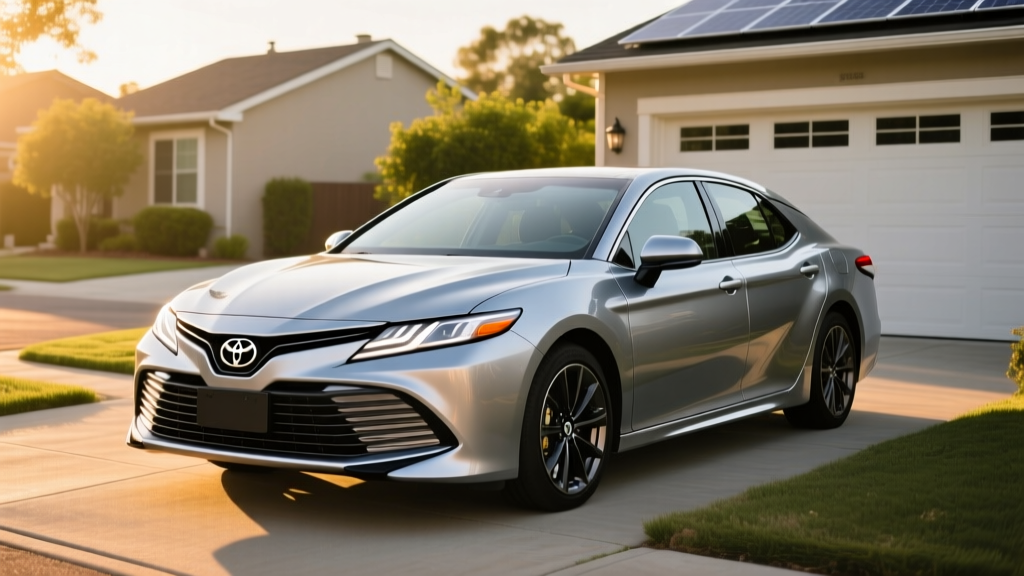
If you're researching the 2024 Toyota Camry Hybrid MPG before buying, you're looking at one of the most efficient midsize sedans ever sold in the United States. The Camry Hybrid pairs a 2.5-liter four-cylinder engine with an electric motor system to deliver EPA-estimated ratings that rival compact hatchbacks — while offering midsize interior space. This guide breaks down every efficiency figure, powertrain spec, battery warranty detail, and ownership cost you need before signing on the dotted line.
Note: Toyota redesigned the Camry for the 2025 model year, making it hybrid-only across all trims. The 2024 model year represents the final year of the previous generation, which offered both gas and hybrid powertrains. If you're shopping used or considering remaining 2024 inventory, this data applies directly.
2024 Toyota Camry Hybrid MPG: EPA Ratings by Trim
The 2024 Camry Hybrid comes in LE, SE, XLE, and XSE trims, with optional all-wheel drive (AWD) on most. The front-wheel-drive (FWD) LE trim delivers the highest EPA numbers, while AWD and sport-tuned trims reduce efficiency slightly due to added drivetrain weight and wider tires.
| Trim / Drivetrain | City MPG | Highway MPG | Combined MPG | Fuel Tank (gal) | Est. Total Range (mi) |
|---|---|---|---|---|---|
| LE (FWD) | 51 | 53 | 52 | 13.2 | ~686 |
| SE (FWD) | 44 | 47 | 46 | 13.2 | ~607 |
| XLE (FWD) | 44 | 47 | 46 | 13.2 | ~607 |
| XSE (FWD) | 44 | 47 | 46 | 13.2 | ~607 |
| LE (AWD-e) | 51 | 53 | 52 | 13.2 | ~686 |
| SE (AWD-e) | 44 | 47 | 46 | 13.2 | ~607 |
| XLE (AWD-e) | 44 | 47 | 46 | 13.2 | ~607 |
Source: EPA Fuel Economy
The LE uses low-rolling-resistance tires, lighter wheels, and a slightly different final-drive ratio. The SE, XLE, and XSE trims carry larger wheels (18" or 19"), sport-tuned suspensions, and wider tires that increase rolling resistance and curb weight by roughly 50-100 lbs. That 6-MPG gap is real and consistent across model years.
Real-World MPG: What Owners Actually Report
EPA estimates are laboratory-derived. Real-world results depend on driving style, climate, and route mix. For the 2024 Camry Hybrid, the pattern is consistent with Toyota's Hybrid Synergy Drive system across the RAV4 Hybrid and Prius:
- City driving (stop-and-go): The hybrid system excels here. Expect to meet or exceed the EPA city number. Many owners of the LE trim report 52-56 MPG in urban commuting, because regenerative braking recaptures energy at every stop and the engine shuts off frequently at low speeds.
- Highway cruising (65-75 mph): Hybrids lose their city advantage on the open road. Sustained high speeds reduce regenerative braking opportunities and increase aerodynamic drag. Expect 42-48 MPG highway in the LE, and 38-43 MPG in SE/XLE/XSE trims — slightly below the EPA highway sticker.
- Cold weather (below 40°F): The engine runs more frequently to heat the cabin and warm the battery. Expect a 10-15% reduction in MPG during winter months, dropping the LE to roughly 44-47 MPG combined until temperatures recover.
- Mountainous terrain: Regenerative braking on descents partially offsets the energy cost of climbing, but net efficiency still drops 5-10% compared to flat-terrain driving.
EPA combined: 52 MPG (LE FWD). Real-world expectation: 48-54 MPG combined depending on city/highway split and climate. Annual fuel cost at 15,000 miles/year and $3.40/gallon: approximately $980 for the LE, $1,108 for SE/XLE/XSE trims.
HEV vs PHEV vs EV: Which Powertrain Fits You?
The 2024 Camry Hybrid is a conventional hybrid (HEV) — it does not plug in. Toyota does not offer a Camry plug-in hybrid (PHEV) in the US market. If you're comparing the Camry Hybrid against a PHEV like the Toyota RAV4 Prime or a full battery-electric vehicle (BEV) like the Tesla Model 3 or Hyundai Ioniq 6, here's how they differ:
| Feature | HEV (Camry Hybrid) | PHEV (e.g., RAV4 Prime) | BEV (e.g., Ioniq 6) |
|---|---|---|---|
| Plugs in? | No — regenerative braking only | Yes — Level 1/Level 2 | Yes — Level 1/2/DC fast |
| Electric-only range | ~1 mile at low speed | 42 miles (RAV4 Prime) | 305-361 mi (Ioniq 6) |
| Fuel/energy source | Gasoline only | Gasoline + electricity | Electricity only |
| Combined MPG / MPGe | 46-52 MPG | 38 MPG + 94 MPGe | 132-140 MPGe |
| Home charging needed? | No | Recommended for EV range | Essential |
| Federal tax credit (§30D) | No | Up to $7,500 (if eligible) | Up to $7,500 (if eligible) |
| Typical starting MSRP | $28,855 (LE) | $43,690 (RAV4 Prime SE) | $37,500 (Ioniq 6 SE) |
Choose the Camry Hybrid (HEV) if: You want maximum fuel efficiency with zero lifestyle change — no plug, no charging apps, no range planning. You drive a mix of city and highway and want a sedan under $30,000.
Choose a PHEV if: You have home charging access, a commute under 40 miles round-trip, and want to drive mostly on electricity while retaining gas capability for road trips.
Choose a BEV if: You have reliable home or workplace Level 2 charging, want to eliminate gas entirely, and your typical road trips fall within DC fast-charging infrastructure.
Powertrain and Performance Specs
The 2024 Camry Hybrid uses Toyota's fourth-generation Hybrid Synergy Drive, pairing a 2.5-liter Dynamic Force four-cylinder engine with one or two electric motor-generators and a sealed nickel-metal hydride (NiMH) traction battery.
| Specification | Detail |
|---|---|
| Engine | 2.5L 4-cylinder Atkinson cycle |
| Engine HP | 176 hp @ 5,700 rpm |
| Electric motor output | 118 hp (FWD) / 118 hp front + 40 hp rear (AWD-e) |
| Net combined system HP | 208 hp (FWD) / 219 hp (AWD-e) |
| Transmission | Continuously Variable (eCVT) |
| Traction battery | 1.6 kWh NiMH (sealed, not plug-in) |
| 0-60 mph | ~7.2 seconds (FWD) / ~7.0 seconds (AWD-e) |
| Drivetrain | FWD or electronic AWD (AWD-e with independent rear motor) |
| Curb weight | 3,472-3,572 lbs depending on trim |
The AWD-e system deserves attention: rather than a mechanical driveshaft, a separate 40-hp electric motor powers the rear axle only when the front wheels slip or during hard acceleration from a stop. It disengages above ~43 mph to preserve efficiency. This means AWD-e adds traction in rain and light snow without the constant fuel-economy penalty of a traditional AWD system.
Pricing, Trims, and Tax Credit Eligibility
The 2024 Camry Hybrid was offered in four trims. Below are the original MSRP figures (destination included):
- LE: $28,855 (FWD) / $30,395 (AWD-e)
- SE: $30,390 (FWD) / $31,790 (AWD-e)
- XLE: $33,295 (FWD) / $34,695 (AWD-e)
- XSE: $33,745 (FWD) / $35,145 (AWD-e)
The 2024 Camry Hybrid is a conventional HEV and does not qualify for the IRS §30D Clean Vehicle Credit (up to $7,500). That credit applies only to plug-in electric vehicles (PHEVs and BEVs) meeting battery-sourcing, MSRP, and buyer-income requirements. The Camry Hybrid also does not qualify for the §25E used-EV credit.
Some states offer rebates for high-efficiency hybrids — check your state energy office or AFDC state incentive database for local programs.
Battery Warranty, Lifespan, and Replacement Cost
Hybrid battery longevity is the single most common concern among first-time hybrid buyers. Toyota's track record here is strong — the Prius, first sold in the US in 2000, demonstrated that NiMH hybrid batteries routinely last 150,000-200,000+ miles with minimal degradation.
- Hybrid battery warranty: 10 years / 150,000 miles (whichever comes first), applicable in all 50 states
- Hybrid system components warranty: 8 years / 100,000 miles (inverters, motor-generators, control modules)
- Capacity retention: Toyota does not publish a minimum SoH threshold for the hybrid battery, as the 1.6 kWh NiMH pack is small and cycled shallowly — deep degradation is rare in normal use
If replacement is needed out of warranty, a new OEM Camry Hybrid battery from Toyota costs approximately $2,500-$4,000 including labor at a dealership. Independent hybrid specialists and refurbished battery options can reduce this to $1,500-$2,500. Given the shallow cycling and Toyota's NiMH durability data, most owners will never face this expense.
Camry Hybrid vs RAV4 Hybrid vs Prius: Efficiency Compared
If you're cross-shopping Toyota's hybrid lineup, here's how the 2024 models stack up on the EPA cycle:
| Model | Combined MPG (best trim) | Combined HP | Starting MSRP |
|---|---|---|---|
| Prius (FWD LE) | 57 MPG | 194 hp | $27,950 |
| Camry Hybrid (LE FWD) | 52 MPG | 208 hp | $28,855 |
| Corolla Hybrid (LE FWD) | 50 MPG | 138 hp | $23,550 |
| RAV4 Hybrid (LE AWD) | 41 MPG | 219 hp | $31,725 |
| Highlander Hybrid (LE FWD) | 36 MPG | 243 hp | $39,120 |
The Camry Hybrid occupies a specific niche: nearly Prius-level efficiency in a larger, more powerful, midsize sedan body. If you don't need SUV cargo space and want more rear-seat legroom than the Prius offers, the Camry Hybrid is the efficiency-per-dollar leader in Toyota's 2024 lineup.
Pros and Cons: The Honest Assessment
- 52 MPG combined (LE) — among the best of any midsize sedan ever
- No plug required — zero lifestyle change from a gas car
- AWD-e available for rain/snow traction with minimal MPG penalty
- 10-year/150,000-mile hybrid battery warranty across all states
- Strong Toyota reliability and resale value track record
- ~686 miles of total range on a single tank (LE)
- No federal tax credit (HEV, not PHEV or BEV)
- 6-MPG drop on SE/XLE/XSE trims vs LE — tire and weight penalty
- Highway MPG falls below EPA sticker at sustained 75+ mph speeds
- Infotainment system on base LE lacks wireless Apple CarPlay/Android Auto
- 2024 is the outgoing generation — 2025 redesign is hybrid-only with updated tech
- AWD-e rear motor disengages above ~43 mph (not full-time AWD)
Frequently Asked Questions
How many MPG does the 2024 Toyota Camry Hybrid get?
The EPA rates the 2024 Camry Hybrid LE (FWD) at 51 city / 53 highway / 52 combined MPG. The SE, XLE, and XSE trims are rated at 44 city / 47 highway / 46 combined. In real-world city driving, the LE often exceeds 52 MPG thanks to regenerative braking. Highway-only driving at 75 mph typically yields 42-48 MPG for the LE.
Does the Camry Hybrid need to be plugged in?
No. The 2024 Camry Hybrid is a conventional hybrid (HEV). Its small 1.6 kWh NiMH battery charges exclusively through regenerative braking and the gasoline engine. You never plug it in — you simply fill it with gas like any other car.
Is the Camry Hybrid reliable, and what does a battery replacement cost?
Toyota's Hybrid Synergy Drive has two decades of proven reliability across millions of vehicles. The hybrid battery is covered by a 10-year / 150,000-mile warranty. Out-of-warranty replacement runs $2,500-$4,000 at a dealer, or $1,500-$2,500 from independent specialists. Most original batteries last well beyond 150,000 miles.
Does the 2024 Camry Hybrid qualify for any tax credit?
It does not qualify for the federal §30D Clean Vehicle Credit, which is reserved for plug-in vehicles (PHEVs and BEVs). Some states and municipalities offer rebates for high-efficiency hybrids — check the Alternative Fuels Data Center for programs in your area.
Should I buy the 2024 Camry Hybrid or wait for the 2025 redesign?
The 2025 Camry is hybrid-only across all trims, uses Toyota's fifth-generation hybrid system, and features updated infotainment. If you want the latest tech and don't mind paying full MSRP on a new-generation vehicle, the 2025 is worth considering. If you want proven reliability and potential dealer discounts on outgoing inventory, the 2024 remains an excellent, efficiency-leading sedan.
Camry Hybrid vs a full EV — which saves more money?
A BEV like the Tesla Model 3 or Hyundai Ioniq 6 costs less per mile to "fuel" (roughly $0.04-$0.06/mile on home electricity vs $0.07/mile for the Camry Hybrid LE at $3.40/gallon). However, BEVs carry higher purchase prices, may require home charger installation ($500-$2,000), and can face insurance premiums 15-25% higher than equivalent hybrids. The Camry Hybrid wins on upfront cost and simplicity; a BEV wins on per-mile fuel cost and zero tailpipe emissions — if you have reliable charging access.