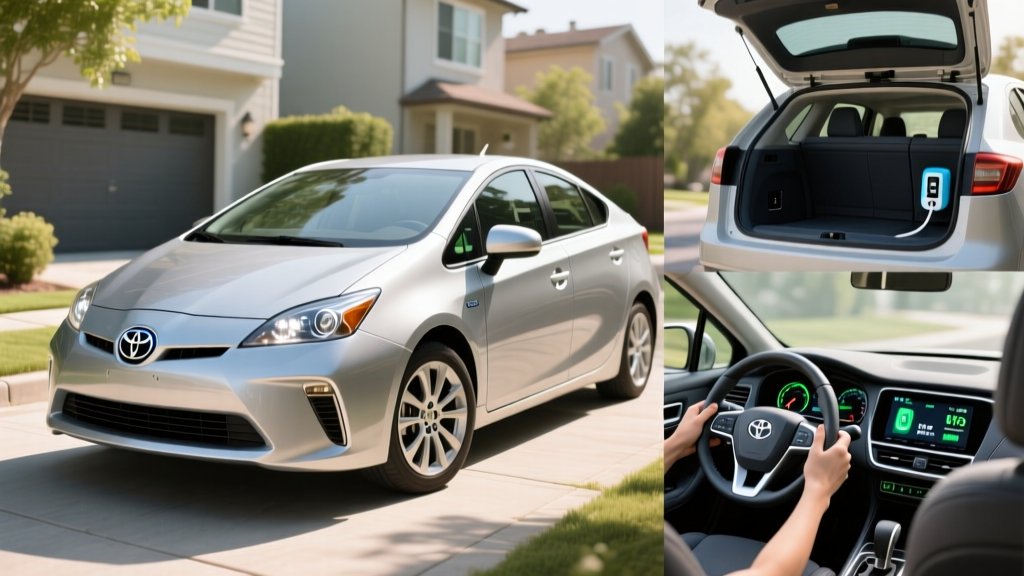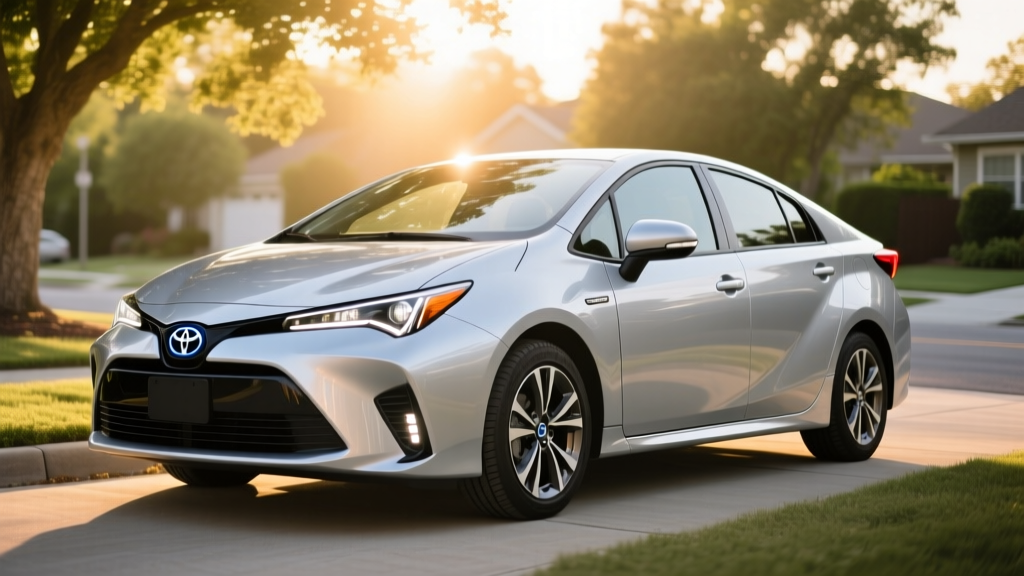
The 2024 Prius Hybrid: A Complete Efficiency Reckoning
Toyota rebuilt the Prius from the ground up for 2023, and the 2024 Prius hybrid carries forward that transformation. Gone is the appliance-car reputation. In its place sits a 196-horsepower, fifth-generation hybrid system wrapped in a sleek fastback body that actually turns heads. But for buyers researching the 2024 Prius hybrid, the core question remains unchanged: how much fuel does it really save, and does the math work against a plug-in hybrid or full EV?
This guide covers every number that matters — EPA MPG, real-world fuel economy, powertrain specs, battery warranty, pricing by trim, and tax-credit eligibility — so you can decide whether the conventional Prius HEV, the Prius Prime PHEV, or a full battery-electric vehicle fits your life.
HEV vs PHEV: Which Prius Are We Talking About?
Toyota sells two distinct Prius models, and confusing them is the most common buyer mistake:
| Feature | Prius (HEV) | Prius Prime (PHEV) |
|---|---|---|
| Powertrain | Hybrid — no plug needed | Plug-in hybrid — charges from outlet |
| EPA Combined MPG | 57 MPG (LE FWD) | 52 MPG (hybrid mode) / 127 MPGe (EV mode) |
| Electric-Only Range | N/A (EV assist only) | 44 miles (SE trim) |
| Battery Capacity | ~1.0 kWh (small buffer) | 13.6 kWh usable (lithium-ion) |
| Charging Required? | No — regenerative braking only | Yes — Level 1 (~4 hrs) or Level 2 (~2 hrs) |
| DC Fast Charging? | No | No |
| Combined Horsepower | 196 HP (AWD: 196 HP) | 220 HP |
| Federal Tax Credit | Not eligible | Up to $3,750 (§30D, subject to sourcing rules) |
The conventional 2024 Prius hybrid (HEV) never plugs in. It recovers energy through regenerative braking and the gasoline engine, storing it in a small battery that assists acceleration and enables brief low-speed electric driving. The Prius Prime (PHEV) has a much larger battery you charge from a wall outlet, giving you 44 miles of pure electric driving before the gasoline engine kicks in as a hybrid.
This article focuses primarily on the conventional 2024 Prius hybrid (HEV), with Prius Prime comparisons where relevant.
Fuel Economy: EPA Numbers and Real-World MPG
The EPA rates the 2024 Prius hybrid across three trims and two drivetrain configurations. Here is the complete breakdown from fueleconomy.gov:
| Trim | Drivetrain | City MPG | Highway MPG | Combined MPG |
|---|---|---|---|---|
| LE | FWD | 57 | 56 | 57 |
| XLE | FWD | 52 | 52 | 52 |
| Limited | FWD | 52 | 52 | 52 |
| LE | AWD-e | 53 | 54 | 54 |
| XLE | AWD-e | 49 | 50 | 49 |
| Limited | AWD-e | 49 | 50 | 49 |
Real-world MPG reality check: Hybrids tend to outperform their EPA city ratings in stop-and-go traffic because regenerative braking recovers energy that a gas car wastes as heat. Owners on Fuelly and similar tracking platforms commonly report 55–62 MPG in mixed suburban driving with the LE FWD trim. Highway-only driving at 75+ mph tends to drop to 48–52 MPG, as the electric motor contributes less at sustained high speeds and aerodynamic drag dominates.
What to actually expect: The LE FWD's EPA rating of 57 combined is achievable in moderate climates with mixed driving. In cold weather (below 30°F), expect a 5–10% drop as the engine runs more frequently for cabin heat and the battery operates less efficiently. Summer highway road trips will yield closer to 50–53 MPG.
The 5 MPG gap between the LE and XLE/Limited trims comes down to weight (heavier wheels, more equipment) and slightly different tire rolling-resistance specifications. If maximum fuel economy is your priority, the LE is the efficiency pick.
Powertrain and Performance Specs
The fifth-generation Toyota Hybrid System in the 2024 Prius is a meaningful upgrade over the previous generation's anemic output.
| Specification | 2024 Prius (HEV) | 2024 Prius Prime (PHEV) |
|---|---|---|
| Engine | 2.0L inline-4 Atkinson cycle | 2.0L inline-4 Atkinson cycle |
| Engine HP | 150 HP | 150 HP |
| Electric Motor HP | 83 HP (front) | 120 kW (~161 HP) |
| Combined Net HP | 196 HP | 220 HP |
| 0–60 MPH | 7.0 sec (FWD) / 6.9 sec (AWD-e) | 6.6 sec |
| Drivetrain | FWD or AWD-e | FWD only |
| Transmission | eCVT (planetary gearset) | eCVT (planetary gearset) |
| Hybrid Battery | Lithium-ion, ~1.0 kWh | Lithium-ion, 13.6 kWh usable |
| Curb Weight | ~3,097 lbs (LE FWD) | ~3,532 lbs (SE) |
The 2.0-liter engine replaces the old 1.8-liter, delivering substantially more power on ramp merges and highway passing. The 0–60 time of 7.0 seconds is not sports-car territory, but it eliminates the "merge anxiety" that plagued earlier Prius generations. The AWD-e variant adds a rear-mounted electric motor (not a mechanical driveshaft) that engages automatically during acceleration from stops and in low-traction conditions.
Pricing, Trims, and Tax Credit Eligibility
The 2024 Prius hybrid starts at an accessible price point, though well-equipped upper trims push into territory where PHEVs and EVs become competitive.
| Trim | MSRP (incl. destination) | Key Features |
|---|---|---|
| LE (FWD) | $28,545 | 8" touchscreen, wireless CarPlay/Android Auto, TSS 3.0 |
| LE (AWD-e) | $29,945 | Added rear electric motor, 54 MPG combined |
| XLE (FWD) | $31,895 | SofTex seats, 15" alloy wheels, wireless charging |
| Limited (FWD) | $35,560 | Fixed glass roof, JBL audio, heated/ventilated front seats |
Federal tax credit: The conventional 2024 Prius hybrid (HEV) does not qualify for the IRS §30D federal clean vehicle tax credit. That credit applies only to plug-in vehicles (PHEVs and BEVs) meeting battery-sourcing and critical-mineral requirements. The Prius Prime PHEV may qualify for a partial credit of up to $3,750, depending on current-year battery-component and mineral-sourcing rules — check the latest guidance at IRS.gov. Income caps ($150K single / $300K joint for new vehicles) and MSRP caps ($55K for sedans) also apply.
Some states offer additional rebates for hybrids, though these are increasingly targeted at PHEVs and BEVs. Check your state energy office or AFDC state incentive database for current local programs.
Battery Warranty, Lifespan, and Replacement Cost
Hybrid battery warranty: Toyota covers the 2024 Prius hybrid battery for 10 years or 150,000 miles (whichever comes first) in all 50 states. This applies to both the HEV and Prime PHEV traction batteries. The broader hybrid system (inverter, transaxle, control modules) is also covered under the same 10-year/150,000-mile warranty.
How long do Prius hybrid batteries actually last? Real-world data from the millions of Prius vehicles on the road shows that Toyota's hybrid batteries routinely last 150,000–200,000+ miles with minimal degradation. The HEV's small lithium-ion pack operates within a narrow state-of-charge window (roughly 40–80%), which dramatically reduces wear compared to a full EV battery that cycles through a wider range. Unlike early NiMH packs in first-generation Prius models, the current lithium-ion chemistry is more stable and longer-lasting.
Replacement cost if out of warranty: A new OEM hybrid battery replacement for the current-generation Prius HEV runs approximately $2,500–$4,000 including labor at a dealership. Third-party remanufactured batteries are available for $1,500–$2,500. For the Prius Prime's larger 13.6 kWh pack, expect $5,000–$8,000 out of warranty. Given the 10-year warranty and typical ownership cycles, most original owners will never face this expense.
Reliability and Safety Ratings
The Prius nameplate carries one of the strongest long-term reliability records in the industry. Toyota's hybrid powertrain has been refined over 25+ years and hundreds of billions of real-world miles across global fleets, including taxi and rideshare duty cycles that rack up 300,000+ miles.
The 2024 Prius earned strong safety marks:
- IIHS: Top Safety Pick designation (specific test results available at iihs.org)
- NHTSA: Check current 5-star safety ratings at nhtsa.gov
- Standard ADAS: Toyota Safety Sense 3.0 includes automatic emergency braking with pedestrian detection, lane-departure alert with steering assist, full-speed adaptive cruise control, and lane-tracing assist
Note: Toyota Safety Sense 3.0 is a Level 2 driver-assist system under SAE classification. It requires the driver to remain fully engaged — hands on or near the wheel, eyes on the road. It is not autonomous driving.
Who Should Buy the 2024 Prius Hybrid vs a PHEV or EV?
Choose the 2024 Prius hybrid (HEV) if:
- You cannot install a home Level 2 charger (apartment, street parking, condo restrictions)
- Your budget is $28,000–$35,000 and you want maximum fuel savings without plug-in infrastructure
- You drive 12,000–20,000+ miles per year and want consistent 50+ MPG everywhere
- You take frequent long road trips and don't want to plan around charging stops
- You want Toyota's proven hybrid reliability with a 10-year battery warranty
Choose the Prius Prime (PHEV) if:
- You can charge at home (even a standard 120V outlet works overnight for the 44-mile EV range)
- Your daily commute is under 40 miles round-trip — you'll drive mostly on electricity
- You want EV-like running costs on weekdays with gas-engine flexibility for weekend road trips
- You may qualify for the partial federal tax credit, lowering effective cost
Choose a full EV (BEV) if:
- You have reliable home Level 2 charging and want zero gasoline purchases
- You want access to the full $7,500 federal tax credit (on eligible models)
- Your daily driving is predictable and within the EV's real-world range
- You want minimal drivetrain maintenance (no oil changes, no engine)
Pros, Cons, and the Bottom Line
Pros
- Class-leading 57 MPG combined (LE FWD) — among the highest of any non-plug-in vehicle sold
- 196 HP is a genuine improvement; no longer the slowest car on the highway
- Attractive fastback design — a Prius people actually want to be seen in
- 10-year/150,000-mile hybrid battery warranty across all 50 states
- No plug-in infrastructure required — works everywhere, immediately
- Toyota Safety Sense 3.0 standard on every trim
- AWD-e available for snow-belt buyers without major MPG penalty
Cons
- Rear headroom is tight for taller passengers due to the sloping roofline
- Cargo space (23.8 cu ft behind rear seats) is less than a compact SUV
- No federal tax credit for the HEV — only the Prime PHEV qualifies
- Upper trims (Limited at $35,560) overlap with Prius Prime and some EV pricing
- Infotainment is functional but not class-leading in responsiveness
- AWD-e is electronic only — not a substitute for true AWD in deep snow or off-road
The 2024 Prius hybrid occupies a specific and valuable position: it is the highest-efficiency vehicle you can buy that requires no behavioral change. No plugging in, no charging apps, no range planning. You fill it with gasoline every 500+ miles and drive. For buyers without home charging access, or those who regularly exceed 300 miles between stops, the conventional Prius HEV remains the most rational efficiency choice on the market.
Frequently Asked Questions
How many MPG does the 2024 Prius hybrid get in real driving?
The EPA rates the LE FWD at 57 city / 56 highway / 57 combined. In real-world mixed suburban and city driving, owners commonly report 55–62 MPG. Highway-only driving at 75+ mph typically yields 48–53 MPG. Cold weather can reduce these figures by 5–10%.
Does the 2024 Prius hybrid need to be plugged in?
No. The conventional Prius (HEV) never plugs in. It charges its small hybrid battery through regenerative braking and the gasoline engine. Only the Prius Prime (PHEV) requires plug-in charging to access its 44-mile electric-only range.
How far can the Prius Prime go on electric only?
The 2024 Prius Prime SE achieves an EPA-rated 44 miles of electric-only range. The XSE and XSE Premium trims, with larger wheels, are rated at 39 miles. After the battery depletes, the Prime operates as a conventional hybrid at 52 MPG combined.
Is the 2024 Prius hybrid reliable?
Toyota's hybrid system has over 25 years of continuous refinement, and the Prius carries one of the strongest reliability records in the auto industry. The hybrid battery is warrantied for 10 years / 150,000 miles. Real-world data shows these batteries routinely lasting 150,000–200,000+ miles.
What does a Prius hybrid battery replacement cost?
An OEM replacement hybrid battery for the current-generation Prius HEV costs approximately $2,500–$4,000 at a dealership, including labor. Third-party remanufactured options run $1,500–$2,500. Given the 10-year/150,000-mile warranty, most original owners will never pay this out of pocket.
Does the 2024 Prius hybrid qualify for a federal tax credit?
No. The conventional Prius HEV does not qualify for the IRS §30D federal clean vehicle credit — that credit is reserved for plug-in vehicles (PHEVs and BEVs). The Prius Prime PHEV may qualify for up to $3,750 depending on current battery-sourcing rules, buyer income limits, and MSRP caps. Always verify current eligibility at IRS.gov or consult a tax professional.
Should I buy the Prius hybrid or the Prius Prime?
If you can charge at home and your daily driving is under 40 miles, the Prime PHEV lets you commute on electricity while retaining gas-engine flexibility for longer trips. If you lack home charging, drive long distances regularly, or want the lowest purchase price, the conventional HEV at 57 MPG combined is the better fit.