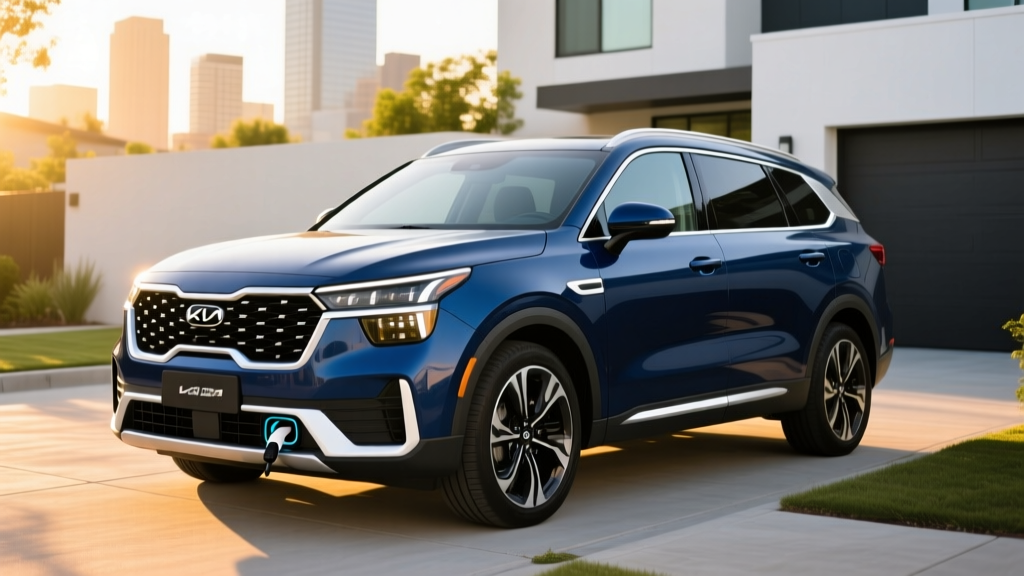
If you're searching for a 2024 Kia Sorento Plug-In Hybrid for sale, you're likely weighing three-row family utility against the promise of short-commute electric driving and long-distance gas flexibility. The Sorento PHEV occupies a specific niche: it's one of the few plug-in hybrids in the midsize SUV segment that offers genuine three-row seating, all-wheel drive as standard, and enough electric-only range to cover most daily errands without burning a drop of gas.
But the PHEV isn't the only Sorento in the showroom. Kia also sells a conventional hybrid (HEV) and a turbocharged gas model. Understanding the differences — and whether the PHEV's premium is worth it for your driving pattern — is essential before you sign. This guide breaks down every number that matters.
Sorento PHEV vs. Sorento HEV: What's the Actual Difference?
Kia offers the Sorento in three powertrain flavors. The distinction between the conventional hybrid and the plug-in hybrid is the single most important decision you'll make, because it affects your fuel cost, your charging habits, and your tax-credit eligibility.
| Attribute | Sorento HEV (Conventional Hybrid) | Sorento PHEV (Plug-In Hybrid) |
|---|---|---|
| Powertrain | 1.6L turbo + 44 kW electric motor | 1.6L turbo + 66.9 kW electric motor |
| Combined Horsepower | 227 hp | 261 hp |
| Battery Size | 1.49 kWh (small buffer) | 13.8 kWh (usable) |
| Plug-In Charging | No — charges via regen & engine | Yes — Level 1 and Level 2 AC |
| Electric-Only Range | N/A (motor assists only) | 32 miles (EPA) |
| EPA Combined MPG / MPGe | 37 MPG combined | 79 MPGe (elec+gas) / 34 MPG (gas only) |
| Drivetrain | AWD standard | AWD standard |
| Base MSRP (2024) | ~$38,390 (S trim) | ~$50,290 (SX trim) |
| Federal Tax Credit (§30D) | Not eligible | Eligible — up to $7,500 (rules apply) |
The conventional HEV is a self-charging system. Its small 1.49 kWh battery recovers energy through regenerative braking and the gasoline engine — you never plug it in. It delivers strong city MPG because the electric motor handles low-speed driving, but it cannot travel any meaningful distance on electricity alone.
The PHEV's 13.8 kWh battery is roughly nine times larger. Plug it in overnight and you get 32 miles of pure electric driving — enough for school runs, grocery trips, and most commutes. When the battery depletes, the gasoline engine seamlessly takes over, and you drive it like a conventional hybrid with 34 MPG combined.
Fuel Economy and Electric Range: The Numbers That Matter
The EPA rates the 2024 Sorento PHEV at 79 MPGe when operating in blended electric-gas mode and 34 MPG combined once the battery is depleted and you're running on gasoline alone. Here's the full breakdown from fueleconomy.gov:
| Mode | City | Highway | Combined |
|---|---|---|---|
| Charge-Sustaining (Gas Only) | 33 MPG | 34 MPG | 34 MPG |
| Blended (Electric + Gas) | 79 MPGe | 79 MPGe | 79 MPGe |
The EPA's 32-mile electric-only estimate assumes moderate temperatures and mixed driving. In real-world testing, expect 28–32 miles of EV range in spring/fall conditions, dropping to 22–26 miles in freezing weather due to cabin heating demands and reduced battery efficiency. Highway driving at 70+ mph also shortens EV range to roughly 24–27 miles. Once the battery is depleted, the 34 MPG combined figure is realistic — many owners report 33–36 MPG in mixed driving, and city driving can push toward 37–38 MPG thanks to regenerative braking.
The total combined range — electric plus a full 12.4-gallon fuel tank — works out to roughly 460–480 miles depending on conditions. That eliminates range anxiety entirely: you get EV-style savings on short trips and gas-car convenience on road trips.
Powertrain, Performance, and Charging Specs
The PHEV pairs a 1.6-liter turbocharged four-cylinder engine with a more powerful electric motor than the HEV uses, yielding a combined 261 horsepower and 258 lb-ft of torque. A 6-speed automatic transmission (no CVT) sends power to all four wheels. The result is a 0–60 mph time of approximately 7.4 seconds — noticeably quicker than the HEV's ~8.0 seconds and genuinely adequate for highway merging with a full load of passengers.
| Engine | 1.6L Turbocharged GDI I-4 |
| Electric Motor | 66.9 kW permanent-magnet synchronous |
| Combined System Output | 261 hp / 258 lb-ft torque |
| Transmission | 6-speed automatic |
| Drivetrain | AWD (standard) |
| Battery Capacity | 13.8 kWh (lithium-ion polymer) |
| EPA Electric Range | 32 miles |
| EPA MPGe (Blended) | 79 MPGe |
| EPA MPG (Gas Only) | 34 combined |
| Fuel Tank | 12.4 gallons |
| 0–60 mph | ~7.4 seconds |
| Towing Capacity | 2,000 lbs |
| Cargo (Behind 3rd Row) | 12.6 cu ft |
| Cargo (2nd Row Folded) | 45.0 cu ft |
| Cargo (All Folded) | 75.5 cu ft |
Charging: Level 1 and Level 2 Only
The Sorento PHEV uses a standard J1772 connector for AC charging. It does not support DC fast charging — this is normal for PHEVs with batteries under 20 kWh. Here's what to expect:
| Charging Level | Power | Time (0–100%) | Practical Notes |
|---|---|---|---|
| Level 1 (120V household outlet) | ~1.4 kW | ~10 hours | Overnight from a standard outlet |
| Level 2 (240V home/public) | ~3.3 kW (onboard charger limit) | ~3 hours 45 min | Recommended for daily use |
| DC Fast Charge | N/A | N/A | Not supported |
The onboard charger caps at 3.3 kW, which means even a 7.2 kW or 11.5 kW Level 2 home station will only deliver 3.3 kW to the Sorento PHEV. That's perfectly fine — a 3.3 kW charge still fully replenishes the 13.8 kWh battery in under four hours, so plugging in when you get home means a full battery every morning. A dedicated Level 2 home charger installation typically runs $600–$1,500 depending on your electrical panel's proximity to the parking spot.
Pricing, Trims, and Federal Tax Credit Eligibility
The 2024 Kia Sorento PHEV is offered in two trims, and pricing reflects a substantial premium over the conventional HEV:
- SX PHEV: ~$50,290 MSRP (destination included)
- SX Prestige PHEV: ~$53,590 MSRP (adds Nappa leather, ventilated front seats, surround-view monitor, blind-spot view camera, and head-up display)
Both trims come with AWD, a 10.25-inch infotainment touchscreen, wireless Apple CarPlay/Android Auto, and Kia's full suite of ADAS features (forward collision-avoidance assist, lane-keeping assist, blind-spot collision-avoidance, rear cross-traffic alert, and adaptive cruise control with stop-and-go).
Does the Sorento PHEV Qualify for a Tax Credit?
Under IRS §30D Clean Vehicle Credit rules, the 2024 Sorento PHEV may qualify for up to $7,500, but eligibility depends on several conditions that change over time and vary by buyer:
- MSRP Cap: SUVs must be under $80,000 MSRP — the Sorento PHEV clears this easily.
- Buyer Income Cap: Modified adjusted gross income must not exceed $150,000 (single), $225,000 (head of household), or $300,000 (joint filing).
- Battery Component Sourcing: A percentage of battery components must be manufactured or assembled in North America. This threshold increases each year, and Kia's supply chain compliance can shift. Verify current-year status on the IRS clean vehicle credit page or with your dealer at point of sale.
- Critical Minerals: A percentage of critical minerals must be sourced from the U.S. or free-trade-agreement partners. This also tightens annually.
- Point-of-Sale Transfer: As of 2024, eligible buyers can transfer the credit to the dealer at purchase, reducing the purchase price directly rather than waiting for a tax refund.
Important caveat: Battery sourcing requirements have disqualified several PHEVs from the full $7,500 credit in recent years. Before purchasing, confirm the Sorento PHEV's current eligibility on fueleconomy.gov's tax credit tracker and consult a tax professional for your specific situation.
Reliability, Battery Warranty, and Long-Term Ownership Costs
Kia backs the Sorento PHEV's high-voltage battery with one of the strongest warranties in the segment:
- Hybrid/EV Battery: 10 years / 100,000 miles (whichever comes first)
- Powertrain: 10 years / 100,000 miles
- Bumper-to-Bumper: 5 years / 60,000 miles
- Capacity Retention Threshold: Kia replaces or repairs the battery if capacity falls below approximately 70% during the warranty period
The 10-year/100,000-mile battery warranty significantly outlasts the federal minimum requirement of 8 years/80,000 miles and provides genuine peace of mind. For context, a PHEV battery replacement outside warranty for the Sorento would likely cost between $4,000 and $7,000 (parts and labor) based on current Kia parts pricing, though this figure may decrease as the supply chain matures.
On reliability, the 2024 Sorento PHEV carries over the powertrain introduced with the 2022 model year refresh, meaning Kia has several years of real-world data on this system. The 1.6L turbo and 6-speed automatic are proven components. Common owner-reported concerns are minor — occasional infotainment lag and third-row space limitations — rather than powertrain-related. The Sorento earned a Top Safety Pick designation from the IIHS when equipped with specific headlights.
Who Should Buy the Sorento PHEV — And Who Shouldn't?
- Your daily round-trip commute is under 30 miles and you can charge at home
- You need three-row seating but don't want a minivan or full-size SUV
- You take road trips where charging infrastructure is sparse
- You want EV-like daily driving without committing to full electric
- You qualify for the federal tax credit, bringing the effective price closer to the HEV
- You can't charge at home (apartment, no garage, street parking)
- Your daily driving regularly exceeds 40 miles
- You want lower upfront cost (~$12,000 less than the PHEV)
- You don't qualify for the federal tax credit due to income limits
- You want zero tailpipe emissions and minimal maintenance
- You have reliable home and/or workplace charging
- Your typical trips are under 250 miles, or you're comfortable with DC fast charging on road trips
- You want faster acceleration and lower per-mile fuel cost
The Sorento PHEV makes the most financial sense when the math works in your favor: if your commute is short, electricity is cheap in your area, and you qualify for the full tax credit. A buyer paying $0.14/kWh for home electricity who drives 25 miles round-trip five days a week would use roughly 11 kWh per week — about $1.54 — compared to approximately $9.50 in gasoline for the same distance in the HEV. Over a year, that's roughly $400–$500 in fuel savings on electric commuting alone, plus the tax credit offset at purchase.
Pros and Cons at a Glance
- 32-mile EV range covers most daily commutes
- 261 hp provides confident acceleration
- AWD standard on all trims
- Three-row seating in a midsize footprint
- 10-year/100,000-mile battery warranty
- Potential $7,500 federal tax credit
- 6-speed auto (no CVT drone)
- Strong ADAS suite standard
- ~$12,000 premium over the HEV variant
- No DC fast charging capability
- Onboard charger limited to 3.3 kW
- Third row is tight for adults (best for kids)
- Cargo space reduced vs. gas model (battery placement)
- EV range drops to ~22–26 mi in freezing weather
- Towing limited to 2,000 lbs
- Tax credit eligibility subject to sourcing rules
Frequently Asked Questions
How many MPG does the 2024 Kia Sorento PHEV get?
The EPA rates it at 79 MPGe in blended electric-gas mode and 34 MPG combined (33 city / 34 highway) when running on gasoline alone after the battery is depleted. In real-world city driving with regenerative braking, many owners see 35–38 MPG in gas-only mode.
How far can the Sorento PHEV go on electric only?
The EPA estimates 32 miles of electric-only range. In mild weather with moderate speeds, expect 28–32 miles. In freezing temperatures or sustained highway driving, expect 22–27 miles. The gasoline engine takes over seamlessly once the battery is depleted.
Does the Sorento PHEV qualify for the $7,500 federal tax credit?
It may qualify for up to $7,500 under IRS §30D, but eligibility depends on your income (must be under $150K single / $300K joint), the vehicle's battery component and critical-mineral sourcing compliance for the current year, and MSRP under $80,000 (the Sorento PHEV clears this). Verify current status on fueleconomy.gov and consult a tax professional.
Is the Sorento PHEV reliable, and what does battery replacement cost?
The PHEV powertrain has been in production since the 2022 model year with no widespread reliability issues. Kia's 10-year/100,000-mile battery warranty is among the best in the industry. Out-of-warranty battery replacement is estimated at $4,000–$7,000, though this is rarely needed within the first decade of ownership.
Should I buy the Sorento PHEV or a full electric vehicle?
If you can charge at home, your daily driving is under 30 miles, but you regularly take trips exceeding 200 miles, the PHEV offers the best of both worlds. If your trips are predictable and under 250 miles and you want lower maintenance and fuel costs, a BEV like the Kia EV6 (310-mile range) is worth considering. If you can't charge at home at all, the conventional Sorento HEV is the better choice.
Can the Sorento PHEV charge at public DC fast-charging stations?
No. The Sorento PHEV only supports AC charging via J1772 at Level 1 (120V, ~1.4 kW) or Level 2 (240V, capped at 3.3 kW by the onboard charger). DC fast chargers (CCS, NACS, CHAdeMO) are not compatible. This is standard for PHEVs with batteries under 20 kWh.