Quick Verdict: The Sporty Hybrid Crossover That Doesn't Sacrifice Efficiency
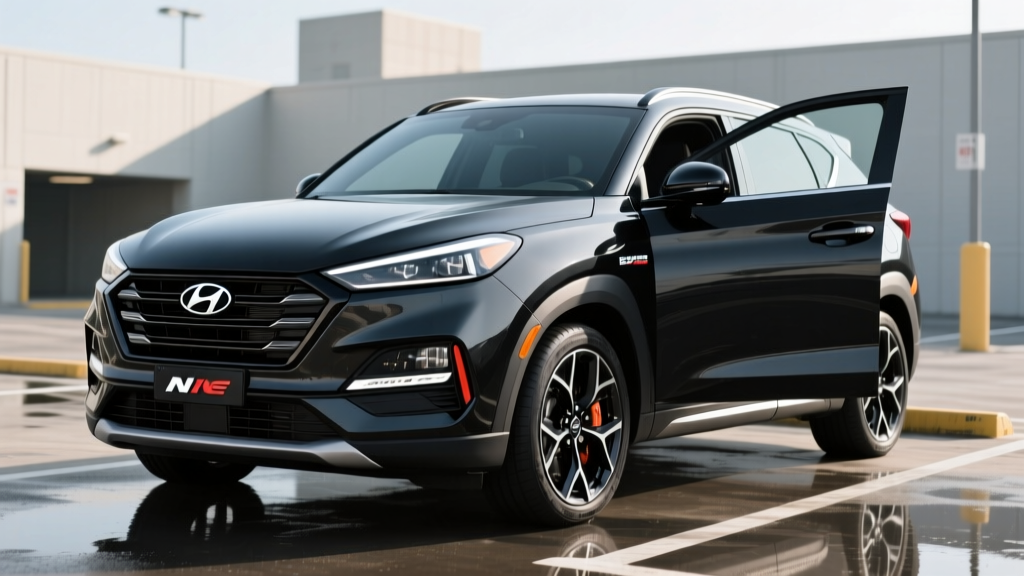
The 2024 Hyundai Tucson Hybrid N Line occupies a specific niche: buyers who want the sport-tuned suspension, blacked-out trim, and N-branded steering wheel of Hyundai's performance sub-brand, wrapped around a proven 226-horsepower hybrid powertrain that returns up to 38 MPG combined. It's not a plug-in — this is a conventional hybrid electric vehicle (HEV) that refuels exclusively at the gas pump — but its electrified drivetrain delivers meaningful fuel savings over the standard 2.5L gas Tucson without the price premium or charging logistics of the Tucson Plug-in Hybrid.
At a starting MSRP of $38,325 (including destination), the N Line Hybrid undercuts many rival sport-hybrid crossovers while offering standard all-wheel drive, a comprehensive safety suite, and one of the longest hybrid battery warranties in the segment. Here's everything you need to know before you buy.
HEV vs. PHEV: Which Tucson Hybrid Are You Actually Looking At?
Hyundai sells two electrified Tucson variants, and confusing them is the most common buyer mistake. The distinction matters for your wallet, your commute, and your garage outlet.
| Feature | Tucson Hybrid (HEV) | Tucson Plug-in Hybrid (PHEV) |
|---|---|---|
| Powertrain | 1.6L turbo + electric motor | 1.6L turbo + larger electric motor |
| Combined HP | 226 hp / 258 lb-ft | 261 hp / 258 lb-ft |
| Battery | 1.49 kWh (self-charging) | 13.8 kWh (plug-in capable) |
| Plug-in Charging? | No — refuels via gas + regen | Yes — Level 1 or Level 2 |
| EPA Combined MPG | 37-38 MPG | 80 MPGe (hybrid mode: 35 MPG) |
| Electric-Only Range | N/A (motor assists engine) | 33 miles EV-only |
| Starting MSRP (N Line) | $38,325 | $40,275 (Limited trim) |
| Federal Tax Credit | Not eligible (§30D is BEV/PHEV only) | Up to $7,500 (subject to sourcing rules) |
If you're reading this article about the 2024 Hyundai Tucson Hybrid N Line, you're looking at the HEV column. This model has no charging port — it generates electricity through regenerative braking and the gasoline engine. You never plug it in. If you want 33 miles of electric-only driving for short commutes, you need the Tucson Plug-in Hybrid instead (which, notably, does not come in N Line trim for 2024).
Fuel Economy: EPA Ratings and Real-World MPG
The EPA rates the 2024 Tucson Hybrid at 37-38 MPG combined depending on wheel size. The N Line rides on 19-inch alloy wheels, which drops it to the lower figure.
| Driving Cycle | EPA Rating | Real-World Expectation |
|---|---|---|
| City | 37 MPG | 38-42 MPG (hybrids excel in stop-and-go) |
| Highway | 36 MPG | 33-35 MPG (sustained 70+ mph reduces regen benefit) |
| Combined | 37 MPG | 35-39 MPG (varies with driving mix) |
Real-world note: Conventional hybrids like the Tucson HEV frequently exceed their EPA city rating because stop-and-go driving maximizes regenerative braking and electric-motor assist. On a 200-mile highway-dominant road trip at 75 mph, expect fuel economy to dip into the low-to-mid 30s. In winter conditions with cabin heating demand, subtract 2-4 MPG from combined figures. According to fueleconomy.gov, the Tucson Hybrid's 37 MPG combined translates to an estimated annual fuel cost of $1,550 (15,000 miles/year, $3.70/gallon regular unleaded).
For context, the non-hybrid 2024 Tucson AWD with the 2.5L engine returns 26 MPG combined — an 11 MPG gap that saves roughly $600-$700 per year in fuel at current prices, helping offset the hybrid's higher MSRP within 3-4 years of average driving.
Powertrain and Performance Specs
| Specification | 2024 Tucson Hybrid N Line |
|---|---|
| Engine | 1.6L turbocharged 4-cylinder (Smartstream G1.6T) |
| Engine Output | 178 hp / 195 lb-ft |
| Electric Motor | 44.2 kW (59 hp) permanent-magnet synchronous |
| Combined System Output | 226 hp / 258 lb-ft torque |
| Transmission | 6-speed automatic with electric motor integrated |
| Drivetrain | HTRAC AWD (standard on all Hybrid trims) |
| 0-60 MPH | ~7.1 seconds (tested) |
| Battery | 1.49 kWh lithium-ion polymer (located under rear seat) |
| Towing Capacity | 2,000 lbs |
| Cargo Volume | 38.7 cu ft (rear seats up) / 80.3 cu ft (folded) |
| Curb Weight | ~3,832 lbs |
The N Line's 6-speed automatic is a deliberate choice over the continuously variable transmissions (CVTs) used in the Toyota RAV4 Hybrid and Honda CR-V Hybrid. The result is more natural, stepped acceleration that enthusiast-oriented buyers appreciate, though CVT-equipped rivals achieve marginally higher EPA ratings through seamless ratio optimization. The 226-hp combined output puts the Tucson Hybrid ahead of the RAV4 Hybrid (219 hp) and behind the Ford Escape Hybrid (210 hp base, 250 hp in the PHEV variant).
N Line: What You Get for the Sport Trim Premium
The N Line isn't a performance overhaul — it's an appearance and handling package layered onto the hybrid powertrain. For the roughly $2,000 premium over the Tucson Hybrid SEL Convenience trim, the N Line adds:
- Unique front and rear fascias with gloss black accents and N Line badging
- Sport-tuned suspension (firmer damping, slightly quicker steering ratio)
- 19-inch N Line alloy wheels with 235/55R19 tires
- N-branded leather/suede steering wheel and shift knob
- Red interior stitching and metal sport pedals
- Black headliner and gloss black mirror caps
- LED daytime running lights with unique N Line signature
The sport-tuned suspension tightens body roll in corners noticeably, but ride quality on rough pavement is firmer than the standard Hybrid. If your daily commute includes potholed city streets or gravel roads, test-drive the N Line back-to-back with the SEL Convenience before committing.
Pricing, Trims, and Tax Credit Eligibility
| Trim | MSRP (incl. $1,395 destination) |
|---|---|
| Hybrid Blue (base) | $34,185 |
| Hybrid SEL Convenience | $36,435 |
| Hybrid N Line | $38,325 |
| Hybrid N Line Convenience | $39,885 |
| Hybrid Limited | $42,410 |
Federal tax credit: The 2024 Tucson Hybrid (HEV) does not qualify for the IRS §30D Clean Vehicle Credit. That credit — up to $7,500 — applies only to battery electric vehicles (BEVs) and plug-in hybrids (PHEVs) meeting battery-component and critical-mineral sourcing requirements per IRS guidelines. Conventional hybrids are excluded regardless of price or buyer income.
However, the Tucson Hybrid may qualify for:
- State-level hybrid incentives: Some states (e.g., Colorado's innovative motor vehicle income tax credit for hybrid purchases) offer rebates or credits for HEVs. Check your state's department of revenue or energy office.
- Employer commuter benefits: Some employer programs extend transit/vanpool subsidies to hybrid purchases.
- Local utility rebates: Rare for HEVs, but worth checking if your utility offers efficiency incentives.
If the federal tax credit is a priority for you, the Tucson Plug-in Hybrid (starting at $37,685 for the SEL trim, up to $7,500 credit if all sourcing requirements are met) is the electrified Tucson that qualifies — but it does not offer N Line styling.
Battery Warranty, Reliability, and Long-Term Costs
| Coverage | Term |
|---|---|
| Hybrid Battery | 10 years / 100,000 miles (original owner); 10 yr/100k in CARB states for subsequent owners |
| Hybrid System Components | 10 years / 100,000 miles |
| Powertrain (engine, transmission) | 10 years / 100,000 miles |
| New Vehicle Limited | 5 years / 60,000 miles |
| Complimentary Maintenance | 3 years / 36,000 miles |
Hyundai's 10-year/100,000-mile hybrid battery warranty is among the strongest in the segment and a major ownership advantage. The 1.49 kWh lithium-ion polymer battery is compact (it lives under the rear seat, preserving cargo space) and operates within a narrow state-of-charge window — the vehicle's software never fully charges or fully depletes it, which dramatically extends cycle life. Based on industry data from similar small-capacity HEV batteries (Toyota, Honda, Hyundai's own Ioniq Hybrid), degradation to the point of noticeable fuel-economy loss is uncommon before 150,000-200,000 miles.
Replacement cost: If the hybrid battery does require replacement out of warranty (typically after year 10 or 100k miles), expect a cost of $2,000-$3,500 for the battery module pack plus labor at a Hyundai dealer. Third-party hybrid battery refurbishers offer rebuilt units for $1,200-$2,000. This is substantially less than BEV battery replacement ($8,000-$20,000) because the HEV battery is small and modular.
According to IIHS, the 2024 Tucson earned a Top Safety Pick+ rating, the institute's highest honor. Hyundai's hybrid system has proven reliable across the Ioniq, Sonata Hybrid, and Tucson Hybrid lineups, with no widespread battery-failure campaigns reported by NHTSA.
Who Should Choose the Tucson Hybrid N Line?
Pros
- 37 MPG combined with AWD standard — strong efficiency for the class
- 226 hp delivers confident highway passing and merging
- 10-year/100,000-mile hybrid battery warranty
- No plug-in charging required — zero lifestyle change from a gas car
- N Line styling and sport-tuned suspension add visual and handling appeal
- Spacious interior with 38.7 cu ft cargo and good rear legroom
- Comprehensive Hyundai SmartSense ADAS suite standard
Cons
- No federal tax credit eligibility (HEV exclusion under §30D)
- Highway MPG drops to low 30s at sustained 75+ mph
- N Line suspension is firmer — rough roads are more noticeable
- 1.49 kWh battery means no electric-only driving mode
- CVT rivals (RAV4 Hybrid) edge out by 1-3 MPG combined
- No N Line option on the Plug-in Hybrid variant
Decision Framework
- Choose the Tucson Hybrid N Line if: You want a sporty-looking, fuel-efficient AWD crossover without changing your fueling habits, you drive 12,000+ miles/year (making the MPG savings meaningful), and you value a long factory warranty.
- Choose the Tucson Plug-in Hybrid instead if: Your commute is under 33 miles round-trip, you have a garage with a 120V or 240V outlet, and you want to capture the up-to-$7,500 federal tax credit.
- Choose a full BEV (e.g., Hyundai Ioniq 5) instead if: You have reliable home Level 2 charging access, your daily driving is under 250 miles, and you want zero tailpipe emissions with minimal maintenance.
- Choose the gas-only Tucson if: You drive fewer than 8,000 miles/year (the hybrid fuel savings won't offset the price premium within a reasonable timeframe) or you want the lowest possible purchase price.
Frequently Asked Questions
How many MPG does the 2024 Hyundai Tucson Hybrid N Line get?
The EPA rates it at 37 city / 36 highway / 37 combined MPG. Real-world city driving often yields 38-42 MPG thanks to regenerative braking, while sustained highway driving at 75+ mph typically returns 33-35 MPG.
Does the Tucson Hybrid N Line need to be plugged in?
No. This is a conventional hybrid (HEV). The 1.49 kWh battery recharges through regenerative braking and the gasoline engine. There is no charging port. You refuel exclusively at a gas station.
How far can the Tucson Hybrid drive on electric power alone?
The HEV cannot drive on electric power alone for meaningful distances. The electric motor assists the gasoline engine during acceleration and can propel the vehicle at very low speeds (parking lots, brief coasting) for a few hundred yards at most. For sustained electric-only driving, you need the Tucson Plug-in Hybrid, which offers 33 miles of EV range.
Is the 2024 Tucson Hybrid reliable, and what does a battery replacement cost?
Hyundai's hybrid system has a strong reliability record, backed by a 10-year/100,000-mile hybrid battery warranty. Out-of-warranty battery replacement costs approximately $2,000-$3,500 at a dealer, or $1,200-$2,000 through third-party refurbishers. The small 1.49 kWh HEV battery is far less expensive to replace than a full EV battery pack.
Does the 2024 Tucson Hybrid qualify for any tax credit?
The conventional Tucson Hybrid (HEV) does not qualify for the federal §30D Clean Vehicle Credit, which is limited to BEVs and PHEVs. Some state-level incentives may apply — check your state's revenue department. The Tucson Plug-in Hybrid may qualify for up to $7,500 federally, subject to battery sourcing rules and buyer income limits.
What's the difference between the N Line and N Line Convenience trims?
The N Line Convenience ($39,885) adds a panoramic sunroof, hands-free power liftgate, leather-trimmed seats (vs. cloth/leatherette on the base N Line), heated rear seats, and a Highway Driving Assist system with navigation-based cruise control. The powertrain, MPG, and exterior N Line styling are identical.
How does the Tucson Hybrid N Line compare to the RAV4 Hybrid?
The Toyota RAV4 Hybrid XSE returns 39 MPG combined (2 MPG more) with 219 hp (7 hp less) and starts around $37,500. The Tucson Hybrid N Line offers more cargo space (38.7 vs. 37.5 cu ft), a longer warranty (10yr/100k vs. Toyota's 10yr/150k hybrid battery but 3yr/36k new-vehicle vs. Hyundai's 5yr/60k), and a conventional automatic transmission vs. Toyota's CVT. The RAV4 wins on MPG; the Tucson wins on interior volume and driving feel.