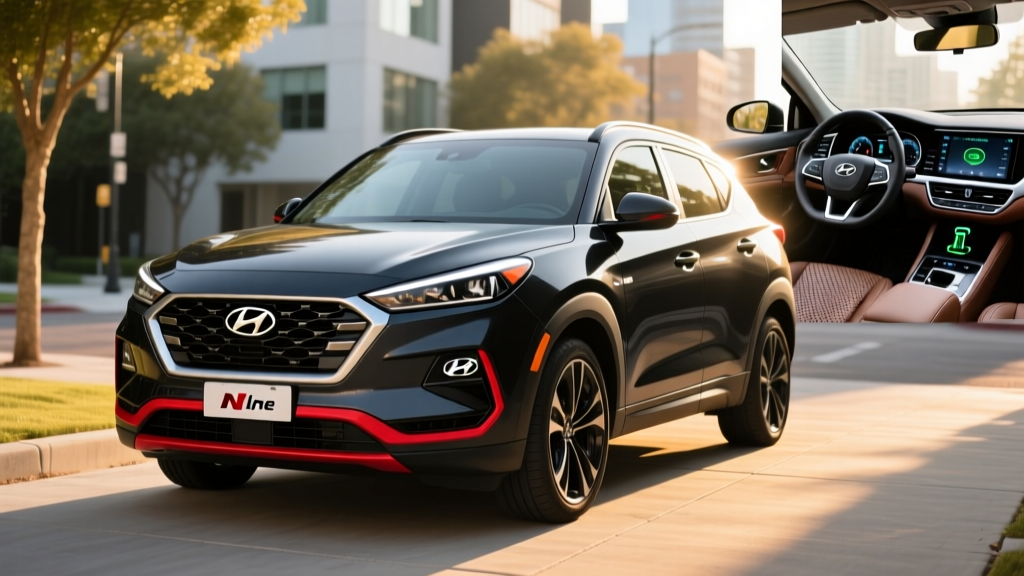
The 2024 Hyundai Tucson Hybrid N Line sits in a sweet spot for buyers who want sportier styling and solid fuel economy without committing to a plug. It pairs a 1.6-liter turbocharged engine with an electric motor for 226 combined horsepower, all wrapped in Hyundai's aggressive N Line appearance package. But does the real-world MPG match the EPA sticker, and how does it stack up against the Tucson PHEV or a full EV? Here's the data-driven breakdown.
HEV vs PHEV: Which Tucson Hybrid Are You Looking At?
Hyundai sells two electrified Tucson variants, and confusing them is the most common buyer mistake. The Tucson Hybrid (HEV) is a conventional hybrid — it generates all its electricity from the gasoline engine and regenerative braking. You never plug it in. The Tucson Plug-In Hybrid (PHEV) has a larger battery you charge from a wall outlet, giving it an electric-only driving range before the gas engine kicks in.
| Attribute | Tucson Hybrid (HEV) | Tucson Plug-In Hybrid (PHEV) |
|---|---|---|
| Plug-in charging required? | No | Yes (Level 1 or Level 2) |
| Electric-only range | N/A (motor assists engine) | 33 miles (EPA) |
| Battery capacity | 1.49 kWh (small buffer) | 13.8 kWh |
| Combined horsepower | 226 hp | 261 hp |
| EPA combined MPG / MPGe | 38 MPG | 80 MPGe (electric) / 35 MPG (gas) |
| Drivetrain | AWD standard | AWD standard |
| Federal tax credit (§30D) | Not eligible | Up to $7,500 (eligibility varies) |
The N Line appearance package is available on the HEV Tucson Hybrid. The PHEV is offered in SEL Convenience and Limited trims but does not carry the N Line badge for the 2024 model year. If you're specifically shopping the 2024 Hyundai Tucson Hybrid N Line, you're looking at the conventional HEV.
Fuel Economy: EPA Ratings and Real-World MPG
The 2024 Tucson Hybrid carries EPA ratings of 38 MPG combined, broken down as 38 MPG city and 38 MPG highway according to fueleconomy.gov. That puts it among the most efficient compact crossover hybrids on the market, rivaling the Toyota RAV4 Hybrid (39-41 MPG) and Honda CR-V Hybrid (40-43 MPG depending on trim).
| Driving Condition | EPA Estimate | Real-World Expectation |
|---|---|---|
| City | 38 MPG | 39-42 MPG (hybrids excel in stop-and-go) |
| Highway (70 mph cruise) | 38 MPG | 34-36 MPG (aerodynamic drag, less regen benefit) |
| Combined | 38 MPG | 36-40 MPG (depends on driving mix) |
| Cold weather (below 32°F) | N/A | 30-34 MPG (engine runs more for cabin heat) |
Hybrids typically exceed their EPA city rating in real-world stop-and-go driving because regenerative braking recaptures energy that a gas car wastes as heat. Highway driving is where hybrids lose their advantage — at sustained 70+ mph speeds, the gasoline engine does most of the work with minimal electric assist. In cold weather, expect a 10-15% fuel economy drop because the engine runs longer to provide cabin heating and warm up the catalytic converter.
With a 14.2-gallon fuel tank, the Tucson Hybrid delivers a theoretical maximum range of roughly 540 miles on a fill-up under combined driving, or about 450-500 miles in mixed real-world use.
Powertrain and Performance Specs
| Specification | 2024 Tucson Hybrid N Line |
|---|---|
| Engine | 1.6L turbocharged 4-cylinder |
| Engine output | 178 hp / 195 lb-ft torque |
| Electric motor output | 47.7 kW (64 hp) / 195 lb-ft |
| Combined system output | 226 hp / 258 lb-ft torque |
| Transmission | 6-speed automatic |
| Drivetrain | HTRAC AWD (standard) |
| 0-60 mph | ~7.1 seconds (manufacturer estimate) |
| Towing capacity | 2,000 lbs |
| Cargo volume (rear seats up) | 38.7 cu ft |
| Cargo volume (rear seats folded) | 80.3 cu ft |
The 6-speed automatic is a deliberate choice over the CVTs found in the RAV4 Hybrid and CR-V Hybrid. It delivers more natural shift feel and better highway passing response, though CVTs generally squeeze out slightly better city MPG. The 226 hp figure makes the Tucson Hybrid one of the more powerful entries in the compact hybrid SUV segment — the RAV4 Hybrid produces 219 hp, and the CR-V Hybrid makes 204 hp.
The N Line package adds sport-tuned suspension, unique 19-inch alloy wheels, a sport steering wheel, metal pedal covers, and exterior styling enhancements including a distinctive front fascia and dual exhaust tips. It does not change the powertrain output — the mechanicals are identical to other Tucson Hybrid trims.
Pricing, Trims, and Tax Credit Eligibility
The 2024 Hyundai Tucson Hybrid N Line carries an MSRP of $39,085 (including destination). This positions it between the Blue trim ($33,485) and the top-tier Limited ($41,535). The N Line is available in two variants:
- N Line ($39,085): Sport appearance, 19-inch wheels, sport seats, wireless Apple CarPlay/Android Auto, 10.25-inch touchscreen
- N Line Convenience ($40,735): Adds panoramic sunroof, hands-free liftgate, highway driving assist, and additional ADAS features
Federal Tax Credit Status
The Tucson Hybrid (HEV) does not qualify for the federal §30D clean vehicle tax credit. That credit applies only to plug-in electric vehicles (BEVs and PHEVs) meeting battery sourcing, MSRP, and buyer income requirements under current IRS rules. Conventional hybrids have not been eligible for a federal purchase credit since the original Hybrid Tax Credit expired for most manufacturers in the late 2000s.
If you're specifically seeking a tax-credit-eligible Hyundai, the Tucson PHEV may qualify for up to $7,500 under §30D, though eligibility depends on your modified adjusted gross income, the vehicle's MSRP cap ($80,000 for SUVs), and battery critical-mineral sourcing requirements that tighten annually. Consult a tax professional before relying on credit eligibility.
Battery Warranty, Reliability, and Replacement Costs
Hyundai provides one of the strongest hybrid battery warranties in the industry:
- Hybrid/EV battery warranty: 10 years / 100,000 miles (whichever comes first) for the original owner
- Hybrid system components warranty: 10 years / 100,000 miles
- New vehicle limited warranty: 5 years / 60,000 miles
- Powertrain warranty: 10 years / 100,000 miles
Note that the 10-year/100,000-mile battery and powertrain coverage applies to the original owner only. For subsequent owners, Hyundai's warranty transfers as 5 years / 60,000 miles from the original in-service date. This is a critical distinction if you're buying a used Tucson Hybrid.
Regarding reliability: Hyundai's 1.6L turbo hybrid powertrain has been in production since the 2022 model year Tucson redesign. While long-term (10+ year) data for this specific generation is still accumulating, Hyundai's hybrid systems in the Ioniq and Sonata Hybrid have demonstrated strong durability. The 1.49 kWh battery in the HEV is small and operates within a narrow state-of-charge window (typically 40-60%), which significantly reduces degradation compared to larger PHEV or BEV batteries.
If a hybrid battery replacement is needed outside warranty, expect a cost in the range of $2,000-$4,000 for the HEV's small battery pack — substantially less than a PHEV or BEV battery replacement. The 6-speed automatic transmission is also a reliability positive, as it avoids the complexity and potential repair costs associated with CVTs or dedicated hybrid transmissions.
Tucson Hybrid N Line vs PHEV vs Full EV: Which Fits You?
Choose the Tucson Hybrid (HEV) N Line if:
- You don't have access to home or workplace charging
- You want sport styling without paying PHEV or EV premiums
- Your daily driving is a mix of city and highway with no predictable short commute
- You want 500+ mile total range without planning charging stops
- You prefer the simplicity of never plugging in
Choose the Tucson PHEV if:
- You can install a Level 2 charger at home
- Your daily commute is under 33 miles round-trip (you'd rarely use gas)
- You want the potential $7,500 federal tax credit (verify eligibility)
- You want 261 hp and stronger acceleration
- You take frequent road trips but want electric daily driving
For context against a full EV: a battery-electric compact SUV like the Hyundai Ioniq 5 or Tesla Model Y eliminates fuel costs entirely and delivers instant torque, but requires reliable charging access and involves higher upfront cost ($40,000-$50,000+). The Tucson Hybrid N Line at ~$39,000 with no charging infrastructure needs is the pragmatic choice for apartment dwellers, street parkers, or anyone who isn't ready to manage charging logistics.
Ownership Costs: Fuel, Insurance, and Maintenance
At 38 MPG combined and a national average regular gasoline price of approximately $3.30/gallon (check current AAA data), the Tucson Hybrid costs roughly $1,300 per year in fuel for a 15,000-mile annual driving mix. Compare that to the non-hybrid Tucson AWD at 26 MPG combined, which would cost approximately $1,900 per year — a savings of about $600 annually or $3,000 over five years by choosing the hybrid.
Maintenance costs for the hybrid are comparable to the gas Tucson. Hyundai's hybrid system requires no special fluid changes or belt replacements beyond standard service. The regenerative braking system reduces brake pad wear significantly — many hybrid owners report 60,000-80,000+ miles on original brake pads.
Insurance premiums for the Tucson Hybrid N Line typically run 5-10% higher than the gas-only Tucson due to the higher MSRP and hybrid component repair costs. Get quotes from your insurer before purchasing to budget accurately.
Frequently Asked Questions
How many MPG does the 2024 Hyundai Tucson Hybrid N Line get?
The EPA rates it at 38 MPG city, 38 MPG highway, and 38 MPG combined. In real-world driving, expect 39-42 MPG in city conditions and 34-36 MPG at sustained highway speeds. Cold weather can drop combined economy to 30-34 MPG.
Does the Tucson Hybrid N Line need to be plugged in?
No. The Tucson Hybrid is a conventional HEV — it charges its small 1.49 kWh battery through the gasoline engine and regenerative braking. You fuel it like any other gas car. Only the Tucson PHEV requires plug-in charging.
Does the Tucson Hybrid qualify for any federal tax credit?
No. The federal §30D clean vehicle credit applies only to plug-in vehicles (BEVs and PHEVs). The Tucson HEV does not qualify. The Tucson PHEV may qualify for up to $7,500 depending on your income, the vehicle's battery sourcing, and current-year IRS rules. Check IRS.gov or consult a tax professional.
How long will the Tucson Hybrid battery last?
Hyundai warranties the hybrid battery for 10 years / 100,000 miles for the original owner. The small 1.49 kWh HEV battery operates in a narrow charge window, which greatly extends its lifespan. Many Hyundai hybrid batteries from earlier generations (Ioniq, Sonata Hybrid) have exceeded 150,000 miles without replacement. If replacement is needed out of warranty, expect $2,000-$4,000.
Is the N Line just an appearance package or does it change performance?
The N Line is primarily an appearance and handling package. It adds sport-tuned suspension, 19-inch wheels, unique styling, and interior upgrades, but the powertrain (226 hp, 1.6L turbo hybrid) is identical to all other Tucson Hybrid trims. Acceleration and fuel economy are the same.
How does the Tucson Hybrid compare to the RAV4 Hybrid and CR-V Hybrid?
The Tucson Hybrid (38 MPG, 226 hp) trades a slight MPG disadvantage against the RAV4 Hybrid (39-41 MPG, 219 hp) and CR-V Hybrid (40-43 MPG, 204 hp) in exchange for more horsepower and a conventional 6-speed automatic instead of a CVT. Cargo space is competitive across all three. The Tucson's 10-year/100,000-mile battery warranty matches Hyundai's industry-leading coverage.